
PART 1
There was something quietly moving about watching the young monkey sit beneath the trees of the Angkor Wat forest.
It wasn’t making much noise.
It wasn’t rushing toward the other monkeys.
Instead, it watched.
The group was nearby, moving through the forest as they normally would. Some climbed branches while others searched around the ground. Their movements appeared familiar and coordinated.
For the young newcomer, however, everything was different.
It had recently been separated from the environment it knew. Now it was facing the difficult process of becoming familiar with another group.
At first, the little monkey stayed several feet away.
Every time a monkey approached, it looked carefully at its face and body language. Then it waited to see what would happen.
This kind of patience seemed important.
The forest offered plenty of distractions. Leaves rustled overhead. Birds moved through the branches. Sunlight shifted as clouds passed across the sky.
But the young monkey’s attention remained on the group.
It seemed to understand that these were the animals it needed to learn from.
Slowly, it began copying some of their movements.
When another monkey climbed, the youngster watched.
When the group moved forward, it followed from behind.
When they stopped, it stopped too.
Nothing about the process looked instant.
That may be what made it so interesting.
We often think of belonging as something that happens in one emotional moment. In nature, however, acceptance can be much quieter.
It can happen through repeated encounters.
The same faces become familiar.
The same sounds become recognizable.
The same paths through the forest become easier to follow.
For this little monkey, every minute offered another opportunity to learn.
At one point, a monkey came closer and sat nearby.
The youngster looked over but stayed where it was.
Neither animal seemed interested in creating conflict.
They simply shared the same space.
It was a small interaction, but it felt like progress.
The young monkey was no longer completely separated from the group.
It had begun to exist alongside them.
As afternoon approached, the forest became warmer and quieter. The monkeys rested in the shade, and the young newcomer remained close enough to observe.
It still had a long way to go.
The group had not completely accepted it.
But perhaps acceptance was never supposed to happen in a single day.
Sometimes the first stage is simply being allowed to remain nearby.
Sometimes the first sign of trust is nothing more than two animals sitting quietly in the same place.
And sometimes a new beginning starts exactly that way.
Under the ancient trees of Angkor Wat, this little monkey was learning that life could change without warning—but that a new opportunity could also appear.
For now, it waited.
It watched.
And it kept taking small steps forward.
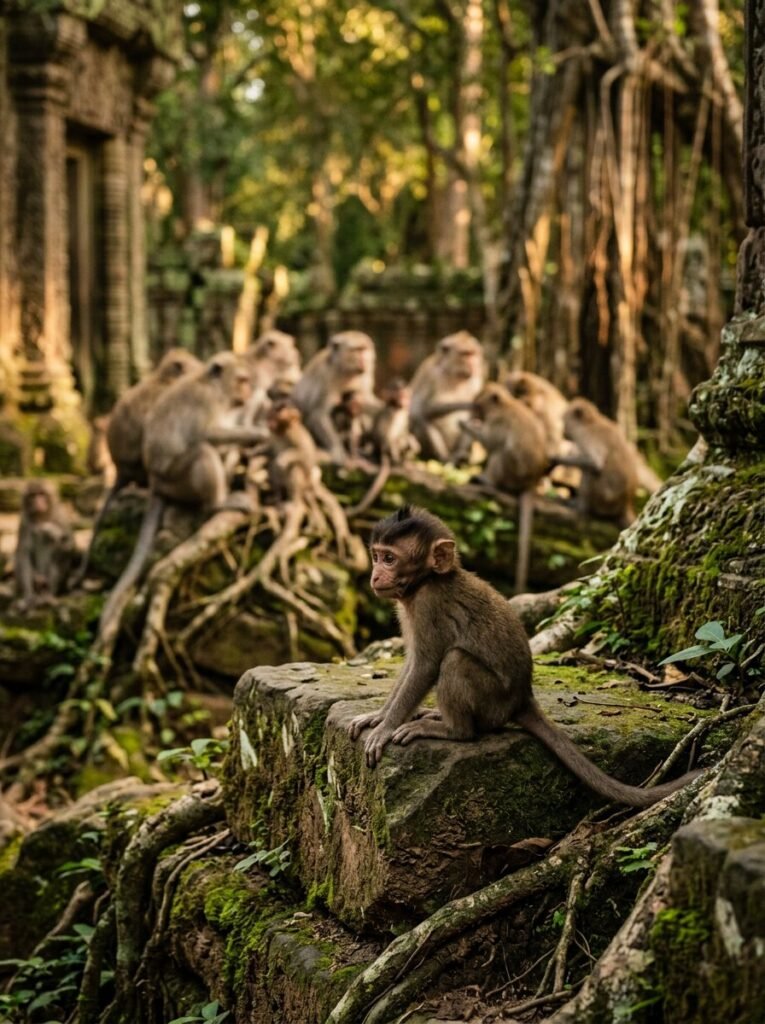
PART 2
The afternoon deepened, and the group moved on. The young monkey followed, as it had learned to do—several feet behind, never too close, never quite one of them.
It had not always moved like this.
Once, it had walked in the middle of a troop, half-hidden against a mother’s warm side, safe in the certainty that it belonged. It had slept curled against her at night, and woken to her scent, and cried into the hollow of her chest whenever the world grew large.
That world had been smaller, then. It had been the space of a few trees, a stretch of roots, a patch of shade that never moved.
Then, one day, the troop had crossed a road.
The road was not far from the forest, but it might as well have been the edge of the world. Cars came down it in hot, rushing bursts. The troop had crossed in pieces—the adults first, then the young, then the mothers carrying their smallest. The young monkey, not yet strong enough to keep up, had been caught on the wrong side when the traffic came.
It had seen its mother turn. It had seen her hesitate, one hand already on the far side of the road, her face turned back toward it.
And then the cars had come between them, and she was gone.
The group the young monkey watched now was not its own. It had found them by following the river of their sound through the trees, and it had stayed because staying was the only thing it knew how to do.
But following was not the same as belonging, and the young monkey was beginning to learn the difference in the oldest and hardest way—through hunger.
Food was not shared here.
When the group found fruit, the adults ate first. When they uncovered grubs beneath a fallen log, the strongest dug and the strongest took. The young monkey hung at the edges of these feedings, watching, waiting, moving in only when the others had already eaten. But there was rarely anything left, and the hunger that had begun as a small, nagging thing had grown into a constant ache that settled behind its ribs and would not leave.
Once, it crept too close.
The oldest female of the group turned with a suddenness that stopped the young monkey in its tracks. Her ears flattened. Her teeth came out, yellow and sharp. She did not need to move or speak. The message was written in the whole shape of her body: not yet, not you, not here.
The young monkey backed away, and the oldest female turned back to her feeding, and the forest went on exactly as before.
It was not the first time it had been turned away. It would not be the last. But there is a particular kind of loneliness that settles over a creature when it is hungry and watched at the same time—when it must stand at the edges of abundance and pretend that it is not starving, that it is not cold, that it does not want, with every part of itself, to be let in.
The young monkey learned to eat last, and little. It learned the sounds the adults made when they were about to turn. It learned the exact distance at which its presence was tolerated, and it kept itself at that distance the way a boat keeps itself off the rocks.
But none of it was enough. The hunger did not care how careful it was.
That night, the group settled into the high branches of a fig tree, and the young monkey settled lower down, alone, where the night wind could reach it.
And for the first time since it had lost the road, it called out—the long, thin cry it had not made since it had a mother to answer it.
The forest swallowed the sound.
No one turned. No one came.
The young monkey called again, and then again, until its voice broke, and the only answer was the far-off sound of the troop shifting in their sleep.
It had not always been alone.
But it was alone now.
PART 3
On the third morning, the young monkey did something it had never done before. It stopped waiting to be allowed.
The group had found a fallen branch heavy with fruit, and for a long moment the feeding was loud and scattered and full of movement. In that chaos, the young monkey slipped in. It was not brave. It was only hungry—hungry in a way that had begun to feel like the only true thing about it.
The oldest female saw it.
For a long, still moment, the two of them faced each other across the fallen fruit. The rest of the group went on feeding around them, oblivious. The young monkey could feel its own heart beating against its ribs, could feel every instinct in its small body telling it to run, to lower its eyes, to make itself small.
But it did not run.
It held the old female’s gaze for one breath, and then two, and then it reached down, very slowly, and took a single piece of fruit.
The old female watched it take it. She did not bare her teeth. She did not turn away. She simply watched, the way the forest watches, the way a thing watches when it has not yet decided what it is seeing.
And then she looked away, and let the young monkey eat.
It was a small thing. No one else in the group seemed to notice it at all. But it was the first time the young monkey had been permitted to take food in this new world, and it understood, in the wordless way of small animals, that something had shifted.
It had not won. It had simply stopped being nothing.
That afternoon, as the group rested in the shade of the temple’s outer wall, the young monkey sat a little closer than it ever had. No one moved away.
And it was then, in the warm quiet of the afternoon, that the young monkey saw the dogs.
They came through the trees the way trouble always comes—not all at once, but by degrees, three low shapes moving between the roots with their heads down and their tails still. The group had not seen them. The adults dozed. The young played in the dust.
The young monkey went rigid.
It had seen dogs before, on the far side of the road. It knew what they were, the way prey knows what hunts it—in the body, before the mind has words. And it did the only thing it could do.
It screamed.
The alarm cut through the afternoon like a stone through still water. The group exploded into movement—up the walls, into the branches, mothers snatching up their young, the whole troop rising out of the shade as one living, panicked thing.
The dogs, caught mid-approach, hesitated. They had come for an easy, unwatched moment, and the moment was gone. They circled once in the dust, snapping at nothing, and then they slouched back into the trees and were gone.
And in the ringing quiet that followed, high in a branch with its heart still hammering, the young monkey felt the eyes of the group on it.
Not with hostility.
With something else.
The oldest female looked at it for a long time. Then she climbed down, and crossed to where the young monkey clung, and she did something the young monkey had not felt in longer than it could remember.
She groomed it.
Her fingers moved through the fur at its shoulder, picking, smoothing, and the young monkey went very still, because it had forgotten—had truly forgotten—what it felt like to be touched with kindness.
It was the oldest and simplest language the troop had. Grooming was not only about keeping clean. It was how they bound themselves to one another, how they said, without a single sound, that a body was not alone. The young monkey had watched this ritual a hundred times from a distance, always from the outside, always the one looking in. And now, here it was, under the old female’s patient hands, being spoken to in the language it had been so desperate to hear.
It was not acceptance. Not yet. It was the beginning of it, the first thread of a thing that might, in time, be woven into something stronger.
But it was enough. For now, it was enough.
PART 4
The acceptance did not come quickly, and it did not come completely.
The young monkey was tolerated now. It was allowed to feed at the edges of the group, to sit within sight, to sleep on the lower branches of the same tree. But it was still an outsider in the ways that mattered. The adults still moved between it and the best food. The mothers still drew their young closer when it passed. The oldest female, for all her unexpected kindness, still kept a distance that felt, at times, like a door left only a little open.
And then the rains came.
They came in the night, the way the monsoon always comes—not as rain but as a wall, a roaring grey curtain that turned the whole world to water. The forest that had been so full of small, familiar sounds went silent beneath it, and then loud again, and then the wind rose, and the trees began to move as if in pain.
The group fled for the temple.
It was a small, half-fallen structure deeper in the forest, a place of leaning walls and a roof that still held. The adults knew it. They went straight to it through the dark and the water, the way creatures go to the one place they trust when the sky opens.
The young monkey did not know it.
It followed as best it could, but the rain was a blindness, and the wind tore at the branches it climbed, and the path that had been clear in daylight had become a river of mud and noise. Twice it slipped and caught itself. The third time, it did not catch itself.
The ground gave way beneath its feet.
It fell, tumbling through wet leaves and over roots, and came down hard in a shallow ditch that was already filling with black water. The rain came down, and the ditch filled, and the young monkey clawed at the slick mud and found nothing that would hold.
It cried out.
The storm swallowed the sound.
Above it, through the grey and the noise, it could see the pale shape of the temple, and the warm dark of the entrance, and the faint movements of the troop settling inside—so close, and so impossibly far.
The water was rising.
The young monkey cried out again, higher this time, the long thin sound it had made on the first lonely night, when no one had answered.
It thought, in the way small creatures think in the last dark moments, of all the days it had waited at the edges. Of the mother it had lost across the road. Of the food it had learned to eat last. Of the distance it had kept so carefully, so patiently, hoping that one day the distance would close. All of it, every small step, every watched moment—had it all been leading to this? To a ditch in the rain, alone, with the whole world turned to water and no one looking back?
It cried out a third time, and the sound broke in its throat.
And inside the temple, through the roar of the rain, someone heard it.
The oldest female lifted her head.
She looked toward the entrance, toward the sound, and for a long moment she did not move at all.
And the water kept rising.
PART 5
She came.
The oldest female stood in the entrance of the temple and looked out into the storm, and then she did what the young monkey, from the bottom of the filling ditch, would never forget.
She came out into the rain.
It was the kind of thing that should not have happened. In the old life, on the far side of the road, the young monkey had learned the rules of the world the way all young things learn them—through the bodies of the adults around it, through the way the strong moved and the weak waited, through the thousand small cruelties and kindnesses that make up a troop.
And one of those rules was this: the strong do not go back into the storm for the weak.
Except that the oldest female did.
She came out into the rain.
She crossed the flooded ground toward the sound, slow and certain, the rain flattening her fur against her body, and behind her came others—first one, then two, then the whole troop moving out of the warm dark into the storm, following her the way they followed only their own.
The young monkey, chest-deep in the rising water, watched them come and could not believe what it was seeing.
It had spent all these days learning that it was not one of them. That it must wait at the edges. That it must take nothing for granted. That belonging, if it ever came, would come slowly, in inches, over a hundred small shared moments.
It had been wrong.
Belonging had not come in inches.
It had come all at once, in the middle of a storm, in the shape of a family walking out into the rain.
The oldest female reached the edge of the ditch and reached down, and the young monkey reached up, and for the second time in its life—the first being a road, on the far side of which everything it had known was lost—it was lifted out of the dark.
They carried it back into the temple, out of the water, into the warm press of bodies and the smell of wet fur and the sound of a troop settling around it.
And for the first time since the road, the young monkey was in the middle of them.
Not at the edges. Not several feet behind. In the middle, where the warmth was, where the mothers drew their young close, where the oldest female curled her body around the small, shivering thing she had once bared her teeth at.
The storm went on all through the night, but inside the old temple, under the roof that still held, the young monkey slept warm for the first time in longer than it could remember.
When it woke, the rain had stopped.
The forest was washed clean and glittering, and the light that came down through the leaves was the pale, rinsed light of a new day. The troop stirred around the young monkey, and it felt, for the first time, the small ordinary press of their bodies as they rose—not a thing to be afraid of, but a thing to belong to.
It had spent so long watching from a distance that it had almost forgotten how close the world could be.
The troop moved out into the new morning the way they always did—except that now, the young monkey did not follow from behind., and the troop moved out into the new morning the way they always did—except that now, the young monkey did not follow from behind.
It walked among them.
It was home.