PART 1
The Angkor Wat forest was unusually quiet that morning. Sunlight filtered through the trees, leaving soft patches of gold across the ground. Somewhere above, birds called from the branches while leaves moved gently in the breeze.
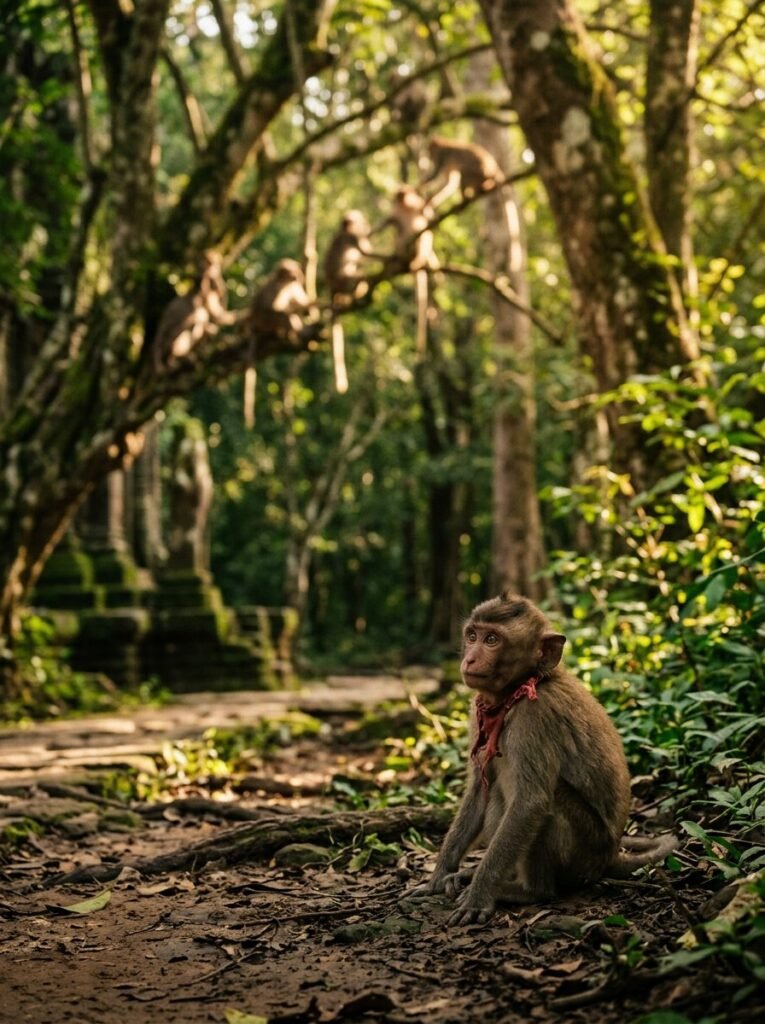
Near the edge of the forest, a young monkey sat quietly.
It was still learning how to understand the world around it. Everything seemed unfamiliar—the trees, the sounds, and especially the group of monkeys watching from a short distance away.
The little monkey had recently been left behind by its previous owner. Now it had been given another chance to live among other monkeys, but the transition was not easy.
It stayed close to the ground, occasionally looking toward the group.
One monkey moved closer.
The newcomer immediately became still.
There was no dramatic confrontation. Instead, there was something much more natural: observation.
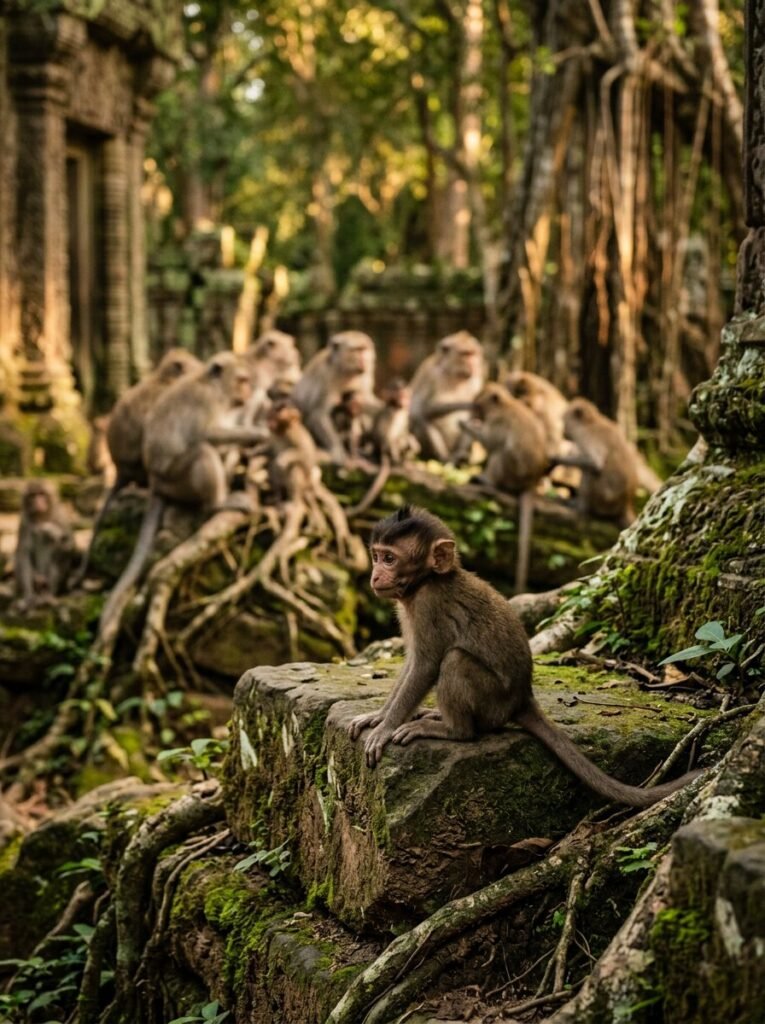
The older monkey looked carefully at the newcomer before moving away. A second monkey watched from a branch overhead. The young one seemed to understand that it needed to be patient.
For an animal entering an established group, belonging cannot happen instantly.
The little monkey waited.
Every few minutes, it looked toward the others. Sometimes it took one or two small steps forward. Then it stopped again, apparently deciding whether it was safe to continue.
Watching the scene, I was struck by how much communication was happening without sound.
A glance.
A pause.
A careful movement.
A little distance.
The forest group seemed to be deciding what to make of their new visitor.
Eventually, one monkey came closer again. This time, the young newcomer did not move away.
It simply watched.
That small change felt meaningful.
There was still plenty of distance between them, but the first step toward acceptance had begun.
The sunlight moved across the forest floor as the morning continued. The young monkey remained near the group, quietly learning their movements and routines.
It wasn’t suddenly part of the family.
But it wasn’t completely alone anymore, either.
That distinction matters.
For a young animal that has experienced a major change, a peaceful place to rest and observe can be the beginning of something important.
The Angkor Wat forest has its own rhythm. Nothing happens instantly. Animals learn their surroundings through repeated experiences, careful observation, and time.
The little monkey seemed to be doing exactly that.
It watched where the others traveled. It noticed when they climbed. It listened when they called to one another.
And slowly, it began moving a little closer.
There was no grand moment when everything changed.
Instead, there were many tiny moments.
A shared glance.
A few steps.
A pause.
Another chance.
By the end of the morning, the young monkey was still waiting for complete acceptance. But it had something equally valuable: an opportunity.
Sometimes a new beginning doesn’t look dramatic.
Sometimes it looks like a small monkey sitting beneath the trees, watching a group from a safe distance and slowly learning that it may have a place there after all.
PART 2
The young monkey had not been born in this forest. It had been born in a place of walls, in a world that smelled of nothing green—of plastic, and soap, and the inside of a house. It had been small enough to be carried, once, and it remembered the carrying.
It remembered the cloth tied around its neck.
It remembered the hand that came down with food, the same hand every time, soft and sure, and the voice that went with the hand, low and familiar, saying words that meant food, or come, or good.
It had not known, then, that it was not a pet so much as a thing—a small, bright novelty that had been wanted for a season and then, slowly, stopped being wanted. It had only known that the hand fed it, and so the hand was home.
It had been kept, for a time, in a cage. It remembered the bars now only as a pattern of shadows it could never seem to step out of, even in dreams. It remembered the way the door of the cage had a sound—a small, sharp click—and the way that sound had once meant the hand was coming, and food, and the voice. It had loved the click, once. It had trusted it.
Then, one morning, the hand had opened a door and not closed it again.
The young monkey had followed the hand to the edge of something loud and bright—a road, a car, a gate—and had waited in the way it had learned to wait, patient and trusting, for the hand to come back.
The hand did not come back.
It waited a long time. It waited until the light changed and the world cooled and the sounds around it became the sounds of a place it did not know. And then, because there was nothing else to do, it had turned toward the green, and walked in.
Now it sat beneath the trees of Angkor Wat, and everything it knew was wrong.
It did not know how to find food. In the world of walls, food had always appeared from a hand, from a bowl, from a flat surface that never moved. Here there were no bowls. There were only the others, moving through the trees with a purpose the young monkey could not read, stopping to eat things the young monkey did not recognize as food at all—bark, and leaves, and small dark things pulled from under stones.
It watched them, and it tried to learn, but hunger was a language it had never had to speak.
On the second morning, it found something bright and soft lying on the ground near the temple path—a piece of fruit, half-eaten, dropped by a tourist and forgotten. The young monkey did not hesitate. It knew this shape. It had been fed shapes like this from a hand. It took the fruit and ate it quickly, and for a little while the ache behind its ribs eased.
By evening, it was sick.
It lay at the base of a tree, breathing in short, shallow pulls, its stomach a knot of pain. The fruit had been old, or wrong, or both, and the young monkey had no way to know it. In the world of walls, nothing had ever made it sick. The hand had always known what was safe.
Now there was no hand. There was only the young monkey, alone, learning the forest’s lessons one punishment at a time.
The group watched from a distance, and did not come closer.
And the young monkey, curled in the cooling leaves, called out once into the dark—the soft, questioning sound it had always made for the hand that fed it—and listened to the silence where an answer should have been.
There was no answer.
There never would be again.
PART 3
The young monkey did not die that night, though the sickness left it weak and shaking, and for two days it moved like something much older than itself. It drank from a puddle of rainwater. It slept more than it was awake. And it watched the group with a new and desperate attention, because it had begun to understand, in the deep and wordless way of animals, that the forest would not be kind to it simply because it was small.
It had to learn, or it would not last.
And so it learned.
It learned that the others turned over fallen bark with their small, clever hands, and found food beneath. It learned that the best feeding happened in the cool of the morning, before the day’s heat, and again at dusk. It learned to follow the group’s sound—the soft hoots and clicks, the rustle of bodies through leaves—and to read in that sound where food was being found.
But it learned these things from a distance, and distance was costing it.
The others had begun to tolerate it, in the way a room tolerates a shadow in the corner. But tolerance is not belonging, and the young monkey was beginning to understand that it might live its whole life at the edges of this troop, close enough to watch and never close enough to be one of them.
Then, on the fifth morning, the young monkey was given a choice it did not know how to make.
The tourists came.
They came down the temple path in bright clothes, with bags that rustled and hands that held food. One of them—a woman with a soft voice and a hand that reached out, open and patient—crouched at the forest’s edge and called to the young monkey.
The young monkey went still.
Because it knew that hand.
Not that exact hand, but the shape of it, the angle of it, the promise in it. A hand held open meant food. A hand held open meant the world of walls, and bowls, and the voice that said good. A hand held open meant the only home the young monkey had ever known.
Its body remembered before its mind did. It took a step toward the woman. Then another.
The woman made the soft sound—the one the young monkey had been taught to come to—and held the food out, and waited.
And the young monkey, standing at the edge of everything it had lost, felt the pull of it like a rope around its chest.
It wanted to go. It wanted, with every tired, hungry part of itself, to cross that small distance and take the food and be held again, to be carried, to be a pet, to be safe.
It took one more step.
And then it stopped.
Because behind it, in the trees, the group had gone quiet.
The young monkey turned. They were watching—not with the flat, unbothered gaze of tolerance, but with something else, something alert and waiting, the way a troop watches when one of its own is about to choose.
The oldest female stood at the front. She did not call. She did not move. She only watched, and in her watching there was a question the young monkey felt in its bones, though it had no words for it.
What are you?
The young monkey looked at the woman’s open hand, and at the food, and at the soft, patient face above it. And then it looked back at the group in the trees, and at the old female, and at the forest beyond them—the green, difficult, unforgiving forest that had never once fed it from a bowl, and never once asked it to be anything other than what it was.
It turned its back on the hand.
It turned, and it walked into the trees, and it did not look back once.
That evening, the old female let it sit beside her while she ate. She did not groom it, and she did not speak to it, and she did not look at it at all. But she did not chase it away.
And when a piece of fruit fell between them, she did not take it.
The young monkey looked at the fruit, and then at the old female, and then, slowly, as if it could still hardly believe such a thing was possible, it reached out and took it.
It was the first meal it had ever earned in its life.
PART 4
But the wild does not reward a single act of courage, and the young monkey’s troubles were far from over.
The sickness had left it thin, and the thinness left it slow, and the slowness was the most dangerous thing of all. The troop moved with the confidence of animals who had never known a wall, who had never been fed from a hand, who had never had to learn, at the cost of their own bodies, what was safe to eat and what was not. They moved up and down the temple stones and through the high branches, and the young monkey, watching them, felt the distance of all the things it had not learned.
Worse, the old fear had not left it.
It had turned its back on the woman’s hand, but the hand still came to it at night, in the half-dreams of a body that had never stopped being a pet. It would wake to the memory of a voice, of a cloth at its neck, of the particular warmth of being carried, and it would look around at the dark forest and not know, for a terrible moment, which world was real.
The group had begun to accept it in small ways—a shared branch, a tolerated nearness, the old female’s quiet allowance—but the young monkey could feel, beneath every small kindness, the unspoken fact of its own strangeness. It was not quite a monkey. It was not quite anything else. It belonged to no world completely, and at dusk, when the troop settled into the trees and the light went out of the sky, that not-belonging pressed on it like a weight.
Then came the night of the fire.
It was not a fire in the forest. It was a fire at the forest’s edge, where the road was, where the people were—a bright, roaring thing that threw long shadows and filled the air with smoke and the smell of burning. The young monkey did not know what it was. But the troop knew, and the troop fled.
They fled toward the deep forest, away from the road and the light, the way wild things have always fled from fire. The young monkey, caught low on the ground and still slow from its sickness, could not keep up.
It ran until its legs would not run anymore, and then it stopped, and turned, and found itself alone.
The troop was gone.
The young monkey stood at the edge of a clearing it did not know, in the dark, with the smell of smoke behind it and the deep forest in front of it, and it called out—the high, thin cry it had learned in the world of walls, the cry that had always brought the hand.
Nothing came.
It called again. And again. And the forest, indifferent, gave back only its own small sounds—an insect, a rustle, the distant crack of the fire.
And then, very close, from the direction of the road, it heard a sound that stopped the blood in its body.
The low, growling breath of a dog.
The young monkey went cold. It knew that sound too. It had heard it once before, at the edge of the world of walls, on the day the hand had opened the door and not come back.
It pressed itself down against the ground, and it did not breathe.
The growl came again, nearer now, and then another, lower and behind it, and the young monkey understood, with the terrible clarity of prey, that it had been seen, and that it was alone, and that the deep forest, which had never once been kind to it, was suddenly very far away.
PART 5
What happened next happened faster than thought.
The first dog broke from the dark, low and silent, and the young monkey’s body moved before its mind could catch up—not toward the road, not toward the world of walls it had once called home, but into the trees, toward the only thing that had ever been real.
It climbed.
It climbed the way it had watched the others climb a hundred times, the way it had practiced in secret when no one was watching, and for the first time in its life its hands—the soft hands that had never been taught to hold a branch—found their grip and held.
The dogs reached the base of the tree and leapt, and fell back, and leapt again, and the young monkey climbed higher, higher, until the barking below was only a sound, and then less than a sound, and then nothing at all.
It did not know how long it stayed there, pressed into the fork of a high branch, its heart hammering. The fire at the road’s edge burned on for a while and then died, and the smoke thinned, and the dark settled back over the forest like water.
And then, from somewhere below and to the east, it heard a sound it knew.
Not the hand. Not a voice.
A low, questioning hoot, rising at the end.
The old female.
The young monkey answered, a thin, wavering sound, and the old female called again, nearer this time, and then there were others—the whole troop, threading back through the dark toward it, the way a family threads back toward the one who has been lost.
They came up the tree and settled around the young monkey, close and warm, and the old female climbed the last branch and sat down beside it, and for a long time neither of them moved.
And then, very slowly, the old female reached out and began to groom the young monkey’s fur, picking, smoothing, working the dust and the fear out of its small body the way she had never done before, not once.
The young monkey went still, and then it leaned into the touch, and it understood, with a certainty that filled it to the edges, that it had made its choice, and that the choice had been seen, and that it was no longer a shadow in the corner of the room.
It was one of them.
In the morning, when the light came back to the forest, the troop moved out together, and the young monkey moved with them—not behind, not at the edges, but among them, in the middle, where it had always belonged without knowing it.
It would never be carried again. It would never be fed from a hand. The world of walls was gone, and it was not coming back.
But as the young monkey looked out over the green, difficult, beautiful forest that had once seemed so foreign, it felt something it had not felt in all its short life.
It felt wild.
And it felt free.