
PART 1
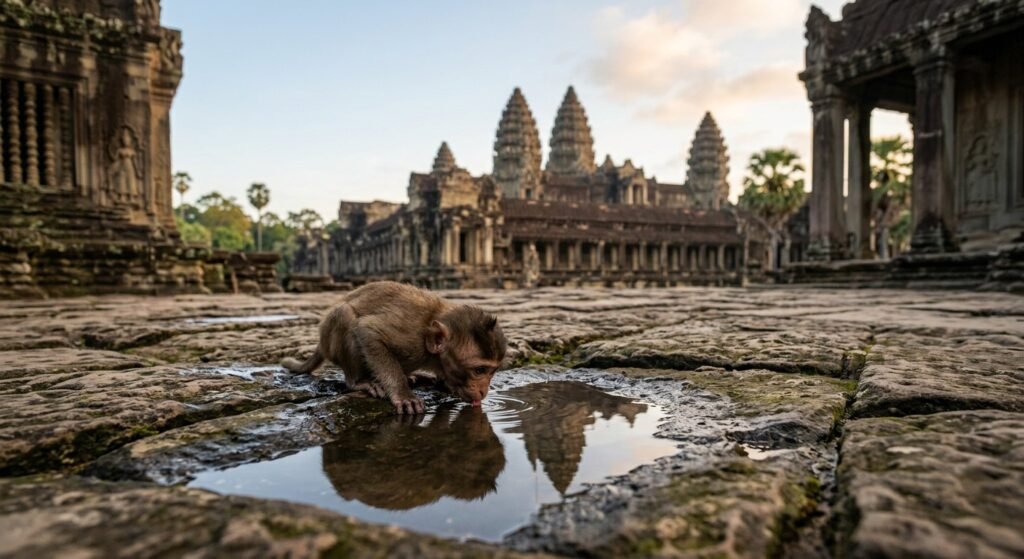
Morning light filtered through the trees surrounding Angkor Wat, turning the old stone pathways a soft shade of gold. The forest was already alive with movement. Birds called from high branches, leaves shifted in the warm breeze, and a troop of monkeys moved quietly between the trees and ancient temple structures.
Near one of the stone stairways, a very young monkey appeared determined to follow the others.
The baby was still learning how to move confidently through the uneven world around it. Every step seemed to require concentration. Its small hands touched the stone carefully while its feet searched for a secure place to land.
For a moment, everything seemed fine.
Then the baby lost its balance.
Its tiny body shifted unexpectedly, and it rolled down several steps before coming to a stop. The moment happened quickly, leaving nearby monkeys suddenly alert.
The baby paused.
For a few seconds, it simply sat there, appearing surprised by what had happened. One adult monkey nearby turned toward the little one, watching closely. The rest of the troop continued moving, but the atmosphere seemed briefly different—as if the small interruption had caught everyone’s attention.
Then something remarkable happened.
The baby began to move again.
Slowly, it placed its hands on the stone and tried to regain its balance. There was no dramatic rush, no grand rescue scene. Instead, there was simply a small animal learning from an unexpected moment.
That quiet determination was what made the scene memorable.
In the Angkor Wat forest, young monkeys face a world filled with branches, roots, stones, walls, and steep surfaces. Every day brings another challenge. A fallen leaf can become something interesting. A tree branch can become a playground. A staircase can become an obstacle that requires patience and practice.
The baby monkey looked upward again.
The stairs remained exactly where they had been before.
But now the tiny monkey seemed more careful.
PART 2
The baby did not rush. It climbed the last of the stairs slowly, placing each foot with a new kind of care. The fall had not broken anything, but it had changed something in the way the little one moved—the way it tested each stone before trusting it, the way it paused at every edge.
What the baby did not know was that the fall had never been the real problem.
Ahead, the troop was already moving on. They moved the way monkeys move when the day has somewhere to take them, not lazily the way they had moved at dawn, but with a quiet, settled purpose. The older males went first. The females followed with their young. And at the very back, carrying a newborn so small it was little more than a scrap of dark fur pressed to her chest, walked the baby’s mother.
The newborn had come in the night.
For weeks before that, the mother had carried the baby everywhere—on her back, against her chest, through branches and over walls and up steps far too steep for such small legs. The baby had never needed to walk. It had only needed to hold on. It had fallen asleep against the warmth of its mother’s fur and woken to the same warmth, as if the world itself were made of holding.
That morning was the first morning the baby had woken without its mother’s body beside it. It had woken instead to the sound of the newborn crying, a thin and insistent sound, and to a space beside it that was already cool. The mother had not gone far. She never went far. But she had moved her attention the way a river changes its course, slowly and then all at once, and the baby had felt that change the way a small creature feels a coming storm—without knowing what it meant.
Now both of the mother’s arms were full, and her back was no longer the safe place it had always been. The baby—the one who had just learned what it felt like to fall—was expected to keep up on its own.
It was no longer the youngest of the troop. It was only the one left behind.
The baby did not understand any of this the way a person would understand it. It understood only that something it had always been able to count on was suddenly gone, the way the ground is suddenly gone when a branch gives way. It kept to the edges of the path, where the shadows were, and it kept the troop in sight the way a small boat keeps the shore in sight—afraid that if it looked away even once, the distance would become too great to cross.
The baby called out, a thin sound that carried only a little way. The mother did not turn. She was already negotiating a fallen tree trunk, balancing with the newborn, her attention divided between the ground ahead and the tiny life at her chest. Perhaps the sound reached her. Perhaps it was swallowed by the noise of the waking forest. Either way, the distance between them only grew.
Near the eastern gate, a crowd of tourists had begun to gather. Their voices rose and fell like weather. Somewhere on the road beyond the trees a motorbike sputtered and coughed. None of it belonged to the world the baby understood. It pressed close to the base of a stone pillar and waited for the noise to pass, and in that small hesitation the troop slipped further away, until the baby could see only the pale movement of tails disappearing between the trees.
Then the shadow came.
It crossed the ground in front of the baby without a sound—wide, gliding, wrong. The baby looked up. High above, between the baby and the sun, a shape wheeled slowly in the clear air. Wings, broad and still. It did not flap. It only turned, patient as the day itself, watching the ground the way the day watches.
The baby pressed itself against the stone and did not move at all.
It stayed that way for a long time, breathing in small, quick sips, watching the shape turn and turn in the blue. It had been a morning of falling. It did not yet know that the falling was only the beginning, and that before the day was out, it would be asked to climb higher and further than it ever had—alone, and with no one watching to see whether it made it.
PART 3
The troop was gone. Or nearly. One shape still stood at the edge of the treeline—the baby’s mother, pausing for a heartbeat on a high root, the newborn still pressed to her chest. She looked back once, briefly, the way a creature looks back when it is deciding something that cannot wait. Then she was gone too, and the baby was alone with the stones.
For a long while the little monkey did not move. The shadow in the sky had drifted away, but the fear it left behind stayed close, like a cold place on the skin.
Then, very slowly, the baby began to follow.
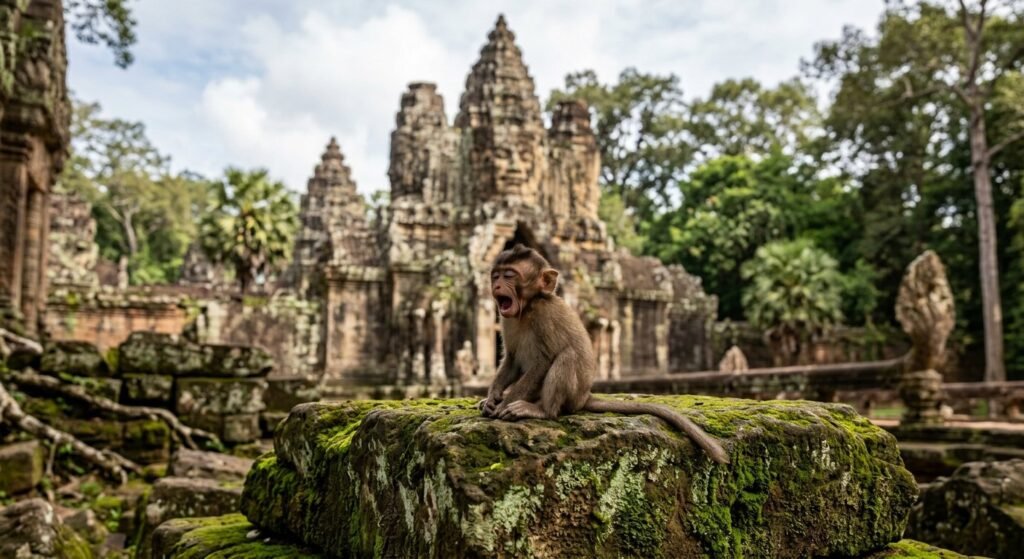
The path led to a low wall—old stone patched with moss, taller than the baby by a great deal. The adults had crossed it without breaking stride. To them it was nothing: a step, a pause, a thing already forgotten. To the baby it was a mountain.
It tried the way the adults had gone. It jumped and fell back. It jumped again, and again, its small hands scrabbling against stone that offered nothing to hold. Each failure cost a little more. The baby sat down at the foot of the wall, and for a moment it looked the way any small tired thing looks when the world has suddenly grown too large—quiet, and still, and impossibly alone.
The morning had grown warm. The stone held the heat and gave it back, and the baby’s small chest rose and fell with the effort of everything it had tried. It was the kind of moment that asks a creature to decide something about itself. It could stay at the foot of the wall and wait, and wait, and wait—for a mother who was carrying someone else now, for a troop that had not looked back, for a day that would not slow down. Or it could find another way. It had never had to make that choice before. It had always been carried.
Then it stopped trying to be like the others.
It turned away from the wall and looked around. Not far off, a young tree leaned against the stone, its trunk thin and smooth, its branches reaching up past the top of the wall. The adults had not used it. It was not the way things were done.
The baby climbed it anyway.
It was slow work. The trunk swayed a little under the baby’s weight. Twice the little monkey slipped and caught itself, heart hammering, and both times it kept going, higher than it had ever climbed on its own, until the top of the wall came level with its hands. Then it stepped across—a small, deliberate step onto the stone that had seemed impossible only minutes before.
From the top of the wall, the baby could see the forest opening out below it. It could see, far off, the troop moving through the trees. It could see, closer than it had dared to hope, the way forward.
And it understood, in the wordless way that small creatures understand such things, that it had not fallen behind because it was weak. It had fallen behind because it had been learning to walk on ground that was never made for the small.
The smallest monkey in the troop had found its own way.
Somewhere below, in the direction the troop had gone, a bird called out once, and the sound echoed off the old stones and came back smaller than before. The baby turned its face toward it, and then turned away again, toward the way forward. It did not know that the hardest part of the day was still waiting. It knew only that it had climbed a wall it had not been meant to climb, and that the ground, for the first time, felt like something it had earned.
PART 4
But the day was not finished with the baby yet.
The wall ran on into a long stretch of crumbling ledge along the temple’s outer face. It was a narrow place, wide enough for a grown monkey and no more. Below it, the stone dropped away into shadow and broken rock. The baby moved along the ledge with its body low, the way it had learned to move since the fall—testing every inch, reading the stone the way the old monkeys read the sky.
Halfway across, the stone moved.
A piece of the ledge broke away beneath the baby’s foot and tumbled down, and down, and was gone. The baby froze, flattened against the wall, its fingers curled into a seam in the old stone. For a long moment nothing happened. Then the seam began to crumble, grain by grain, a fine trickle of dust running down past the baby’s face like sand through an hourglass.
The baby did not dare look down. It had learned, in the way the very small learn such things quickly, that looking down makes the distance grow. So it kept its eyes on the stone in front of it, on the thin line of the ledge, on the place where the wall met the sky, and it moved the way a thought moves—carefully, and one piece at a time.
Above the treeline, the shadow was back.
It came lower this time, close enough that the baby could feel the change in the air, the way the light dimmed as the great wings passed. The bird turned in a slow, deliberate circle, and it looked down, and it saw the baby pressed there against the crumbling stone—small, and alone, and very far from the ground.
The bird did not dive. It did not need to. It only waited, the way the forest waits, the way the day had been waiting since the first fall. It knew what the baby knew, in the old and patient way that hunters know such things: that everything that climbs must eventually come down, and that fear makes the smallest creatures careless.
The sky was changing too. The gold of morning had gone out of it. The light over Angkor Wat had gone the pale, watchful color it takes before evening, and the shadows between the trees had begun to deepen and fill with a darkness that moved.
The troop was nowhere to be seen.
The baby looked back along the ledge. The way it had come was broken now, the stone loose and shifting. The way forward was longer still, and dark, and the wind moved over the old stone like a hand testing a wall.
The baby’s arms had begun to tremble. It could feel the tiredness now, moving through it like water finding every crack. It thought of the warm place on its mother’s back, of the sound of the troop moving through the leaves, of all the ordinary things it had not known were safety until they were gone. And it held on, because holding on was all that was left, and because somewhere in the forest, it believed, a mother might still turn around.
High above, the bird banked once and began to come around again, lower this time, and the baby felt the small hairs along its back rise the way they rise before rain. There was no time left for being careful. There was only the choice between the crumbling stone behind it and the dark way forward, and a small creature who had already learned, in one long day, how much it could carry.
And the seam the baby was holding began, very quietly, to give way.
PART 5
The seam gave way.
But the baby did not fall.
In the instant the stone crumbled, the little monkey pushed away from the wall—not down, but forward, toward the one place on the ledge that still looked solid. It landed badly, scrabbling, sliding, and for one terrible heartbeat it seemed the whole world was tipping sideways. Then its hind foot found a root that had grown through a crack in the stone, and the baby held on with everything it had, and slowly, slowly, the world steadied.
For a long time the baby simply hung there, breathing.
The shadow above had gone. The wind had softened. And in the quiet that followed, there came a sound the baby knew—a low, questioning call, rising at the end, the way it had sounded every single day of the baby’s life.
The mother was coming back.
She came up the wall the way the adults always did, easy and sure, the newborn still asleep at her chest. When she reached the ledge she stopped, and she looked at the baby for a long moment, the way a creature looks at something it had almost stopped waiting for. Then she sat, and she waited, and the baby—slowly, carefully, the way it now did everything—crossed the last of the ledge and climbed onto her back, into the warm place that had always been waiting.
The newborn shifted against the mother’s chest and made a small sound, and the mother answered it without looking away from the baby on her back. It was a sound the baby knew, a sound it had not heard all day, and it settled into the baby the way warmth settles into stone at the end of a long afternoon. The baby closed its eyes for a moment, and for the first time since the stairs, it let itself stop being careful.
The troop had not gone as far as the baby had feared. They had only gone far enough, it turned out, for the baby to learn what it could do alone. Some things only look like abandonment from a great distance.
Far below, the stones of Angkor Wat were turning the deep blue of evening, and the first bats were stitching themselves across the sky where the shadow had been. The troop moved on through the trees in the easy, unhurried way of creatures who have nowhere left to be. And the baby, watching them, understood something it would carry for the rest of its life—that being small is not the same as being lost, and that the ones who are left behind are sometimes only the ones being made strong enough to follow.
As the last light faded over Angkor Wat and the forest settled toward sleep, the mother moved back along the wall with two young now—one at her chest, and one on her back, small but holding on. And the baby, looking out over the old stones and the darkening trees, understood that it was not at the back anymore.
It had not been left behind.
It had only needed to learn how far it could climb.