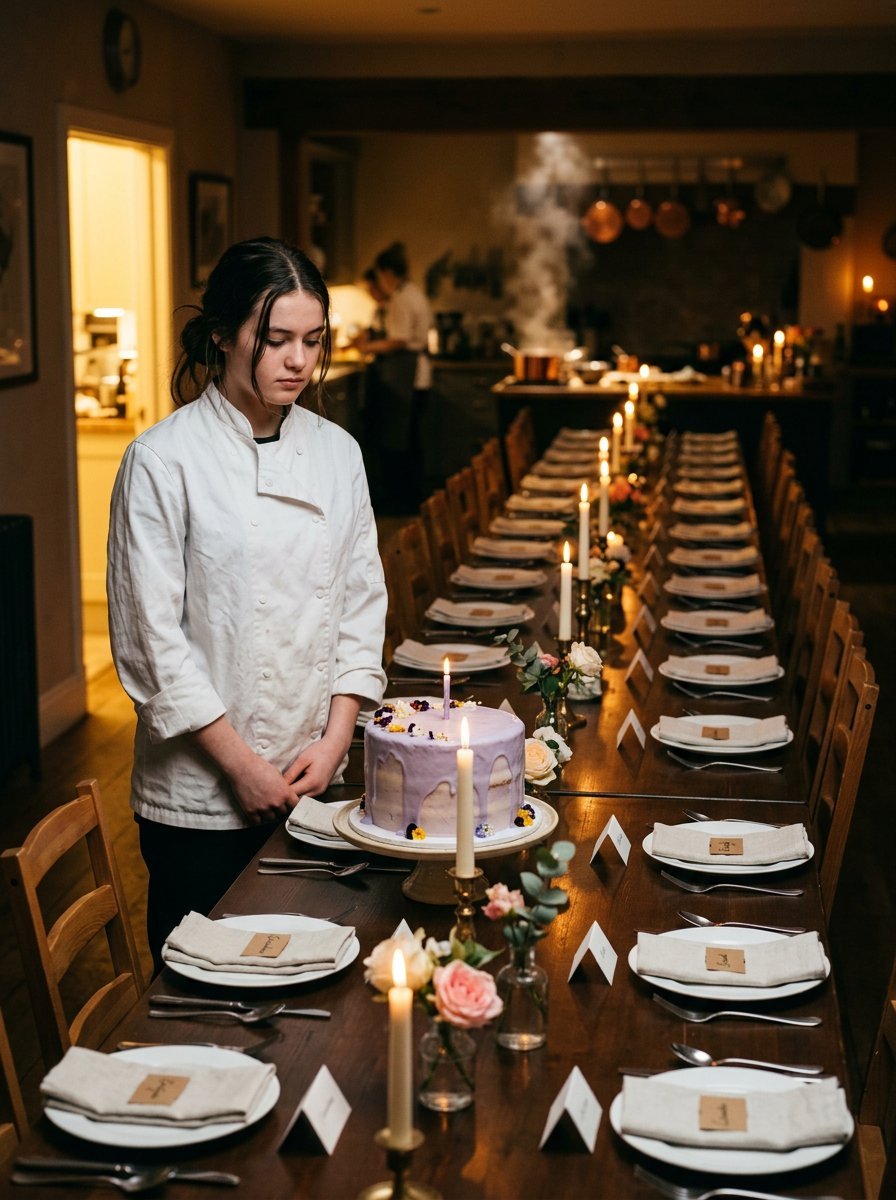
My 17-year-old daughter spent three days cooking for 23 people for my mother’s 67th birthday. Ten minutes before the party, Dad texted, “We decided to celebrate at a restaurant instead. Adults only.” Then they charged $1,327.90 to my card for their dinner. I didn’t argue. I made one phone call that changed everything. Fifteen hours later, they were pounding on my front door, demanding I fix what had happened. Ten minutes before my mother’s birthday party, my seventeen-year-old daughter was putting the finishing touches on a three-layer cake. Twenty-three plates were waiting on the dining room table. Fresh flowers. Handwritten place cards. Printed menus. The house smelled like roasted duck, fresh thyme, and warm butter. Ava had been cooking for three days.
She wanted to become a professional chef,
and tonight was supposed to be her chance to prove she was serious.
“Mom, do you think Grandma will like the lavender glaze?”
I smiled.
“She’ll love it, sweetheart.”
Then my phone buzzed.
PART 2
The screen lit up in my hand.
Dad: We decided to celebrate at a restaurant instead. Adults only.
Three seconds later, a second bubble.
Dad: Don’t wait up.
I read it four times. My father had known about this on Tuesday. He waited until ten minutes before the doorbell to send a message he could have sent on Sunday. The delay was the point.
Ava was behind me holding a piping bag. She read it over my shoulder because I did not turn the phone away in time. That is a thing I will carry the rest of my life.
“Adults only,” she said.
“Ava.”
“I’m seventeen.” She said it the way you say the answer to a math problem you have finally solved. “Everybody in this family is an adult except me and Cameron.”
Cameron was eleven. My brother Dean’s youngest.
She set the piping bag down very carefully and untied my mother’s apron. Underneath she was wearing the white chef’s coat she had bought in August with four hundred dollars of custard-stand money, saving the tags for tonight.
“Is it the food?” she asked. “Did I do something wrong with the menu?”
“No. Baby. No.”
“Because I can fix it. If the duck is too much. If it’s too fancy.” Her voice did not shake, and that was the worst part. “I could do the chicken instead. I have time.”
“Come here.”
She did not come. She looked past me at the dining room — twenty-three plates, twenty-three place cards in her own handwriting, every one with a drawn sprig of thyme in the corner. Her grandmother’s name was done in gold.
“Did you know,” she said, “that I called Bellamy’s on Monday? I wanted to see what a real chef puts on a menu for a birthday. And the woman said they do a duck with lavender honey.” She laughed once. It was not a laugh. “I thought I invented that.”
She pulled the cake out of the refrigerator, and we stood there looking at three days of her life.
Then she said, “Sit down. We’re eating.”
“Ava—”
“I made it for Grandma. But I made it, Mom. I’m not going to let him put it in the trash because he’s in a mood.” She took two forks out of the drawer. “Two plates. Come on. You look like you’re going to fall over.”
So that is what we did. At 6:15 on a Saturday in October, my daughter and I sat at the end of a table set for twenty-three and ate roast duck off my mother’s wedding china. There were twenty-three candles in the centerpiece. She lit every one of them.
“This is the best thing I’ve ever made,” she said, with her mouth half full.
“It is.”
“Don’t cry. It’s a birthday.”
At 6:41 my phone went off again. The family group chat. Pam, my sister-in-law, had posted a photograph.
The long table at Bellamy & Sons. My mother at the head, laughing at something off-camera. My father beside her with his hand on her chair. Dean’s fifteen-year-old son, Owen, in a blazer he had clearly been forced into, holding a Shirley Temple with a paper umbrella.
The caption said: Dad’s treat ❤️
I enlarged the picture and looked at my mother’s throat. Pearls. And at the far end of the table, on a silver stand, a cake that had not come out of my kitchen.
My daughter had a fork in one hand and her phone in the other, and she did the thing she has done since she was four years old, which is to become completely still.
“They got a cake,” she said.
“Ava.”
“From a bakery.” She set the fork down. “Okay.”
She got up, took three plastic containers out of the pantry, filled one with duck and potatoes and green beans, packed a slice of cake in another, and wrote on the lid in black marker: FOR GRANDMA — 20 MIN AT 350.
“Mom,” she said, without turning around. “Why did you let him have the card?”
My phone buzzed against the table.
BELLAMY & SONS — $1,327.90.
Twenty-three covers. Twenty-three people in a restaurant seven miles from my kitchen, eating a meal I had paid for, with a cake I had paid for, next to a granddaughter who was not invited.
Upstairs, in my bedroom, I downloaded six years of credit card statements in a single file.
I gave him the card in March 2019, when my mother had her knee replaced and he sat in a hospital cafeteria with his hands shaking and told me he did not know how they were going to manage. I set up a transfer of seven hundred and fifty dollars a month and told him it was for six months. The six months ended in September 2019. So did the conversation.
What I did not know was the card. Six years of it. A golf club. A cruise deposit in June. A steakhouse in August, $880 for four people. A jeweler’s in town on Tuesday — $412, posted at 2:47 p.m. Stone’s in March, $2,400, which I had no explanation for and did not like.
I am a regional operations director for a company that sterilizes surgical instruments, and I am good with a spreadsheet. It took me eleven minutes to build the tab.
Sixty thousand seven hundred and fifty dollars in automatic transfers. Twenty-three thousand six hundred and sixty-six dollars on the card. Eighty-four thousand, four hundred and sixteen dollars, over six years, to a man who told a restaurant full of my relatives that he was treating them.
Ava knocked at 7:02. “Mom? What are you doing?”
I picked up my phone. “I’m making a phone call.”
PART 3
At 7:06 a woman named Renee answered on the fourth ring.
“This is Renee. How can I help you tonight?”
“I need to dispute a charge.” My voice sounded strange to me — flat and very calm, the voice I use at work when something has gone wrong. “And I need to remove an authorized user. The charge is $1,327.90 at Bellamy and Sons, posted at 6:58.”
I read her the card number and the last four of my social, and I heard her typing.
“Okay, Mrs. Bennett. I see the charge. And I see the authorized user — Gerald Vance, correct?”
“Correct.”
“Ma’am, I have to tell you that as an authorized user, he is permitted to use the card. Removing him would stop future use, but the charge itself is a legitimate purchase.”
“Then he shouldn’t be on it,” I said.
She stopped typing. Behind her I could hear a room full of other phone calls.
“Okay,” she said. “I can remove him effective immediately. Do you want me to close the card and issue a new one?”
“Yes.”
“And you still want to dispute the charge.”
“I want that charge to stop being my responsibility.”
She was quiet for a moment. “Mrs. Bennett. This is your father.”
“Yes.”
“Has he done something to you?”
I opened my mouth to say no, because that was the answer I had given every single time — he’s fine, he’s just old-fashioned, it’s a family thing, we’re managing. Instead I put my hand over my mouth and cried in the dark with the phone against my forehead while a stranger in a call center in Columbus waited for me to be able to speak.
“Ma’am,” Renee said, “are you all right?”
“No,” I said.
“Okay,” she said. “Then let’s do this properly.”
She opened a formal dispute, removed Gerald Vance as an authorized user at 7:14 p.m., and closed the card ending in 4417.
“You’ll see a provisional credit in five to seven business days,” she said. “The merchant gets a chargeback notice. It normally takes a while.”
“Do you need anything else from me?”
“Only this. Do you want to file a police report?”
I thought about a man in a church shirt who used to carry me on his shoulders at the county fair, and sixty thousand seven hundred and fifty dollars of automatic transfers, and my daughter writing FOR GRANDMA on a plastic lid.
“No,” I said. “I don’t.”
“Your reference number is 44-8891-C. Call us if anything changes.”
“Thank you, Renee.”
“Good luck tonight, Mrs. Bennett.”
Renee told me the chargeback would take five to seven business days. It took forty-one minutes.
At 7:47 my phone vibrated. Dean: Call Dad. At 7:49: Right now.
At 7:58 Pam sent a message. Pam has never once sent me a message that was not in three parts. This one was in seven.
At 8:06 my phone rang. It was my mother, and I let it ring against my palm six times before I answered.
“Julia.” My mother had been careful her whole life. “Your father is very upset.”
“I know.”
“Everyone’s upset. There was some trouble with the bill.” She paused. “He says you called the bank.”
“I did.”
“Mom, do something for me tonight,” I said. “Look at the necklace you’re wearing and ask him how he paid for it.”
The silence on that call went on long enough that I heard someone at a table behind her say, “Ruth, honey, come sit down.”
“I’ll come to you tomorrow,” my mother said quietly. “Eleven o’clock.”
Then she hung up.
At 9:14 my phone rang again. This time it was my aunt Denise, my mother’s older sister, seventy-one years old, who had been at that table and who had paid the bill.
“Your father told twenty-three people, in a nice restaurant, that you had fallen on hard times and that he and your mother had been helping you out.” Denise has a voice like a door closing in a cold hallway. “He said it while we were cutting the cake. He said you’d pay us back when you got on your feet. And Julia, he was so relaxed. Forty-five years I’ve known that man, and I have never heard him lie as easily as he did tonight.”
I sat down on the floor.
“Aunt Denise.”
“When the manager came back to the table — did you know a chargeback goes to the restaurant, not the bank? They wanted a different card. Your father handed his over and it declined. Then Pam’s declined. Then Dean sat there with his head down like a boy who didn’t want to be asked about his homework. So I paid it. Three forty-seven with the tip.”
“Denise—”
“I don’t need the money and I am not going to ask you for it. But I saw that photograph of your table. You weren’t even in it.” Her voice went soft at the edges. “Whatever you did tonight, girl, do it again.”
After I hung up, I sat in the hall outside my daughter’s bedroom and listened to the shower run, and I thought about my father telling a room full of my own family that I could not pay my own way while holding a fork I had paid for.
At 10:31 a car came up the street and stopped in front of my house with its lights on. It sat there for twenty-two minutes before it pulled away.
I set an alarm for seven, lay down on the covers with my shoes on, and waited for what I knew was coming.
PART 4
The pounding started at 10:09 on Sunday morning.
It is a different sound than a knock. Across the street, Mrs. Kowalski came out onto her lawn and looked from the man on my porch to the sedan double-parked in my driveway with its engine running.
“Julia. Open this door.”
I opened it, stepped out onto the porch, and pulled it shut behind me.
My father was in his church shirt. Dean stood behind him in the driveway in the same windbreaker he has worn since high school.
“You will call that bank,” my father said, “and you will tell them you made a mistake.”
“Good morning, Dad.”
“Twenty-three people. Pam. Your aunt Denise. Your mother’s whole side of the family. And they watched a manager walk to my table and tell me my card was no good. I have never been so humiliated in my life.”
“You’ve been humiliated before,” I said. “But not last night.”
His face changed.
“You made him look like a thief,” Dean said.
“Did I? Who paid for your son’s dinner, Dean?”
He went quiet.
“Mine,” I said. “I paid for Owen’s Shirley Temple and his blazer. I paid for the two of you, and for the cake my daughter made after your restaurant told me on Monday that they do a duck with lavender honey. Ten minutes, Dad. You gave me ten minutes. What did you think I was going to do, throw the duck out and go to my room?”
“You’re making a scene.”
“I’m on my own porch.”
“Your porch.” He laughed, once, with no humor in it at all. “You have always had a very good opinion of your own porch.”
“Dad.” Dean put a hand on his arm. “Just tell her to fix it and let’s go.”
“Eighty-four thousand, four hundred and sixteen dollars,” I said.
The door behind me moved. Ava was standing in it in her coat, holding her phone against her chest.
“Go inside,” my father said.
“No,” I said.
“Julia, this is not a conversation for—”
“Eighty-four thousand, four hundred and sixteen dollars,” I said again. “Sixty thousand seven hundred and fifty of it in automatic transfers. Twenty-three thousand six hundred and sixty-six of it on a card I gave you for emergencies. I sat on my floor last night and added up six years of it, and I am going to say it until it is in the air and the whole street can hear it.”
Dean said, “Dad’s been helping you for years.”
I looked at my brother for a long moment.
“Is that what he tells you?”
My father’s jaw moved. He looked at the street. He looked at the Kowalskis.
“Where did Mom’s pearls come from?” I said.
“That’s not—”
“Four hundred and twelve dollars at Weston and Company on Tuesday afternoon. I have the exact time. Was it a birthday gift, Dad, or were you just the one who handed it to her?”
“I bought your mother a present,” he said. “That is what a husband does.”
My voice did not rise. I said all of it at the volume a person uses to read a bill to a stubborn customer.
“You put a present on my card,” I said, “and let her thank you for it in front of twenty-three people.”
“You’ve got one card left,” my father said, “and I will tell you what you’re going to do with it, because you owe me.”
“Say it.”
“You will call that bank, withdraw the dispute, and apologize to the people at that table.” He stepped closer. “Or I will go to your mother this morning and tell her exactly what kind of daughter she raised.”
Behind me, Ava made a sound.
“Grandpa,” she said, “why didn’t you want me there?”
Nobody said anything.
“The restaurant isn’t adults only. I know, because I called it. I wanted to see what a real chef puts on the menu for a birthday. Owen is fifteen and he was there. So it was just me.” Her arms were folded and her chin was up and I have never been prouder of anything in my life. “I made twenty-three place cards. I did Grandma in gold.”
My father looked at her and did not say one word.
“Renee asked me on Saturday night if I wanted to file a police report,” I said. “I told her no. That’s the last nice thing I will ever do for you.”
“Get off my porch.”
“Your porch.”
“Get off my porch, Gerald Vance. Get in your car.”
“Your porch,” he said again, and he smiled at me then, the way he smiles when he has decided to hurt someone properly. “That’s the funniest thing you’ve said all morning. I put twenty-five thousand dollars down on this house.”
The whole street went quiet.
“What twenty-five thousand?”
“You heard me. In 2009. And I have never asked you for one penny of it back.” He turned toward the steps. “I want it now. This week.”
“Dad. What twenty-five thousand?”
He did not turn around. Over the roof of the sedan, my father looked back at me and said, “Ask your mother.”
The car pulled out of my driveway. Mrs. Kowalski was still standing on her lawn with her hand over her mouth.
I stood on the porch a long time with my phone in my hand. Then I called my mother.
PART 5
Her car came up the street at 11:20 and parked in the driveway.
My mother got out slowly, one hand on the door for balance, carrying a manila envelope so old it had gone the color of weak tea.
“Get me a chair,” she said, “before I fall over.”
We sat her at the end of the table. The twenty-three settings were still there, untouched since Saturday.
“She really did it,” my mother said softly. “Twenty-three.”
Then she started to cry. My mother cries the way she does everything: efficiently, and then she stops, and then she does something.
“Show me,” she said, and held out her hand.
I gave her the laptop. She put on her glasses and went down the list the way she used to go down the church prayer circle, one name at a time, until she reached the bottom.
Eighty-four thousand, four hundred and sixteen dollars.
She took her glasses off and set them on my wedding china. “I knew something was off,” she said. “The cruise. The golf. He got very strange about the mail.” She looked up at me. “I did not look, Julia. That is not the same as not knowing. If I had looked, I would have had to do something, and I have never once been brave about money.”
“You’re here.”
“I’m here after the fact.” She slid the envelope across the table. “Open it.”
Inside was a wire transfer slip from 2009 — carbon paper, my grandmother’s name typed in a box at the top. Twenty-five thousand dollars, out of the estate of Ada Whitfield on May 14, 2009, into a title company account in my name, with a memo line in my mother’s handwriting: JULIA — HOUSE.
“That was my mother’s money,” she said. “He was not in the room when I signed that slip, and he did not know it was twenty-five thousand until I told him at supper. Do you know what he said? ‘Good. Now we can tell people I put her down on that house.'”
“He has told that story at every graduation, every Christmas, every time somebody asked about this house,” she said. “And I let him. Every time.” She put her hand flat on the table. “That is mine to answer for, and I am answering for it today.”
At noon she called him and told him to come. She did not use the word please. He was there in fourteen minutes, and Dean drove him.
My mother sat at the head of that table with twenty-three empty plates in front of her. My father came in and stopped when he saw her face.
“Sit down,” she said.
“Ruth.”
“Sit down, Gerald.”
He sat at the far end. Dean stayed by the door.
She pushed the slip down the long white cloth toward him. “Twenty-five thousand dollars, May 14th, 2009. You want it back. There it is. It was my mother’s money, it went into this house, and it did not come from you.”
He looked at that slip the way a man looks at a photograph of himself at a wedding he has been claiming he attended.
“Ruth, that’s not—”
“Say one more word about that money in front of my daughter and my granddaughter and I will have our lawyer look at every account with my name on it, and I will not stop at the twenty-five.” She said it without heat, and that was worse. “Now. The necklace.”
“Ruth.”
“I’m wearing a gift my daughter paid for. Take it off me.”
He did not move. She reached up and unclasped it herself, and set it on the table in a little shining heap, and pushed it toward him the way she had pushed the slip.
“Four hundred and twelve dollars,” she said. “Give her the money or give her the pearls. I don’t care which. But I am sixty-seven years old today, and I will not wear another thing in my life that my daughter’s money bought.”
Dean said from the doorway, “Dad. Did you buy me that watch with her card? The one at Stone’s, in March?”
Nobody answered him.
My father stood up so fast his chair went back into the buffet. He said a thing to my mother that I will not write down, and then he went out and sat in the passenger seat of the sedan with his arms folded like a man waiting for a valet.
Dean did not go with him. He stood in my kitchen doorway looking at the table, at the twenty-three plates, at the pearls, at his mother.
Then he said, “I didn’t know about the watch. I swear to God, Aunt Julia.” He has called me Aunt Julia since he was four, because his sister did and he copied her. “I’m taking him home. But I’m coming back.”
He came back that night.
At six o’clock my mother set her purse by the front door and said she was staying for supper. Ava put her chef’s coat on over her sweatshirt and took out the containers — the duck, the potatoes, the beans, the rolls she had wrapped in foil on Thursday. She heated all of it and set three places at the end of that long table, and then, after a minute, a fourth.
“Dean texted me,” she said. “He asked if there was any cake.”
There was. It had sat in the refrigerator for two days behind a Tupperware with her grandmother’s name on the lid.
My mother ate the duck and said nothing for a while. Then she put her fork down.
“Julia. Look at these place cards.”
“I know.”
“She did the gold.” She touched the edge of the card. “No one has ever written my name in gold before.”
Ava cut four slices and set them down one by one.
“Best thing I ever made,” she said.
She wasn’t talking about the cake.
People still tell me a phone call changed everything. It didn’t. My daughter did that three days earlier, with a gold pen and flour on her forearms, at a table set for people who never came.
All the phone call did was make room.