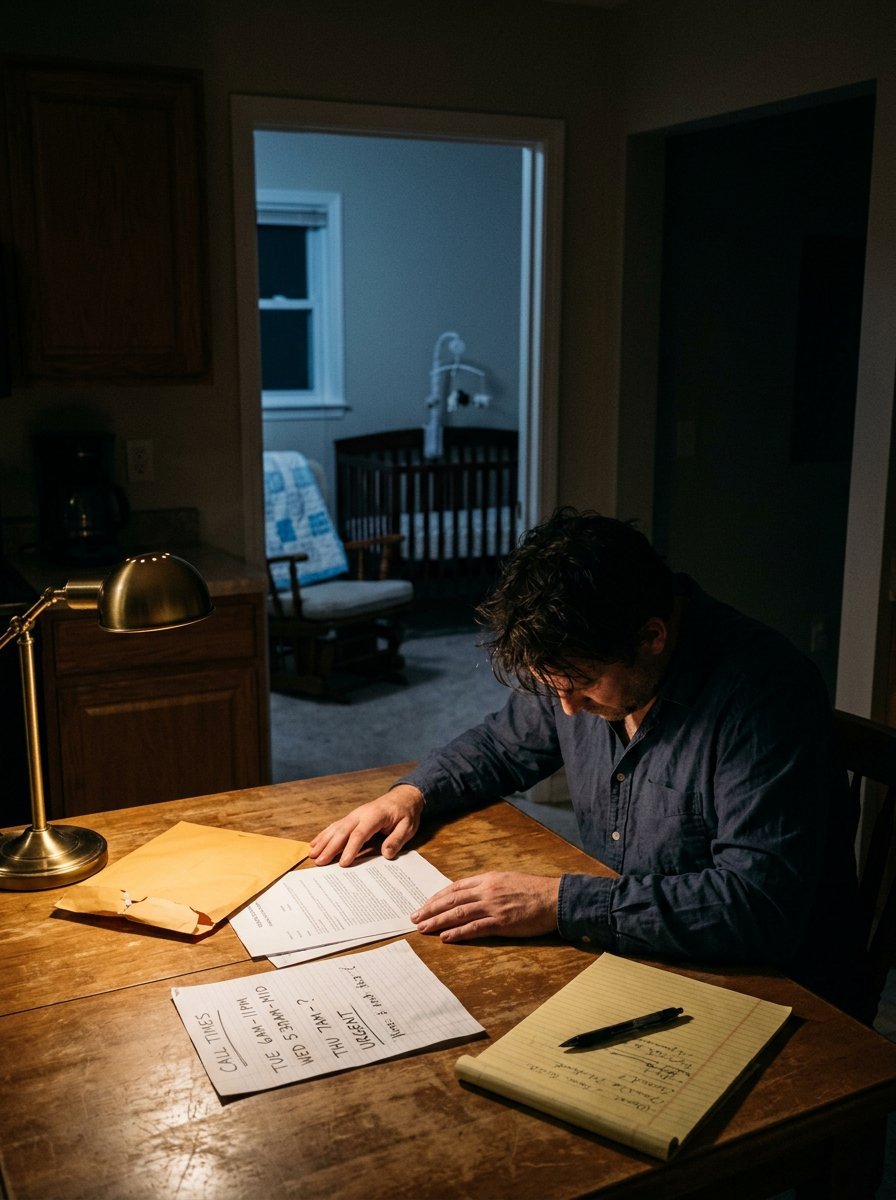
I carried the envelope into my office and took it apart on the desk. First page: a courier receipt. Three deliveries, made twelve days before I even came home. Second page: the hospital invoice for my son’s birth, with the transport note signed by the woman who drove my wife there — not her sister. Third: a bank document for a $1.2 million line of credit, signed in my wife’s name, in handwriting that was not hers. I know, because I forged it. Then the last page, handwritten. A phone log for the night Owen was born — fourteen calls between 11:20 and 3:04, all of them to me. And one of them to a number I recognized as Tessa’s.
She hadn’t been waiting for me.
To come home.
And apologize.
She had already mailed.
Everything.
PART 2
I had been gone eighteen days. On March 2nd I stood in this kitchen with a bag by the door and told my wife I was flying to Denver for a walkthrough on the Ashcroft job, and then I drove twenty-five minutes across town to Tessa’s and stayed there.
I sat in that office with the pages spread out in front of me like a hand I had already lost, and then I did what I do. I got a pen. I wrote the date on a yellow legal pad, and the four things on the desk under it, and then I typed the tracking numbers into the courier’s website.
The first came up before the page finished loading. Delivered March 8th, 10:12 a.m., signed for at First Federal Savings on Market Street — a looping J. Petrakis, the loan officer who took my application in February and shook my hand.
The second: March 8th, 10:41 a.m., Pruitt Development, signed Dale Pruitt in the flat scrawl I have looked at on plans and checks for eleven years.
The third took me longer, because I did not believe it. March 7th, 2:05 p.m., 14 Crescent Court — my mother’s house. Signed P. Avery.
It was not shame. It was closer to professional respect — the way you look at a bid that came in lower than yours and was done honestly. My wife had mailed three packages to the only three people on earth who could take my life apart, twelve days before I walked through my own front door.
She had kept the books for Avery Custom Homes for six years, back when it was two trucks and a rented office and a woman at the kitchen table with a calculator and a pencil behind her ear. I taught her to read a draw schedule. She taught herself everything else.
I went through the house. Her keys were in the blue dish on the counter. Her coat was gone from the hooks. The nursery door was open and the crib was gone, and the rocking chair her father made, and every folded thing that had ever belonged to my son. The room smelled like the lemon soap she used on the baseboards.
There was no note. That is the part I keep coming back to. No note, nothing but the envelope in the middle of the table, squared to the edge of the wood, so that I could not put down my keys without picking it up.
My phone rang at 4:52.
“Dale.”
“Are you at the house?” He did not say my name. He has said my name at the start of every conversation we have had since 2013.
“I’m at the house.”
“There are nine boxes in my conference room and my lawyer is on his way. The accounts are frozen. Your wife sent me nine years of draw requests, Grant. Nine years. Every invoice I signed. Every change order where the number went up after the client stopped watching. There is a cover letter in here.”
“What does it say?”
“She says she is not going to sue me. She says she is going to sit and wait, and in six months I will be the one calling her.” He laughed once, with nothing in it. “She’s right. I read the whole thing in my truck and then sat there twenty minutes trying to work out how much I knew and when I knew it.”
“Dale—”
“Do not come to the office. Do not come to my house. I’ll call you when I have a lawyer to give you a number.”
He hung up.
I called my mother. It rang twice and went to voicemail, and her voice came on, the one she uses for strangers.
“You have reached Patricia Avery. If this is about a contract, call my son’s office. If this is my son —” a pause, and I could hear her choose the words, “— I have nothing to say to you today.”
I sat down on the floor of the nursery with my back against the wall where the crib had been, and I took the hospital invoice out of the envelope for the second time.
There was a stamp across the bottom, the purple kind they use at the front desk. Paid in full, March 4th, 3:51 p.m., debit card. Six thousand four hundred and twelve dollars. She had paid for the birth of my son from a hospital bed with the card her mother gave her for emergencies.
Then I read the last page properly. The phone log was handwritten — fourteen lines, not a printout. She had copied it out herself in the neat accountant’s print she used on grocery lists, times on the left, durations on the right.
11:20 p.m. — 0:00
11:26 p.m. — 0:00
11:31 p.m. — 0:00
11:38 p.m. — 0:00
Fourteen calls. Every one of them to my cell phone. Every one of them unanswered.
And then, at 11:47, one call to a number I had saved in my phone as Tessa Marsh, and a duration of nine minutes and twelve seconds.
Underneath all of it, at the bottom of the page, she had written one more line in blue ink.
3:04 a.m. — Owen. 7 lb 9 oz. I stopped calling.
I called Tessa. It rang through to voicemail, and I called again, and on the third try she sent a text that was four words long.
Do not come here.
March 6th, the courier receipt said. Prepaid in cash. Picked up at 118 Birchwood, which is our address. Dana had let herself in with the key under the mat and handed three Tyvek envelopes to a man in a van while her sister was two days past giving birth in a hospital bed.
My email chimed at 6:11 p.m.
From: L. Sorenson, Attorney at Law. Subject: Avery — proposed separation agreement, draft.
One attachment. Forty-one pages.
Page nine was a schedule of every financial document executed in our marriage — dates, institutions, amounts, signatures. Two hundred and six entries. At the bottom she had scanned in three more lines, in her own hand.
- Line of credit, $1,200,000. First Federal Savings. Executed February 9. Signed “N. Avery.” Not her signature.
- Transfers, $40,000. Avery Custom Homes operating account to Marsh Interiors LLC, October through January. Not a business expense.
- Signature card, First Federal Savings, January 14. Replaced the original. Original removed.
And under that, a note.
I know, Grant. I have known since January 14th. You have eaten dinner across from me forty-one times since then. You have not once asked me to sign anything.
Please read all forty-one pages. I did not write them fast, and I would like you to read them slow.
PART 3
I drove to Tessa’s at seven in the morning, because I had run out of other things to do.
She lived in a condo off Route 9 with a parking lot that fills up with rain. I sat in my truck until she came out with a coffee cup, and then I stood where she would have to see me.
“Don’t,” she said. Her face was doing something I had never seen it do.
“Tessa. What did you tell her?”
She put her cup on the roof of her car and looked at me, and I understood that I was not the person she was most angry at. I was not even the person she had been thinking about.
“I didn’t tell her anything,” she said. “She called me.”
“…What?”
“At eleven forty-seven on the third of March, a number I didn’t know called my phone. A woman said, ‘Is this Tessa?’ and when I said yes she said, ‘This is Nora Avery. I’m in labor. There’s blood. I’ve called my husband fourteen times and he isn’t answering, and I found your number in his phone in August, and I don’t have anyone else, so I am asking you.'”
I could hear the rain on the roof of her car.
“I didn’t believe her at first. I thought it was a wife playing a game. Then she said, ‘He told me he was in Denver,’ and I said, ‘He told me he was divorced,’ and there was a silence on that phone I will be hearing for the rest of my life.” Tessa looked at the parking lot, not at me. “Then she said, ‘I understand. Thank you anyway.’ She hung up, Grant. She didn’t scream at me. She didn’t call me a name.”
“So you drove her.”
“I drove her.” She nodded slowly. “I put my flashers on and went forty minutes across town to a house I had never seen, and she was on the porch with a bag already packed, because she is the kind of woman who packs a bag before she calls anyone. She got in my car and said, ‘I’m Nora.’ She apologized to me for the mess in the front seat.”
“And the transport note,” I said.
“He wasn’t there to sign it,” Tessa said. “Somebody had to sign it. I signed it.”
I had a hundred questions, and every one of them was about me.
“She was in that room for four hours. She did not cry. She held my hand through two of them, and when they took her back she asked me to call her sister, and then she asked me, very politely, if I would leave before you got there. I said you wouldn’t be coming. She said, ‘I know. I’d still like you to leave.'”
“Tessa.”
“Nine months I have been the woman who took a man at his word.” She picked her coffee up off the roof. “I have driven past your house. I have driven past your wife’s vegetable garden. Do you know what I did when I found out? I sat in my car and threw up in a coffee cup.” She looked at me. “I’m not the one you lie to. But I am not going to be the one you get to keep, either.”
“What does that mean?”
“It means the forty thousand dollars you moved into my company is going back to your wife, and I am going to be the one who hands it to her.” She opened her car door. “And Grant — your wife asked me for one thing. She asked me to tell you the truth if you ever came here, because she was through being the one who explains you.”
She got in and shut the door and drove away, and I stood in the parking lot in the rain like a man waiting for a bus that had already gone.
I went to my mother’s at eleven.
She is seventy-one and she does not open the door for anybody without looking through the side window first.
“You don’t come in,” she said. “You stand on the mat.”
“Mom.”
“Forty years I sold other people’s houses. I have watched men like you and told myself you were different, and the reason I told myself that is that I am your mother and it is my job.” She was holding a manila envelope in her left hand, and I knew what was in it. “She sent me the whole file. Every wire, every signature. And a cover letter, three pages, in her own hand, thanking me for raising her husband, and telling me she was not going to give any of it to the police, because she does not want her son to grow up with a father in a court file with his name on it.”
“Then she’s not going to sue.”
“She filed for divorce in January, Grant.” My mother said it quietly, and it is the only part that mattered. “And she has been ready to send that file to the county prosecutor since the day she found it. The only reason she hasn’t is that she wanted to be able to tell her son she gave you until the end of March. She kept a calendar on the refrigerator. I have a copy. Every day is crossed off except one.”
“Mom—”
“Your father died in 2011 with his name on this house and nothing else. I paid off the note on it in 2016. You will not have it.” She stepped back. “She comes to my house on Sundays with the baby. She has asked me to keep coming to the door. So I will see you on Sundays, from the porch, if that is still what she wants. Today it is not.”
She closed the door. I heard the deadbolt turn.
I stood on that mat a while, and then I checked my phone, because I am who I am. An email at 1:18 from L. Sorenson.
Mr. Avery — Ms. Avery will meet you at the house on Saturday at eleven. She has three conditions. She will tell you what they are herself. Please come alone.
PART 4
The house was warm when I came in, which was a kind of cruelty I had not expected.
Nora was at the kitchen table with a legal pad and a pencil behind her ear, the way she used to do our books on Water Street. My son was in a carrier on the floor beside her, asleep with one arm up over his head.
He was seventeen days old. I had never held him.
“Don’t wake him,” she said, without looking up. “Sit.”
I sat.
She turned the legal pad around and slid it across the table. Three lines, in her neat print.
- Deed. Sole owner: N. Avery. Recorded by Monday.
- Shares. Avery Custom Homes, all, assigned to D. Pruitt at book value. Signed Monday.
- The loan. Sole borrower: G. Avery. We remove my name or we go to the attorney general’s office Monday at ten.
“You have until nine a.m.” She put the pencil down. “I called the bank again on March 5th. They do not get to keep a loan on a fraudulent signature, and what they can do instead is call the police. What they agreed to do, in writing, is wait until Monday, because I asked them to, and because I told them a man I know needs three days to sign his own name.”
“His own name,” I said.
“That was the joke I made to myself in the hospital.” She said it without heat, which was worse than heat. “Forty-one times I sat across a table from you. Do you know what I was thinking while you talked about the subdivision? I was thinking, this man has a tell. He signs his checks with a little loop on the G, and when he lies he presses too hard, and I can see the back of the page from the front.”
“Nora.”
“Don’t.” She said it the way she said it to the dog when it got up on the counter. “I am going to say the rest of this, and you are going to listen, and then we are done, because I have to feed him in twenty minutes.”
She found the signature card on January 14th, in an envelope from the bank that came to the house because the account had her name on it, and her name on it was the entire point of the thing. In February the first statement arrived with a copy of the executed note in it. She sat in this kitchen and looked at a signature in her own name that she had never written.
“And then I did what I do,” she said. “I got a notebook out of the drawer.”
She did not call a lawyer in January, because a lawyer would have told her to file, and she was not ready. She called the bank, and the bank sent one polite letter. Then she waited, and went through nine years of a business she had built the books for, and wrote it down in order, with dates.
“I gave you until the third,” she said. “That was the day I broke up with the idea of you. I had it very neat. I was going to put the file on the table the morning you got back from Denver and ask you to leave, and I was going to be calm and reasonable and I was not going to cry.” She stopped and looked at the ceiling for a second, the only time all morning. “Instead my water broke at ten-forty at night in the kitchen.”
She called me fourteen times. She did not call her own sister until the next morning.
“And the courier,” I said, because I could still hear the receipt in my pocket.
“Six in the morning, on the third. I had it ready since January. I packed the whole file in three Tyvek envelopes in the nursery so I could look at them while I folded his clothes.” Her voice did not change. “My sister picked them up at eight-fourteen on the sixth while I was still in the hospital. Cash, because I told her you could trace a card in three minutes.”
She stood up and lifted the carrier off the floor and set it on the table between us. Owen slept through all of it with his hand still up by his head.
“Two hundred and six documents,” she said. “I know because I numbered them. The last one I put in that envelope on the kitchen table is the phone log. I wrote it out by hand. Fourteen times my finger went down on the call button. Fourteen times.”
“Say the thing,” I said. “Whatever it is you want to say to me, say it.”
For a second she looked like she might cry, and then she did not, because she never did.
“Eleven twenty,” she said. “That’s the thing. Eleven twenty in the dark in the kitchen with water on the floor, and I was not afraid of the labor. I was afraid that I would have to do it without you. And then, at three-oh-four in the morning, I stopped being afraid, because I understood that I already was.”
She looked at the clock on the stove.
“Nine a.m. Monday. Sign all three, in your own hand, and the fourth envelope does not get mailed. I am not going to be a woman who makes a threat she won’t keep. It goes to the licensing board, the county prosecutor, and the reporter at the Courier who has been calling me since March.”
“You called a reporter?”
“He called me. I didn’t return it.” She picked up the carrier. “That’s the whole offer. There’s no version of this where you talk.”
She walked to the front door and opened it, and stood there with my son in her arms.
And then, outside, a white car pulled into the driveway and stopped, and Tessa got out.
Nora did not look surprised. She held the door with her hip and looked at me.
“Sit down, Grant,” she said. “There’s one more page.”
PART 5
Tessa came in with a folder and did not take her coat off. She put it on the table between the legal pad and the carrier, stepped back, and looked at me for exactly as long as it took to decide that I was furniture.
“I want this on the record, such as it is,” Tessa said. “There’s a bank account at Huntington in my company’s name. It was opened in September. I signed the card. He never put a dollar in it himself — he moved it out of the business in four transfers, forty thousand total, and he told me it was a deposit on a kitchen job in Dublin.”
Nora flipped the folder open. Bank statements, four of them, with a sticky tab on each transfer.
“That’s number eighty-seven in the notebook,” Nora said. “I could see it leave and I couldn’t see it land, and it has been driving me crazy since February.”
“It went back Tuesday,” Tessa said. “It’s in the escrow account. I have the wire confirmation.”
The two women looked at each other over the top of my son’s head, and something passed between them that I have no share in and never will.
“I’m sorry,” Tessa said. “For the part that was mine.”
“I know,” Nora said. “You came when I called.”
That is how it ended, that morning — not with me, and not about me.
I signed the three pages on Monday at 8:40 in the morning at a title company on Market Street, next to my mother, who came because Nora asked her to and who did not speak to me except to say, when I fumbled the pen, “Sign your own name, Grant. It’s the one you’re best at.”
The deed went to Nora. The shares went to Dale Pruitt at book value, eleven thousand dollars, because a lawyer told him it was the cleanest way to keep the company out of a courtroom with my name in it. The line of credit was rewritten with one borrower and one signature, mine. I have paid on it every month since, and I will be paying on it when my son is old enough to drive.
First Federal sent a letter in June closing the fraud file without prejudice. I looked the phrase up. It means they can open it again whenever they like.
The licensing board suspended my contractor’s license for two years on the strength of the public record. There was a notice in the Courier with my name in it and the words “document irregularities.”
I do not run anything now. I swing a hammer for Ron Delgado, my foreman for seven years, who called the week the notice ran and said, “I’ve got work, I’ve got no opinion about you, and I’m paying thirty-one an hour.” I rent a room above a garage on Water Street and Ron picks me up.
Nora and I were divorced in November. Three pages, no hearing. She has the house and the garden and the blue dish on the counter and my son, and I have one hour on Sundays on my mother’s porch on Crescent Court. I do not get overnights. I do not get to be the one who picks him up when he cries. Nora sits in the kitchen with the window open and can hear everything.
He calls me Grant, because Grant is what his mother calls me, and I asked her once why she does it when she has every right to call me something worse in front of him.
We were on the porch in April, my son two years old and driving a plastic truck up and down my knee, and she leaned in the doorway with a dish towel over her shoulder and took a long time to answer.
“Because he’s going to be a man,” she said, “and I am not going to hand him a reason to be a worse one.”
“You never asked me for an apology,” I said.
“No.”
“Why?”
She looked at me the way she used to look at a column of numbers that did not add up.
“An apology is what you give somebody when you want the subject closed,” she said. “I’m not closing it. I’m raising him in it.”
Then she went inside to start supper, and Owen climbed up into my lap and put his truck under my chin and said, “Go.”
I keep the courier receipt in my wallet, folded into quarters behind my license. Three tracking numbers, delivered twelve days before I came home. Every few weeks a bank teller or a rental office or a man at a job site asks me to confirm my name, and I hand it over, and they look down at a piece of paper with three dates on it, and they say my name out loud to be sure, and I say yes.
Yes. That one. In my own hand.