My mother made my 6-year-old adopted daughter scrub Christmas dishes while her biological granddaughters enjoyed their expensive gifts. When I confronted her, my father sneered, “Renata needs to understand the difference.” I reached for a sealed letter about my daughter’s adoption records. My mother went pale and shouted, “Mauricio, don’t open that!” Then I noticed the envelope had already been opened—and my signature was on a document I’d never seen before.
“Scrub harder, little one. You’re not here to decorate.”
I stopped in the kitchen doorway.
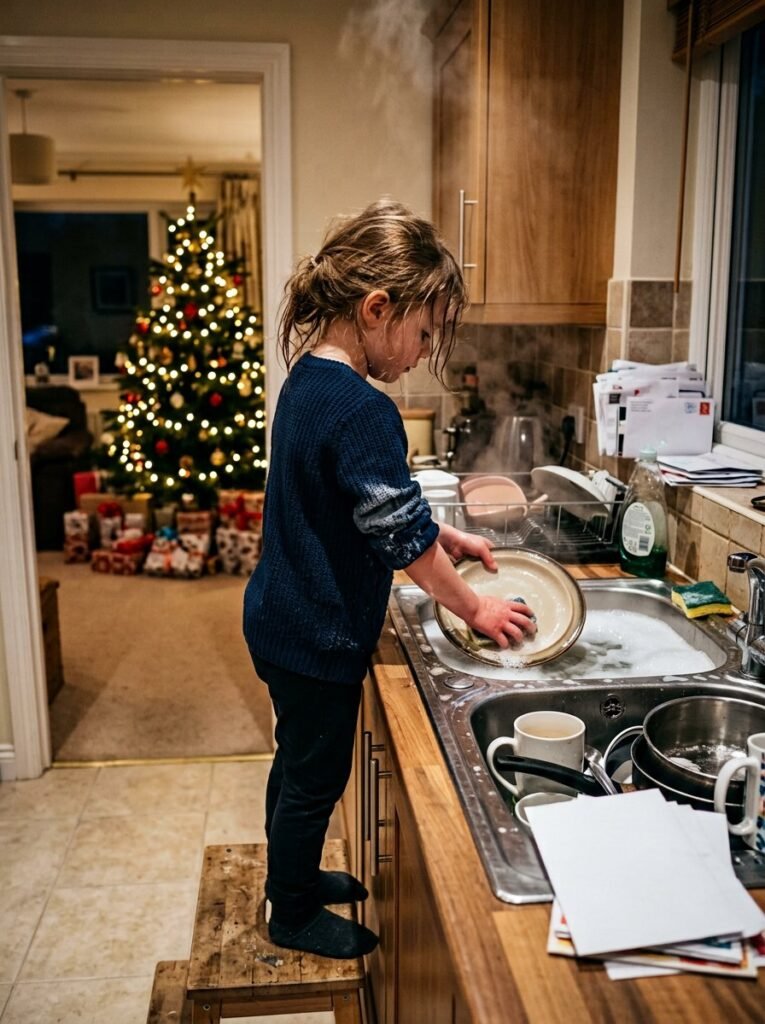
Renata stood on a wooden stool at the sink, trying to work through a mountain of greasy dishes.
Her sleeves were soaked.
Her little hands were red from the hot water.
Across the hallway, Sofia and Emma laughed beneath the Christmas tree, surrounded by expensive presents.
“Renata?”
She turned so fast that water splashed across the counter.
“Daddy!”
The relief in her voice nearly broke me.
My name is Mauricio DeLuca.
Powerful men had lowered their voices around me.
I had faced situations that made most people hesitate.
But nothing had ever made me feel as helpless as seeing my daughter at that sink while everyone else celebrated Christmas.
I looked at my mother.
“Carmen, why is my daughter washing everyone’s dishes?”
She kept polishing a crystal glass.
“No one lives for free in this house.”
I stared at her.
“She’s six.”
“And she’s old enough to learn responsibility.”
“Responsibility?”
I glanced toward the living room.
“While Sofia and Emma open presents?”
My mother looked up.
“Don’t start, Mauricio. The girls have their Christmas traditions, and Renata needs to learn how things work in this family.”
In the next room, my nieces tore through expensive gifts while ribbons and wrapping paper covered the floor.
Then I looked back at my daughter.
“And what exactly is her place in this family?”
My father appeared behind Carmen.
“Mauricio, don’t make a scene.”
I turned toward him.
“Then give me a reason not to.”
I pointed toward the living room.
“Why are my nieces opening presents while my daughter washes their dirty dishes?”
His gaze moved to Renata.
There was no warmth in it.
No embarrassment.
“Paola’s girls are our real granddaughters.”
For a moment, I couldn’t speak.
Then he said the words that silenced the kitchen.
“Renata needs to understand the difference.”
My mother lowered the crystal glass onto the counter.
Neither of them looked ashamed.
Renata climbed down from the stool.
She walked toward me with her head lowered and wrapped both arms around my leg.
“Daddy, did I do something bad?”
I bent down and lifted her into my arms.
“No, sweetheart.”
I held her close.
“You did nothing wrong.”
She pressed her face into my shoulder.
“Then why do I have to wash the dishes?”
I tightened my arms around her.
I had adopted Renata when she was two.
I had chosen her.
Loved her.
Promised her a home where she would never have to wonder whether she belonged.
Yet my parents had spent years whispering about bloodlines.
Inheritance.
What made someone “real.”
I had heard the comments before.
Dismissed them as old-fashioned thinking.
Told myself they would accept her in time.
Standing in that kitchen, I understood how badly I had misjudged them.
Renata wasn’t asking for expensive gifts.
She wasn’t demanding special treatment.
She wanted to know why her cousins were allowed to celebrate while she was made to work.
And my parents had made her think the problem was her.
I carried her away from the sink.
She would not spend another minute there.
Then I remembered the drawing folded inside my coat.
Renata had drawn our whole family.
Grandma.
Grandpa.
Sofia.
Emma.
Me.
Everyone had a smiling face.
But Renata had drawn herself far away from the others.
When she first showed it to me, I told myself it was just a child’s imagination.
I hadn’t wanted to believe she already felt like an outsider in the family she was supposed to call her own.
Now the drawing made perfect sense.
And suddenly, another detail from that morning refused to leave my mind.
A sealed envelope from a law firm had arrived at my house.
The letter referenced Renata’s adoption records and requested an urgent private meeting.
I hadn’t opened it.
With Christmas preparations consuming the day, I assumed it was routine paperwork that could wait.
But after hearing my father call my daughter less than a real granddaughter, I wasn’t so sure.
I looked toward the hallway.
My private study door was closed.
“Daddy?” Renata whispered.
“I’m here, sweetheart.”
I kissed her forehead and carried her toward the study.
Behind me, my mother called out.
“Mauricio, where are you going?”
I stopped.
“To my study.”
Then:
“I have a letter to read.”
The sound that came from her next was nothing like the irritation from moments earlier.
It was panic.
“Mauricio, don’t open that!”
I turned.
Carmen stood beside the counter, gripping the crystal glass so tightly her fingers trembled.
My father had gone pale.
The confidence had vanished from his face.
I looked from one to the other.
“Why?”
Neither answered.
My mother opened her mouth.
Closed it again.
My father stared at the floor.
For the first time that Christmas, they looked afraid.
Then Renata leaned toward my ear.
“Daddy?”
“Yes, sweetheart?”
Her voice dropped to a whisper.
“Grandma already opened that letter.”
My blood went cold.
I looked at Carmen.
She didn’t deny it.
Didn’t explain.
She just stood there without meeting my eyes.
I carried Renata into the study.
The envelope was exactly where I had left it.
Except now the seal was broken.
I opened it.
The first page mentioned Renata’s adoption records.
The second contained a document I had never seen before.
At the bottom was a signature.
Mine.
I stared at it.
Same name.
Same shape.
Same handwriting.
But I had never signed that document.
And suddenly, I understood that whatever my parents had been hiding went far beyond the way they treated my daughter.
PART 2
I read the whole thing standing up, with my coat still on and my daughter’s arms still around my neck.
Page one was a cover letter from a firm called Halloway & Pike, on Wabash Avenue, signed by an associate named Bridget Amaya. During the digitization of a purchased file, it said, a discrepancy had been found in the record of the adoption of R.M.S., docket A-2019-0447, Court of Common Pleas, Family Division. It concerned a filing made on March 12th, four years ago, and Mr. DeLuca should be aware of it before his scheduled review. A certified copy was enclosed.
Page two was Exhibit A.
ORDER OF DISMISSAL. Upon the written withdrawal of the petitioning party, filed March 12, the Petition for Adoption of R.M.S. is hereby DISMISSED, without prejudice. Final decree of adoption is not entered.
I read that paragraph four times.
A final decree of adoption is not entered.
There is a room in my memory I have gone back to more often than any other. On the second floor of the county family courthouse, with a carpet the color of wet sand and two windows and a radiator, on the thirty-first of May four years ago, a judge signed a piece of paper and said, “Congratulations, Mr. DeLuca,” and a woman in a cardigan brought my daughter out in a yellow dress with her shoes in her hand. I have told that story at dinners. I have believed it for a thousand nights.
Page three of the letter was the withdrawal.
One page. Four paragraphs. A statement that the undersigned petitioner, Mauricio A. DeLuca, being the prospective adoptive parent, hereby voluntarily and irrevocably withdraws his consent and his petition, and requests that the matter be closed.
The signature at the bottom was mine, and it was an excellent forgery — a small hook on the D, an old habit of starting the M from the bottom, the way the “o” in Mauricio never quite closed. Whoever signed it had watched me sign a hundred things.
Beneath the signature was a notarial certificate. Sworn before Dolores M. Kim, Notary Public, State of Ohio, commission expires 2027, at 118 Grandview Avenue, on Tuesday, March 12th, at 2:41 in the afternoon.
118 Grandview Avenue is my father’s insurance office.
Page four was a check for two thousand five hundred dollars, drawn on the account of DeLuca Insurance Group, payable to Ned Boyer, Attorney at Law. The memo line said filing.
Renata had put her thumb in her mouth, which she only does when she is pretending not to listen.
I put the letter down on the desk and picked up the phone and called the number on the letterhead.
Bridget Amaya answered on the third ring. It was four o’clock on Christmas Eve.
“Ms. Amaya. Mauricio DeLuca.”
There was a pause, and then the sound of a chair. “Mr. DeLuca. I didn’t expect — thank you for calling on a holiday.”
“Explain this to me.”
“Okay.” I heard her take a breath. “Ned Boyer died two years ago and his practice was sold. We bought the files. I was digitizing the closed matters and found the withdrawal in a folder that also had a draft of a trust amendment in it, and I ran the docket, and the docket says dismissed.” She stopped. “Mr. DeLuca, I have to ask you something, and I want you to answer it plainly. Did you sign that document?”
“No.”
“Did you ever go to that notary?”
“I was in Chicago. I closed on a building on Wacker Drive at ten in the morning with nineteen people in the room, and my flight home was at 6:40 that night. I have the boarding pass in a drawer.”
“Good. Because there’s more.”
“There’s more.”
“There’s a second document in the file, and I won’t send a stranger a photograph of something I can’t explain. It’s a trust amendment, drafted by the same lawyer two months later. It changes the definition of issue in the Salvatore DeLuca Irrevocable Trust to persons of the blood, and it says that no adopted person shall take under this instrument.”
The radiator in my study knocked. I could hear my father’s voice in another part of the house, and my mother’s, and the sound of a drawer closing.
“Is the amendment executed?”
“Executed, notarized, and recorded with the trustee. And I did not want to put this in a letter on Christmas Eve, but you need to know it tonight, because that trust pays out to the grandchildren, and if the adoption had been finalized, your daughter would have been one of them.”
I sat down in the chair behind my desk with my daughter on my knee.
“How does a lawyer do this?” I said. “How does a lawyer file a withdrawal in a judge’s court and forge a signature and not go to prison?”
“Because nothing happened. The petition is withdrawn, the matter is closed, nobody is harmed, no one is the wiser. There’s no opposing party. There’s no appeal. There’s no one to complain.” She paused. “A judge who got a phone call from you would have sent a clerk down the hall to see if you were sitting in the lobby. That’s all. That is what the whole thing was designed to survive — a phone call nobody made.”
“Who is the trustee?” I said.
There was a silence on the other end of the call.
“Mr. DeLuca,” Bridget Amaya said carefully, “the trustee is your father.”
I put the phone down.
Renata sat up. “Daddy. Are you mad?”
“I’m not mad at you.”
“Are you mad at Grandma?”
“I’m going to go and talk to Grandma now,” I said. “And I want you to stay in this room with the door shut, and I want you to count to a hundred, and if I am not back by the time you reach a hundred, I want you to come out and find me. Can you do that?”
She thought about it. “Do I count fast or slow?”
“Slow,” I said. “Count very slow.”
PART 3
There were seven of them in the kitchen when I came out: my mother, my father, my sister Paola, her husband, the two girls, and a second bottle of wine.
I put the letter pages on the counter in a row, face up, the way I do with drawings and contracts.
Nobody touched them.
“What is this?” Paola said.
“Read it.”
She read it. She got as far as page two and her hand went to her mouth and she said, “Oh my God,” and she looked at our mother, and my mother looked away, and that is how I learned that my sister did not know about the forgery, and did know about the trust.
“Paola. Look at me. Do you know what that amendment says?”
“Which amendment?”
“Article Four. The one that says no adopted person shall take under this instrument.”
She was crying. “I didn’t know about the letter, Mauricio.”
“I asked if you knew about the amendment.”
And she said, “It was already done.”
The kitchen went very quiet.
“It was already done,” Paola said again, “and it wasn’t going to hurt anybody, because she wasn’t in it anyway, and I thought—” She stopped. “I thought it was just paperwork.”
My father said, “That’s enough, Paola.”
“It is not enough,” I said. “It is nowhere near enough.” I turned to him. “Two thousand five hundred dollars. On a bank check. From your office account, to a lawyer who is dead, with the word filing in the memo line. Did you think nobody would ever look at a bank check?”
“The trust was my father’s,” he said, and his voice had gone strange and flat. “It was his money and his intention, and I know what his intention was.”
“You are the trustee of a document with thirty-one paragraphs in it and you are standing in your kitchen telling me you can read your father’s mind.”
“Your grandfather worked forty years—”
“He worked forty years so his great-granddaughter would wash your dishes on Christmas Eve.” I held page three in front of him. “Two thousand five hundred dollars to make a six-month-old girl disappear from a piece of paper, because if she was on the paper, your daughters’ children would split it three ways instead of two.”
“She is not your blood,” my mother said.
The whole room stopped.
She had not moved from the sink. She still had a dish towel in one hand, and she said it clearly, without crying. I record it exactly because I have heard the other version since — the one she told at church and at her sister’s house: that she never said it, that I misunderstood, that I put words in her mouth.
“Say that again,” I said.
“She is not your blood. She never was. And you stood in my kitchen in April and told me you were going to put her name in that trust, and I want you to hear yourself tonight. You were going to take your grandfather’s money, my father-in-law’s money, the money my children’s children are counting on, and give a third of it to a stranger’s child.”
“A stranger’s child.”
“Yes.”
“Her birth mother was fifteen,” I said. “She signed a surrender in a room at Mount Carmel with a social worker and a court reporter and a Spanish interpreter, because her parents had already told her what would happen if she came home. Renata was placed with us at six weeks. She took her first steps in my living room. So tell me what a stranger is, Mother, because I want to understand the definition.”
“You are making it about you,” my mother said. “You always make it about you.”
“I’m making it about her,” I said. “That’s the whole of the difference between us.”
And that is when my father said the thing that ended it.
“Then you should know,” he said, “that we did what we had to, and if you take this to a lawyer, we will take it as far as it goes.”
I looked at him for a long minute.
“You think I’m afraid of a piece of paper. I have been in this county thirty-one years. Dolores would swear on a stack of Bibles she saw you sign it, because Dolores has been my wife’s best friend for forty years and has never told her a lie that mattered.”
“Dad,” Paola said.
“Be quiet.”
I folded the four pages and put them in my coat.
Then I turned to my mother, and this is the part I have not been able to get out of my head since, because it is not what you would expect from a man who has just been threatened — not anger, not a threat of my own, nothing.
“Mother. Is this why she got the chair in the hall at Thanksgiving?”
Her chin came up. “It’s your father’s house.”
“It was four inches,” I said. “You moved her chair out into the hall. I watched you do it, and I said nothing, because you are my mother, and because every single time I told myself you would get used to her.”
I went back into the study and my daughter was sitting on the rug by the clock, counting.
“Fifty-two,” she said.
“Good,” I said. “Get your coat.”
My father came out onto the porch and did not come to the car, because my father has always understood exactly how far to walk.
“Thursday,” he said. “I’ll call you Thursday and we’ll fix this like men.”
“Don’t call me,” I said. “Call a lawyer.”
I backed out and stopped at the corner and sat with the engine running for a long time, until my daughter asked me if we were going home.
“Not yet. We’re going to see a woman about a court file.”
“A judge?”
“An attorney,” I said. “She has a tree in her office.”
At 6:40 on Christmas Eve I sat in Alicia Ferrante’s front room with a mug of tea going cold in my hand while she read the four pages three times.
“They forged your signature.”
“They lied to a judge, they lied to a notary, and they altered a trust instrument through the office of a dead man who cannot be asked about it.” She took her glasses off. “This is not a family argument that got out of hand. This is a felony with a filing date.”
“Tell me the worst part, because I have been sitting in this chair for half an hour trying to work out which part is worst.”
“The worst part is that there is a little girl in your car with a birth certificate that says M.S. and no parent of record, and a placement file renewed every ninety days for four years because the adoption never closed. The moment this becomes public, that file stops being an administrative matter.” She let it sit. “The minute anyone calls that courthouse, you are a man who has been raising a child he has no legal right to.”
PART 4
We filed on December 26th.
Alicia called it a petition for adoption nunc pro tunc and motion to vacate, which is lawyer for we are going to ask a judge to make her mine retroactively and void a forged dismissal. She filed for the original court record, for Ned Boyer’s complete file, and a preservation letter to Dolores Kim’s notary bond company.
And she sent a letter to the county agency, which is where I made the worst decision of my life.
“Call them now,” she said. “Do not let them find out from the court. Tell your caseworker the truth on the record, with me on the call. It is the only way you walk into that hearing clean.”
I called Denise Ochoa at nine in the morning on December 26th and told her everything. It took forty minutes, and she was quiet for most of it, and at the end she said, “Mr. DeLuca, I have been the caseworker on this file for two years and I have written the same sentence in every review.”
“Which sentence?”
“‘Appears bonded and secure in the home.'” Her voice did something. “I am going to have to write a very different sentence now, and I hate it, and I am going to write it anyway.”
On December 27th, at 4:15 in the afternoon, a process server came to the house with a petition filed by my parents’ attorney, one Curtis Vantz, alleging that I had obtained placement through fraudulent means, that the agency had been deceived for four years, and that the child should be placed immediately with her grandparents as the only family this child has ever known.
I read that phrase standing in my own driveway. Six years. They had never once driven her to school. They had never once stayed with her when she was sick. They had bought her a chair for the hall.
I called Alicia and read it to her.
“Vantz is good,” she said. “That will take me sixty days to kill.” She stopped. “Mauricio. There is another page in that envelope and I need to know what it says.”
It was a notice of hearing: January 6th, at nine in the morning, before Judge Alan Whitcomb. And beneath it, an emergency motion for temporary custody pending the hearing.
An emergency motion is heard in seventy-two hours. The twenty-seventh was a Friday. The thirty-first was a Sunday.
“He is not trying to win,” Alicia said. “He is trying to make sure that on January sixth you walk into a courtroom where the child has already been living somewhere else for a week, because then the question is not whether you have been her father for four years. It is whether moving her again would traumatize her.”
The line went quiet.
“Alicia. Are they going to come to my house?”
“New Year’s Eve,” she said. “They’ll come on New Year’s Eve, because the courthouse is closed on the first and they want her sleeping in a stranger’s bed on the second. Be home.”
At 6:20 in the evening on December 31st, I was standing in my kitchen watching my daughter eat soup in her pajamas when two headlights came up the drive and stopped behind my car.
A sheriff’s deputy got out.
He had a folder in his hand and he stood on my porch and looked at the door for a long moment before he knocked, and I have wondered since whether that pause was procedure or a man’s conscience.
There was a second car behind him. A woman in a coat with a clipboard — not Denise Ochoa; someone from the county’s emergency placement office, who would not look at me and would not tell me her name.
The deputy knocked.
Renata put her spoon down.
“Daddy?”
“Stay where you are, sweetheart.”
I opened the door and the deputy held up the folder and said, “Mr. DeLuca, I have an order for temporary custody of the minor child, pending the hearing. I’m sorry, sir. I have to take her tonight.”
PART 5
Here is what saved my daughter, and it was not a lawyer and it was not me.
It was a notary’s log.
Dolores Kim has kept a bound journal since 1998, because Ohio law requires it and because she is a careful woman. Every act, every date, every signer, every ID number.
Alicia’s associate photographed all four hundred and eleven pages on January 3rd. On the page for March 12th there is an entry at 2:41 p.m. for Mauricio A. DeLuca, and the identification number written beside it is an Ohio driver’s license that expired in 2021, and that I had reported stolen out of a locker at Midway Airport on February 2nd of that year.
The handwriting in that entry is not Dolores Kim’s. It is my mother’s. She used to help out at the office on Saturdays. I have watched her write “D. Kim” on a delivery slip a hundred times.
On January 4th, Alicia took Dolores Kim’s deposition on the ninth floor. She is seventy-one years old, she came in with her sister, and she cried before anybody asked her a question.
“I didn’t know it was a real paper,” she said. “Carmen brought it in and said it was a formality, that Mauricio had signed it at her kitchen table and just needed it stamped. And I said, you don’t notarize a signature you didn’t watch, and she said, we’ve been friends forty years.”
“Did you watch him sign it?”
“No, ma’am. I never saw him at all.”
“You wrote in your journal that you did.”
“Carmen wrote the whole entry at the desk,” Dolores Kim said, “and I signed off because I was sixty-seven years old and tired and I trusted her, and I have been sick about it for four years.”
On January 6th, at nine in the morning, Judge Alan Whitcomb heard both motions together in a courtroom with bad carpet. It lasted six hours and eleven minutes. Curtis Vantz argued that the child had been placed with a non-relative under a false pretense and that his clients, as the only family the child had ever known, were the appropriate placement.
Alicia stood up and said five sentences, and I have them word for word.
“Your Honor, my client did not withdraw that petition. He did not sign that document and he was in Chicago when it was stamped. The person who filed the withdrawal is the trustee of the trust that the adoption would have altered, and the notary who stamped it has testified under oath that she never saw him. Their motion is not a motion for custody. It is the second act of the same crime.”
Judge Whitcomb took it under advisement at 3:40. We went home and I sat in my kitchen with my hands flat on the table until the phone rang at 6:12.
“Temporary custody is denied,” Alicia said. “She stays with you. And Mauricio — he vacated the dismissal.”
“What does that mean?”
“It means that as of this afternoon, that petition has been pending since 2019 with no withdrawal.” A breath. “It means we can finish it.”
We finished it on the last Friday in March, in the same courthouse, in front of the same judge, and it took eleven minutes.
My mother did not come. My father did not come. Paola sat in the back with her husband and her girls, and at the end Sofia asked me if Renata was her cousin now, for real, and I said she had been the whole time, and Sofia said, “Okay,” and went back to her coloring book.
The final decree of adoption is one page. It has a seal. It says that from this day, the child shall be known as Renata Elena DeLuca, and that all rights and obligations between the petitioner and the child shall be as if she had been born to him.
As if. That is the language. Four years, a forged signature, a stolen driver’s license, and two thousand five hundred dollars, and the state’s best answer is as if.
I got a new birth certificate in April, and I have it in a drawer in my study, and the father’s line says my name.
My parents were indicted in May. Four counts for my father — forgery, uttering a forged instrument, tampering with records, and theft by deception. Two for my mother, and the count I did not expect, the one that made me put the paper down and walk out onto the porch: coercion of a notary public.
They pleaded in September. My father to a felony with a suspended sentence and restitution, my mother to a misdemeanor. Neither went to prison and I did not ask for it. My father has not spoken to me since. My mother sends a card on Renata’s birthday now, addressed to both of us, and the last one had a five-dollar bill in it, and I have not decided what to do about that.
The trust was reformed in November. Article Four is gone and the trustee is a bank, which is what I should have insisted on in the first place, and the three girls are equal beneficiaries.
The old drawing is in a frame in my study — the one where everybody is smiling and my daughter has drawn herself at the far edge of the paper, with a gap between her and the rest of us wider than her whole body.
She drew a new one in April, on the back of a piece of junk mail, on the night we got the birth certificate.
In the new one, everybody is holding hands and there is no gap anywhere, and I am at one end and she is at the other, and above her head in careful six-year-old letters she has written the word that was on the paper the judge signed.
It is on the refrigerator now, and there is a crease in the middle of it from being carried around in my coat for a week.
She asked me that night, at bedtime, whether she was real now.
I told her she had been real the whole time, and that it had taken four years and one forged signature and a notary’s logbook for everybody else to catch up.