At the White House check-in desk, my husband told me to keep quiet because “tonight matters.” I handed the hostess my own envelope. She scanned it, went still, and whispered into her radio, “She’s here.” A four-star admiral walked away from a conversation to come shake my hand, and said the President had asked to be told the moment I arrived. For three years, my husband had called me “the queen of spreadsheets.” I watched every drop of color drain out of his face.
PART 1: Two Envelopes
The marble hallway went so quiet I could hear the scanner humming in the hostess’s hand.
My husband stood beside me in his Army dress uniform, his medals lined up as perfectly as he lines them up for photographs. Ten minutes earlier, in the car, he’d straightened his collar in the mirror and warned me not to make small talk.
“There are generals here, Sloane.”
“I know.”
“Cabinet secretaries.”
“I know.”
As we walked up to the East Wing checkpoint, he leaned close to my ear. “Just smile when you’re supposed to.”
That was the part that lodged in my chest. Not the order. Not the low voice. The assumption that I’d come along as decoration.
My husband is Colonel Mitchell Ashcroft. I’m Colonel Sloane Merrick. Same rank. Same Army. Twenty-four years each. But for the three years we’d been married, Mitchell had treated my job in Army logistics like a glorified office errand.
At barbecues, he called me “the queen of spreadsheets.” At his mother’s house, he joked that the Army had finally trusted me with the big paper clips. His mother would laugh and pat his arm and say she was glad at least one of us had a career people could understand.
I let them laugh. I couldn’t tell them what my office actually did. I’d signed papers that said I couldn’t. I’d sat in rooms where phones weren’t allowed, planning evacuation routes, moving medicine and fuel and aircraft and people through places most of the guests tonight couldn’t find on a map.
So I stayed quiet. And Mitchell decided my silence meant there was nothing worth hearing.
Then the invitations came. His arrived first. Thick cream paper, his name printed in bold. He held it up in our kitchen like a medal and called his mother before the envelope flap had even settled. “Mom, we’re going to the White House!” Except it wasn’t really “we.” It was him.
Mine came two days later, in a plain government envelope. Different instructions. A separate arrival time. And one line from the White House protocol office that made my hands go still over the kitchen counter.
I put it in my desk drawer and didn’t say a word.
On the night of the ceremony, Mitchell barely looked at me until we reached security. He presented his invitation with a little flourish. The hostess scanned it and smiled.
“Welcome, Colonel Ashcroft.”
He nodded, satisfied, like the whole building had just confirmed everything he believed about himself.
Then she turned to me. I reached into my handbag and handed her my envelope.
Mitchell’s smile slipped. “What is that?”
I didn’t answer. I just watched the scanner pass over the little square code. Beep. The hostess looked at her screen. Then she scanned it again, slower. First her face changed. Then the way she stood. She reached for the radio clipped to her jacket.
“Protocol, checkpoint one,” she said quietly. “She’s here.”
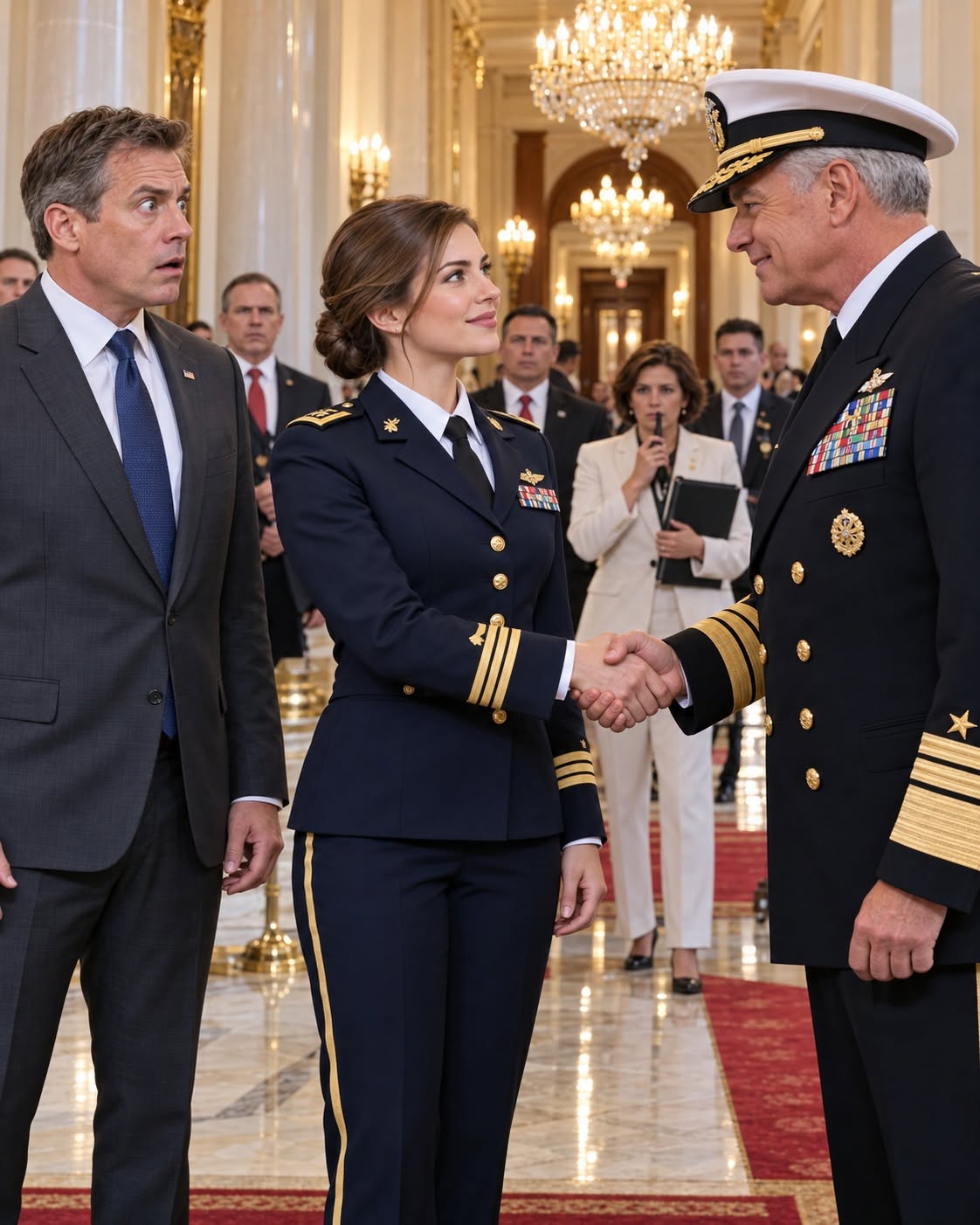
Across the hallway, a four-star admiral stopped talking in the middle of a sentence. He excused himself from two generals and walked straight toward us.
Mitchell shifted beside me. “Sloane,” he murmured. “What’s going on?”
The admiral stopped in front of me and held out his hand.
“Colonel Sloane Merrick. It’s an honor to finally meet you in person.”
My husband’s shoulders went rigid.
I shook the admiral’s hand. “The honor’s mine, sir.”
“The President asked us to let him know the moment you arrived.”
Mitchell drew in a breath so sharp the hostess glanced at him.
A protocol officer came over holding a black folder against her chest. She smiled warmly at me. Then she turned to my husband with that careful politeness people use when they’re quietly closing a door.
“Sir, your assigned seating is this way.”
Mitchell stepped forward. “My wife is with me.”
“Colonel Merrick has separate seating, sir.”
That one sentence did what three years of arguments never had. It put the truth in the room without anybody raising their voice.
I followed the admiral toward the East Room. At the doorway, I looked back once. Mitchell was still standing at the checkpoint, one hand half raised, as if refusing to understand could somehow stop it from happening.
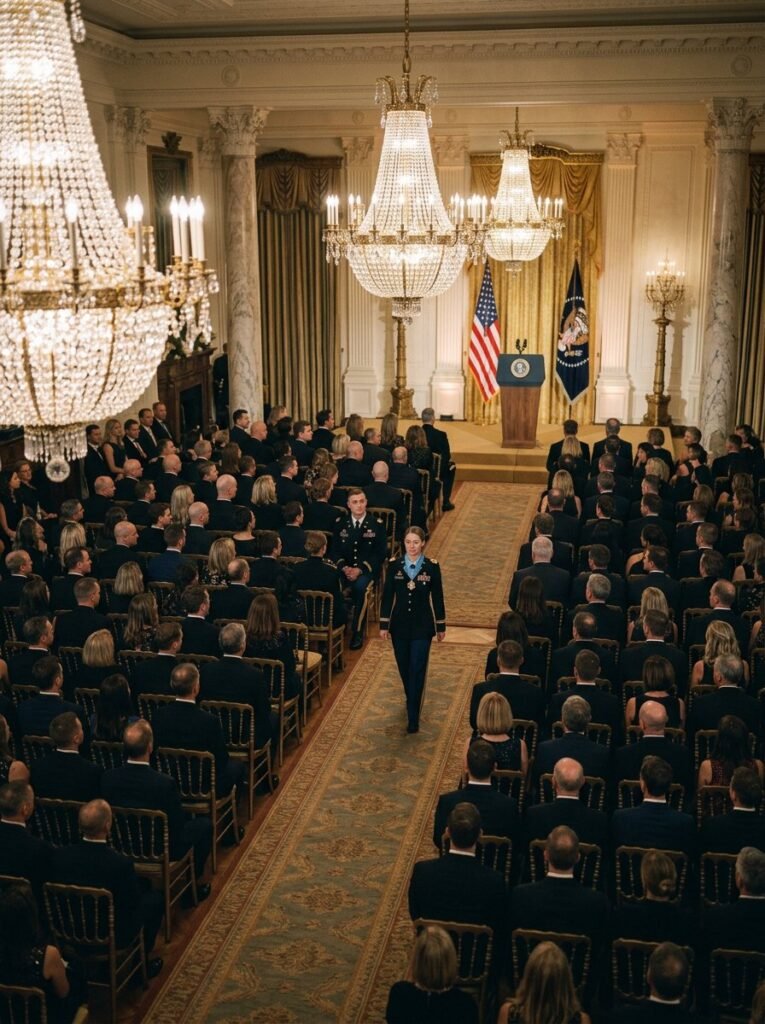
Rows of gold chairs stretched across the room. Senior officers stood up as I walked past. An Air Force general smiled at me like he’d been hearing my name for months.
“So you really exist,” he said quietly.
“Only on good days, sir.”
He laughed, and pointed me to the front row.
The President walked in. Everyone stood. The applause rolled under the chandeliers. I kept my hands folded in my lap.
The President began to speak. About quiet work. About people who plan for the worst day of somebody else’s life, so that day ends with them coming home. About heroes who never make the headlines.
Mitchell sat eight rows behind me. For the first time in three years, he was actually listening.
Then the President turned toward the front row. He looked right at me. And he paused, just before he said my name.
PART 2
“Colonel Sloane Merrick.”
Nine hundred people turned their heads at once, and I heard my own name come back off the marble in a way I had never heard it before — not shouted across a parking lot by a sergeant with a clipboard, not read off a roster in a hangar at four in the morning. Said by the President of the United States, into a microphone, in the East Room, with the chandeliers lit.
“Stand up, Colonel. Please.”
I stood.
I want to tell you what I was thinking, because it was not pride. It was a number. Four thousand three hundred and twelve. I was thinking that four thousand three hundred and twelve people had names, and that I had read a great many of them at three in the morning in a room with no windows, and that the man on that stage was about to make all of it public for the first time in four years.
“Four years ago,” the President said, “this country had nineteen days to move four thousand three hundred and twelve people out of a place that was closing around them. Seventy-one flights. Nine airfields, four of them unlit. Fuel, medicine, water, aircraft parts, and eleven thousand pounds of baby formula, moved by people who never got a photograph taken. The operational plan for that came out of one office, and that office had one colonel in charge of it.”
Somebody behind me said, softly, “Jesus.”
“Operation Steady Lantern,” he said. “Colonel Merrick built the sequence. She built it in a room with no windows, on a schedule that changed every eight hours, and she did not lose a single aircraft and she did not lose a single passenger in the air. Not one. The last aircraft out of that field carried eight hundred and twenty-three souls, and a girl was born somewhere over the water at thirty-one thousand feet, and the crew named her Lantern, after the call sign of the aircraft.”
The room laughed. I did not.
“Colonel Sloane Merrick,” the President said, “on behalf of a grateful nation, and on behalf of four thousand three hundred and twelve people who do not know your name, the Distinguished Service Medal.”
I walked forward. I have walked a great many places in a uniform and I have never in my life had trouble with my legs, and I had trouble with my legs in the East Room.
The medal is heavier than it looks. The ribbon is blue and it has a way of sitting that you have to learn.
When I turned around, the entire room was on its feet. It went on for a long time. I looked for one face in that room, and I found it eight rows back and eleven seats to the left, and Mitchell was not clapping.
He was not clapping, and he was not standing, and the general beside him had stood up and was looking down at him with an expression I have seen on a first sergeant’s face in a motor pool.
Then the general said something to him, quietly, and Mitchell got up.
I did not smile at him. I want to be honest about that. I looked at him for about three seconds and then I looked away, because there was a photographer in the aisle and I have spent twenty-four years not giving anybody that picture.
Here is what was in the plain government envelope that had come to our house two days after his.
Colonel Merrick — The President has asked that you be seated in the front row for the citation. Please arrive at 18:40, separately from your spouse’s party. The citation remains embargoed until it is read. Do not discuss this with anyone, including family.
I had read that line at my kitchen counter with the water still running in the sink, and then I had gone to the drawer and put it under a folder of PCS orders and shut the drawer, and I had not said one word to my husband about that envelope in nine days.
Nine days. I want you to sit with that, because I have.
At the reception, in the East Colonnade, a rear admiral I had never met shook my hand and said, “The schedule on the nineteenth. The eight-hour rebuild. That was the whole thing. Everything after that was just driving.” And a woman from the State Department told me her brother had been on flight sixty-eight. And a master sergeant with a Bronze Star and a cane stood in front of me for a full ten seconds before he could say anything at all, and then said, “Ma’am. I was on the ramp.”
That is the part they never put in the citation. The ramp.
At twenty past ten, a protocol officer named Ms. Okafor touched my elbow and said, “The President would like a word before midnight. Just you, ma’am. In the Map Room. Twenty minutes.”
“Thank you.”
“He asked me to tell you it isn’t a photograph,” she said, and smiled, and left.
I had eleven minutes. I stood in a corner of the colonnade holding a glass of water I did not drink, and I watched my husband work the room, and I want to tell you what he was doing, because it is the whole of him.
He was telling a brigadier general a story. I could not hear it, but I could see it — the hand coming up to the shoulder, the laugh, the way he leans back on his heels when he has got to the good part. And the general was listening politely, and looking, every few seconds, over Mitchell’s shoulder, at me.
Then Mitchell saw a four-star crossing the room toward the doors, and he moved, and I heard him say, “General — Mitchell Ashcroft. My wife and I are here for the ceremony.”
And the general stopped, and looked at him, and said, “Your wife.”
“Yes, sir.”
“Colonel,” the general said, “half the people in this room flew here for your wife.”
Then he shook Mitchell’s hand, because he is a decent man, and walked away, and I watched my husband stand alone in the middle of the East Colonnade holding a glass of champagne he had not drunk either.
At that moment a duty officer in an Army uniform — a major, young, with a folder and a very straight back — appeared at my shoulder.
“Colonel Merrick. Ma’am. I’m sorry to interrupt.”
“It’s all right.”
He looked at the folder in his hand and then at me and then, briefly, across the room at my husband.
“Ma’am, this is not from the protocol office,” he said. “This is from the Office of the Chief of Staff. They’ve asked me to put a question to you tonight, before the evening briefing, and I’m sorry, but I have to ask it now.”
“Ask.”
He lowered his voice.
“Has your husband ever discussed the details of your work outside your home?”
PART 3
The Map Room is not a big room. It has maps on the walls that are older than the country and a clock that is older than the maps, and the President of the United States stood in it at eleven o’clock at night with his jacket off and his sleeves rolled up, looking at a photograph on the table.
“Colonel.”
“Mr. President.”
“Don’t do that,” he said. “Sit down. I’ve been on my feet since six.”
I sat.
He turned the photograph around. It was an eight-by-ten, printed, not a screen: a C-17 on a tarmac in the dark with its loading ramp down and a line of people going up it, and a crew chief at the bottom of the ramp holding the hand of an old woman with a plastic bag.
“Flight sixty-eight,” he said. “They printed it for me. There were eleven of those flights where the crew had to shut the doors with people still on the ground, and I have read every one of the after-action reports, and every one of them says the same thing about the schedule.”
“That it worked, sir.”
“That it worked.” He sat down across from me. “You know what else they say? That the schedule was the reason it worked. Not the airplanes. Not the fuel. The schedule. Somebody in a room with no windows figured out that you cannot move nine thousand people through a place where the runway is only usable for six hours a night unless you stop thinking about airplanes and start thinking about the order people get on them.” He tapped the photograph. “That was you.”
“Yes, sir.”
“And you have been doing that for twenty-four years.”
“Yes, sir.”
“Then let me ask you the question I have been asking all night.” He put his hands on the table. “Why is it that the citation had to be declassified tonight? Why has your work been dark for four years? I got a briefing on it. I understand the classification. I am not asking about the classification.”
I looked at the clock.
“You are asking why I never told anyone.”
“I am asking why a colonel with twenty-four years in and a two-star’s work on her record has been sitting in a room with no windows for four years, and no one in this building knew her name until nine o’clock tonight.”
And I told him the truth, in the Map Room, at eleven at night, in about four minutes.
I told him that the office is small and the work is dark and that the people who do it are not supposed to be known, because a logistics plan is a map of everything a country cannot protect. I told him that I had signed the papers happily and that I would sign them again. I told him that the reason nobody in that room knew my name was not modesty and not humility and not the Army. It was that the work is only good if it is invisible.
Then he said, “And your husband of three years?”
I did not answer.
“Colonel,” he said. “I have a folder in front of me that I did not want to read tonight, and I am going to tell you what is in it, because you deserve to hear it from me and not from a major at a reception. Two things. The first is that at some point after ten o’clock, an officer from the Chief of Staff’s office asked you a question about your husband and your work, and you told him you would answer it in writing.”
“Yes, sir.”
“The second is that at nine-forty this evening, a team at the office of the Director of Army Staff pulled every social media post by a woman in Ohio named Patricia Ashcroft, because her name came up in a threat-screening run on tonight’s guest list.”
The clock ticked.
“Your mother-in-law,” he said.
“Yes, sir.”
“She has four hundred and eleven posts about her son. She has thirty-one about you.” He slid a printed page across the table. “This one was posted eleven days ago. I want you to read it out loud, so that I know you understand what we are dealing with.”
I read it out loud.
So proud of my son Col. Mitchell Ashcroft who is headed to the White House next week! His wife is going too but she just does paperwork, she’s been at a desk for 3 years so it’s really HIS night. We call her the queen of spreadsheets lol. More importantly — so proud of my boy who planned and ran the whole operation to get all those people out in 2021, the one they’re giving out medals for. He never talks about it but a mother knows. ❤️
The clock ticked.
“Eleven days ago,” the President said, “that post sat on a public page with nine hundred followers and a photograph on it that was taken in your backyard in July, at a barbecue, with a whiteboard visible behind the picnic table.”
I closed my eyes.
“That whiteboard is the reason I am sitting here with you at eleven o’clock,” he said. “I want you to tell me who took the photograph.”
“I don’t know, sir.”
“Then I want you to tell me something else.” He leaned forward. “Colonel. In your own words. In the last three years, has your husband ever said anything to you about your work that made you think he knew more than he was supposed to.”
I thought about a Tuesday in March, in the kitchen, when Mitchell had said, “I hear they’ve got you doing the depot runs to the east coast now,” and I had said, “Something like that,” and he had said, “You know, if you ever want a real command—”
“No, sir,” I said. “Not to me.”
The President looked at the clock.
“Then I am going to tell you one thing, and then Ms. Okafor is going to walk you out through the north door, because there are people in the hallway with cameras and I would rather they did not get a photograph of you tonight.” He stood. “Your husband is not in trouble for being an idiot at a dinner table. Half the married officers in this Army have been an idiot at a dinner table. He is in trouble because a whiteboard was in a photograph in a backyard, and the woman who posted it has been describing an operation in a public forum for four years, and she got the details from somewhere, and there are only two people in this world who could have given them to her.”
PART 4
I did not go home. Ms. Okafor put me in a car at 11:40 and the car took me to a hotel in Rosslyn, and at 12:20 in the morning I sat on the end of a hotel bed in a dress uniform with a medal in my lap and my phone face-up beside me.
Mitchell called eleven times between midnight and one.
At 1:04 he sent four messages in a row.
Where are you.
Sloane.
They’re asking me questions.
Call me.
At 6:40 in the morning, a colonel from the Office of the Chief of Staff called me, and she was professional and kind and she asked me to come to the Pentagon at nine and to bring a written statement and to come alone, and then she said, “Colonel Merrick, I need to tell you something before you walk in here. Your husband has been interviewed. He has retained counsel. He has been told not to contact you.”
At 8:15 I walked into a room on the fourth floor with a table and four chairs and a major with a recorder, and I gave a statement that took fifty minutes and did not contain one word against my husband.
I want to tell you why, and it is not noble. It is that everything I could say about Mitchell Ashcroft in that room was already in a file, and the only thing I could add was the sound of my own voice saying it, and I have spent twenty-four years not being that officer.
At 10:30 they showed me the photograph.
A picnic table in my backyard in July. Six people, paper plates, a cooler with the lid open. Mitchell on the near side with a beer, laughing. Behind him, through the sliding glass door and into the dining room, a whiteboard on an easel that I had brought home on a Friday and never taken back, with eleven magnetic tiles on it and a timeline in three colors.
It had been in my dining room for four days. I had a domestic reason for it, and the domestic reason was that I was working fourteen hours a day and I wanted to see my own kitchen.
“You understand what this is,” the colonel said.
“It’s a building schedule for a movement of medical stores from two depots to a staging airfield, with an eighty percent probability window on the second corridor.”
“Is it current?”
“No, ma’am. It’s from March.”
“Is it accurate?”
I looked at the photograph for a long time.
“It’s accurate as of March,” I said. “Which is why it was on an easel in my dining room for four days and then destroyed. And the reason it’s in this photograph is that nobody in my family has ever once asked me what I do, so nobody in my family knew to look away from it.”
The colonel wrote that down. She wrote it down word for word, and I have wondered since whether that was the sentence.
At 2:15 that afternoon I was informed of the outcome of the preliminary review, in writing, and I will summarize it, because the document is four pages and it is mine.
The inquiry found no compromise attributable to me. It found that the photograph was taken in my home by a family member, without my knowledge, and posted publicly by another family member, without my knowledge. It found that the schedule depicted was out of date, partially obscured, and of limited intelligence value.
It also found that between March of last year and October of this one, Colonel Mitchell Ashcroft had, in the presence of at least four commissioned officers, described his wife’s assignment as “depot runs,” described a “big movement coming in the spring,” and stated that his wife “runs the schedule for the east coast.”
And it found that Patricia Ashcroft, of Millford, Ohio, had posted that information publicly on thirty-one occasions over four years, including four posts that referenced the number of flights in an operation that had never been publicly acknowledged.
The finding as to me: no action.
The finding as to my husband: referred for a command climate review and a security clearance re-adjudication, and relief from his current assignment pending the outcome.
At 4:50 I went home for the first time in nineteen hours. Mitchell was in the driveway with two bags in his truck.
He looked terrible, and I am not going to pretend I did not feel something about that.
“They’re pulling my command,” he said.
“I know.”
“Do you know that my mother has been on the phone with my sister since six this morning, telling her that you set this up?” He laughed, and it was an ugly sound. “She thinks you did this. She thinks you used tonight to—”
“Mitchell.”
“Three years,” he said. “Three years, and you couldn’t have told me one time. Not the details. Not the classified part. Just — ‘Mitchell, my job is bigger than you think.’ One sentence, and I would have—”
“You would have what?”
He stopped.
“You would have stopped calling me the queen of spreadsheets at your mother’s table?” I said. “Or would you have kept doing it, but at least I would have known that you knew?”
“That’s not fair.”
“No,” I said. “It isn’t. Here’s what’s fair. In three years I never once told you what I do. That’s mine, and I carry it, and I am sorry for it. But you never once asked me a question that wasn’t a joke.” I looked at the bags in his truck. “You told me to smile when I was supposed to. You told me not to make small talk. You told me there were generals there, as if I hadn’t spent twenty-four years in the same Army as you, as if I hadn’t been in rooms that would make that East Room look like a school gymnasium. You spent three years deciding I was small, Mitchell, and you did it out loud, in front of your mother, and I let you, and that is the part I am going to have to answer for at some point with somebody who isn’t you.”
He stood there in the driveway with his hand on the truck.
“Are we done?” he said.
“I don’t know,” I said. “Are you going to answer the question they asked you under oath?”
His face changed.
“What question?”
“The question about the whiteboard,” I said. “The one in the photograph. The one in our dining room for four days in March.” I watched him. “Somebody put it there, Mitchell. I put it there. And somebody took a photograph through the glass door at a barbecue where I was at the depot in Maryland until seven o’clock at night, and you had six people in the yard, and I want to know which one of them walked up to our sliding door with a phone and took a picture of my dining room.”
“It was a barbecue.”
“I know it was a barbecue.”
“It was my mother’s camera,” he said. “She takes pictures of everything. She took two hundred pictures that day.”
The street went very quiet.
“Did you bring that whiteboard home,” I said, “or did I?”
And Mitchell Ashcroft looked at me in our driveway with his two bags in his truck and said something that I have thought about every day since.
“I don’t know,” he said. “I honestly don’t remember.”
PART 5
I did not file. He did not file. We sat in a mediator’s office in Alexandria in February for four hours, and it was the most honest four hours of the marriage, and it ended the way it had to end, and neither of us said one cruel thing in that room. He kept the truck. I kept the house. His mother is not permitted on my property and I have never once had to enforce it.
Mitchell took the relief, and then he took the retirement, and then he took a job with a defense contractor in Ohio where nobody calls him Colonel and he makes more money than he ever did in uniform. I have heard that he is good at it. I hope he is. That is not a generous sentence; it is simply true, and I have worked hard to get to a place where the true thing and the kind thing are the same thing.
His clearance was re-adjudicated in June. It was not revoked. It was restricted, which in our world is a kinder word for the same outcome, and he was told in writing that the restriction was not based on disloyalty but on a documented pattern of discussing protected information with an unauthorized family member for the purpose of being admired.
That sentence was written by a GS-14 in the Office of the Chief of Staff who has never met either of us. I have read it more times than I should have.
Patricia Ashcroft’s page came down in November, five days after a letter from the Army’s Office of Special Investigations. She has never spoken to me since. She told her church that I broke her son. I have decided to let her have that, because the alternative is a conversation, and I have had enough of those.
My promotion list went to the Senate in March. I was confirmed in May, and I will not describe the ceremony, except to say that my father, who is eighty-one and has never in his life understood what I do, flew to it, and stood up at the wrong time, and had to be told to sit down by a very patient major, and afterwards he said, “Your mother would have killed me.” My mother died in 2019. She never knew either.
That is the part of this story that I have not been able to make peace with.
Two weeks after the East Room, I got a call from a woman named Nadia Rahimi, who is a major in the Army Reserve and who was on flight sixty-eight. She said, “Ma’am, I need to ask you something and then I’ll hang up. Do you remember the ones who didn’t get on?”
I said I remembered every one of them. There were nine.
She said, “I have their names. I’ve had them for four years. I want to know if there’s a way to put them somewhere.”
There is. There is a wall at Fort Lee, in a building with no plaque on the outside, and it has the names of the ones who did not get on, in alphabetical order, and there is no rank after any of the names, because at that point in the evening rank had stopped being useful. Major Rahimi and I spent a year getting it approved.
The wall was dedicated in October, two years and seven months after the East Room, in a room with no windows, in front of forty people.
I have one more thing to tell you, and then I am going to stop, because this has gone on longer than I intended and because there is a version of this story that is about a marriage and a medal, and that is not the version I want to leave.
In April, a card came to my office at Fort Lee from a woman in Michigan. Inside was a photograph of a little girl, two years old, in a pink coat, standing in the snow with her hands out.
The card said:
You don’t know me. I don’t know you. My daughter was born on an airplane in the dark and the crew named her Lantern because they said she was the last light on. I have been told not to write to you and I am writing anyway. I want you to know that she is two, that she is afraid of nothing, and that she says goodnight to the sky.
Thank you for being awake that night.
I keep it in the drawer of my desk, in the same drawer where I once hid a plain government envelope under a folder of PCS orders.
The envelope is gone.
The girl is not.