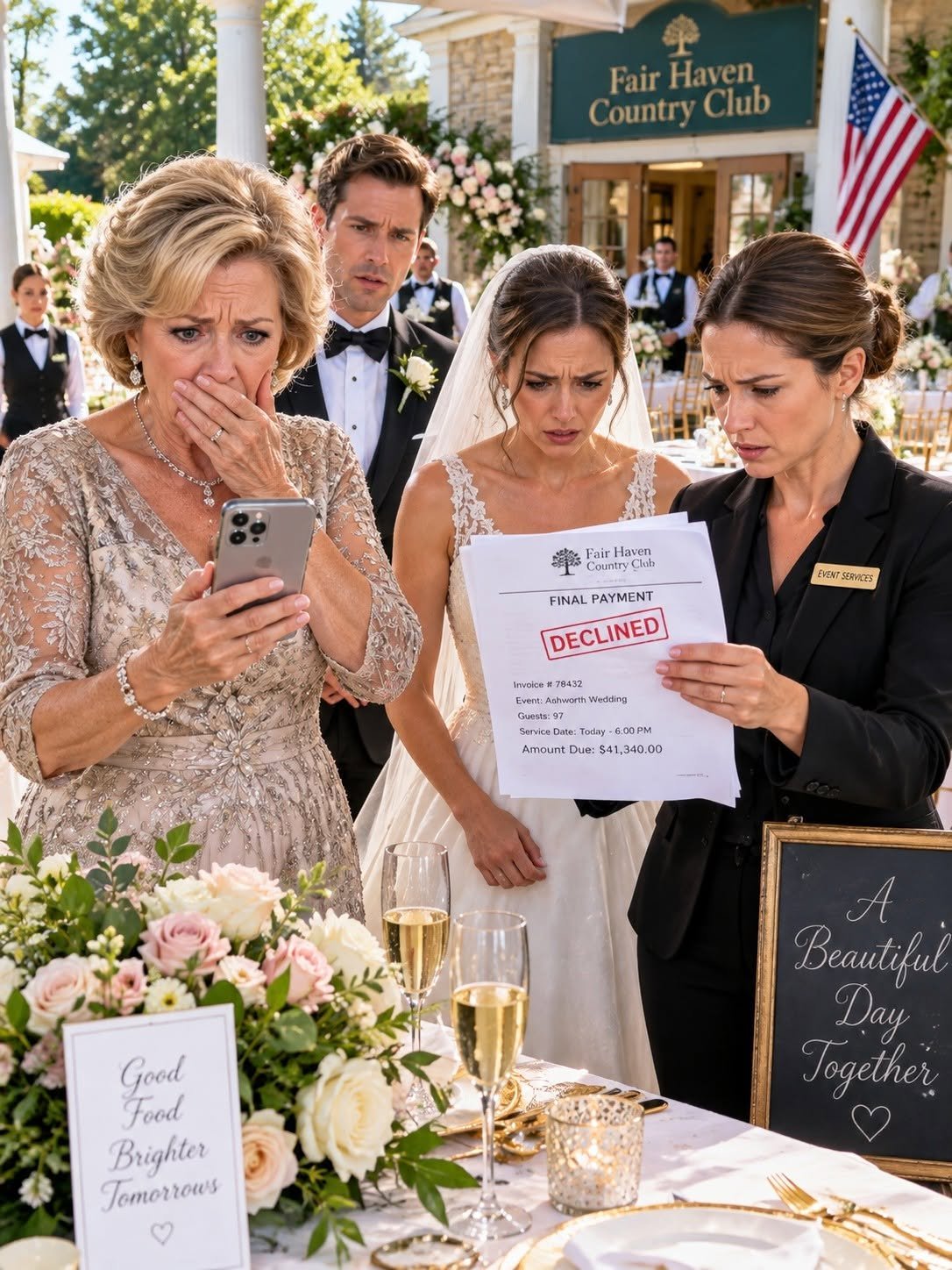
My mother-in-law banned me and my seven-year-old daughter from a wedding with ninety-seven guests and twenty-two children. “Her kid doesn’t belong with us,” she said — casually, the way you’d brush crumbs off a table. I didn’t shout. I didn’t cry. I made one quiet move. And when the final payment came due, they checked the account and started screaming.
This is what happened before that morning.
I had been married to Ken for four years. My daughter, Piper, was seven. Her biological father died when she was fourteen months old, and Ken came into our lives later and did everything a father does. He taught her to ride a scooter. He sat up through ear infections. The first time she called him Daddy, he cried where he thought I couldn’t hear him.
But he never adopted her.
Every time we talked about it, his mother, Varity, found a reason. Too soon. Complicated for the estate. Let things settle. And Ken always agreed, so I told myself that love didn’t need paperwork.
Then one morning, Piper looked up from her pancakes and asked, “Are we still going to Aunt Elean’s wedding?”
My hand stopped over the stove. “What wedding?”
“Aunt Elean’s. Grandma said there’s cake and dancing, and all the cousins are coming.”
Forty minutes earlier, Ken had walked out the door carrying a garment bag and an overnight duffel. He told me his mother wasn’t feeling well. He never mentioned that his sister was getting married in two days. He never mentioned that Piper already knew.
After school drop-off, I came home and started looking.
Behind the paper towels in the pantry, I found a folder. Inside was everything. The country club contract. A color-coded seating chart. A guest list with ninety-seven names — twenty-two of them children under twelve. Piper wasn’t on it. Neither was I.
Then I found the payment schedule. Final balance due the next morning. Billing contact: me. Linked account: our joint checking — the account holding almost every dollar Ken and I had put away toward our shared life. Somebody in that family had sat down in a room I wasn’t in and typed my name onto a billing form.
My name. My money. My daughter erased from the room.
I called Ken. Voicemail. Varity. Voicemail. I called the bride, and she heard my voice and hung up.
That was when my hands stopped shaking. I opened Instagram. The bride had posted clips from the rehearsal dinner — string lights, champagne, people laughing — and over all of it, I heard Varity’s voice.
“Not coming,” she said.
Someone asked her why.
“This is Elean’s day. We’re keeping it family.”
Then she waved one hand, brushing away crumbs that weren’t there. “Her kid doesn’t belong with us.”
Her kid. Not Piper. Not my granddaughter. Her kid.
Then she added, “I told Ken — Marin and the child are not to show up. Period.”
And behind her, I heard my husband laugh. A small laugh. Easy. Comfortable. The kind of laugh a man makes when he’s already chosen his side.
I saved that video in three places. Then the contract, the seating chart, the guest list, the payment schedule. Evidence disappears quickly once people realize what it proves.
That afternoon, Piper climbed into the car holding a handmade wedding card she’d spent all week on. “Can we give this to Aunt Elean at the wedding?”
I looked at her in the rearview mirror. “We’re not invited, baby.”
Her face fell. “Is it because I’m not really family?”
I gripped the steering wheel. “No,” I said. “You are family where love is real.”
She didn’t cry. She put the card in her backpack, very carefully, like something that could still be saved.
That night, after she fell asleep, I packed our passports, her birth certificate, and the papers I never thought I’d need. Then I opened the joint account.
The payment was due in the morning. Ninety-seven guests. Open bar. Plated dinner. A ballroom full of people my money was expected to feed while my daughter was ruled unworthy of a chair.
I stared at the balance for a long time.
Then I moved almost all of it into an account with one name on it — mine. I left behind exactly the amount Ken once bragged he’d paid for my engagement ring. I booked two one-way tickets to my sister’s house, turned off the lights in that kitchen, and closed the door behind us without leaving a note.
The payment schedule said the balance was due at nine. I set no alarm.
Somewhere in that town, people were about to start screaming. And for the first time in four years, I wasn’t going to be there to hear it.
───────────────────────────────
PART 2
The phone started ringing before I finished my coffee.
Fair Haven Country Club flashed across the screen. I answered.
“Mrs. Whitfield? This is Denise from event services. We’re showing a declined transaction on the final payment for the Ashworth wedding. Ninety-seven guests. Service tonight at six. We need this resolved within the hour.”
I looked at my daughter’s half-eaten pancakes on the kitchen table.
“I’m not the person you want,” I said. “Call Varity Ashworth. It’s her card on file now.”
A pause. “Ma’am, the account is listed under Marin Whitfield.”
“It was.”
I hung up. Then I turned off airplane mode, and eleven missed calls hit the screen at once, like hail on a tin roof.
Ken’s first voicemail was controlled. “Marin. Call me. The venue says the card was declined.”
The second one wasn’t. “Where the hell is our money? They’re saying we owe forty-one thousand dollars or they cancel the reception.”
I called him back from my sister’s back porch, where Piper couldn’t hear me. He answered on the first ring.
“Where is the money?”
“I moved my money.”
A beat of silence. “You can’t just do that.”
“I can stop paying for a wedding I was banned from attending.”
“Marin—”
“Your mother called Piper ‘her kid.’ I watched you stand there and laugh.”
His breathing changed. “You saw that?”
“I watched it twice.”
“That’s not what it looked like.”
“I have the video.”
Then he tried something else. “You can’t disappear with Piper. She’s my—”
“She’s not your legal anything, Ken. That’s the point. You had six years to make it real on paper. Your mother kept stopping it. You kept letting her.”
He had no answer for that. In the background, I could hear Varity demanding to know what I was saying.
“The venue needs payment,” I told him. “Ask your mother.”
I hung up. He didn’t call back. She did.
Varity’s voice had transformed. Warm. Wounded. “Marin, sweetheart. There’s been a terrible misunderstanding. Of course Piper is family. Come home, and we’ll fix this together.”
“I have the video.”
A pause. Then the warmth went out like a light switch. “Put the money back. This is humiliating.”
I looked through the window at Piper drawing with sidewalk chalk. “You’re right,” I said quietly. “It is humiliating.”
“Ninety-seven guests are about to ask why this wedding is falling apart.”
She stopped breathing for half a second.
“I’d start deciding what you’re going to tell them.”
I ended the call. For ten minutes I sat there feeling nothing but relief — the kind that comes when the thing you’ve been dreading has finally happened.
Then, at eleven o’clock that night, Ken called again.
He wasn’t shouting anymore. That was worse.
“Four years,” he said. “Four years, and you never once asked why I wouldn’t sign those papers.”
“I asked a hundred times.”
“You asked when. You never asked why.” A long pause, like he was deciding something. “It’s the trust. My mother’s trust. Every child in this family — born or adopted — gets an equal share when she passes. That’s the clause. She wrote it herself, years ago.”
I sat down slowly on the porch step in the dark.
“Complicated for the estate,” I whispered. His mother’s words, every time the adoption came up.
“Piper would have taken a share of what’s mine,” he said. “Can you blame me?”
I couldn’t speak. Four years of too soon and let things settle and we’ll see. Not one of those excuses had ever been about a little girl’s last name.
“The adoption was never about her,” I said finally. “It was about money.”
“It was about my family.”
“She is your family.”
“She’s not my blood.”
That was the sentence. That was the one that told me who I’d been sleeping beside for four years.
“Your mother called her ‘her kid,'” I said. “And now you just did it too.”
He went quiet. Then, softly, he said the thing that made my blood run cold.
“Mom called her lawyer this afternoon. And Marin — this part isn’t about the money anymore.”
“What does that mean?”
“You’ll find out.”
He hung up.
I sat in the dark kitchen with that folder on my knees — ninety-seven names, one seating chart, one handmade card — and I waited for the next thing to happen.
It took three days.
A letter arrived from a law firm I’d never heard of. It wasn’t about the money.
It was about my daughter.
PART 3
The letter came certified, from a firm called Hartwell & Pace, and it was addressed to Marin Whitfield — no Mrs.
Inside were two documents.
The first was a notice of claim. Return $47,300 to the joint account within ten days or face suit for conversion of marital funds. The second was an offer, and it was worse.
If I returned the money and signed a postnuptial agreement waiving any claim on the Ashworth family trust, ever, for me or for Piper, then Ken would withdraw a petition he had already filed. A petition asking the court to recognize him as Piper’s psychological parent and award him custody rights.
“There’s one line in it I can’t get past,” I told Rachel Okafor the next morning.
Rachel and I had taught at the same elementary school for nine years before she went back to law school. Now she did estates and family work, and she did it the way she had once graded spelling tests: slowly, and with a red pen.
“You moved money that was sitting in both your names, on the eve of a hearing, out of spite.”
“It wasn’t spite. It was—”
“I know what it was. I’m telling you how they’ll say it.” She held up her hand. “Now here’s how I’ll say it. Show me where it came from.”
I gave her four years of statements. She went through them with a highlighter and then a calculator and then, finally, a slow smile.
“Fifty-eight thousand, six hundred of the deposits came from your salary and the last of your mother’s estate. Nineteen thousand, four hundred came from Ken. You moved forty-seven thousand three hundred. You left twelve thousand four hundred sitting right there in the account.” She set the pen down. “Marin, you didn’t move their money. You moved your money — five thousand short of it — and you left the rest.”
“The account had both our names on it.”
“Names aren’t magic. Paperwork is paperwork. Which is a lesson this family is about to learn the hard way.”
Then we got to the part that mattered. The letter had attached one page of Varity’s own trust — the clause about adopted children. Ken had been telling the truth. I still don’t know which is worse: that the adoption died for money, or that he handed me the proof of it himself.
Rachel sent out preservation letters and letters of her own. And four days later, discovery started landing.
The wedding happened. Of course it did. Varity paid the venue the forty-one thousand dollars the night of the reception — only not from her own accounts. She paid it out of the grandchildren’s trust, the money that isn’t supposed to be touched until the shares are distributed, the money that now belongs, in part, to every cousin who flew in that weekend.
“That woman saved face with other people’s inheritances,” Rachel said. “Get me dates.”
The bride posted video from the reception. I watched it once, standing at my sister’s kitchen sink.
Varity, champagne in hand, holding court while the room laughed.
“People will say family is whoever sits at your table,” she said. “No. Family is blood. We don’t keep strangers at our table.”
Ninety-seven guests applauded.
In the comments, somebody asked where Marin was. Somebody else asked where Piper was. By the end of the week, half the people who had clapped were quietly asking who paid for the wedding.
Then came the conciliation conference, a small room with a long table and a mediator named Alvarez, and Varity across from me in pearls and a cardigan she didn’t need.
Their lawyer, Cushing, opened with the transfer being punitive. Rachel answered with a single page — the deposits, the tracing, the twelve thousand four hundred I’d left behind.
Cushing moved on to custody.
Rachel read the trust clause into the record. Varity’s face changed color, slowly, like water coming to a boil.
“Mrs. Ashworth,” the mediator said, “help me understand your position on the child.”
And Varity, on the record, in front of a mediator and two lawyers, said it out loud.
“She is not my granddaughter, and she never will be. She has no Whitfield blood and no Ashworth blood. Family is blood.”
The room went quiet. Ken studied the table.
The mediator asked me what I wanted.
I slid one page across the table. The money stays where it is. The custody petition is withdrawn. And a single sentence, signed.
“Signed?” Varity said. “Signed by whom, exactly?”
I told her.
And then she laughed — a dry, small, dangerous laugh — and picked up her purse.
“By the way,” she said, standing. “That little house on Maple Street? Don’t get comfortable. I helped with the down payment, remember? We’ll be in touch about what’s ours.”
I drove home that night with her voice in my head, and it was still there at 6:40 the next morning, when my phone rang.
It was Piper’s school.
PART 4
“Ms. Whitfield? This is the front office. Piper left the building forty minutes ago.” The secretary’s voice was careful, the way people talk when they already know they’ve done something wrong. “Her father signed her out.”
“Her father is dead,” I said.
The woman stopped breathing.
“Kenneth Whitfield,” she finally said. “He’s on the authorized pickup list. He said it was a family emergency, and Piper recognized him, and she—”
I was already standing, already looking for my keys, already saying words I don’t remember into a phone that had started to shake in my hand.
Nine hundred and forty miles. That’s how far my sister lives from that town.
They had driven it. Varity’s SUV and Ken’s car, both of them, sometime in the night, two days after they walked out of the conciliation room. Varity had a sister there. I didn’t know that then. What I knew was the number of hours between me and my daughter went down to eight, then four, then none, and every one of those hours the police told me the same thing.
Because he wasn’t her legal father, they said, there was no abduction. Because he had signed her out properly and taken her to a private home inside the state and answered his phone, there was no emergency. It was a civil matter. Family court. Hire a lawyer.
I hired one. Mine was already on the phone.
We found the house just after dark. Ken’s car in the drive. Lights on. And through the long front window, my daughter, at a table, eating pizza with a paper crown on her head, like it was a party.
I got to the door before Rachel grabbed my arm.
Piper saw me first. She came off that chair like a shot.
“Mommy! Daddy said we were coming to live here!” She was crying and grinning at the same time, that age where nothing makes sense yet. “Grandma says we’re going to be a real family now.”
Over her head, in the doorway, stood Varity, holding a cup of coffee in one hand.
“He signed her out of school,” I said. “You had him take her out of school.”
“We came for a visit,” Varity said evenly. “You are the one who ran off with a child in the night. You are the one hiding money. Look around you, sweetheart. Who is going to believe you?”
And behind her, in the hall, my husband said the sentence I will hear until the day I die.
“I want to adopt her.”
I stared at him.
“Now?” I said. “Now?”
“Yes.”
“For four years your mother told you it was complicated. Now that she’s met you at a table with a lawyer, now it’s not complicated?” My voice didn’t belong to me. “What changed, Ken? What changed?”
He didn’t answer. He looked at his mother, and his mother looked back at him, and something passed between them that I understood only much later, in a courtroom, on the worst morning and the best morning of my life.
We didn’t take Piper home that night. We took a report, and a photograph of a school sign-out sheet, and a promise from a detective with tired eyes who said the word “custodial” like an apology.
Three days. It took three days. Phone calls where I could hear Varity’s television in the background. Piper asking, in a small voice, on the second night, the question that had started all of this.
“Is it because I’m not really family?”
By then I had a lawyer, and a lawyer has a filing, and on the fourth morning we stood in a hallway outside a courtroom forty minutes from my sister’s kitchen, on an emergency motion, with a judge already turning pages.
Rachel put the folder in my hands and kept her voice very low.
“They didn’t come here to take her to a party,” she said. “They came to file. This state is where Piper lives now, Marin. This is where the custody case has to be heard. And if they get standing here, in a court with a judge who has never met your daughter—”
“Then what?”
She looked down at the papers in her own hand. She’d just been handed them by the clerk, and she hadn’t told me yet what was in them.
Then she said it.
“They’re not asking for shared custody anymore.”
She turned the top page around so I could read the caption.
PETITION TO TERMINATE PARENTAL RIGHTS.
“And here’s the kicker,” Rachel said. “There’s a second petition. Adoption. Varity signed it as the family’s consenting adult.”
The courtroom doors opened behind us.
PART 5
Judge Ferreira had the folder open before either lawyer finished standing, and she did not look like a woman with time to waste.
The petition to terminate my parental rights ran eleven pages. The word “abandonment” appeared nineteen times. Rachel answered it in four sentences: a mother who left an abusive arrangement, notified the school, kept the child in school, and filed within seventy-two hours had not abandoned anyone.
Then she turned to the adoption.
“Mr. Whitfield. You’ve known this child since she was a toddler. Over six years, how many times did you file to adopt her?”
“Timing,” Ken said. “It never felt like the right—”
“Six years,” Rachel said. “And the filing came four days after this court learned the terms of your mother’s trust. Let me read the terms.”
She read the clause. Children born or adopted into the family receive an equal share at distribution. She read it slowly, so the judge could do the arithmetic at the same speed everyone else in the room had.
Then she played the voicemail. My husband’s voice, my husband’s words, in a courtroom with his wife six feet away.
“Piper would have taken a share of what’s mine. Can you blame me?”
Nobody in that room needed help understanding what had changed.
They had spent six years keeping my daughter off the family paper. Now they needed her on it, because the marriage was ending — and because a legal child is a legal beneficiary, with eleven years of control ahead of a father who would hold the checkbook.
“The court has a question,” Judge Ferreira said. “Mr. Whitfield. Do you want the child, or the share?”
Ken’s mouth opened. Nothing came out.
Varity took the stand next, in her pearls, and did what she always does, which is perform. She told the court about a “grandmother’s bond.” She told the court about a little girl who called her Grandma and asked to bake with her. She produced an affidavit that said, in writing, that she had always considered Piper a granddaughter.
Rachel stood, no notes, and said, “Your Honor, one exhibit.”
The reception video, four minutes long, from the bride’s own account.
“Her kid doesn’t belong with us.”
Ninety-seven guests laughing. My husband laughing.
Then the conciliation recording, where Varity said the sentence again, on the record, in front of a mediator.
“She is not my granddaughter, and she never will be. Family is blood.”
The judge set her pen down flat on the bench.
“Mrs. Ashworth,” she said. “Which is it, ma’am? Do I grant custody standing on a bond you swore to, or do I believe you the other two times, under oath, denying it? You’ll forgive me if I don’t accept both.”
Varity tried to explain. She talked about context and jokes and family dynamics. She got three sentences in before the judge said, “Thank you, ma’am. You may step down.”
Then came the house.
Varity’s lawyer produced a loan agreement for twenty-five thousand dollars, signed, dated, claiming an interest in Maple Street. Rachel let him finish presenting it.
“The closing on Maple Street was October 2019,” she said. “This document is dated March 2021. The promissory note for a loan was drafted two years after the money was given — and the money, per the donor’s own card, which is Exhibit J, was a housewarming gift with no strings attached.”
Judge Ferreira turned to the Ashworth lawyer. “You will withdraw that document, counsel, or I will refer the matter myself.”
He withdrew it.
The rest went fast, the way things do once the truth is standing up in the room. The termination petition dismissed with prejudice. The adoption petition dismissed with prejudice. Piper Lane would remain where she had always been, with her mother, in sole legal custody. The school was ordered to correct its records. The county’s detective finally had his civil matter turned into a finding.
On the money, the court accepted the tracing. Fifty-eight thousand six hundred came from me. Nineteen thousand four hundred came from Ken — and the court ordered that returned to him.
I wrote that check the same day. I did not write anything on the memo line. The twelve thousand four hundred I had left in that account stayed exactly where it was, and stayed there for a long time, because I liked knowing it was there. It seemed like a fair price for the wedding band and the story I got in return.
The trust came apart on its own after that. You can’t pay a country club bill with other people’s inheritance and expect everyone to shrug. The cousins hired a lawyer. The estate lawyer resigned. Varity was removed as trustee by her own family in a meeting she wasn’t invited to attend, and the only person who spoke up for her, briefly, was her son.
Ken moved back into his mother’s house and into the room he’d slept in as a boy. He kept a car and a set of golf clubs and a share of the trust that is being counted, dollar by dollar, in a case that will outlive everyone’s patience. The last I heard, he works for his mother’s brother now, and the job came with a lecture.
The house on Maple Street sold in eleven days. Every dollar from it went into a trust with one name on it. Piper’s. I signed those papers at a kitchen table with my daughter on my lap, holding the pen with me, and I told her what it was for.
“For your someday,” I said.
She thought about that for a moment. “Is that better than a wedding?”
“Much better than a wedding.”
She asked once, in the third week, if Daddy was coming. “No, baby,” I said. “He chose his mother’s rules over you. That was never your fault, and it never will be.” She nodded and went back to her drawing.
It was four weeks later, in our new apartment, on a Sunday, that we had pancakes. Just the two of us, in a kitchen small enough to hear the refrigerator hum. Somewhere in a box in the closet was a handmade card that said To Aunt Elean, which Piper had decided she wanted to keep.
She set her fork down and looked at me the way she does when she has been holding onto a question.
“Mom,” she said. “Are we still a family?”
I turned off the stove and sat down across from her, and I thought about ninety-seven guests, and a seating chart, and a blue blouse I threw away, and a house full of people who measured love in shares.
“Yes,” I said. “Smaller, and truer.”