PART 1
On Christmas Eve I worked a sixteen-hour shift in the emergency room so a younger nurse could spend the night with her small children. Twenty-eight people sat down at my parents’ table that night. Every one of them got a chair except my sixteen-year-old daughter.
I have been an ER nurse for twenty-two years. I know what a double shift does to your body, and I know how to build a picture in your head that carries you through it. Mine was this: Sophie at my parents’ table in the house on Rowan Street, in the good sweater she’d picked out a week earlier, holding the gingerbread she’d baked at six that morning, laughing at something one of her cousins said. My mother would put her at the end, near the window, because that was where the extra leaf went in.
Sophie is sixteen. This was the first year she was driving herself to the family gathering, and my parents had offered her the guest room so she could stay over into Christmas morning. She packed an overnight bag — pajamas, toothbrush, the book she’s been reading since October — and told me she felt grown up about it, which is the closest a sixteen-year-old comes to saying she’s happy.
I clocked out at 11:15 p.m. My husband David was on his own shift at the fire station, so I was going home to an empty house, and I was fine with that. I had planned Sophie’s Christmas morning in my head for weeks.
Sophie’s snowy boots stood just inside my front door.
Her coat was lying across the sofa. Her bag was on the floor by the hall closet, unopened, with a wet footprint beside it.
She was asleep on the couch under a thin blanket with her knees tucked up against her chest, and the television had gone to the blue screen, and her phone was in her hand.
I knelt down and touched her shoulder.
“Sweetheart. Why aren’t you at Grandma’s?”
She took a while to answer. She kept her eyes down on the blanket.
“They said there wasn’t room.”
My parents have four bedrooms. They have a pull-out couch, two air mattresses in the basement, and every Christmas of my adult life there has been someone sleeping on the floor of the hallway.
I asked her to tell me slowly, from the beginning.
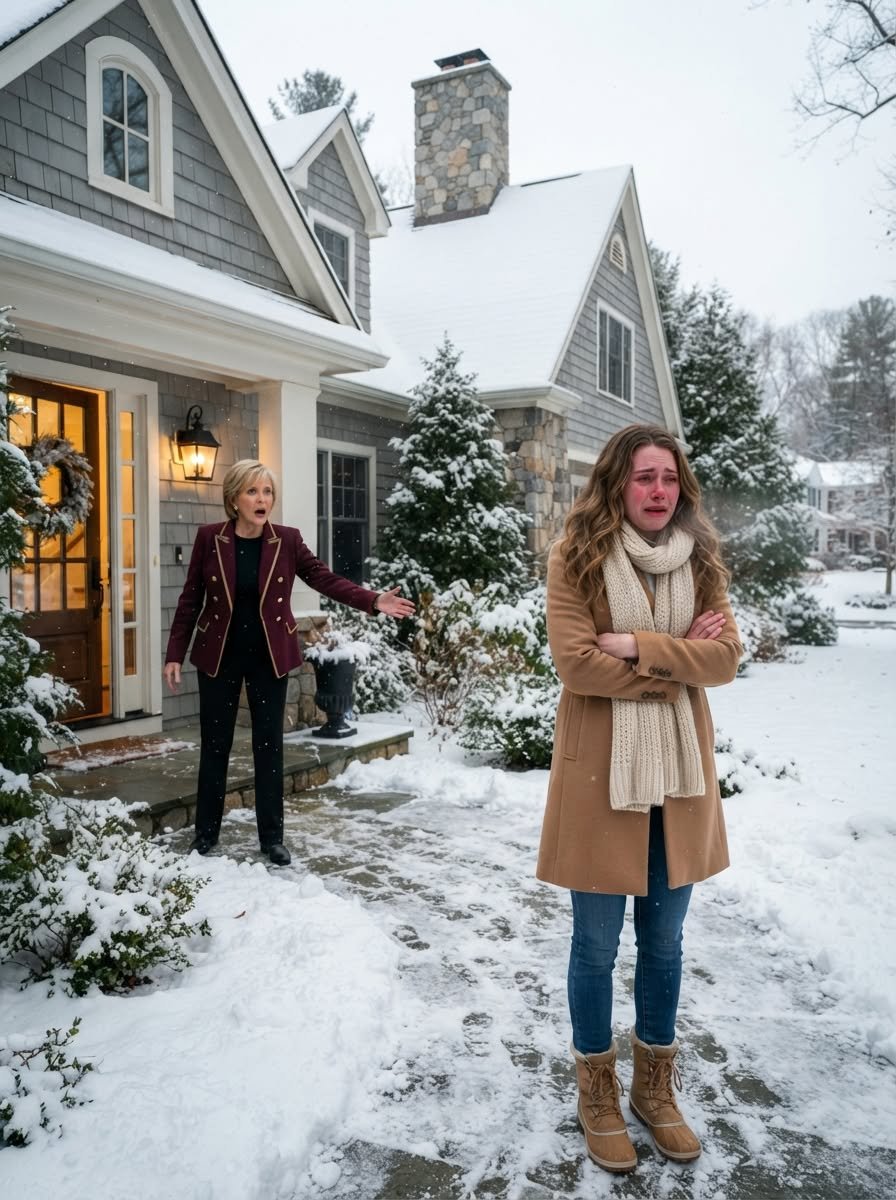
The driveway was crowded when she got there. Vanessa’s car, her husband’s truck, both of the older cousins’ cars, and she had to park at the bottom of the hill. My mother met her at the door and told her they weren’t expecting her. The table was set with every leaf in it, and everyone was already seated, and adding one more chair would spoil the arrangement. My mother said she was sure Sophie understood.
Vanessa’s children had Sophie’s room. Her bag was still in the car.
My father was in the living room with the television on, and he did not get up.
Nobody offered her a plate and nobody offered her a ride home, and after a while my mother said something to my sister about the seating chart in a voice that was meant to be heard. So Sophie took her car keys out of her coat pocket, said goodnight to a room that had already turned back to its own dinner, and drove twenty-five minutes home on dark winter roads by herself.
I sat on the floor of my own living room and asked her one more question.
“What did you eat?”
Her eyes filled up.
“Toast. And half a banana.”
I pulled my daughter into my arms and held the back of her head the way I did when she was small, and she cried the way people cry when they have been keeping something in for hours and finally put it somewhere safe.
“They acted like I was bothering them,” she said into my shoulder.
I have spent years explaining my family to my daughter. Grandma is tired. Your aunt is dealing with a lot. That’s just how they are, and someday you won’t need them to be different. Holding her on that couch at midnight, I could not find one more sentence in me.
David came home at seven in the morning from his shift and found me at the kitchen table, still in my scrubs, with the coffee I had never drunk. His face hardened while I told him.
“Twenty-eight people,” he said. “They couldn’t make room for Sophie.”
“No.”
He sat down across from me. “What are we going to do?”
“I’m not going to argue with them,” I said. “I’m taking action.”
My parents went to bed that night believing they had settled the matter by closing their door. They had no idea that refusing my daughter a chair was going to cost them the house they called home for eight years.
Because they never once said out loud whose name is on the deed.
I did.
───────────────────────────────
PART 2
I did not call anyone. I did not post anything. I did not drive over there and stand in the driveway screaming, which is what I wanted to do at three in the morning with my daughter asleep down the hall.
Instead, at six forty on the morning after Christmas, I parked at the bottom of the hill on Rowan Street with the engine off, walked up the sidewalk in the dark, and taped a manila envelope to my parents’ front door where the doorbell is, because I wanted it found by whoever answered the door first.
Then I drove to the hospital and worked another shift.
The envelope held four things.
The first was a certified copy of the deed to 14 Rowan Street. One name on it. Mine. Recorded in 2016, in the county registry, book 4471, page 118.
The second was a one-page Occupancy Agreement, dated August 2016, with four signatures along the bottom — mine, my husband David’s, my mother’s, and my father’s. Two paragraphs, plain English. It said that the occupants could live at 14 Rowan Street for as long as they chose, that they would pay the utilities and keep the lawn, and that the property remained the sole and separate property of Margaret Vale. My father wrote the sentence himself, in his own handwriting, because he wanted it in his words. I watched him do it at my kitchen table while my mother complained that paperwork between family was insulting.
The third was a Notice of Termination of Occupancy — sixty days, prepared by an attorney named Gail Petrosyan, addressed to Walter and Lorraine Vale.
The fourth was a Christmas card. The one my mother mails every December, with the photo on the front: twenty-eight people arranged on the stairs of the house on Rowan Street, all of them in their good clothes, all of them smiling. Vanessa’s four children in the front row. My father in his recliner pulled to the center. My mother with her hand on his shoulder.
Sophie is not in it. Neither am I.
The envelope also had one line on the front in my handwriting, because I wanted them to understand that I was not confused about what I was doing.
“This is the house your granddaughter drove home from on Christmas Eve.”
My phone started at 8:12 a.m., between patients.
“You cannot be serious.” My mother. “You put a lawyer on your own parents? At Christmas? Your father is shaking.”
“I taped it to the door so you’d have it in writing before anybody called you.”
“Because there wasn’t room at the table? There wasn’t room, Maggie. Do you know how long I spent on that table? Everyone was seated. She was late.”
“She was not late. She was there at four.”
“You have always been like this,” my mother said, and there is a particular tone a woman can put on that sentence when she has been saying it to you since you were nine. “You have always made everything about her.”
Then she hung up, and Vanessa called four minutes later, and Vanessa is a different kind of phone call. Vanessa does not scream. Vanessa explained to me, in the voice she uses for clients at the insurance office, that I was embarrassing the family, that the deed business had been settled years ago, and that if I thought I could simply put two old people out of their home, she would make sure every person in that town heard what kind of daughter I was.
“Your children had Sophie’s room,” I said.
“Sophie is sixteen. She does not need a room.”
“She ate toast and half a banana,” I said. “She drove home on black ice at nine o’clock at night. She has the route memorized now, Vanessa. That’s what our family gave her for Christmas. A route memorized.”
Vanessa was quiet for a second, and then she said the thing that made me understand that something had been happening in that house that I did not know about.
“You’d better talk to your lawyer before you find out what you actually own,” she said, and hung up.
My father did not call at all. Not that day. Not for three weeks.
I did what I should have done eight years earlier. I ordered a title search, and I asked Gail Petrosyan what a person should look for when a family has been very confident for a very long time. On January 4, I sat in her office with a cup of tea I did not drink and she turned her monitor toward me.
“Mrs. Vale, there is a second deed recorded against your property.”
“What does that mean?”
“It means that on November 21, your father signed a quitclaim deed transferring all of his and your mother’s interest in 14 Rowan Street to Vanessa Ryder, consideration one dollar, and that deed was recorded at the registry on November 27.”
“Dad doesn’t own the house.”
“Correct.” She took her glasses off. “The instrument is void, because you cannot convey what you don’t have. But here’s what it does mean. When you go to sell, the title company is going to look at that page, and Vanessa is going to tell them she owns a share of your house, and they are going to stop the closing.” She set the paper down. “The second thing it means is that for two months, your parents have been sitting in that house believing they could sell it.”
“Vanessa told them that.”
“Vanessa told them something. And somebody’s been busy with more than a quitclaim.” She turned her screen again. “Look at the last page. Your parents gave your sister a power of attorney on October 12, the same week she moved her family in.”
I looked at the signature, and it was my father’s, and it was shaky in a way that made my stomach turn over.
And for the first time in my life I did exactly what my father taught me when I was nine years old and learning to drive: keep both hands on the wheel and read the road.
PART 3
I waited until after New Year’s and then I drove to Rowan Street on a Saturday morning, alone, in my scrubs jacket with the hospital badge still clipped to it, and I knocked on the door of my own house the way a stranger would.
Vanessa opened it and did not step back.
“Mom and Dad are resting.”
“I’m not here to see you.”
“Maggie.” My mother came down the hall in her cardigan with her arms crossed. “You don’t get to walk in here and upset him.”
“Then let’s do it in the kitchen,” I said. “The three of us. And Vanessa can stand there, since she seems to live here now.”
We sat at the same table they had refused to put my daughter in. It is a long table, and there were still place cards sitting in a little stack by the tea tin.
“I want to be very clear,” I said. “I am not here to argue about dinner.”
“Good,” my mother said, “because I am not apologizing for a seating chart.”
“Your name is not on that deed, Mom.” I put a copy of it on the table. “Dad’s isn’t either. I own 14 Rowan Street. David and I bought it in 2016 for three hundred and ten thousand dollars, and we bought it because you had thirty days left before the auction.”
“You can’t just—”
“You lost the other house,” I said. “You and Dad took that refinance in 2014, and you took it because Vanessa’s husband needed the money for the flooring business, and then you couldn’t make the payments. The bank sent the notice. You called me from the porch and you said, ‘Margaret, don’t tell anyone.'” I let that sit. “We put down ninety thousand dollars on this house. We have paid the taxes every year for eight years, and the insurance, and the new furnace when the old one went, which was four thousand two hundred dollars in 2019. That is why this house has a deed with my name on it. And Dad wrote the agreement himself because he is an honest man, and I have kept it in a drawer for eight years and never once waved it in your face.”
My father came into the kitchen at that point. He was in his robe and he was holding the doorframe the way I did not want to see him holding anything.
“You said it was ours,” my mother said.
“I never said that,” I said. “You told everybody at church that you bought it back. I let you.”
That, I have to admit, was the truest thing I said that morning, and it is the thing I will carry longest.
“This is why Sophie couldn’t come to dinner, isn’t it,” I said then.
“What?”
“It wasn’t the seating chart. It hasn’t been the seating chart for years.” I looked at my mother. “Since 2019, when Vanessa got the money and we didn’t. Since you decided that I was the daughter who married a firefighter and worked nights.”
“You are twisting everything.”
“Sophie sat in her car at the bottom of that hill and cried and then drove home,” I said. “And you didn’t call me. Not that night, not the next morning. You didn’t call me on Christmas Day. And then on November 21, Dad signed a paper selling my house to Vanessa for a dollar.”
My mother’s face did something I had never seen before, which was nothing at all.
“You weren’t supposed to find that,” Vanessa said from the doorway.
“Of course I was,” I said. “That’s what it’s for.”
Here is the choice I gave them, and I gave it in writing that afternoon, through Gail, because I have learned what my family does with things said out loud.
They could keep living there until June 1, rent-free, if they signed a new agreement acknowledging my ownership. They could buy the house from me at market value, with a credit for eight years of taxes I had paid. Or they could move, and I would pay the first six months of a two-bedroom apartment near the church, and the movers, because I am not throwing two old people into a parking lot in January no matter what they did in December.
What I would not do was let the house sit in a cloud of Vanessa’s paper while my daughter grew up in a family that had a seating chart for who was loved.
My mother read it twice, folded it in half, and set it down on the table exactly in the middle between us.
“Then you’ll have to go through me,” she said.
I looked at my father. He was standing there in the doorway with his hand still on the frame, and he looked down at the floor, and he did not say one word.
PART 4
The petition was filed on January 22 in the county court, and it was eleven pages long, and it named me as respondent.
Vanessa had hired a firm out of the city, and the lawyer’s name on the signature line was one I had never heard, and the document asked the court for four things: a finding that my parents held an interest in 14 Rowan Street; a constructive trust over the property in their favor; an injunction preventing me from selling or encumbering it while the case was pending; and one hundred and sixty-eight thousand dollars in damages for “improvements, maintenance, and care services rendered.”
Attached to it as Exhibit A was my father’s quitclaim deed.
Attached as Exhibit B was an affidavit from my mother, three pages long, swearing that in 2016 I had told her, in the kitchen, that the house was theirs forever and that the deed was “just for the bank,” and that they had relied on that promise for eight years.
I have never said those words. I read the affidavit twice on the hood of my car in the hospital parking lot and then I sat there for a while with the engine running, because there is a specific kind of tired that comes over you when someone who gave birth to you puts a lie into a notary’s book with your name in it.
Two weeks later, Judge Alvarado signed a temporary order. The house could not be listed, sold, refinanced, or insured for a new owner until the case was decided. That was the whole point of the motion and everybody in the room knew it. I had a buyer in March. I had a plan, and college tuition in it, and Sophie’s name on a savings account with eleven thousand dollars in it that we had built one shift at a time.
In February, somebody called Child Protective Services.
That is not a thing I imagined happening. An investigator came to my door on a Thursday afternoon with a clipboard, and she sat in my living room for fifty minutes, and she asked me how often Sophie is home alone, and who watches her when I work nights, and whether my husband works overnight shifts.
I answered all of it. She looked at Sophie’s room, and the food in my refrigerator, and the calendar on the wall where a sixteen-year-old has written her own schedule in three colors of marker because she has been managing her own homework since she was eleven while her mother saved other people’s lives.
Then she asked one more question, in a neutral voice, because it is her job.
“Mrs. Vale, is there anyone in your family who would want to file a report like this?”
“Yes,” I said. “Her name is Vanessa Ryder, and she is my sister, and she is trying to take my house.”
The investigator wrote that down and closed her folder, and on her way out she said something I have not forgotten. “I see maybe forty of these a year. Most of them are garbage. This one will go where it belongs.”
Sophie was at the school where two of Vanessa’s children go. Kids talk, and mothers talk louder, and by the middle of February there were three versions of the story moving through that building, and in two of them my mother was a sweet old woman whose daughter was throwing her out in the snow.
I told Sophie the truth, all of it, at the kitchen table with the papers in front of us. Sixteen is old enough to read your own name in a court file. I did not tell her about the CPS visit for eleven days, and when I did, she did not cry, which was worse. She asked me one question, in a voice an octave too steady.
“Does Grandpa know they’re saying that about you?”
“I don’t know what Grandpa knows.”
She nodded like a person filing something away, and then she went upstairs, and that night I heard her through the wall, and she was not on the phone with a friend, she was playing chess by herself on an app, click, click, click, until almost midnight.
On February 26, my father had chest pains and was taken by ambulance to the hospital where I work. I was assigned to the emergency room that night. I stood at the desk and watched my own mother come through the double doors, and when she saw me in my scrubs with the badge on my chest, she walked up to me in front of four nurses I supervise and said, loudly enough for the waiting room to hear it, “You did this to him.”
A woman in the third row looked up from her phone.
I triaged my father. I started his IV myself. Then I stepped into the supply room, shut the door, and did not cry, because I have been a nurse for twenty-two years and I know what a body does with fear, and I was not going to do it in a hallway where my mother could watch.
He was all right. It was angina and stress and eighty-four years, and he went home on the fourth day, and the only person who came to get him was Vanessa.
The hearing on the injunction was set for March 19. Gail filed our response, our exhibit list, and our motion to dismiss the petition as a matter of law, and then we waited, and I worked, and Sophie went to school, and every morning I drove past Rowan Street on my way to the hospital because it is the shortest route and I will not admit to myself that I chose it on purpose.
On the evening of March 11, at 7:40, the doorbell rang at my house.
David answered it. I heard the door, and then I heard him say, “Can I help you,” and then I heard nothing for a few seconds, which is the sound of a man reading a name on a page.
I came out of the kitchen and he was standing in the doorway with a folded set of papers in his hand, and his face was the color of paper.
“David?”
He didn’t answer. He just turned the top page toward me so I could read the caption myself.
SUBPOENA. IN THE MATTER OF THE PETITION OF WALTER AND LORRAINE VALE. TO: SOPHIE VALE, WITNESS ON BEHALF OF PETITIONERS.
Sophie came down the stairs in her socks with a bowl of cereal in her hands.
“Mom? Who was at the door?”
And I stood there in my own hallway holding a piece of paper that meant my daughter was going to be dragged into a courtroom by her own grandparents, under oath, two months after she ate toast at her grandmother’s house because there was no chair for her.
PART 5
The subpoena was the end of one thing and the beginning of another, and the beginning of it started in a place I did not expect: my father’s own handwriting.
Gail had our exhibits tabbed and copied in three sets, and she walked Judge Alvarado through them on the morning of March 19 in a courtroom that smelled like a school gymnasium.
Exhibit 1 was the recorded deed, 2016, sole owner Margaret Vale.
Exhibit 2 was the Occupancy Agreement, one page, four signatures, two paragraphs. The second signature from the bottom was my father’s, and it was in his hand, not a lawyer’s.
Exhibit 3 was the county tax payment history. Eight years. My name on every check, my account, no gaps.
Exhibits 4 through 11 were receipts: the furnace in 2019, the roof in 2021, the water heater in 2023, all paid by me, none of them by the petitioners.
Exhibit 12 was the quitclaim deed, signed November 21, conveying something my father did not own.
Exhibit 13 was a power of attorney, signed October 12, granting Vanessa Ryder authority over her parents’ affairs.
And Exhibit 14 was a series of text messages, produced under subpoena from my sister’s phone, and read aloud in that room by a lawyer with a flat voice and no interest in any of us.
“Mom, once Dad signs it, it’s basically ours. Don’t worry about Maggie. She works nights, she can’t fight this.”
“Tell the lawyer the part about the kitchen in 2016. Say she said it was ours forever. That’s the whole case.”
“Just keep Dad quiet. He’ll do fine if you tell him he’s helping.”
Vanessa’s attorney objected eleven times in the first hour. Judge Alvarado overruled eleven times and told him to sit down twice.
My mother was on the stand for forty minutes. She was asked whether the affidavit about the kitchen was true, and she said yes, and Gail asked her to describe the kitchen, and she described it, and then Gail asked her which year had the blue countertops and my mother answered confidently, and the photograph in Exhibit 6 was passed up to the bench, dated 2019, with the blue countertops and the same cabinets in the same house, and my mother said she didn’t remember.
Then Gail called my father.
He came up the aisle with a cane, in the same suit he wore to my wedding, and he took the oath in a voice I could barely hear, and he answered the lawyer’s first seven questions with one word each: no, yes, 1962, yes, no, no, yes.
Then Gail asked him whether he wrote the Occupancy Agreement in 2016.
“Yes.”
“Did anyone force you?”
“No.”
“And in November, when you signed the quitclaim deed, who asked you to?”
My father was quiet for a long time. Judge Alvarado let it run.
“Vanessa.”
“Did you believe the house was yours to sign away?”
“No.”
“Why did you sign it, Mr. Vale?”
And my father looked up, and he did not look at Vanessa, and he did not look at my mother, and he looked at me, at the table where I was sitting with my hands folded, and he said the sentence that this whole thing had been waiting eight years to hear.
“Because it was quiet at the house,” he said. “And she came over every day with the coffee and the paperwork. And I have never been any good at telling a person no. Not your mother, not Vanessa. Not even you, Maggie, when you told me to sign that paper in your kitchen and I knew I was signing away the last thing I ever owned.”
He wiped his face with the back of his hand.
“It was your house the whole time,” he said. “I knew. I just liked sitting in it.”
Judge Alvarado ruled from the bench, and it took her nine minutes.
The quitclaim deed was void, and it was struck from the registry with instructions to the county clerk. The petition for a constructive trust was dismissed with prejudice. The claim for one hundred and sixty-eight thousand dollars was dismissed with prejudice, on the ground that the petitioners had paid nothing toward the purchase, the taxes, the insurance, or any improvement on the property, and that the “care services” claimed were, in fact, the ordinary care of a family that had been given a home for eight years without a rent check. The injunction was vacated effective that afternoon. Costs were awarded against the petitioners, and the court referred the quitclaim and the supporting affidavit to the district attorney for review of a claim of fraudulent conveyance.
And then the judge looked over the top of her glasses at the room and said one last thing, in a tone I will keep for the rest of my life.
“Mr. and Mrs. Vale, you had a daughter who paid your taxes for eight years and never told a soul. You had a granddaughter who wanted to sleep in your guest room. This court does not get to decide who sits at your table. But this court can tell you that you had it exactly backwards.”
Child Protective Services closed their file in April. Unfounded. The investigator’s closing note said what she told me she would say: that the report had been made by a family member in the middle of a property dispute, and that there was no basis of any kind.
I sold the house in August to a young family — a teacher and a machinist with a two-year-old boy and a dog that was terrified of the porch. They paid three hundred and ninety thousand dollars, and I stood in the driveway and watched them walk in with the key in their hands, and I felt the way you feel when you finally set down something you have been carrying up a hill for eight years.
My parents moved in June into a two-bedroom apartment three blocks from their church, with a balcony, because my mother wanted a balcony. I paid the first six months, the movers, and the deposit, exactly as I had put in writing in January, because I do not say things I will not do. Vanessa’s husband left in the spring, and the flooring business with him, and Vanessa has not spoken to me since the courtroom. My mother called me in September to ask whether I would ask David to look at the balcony door. I said yes. That is as far as the two of us have gotten, and at forty-seven years old I have finally stopped trying to get further.
And my father?
In October he drove over unannounced and stood on my porch holding a bird feeder he had built himself, out of cedar, with a copper roof, and he asked if there was a tree in my yard. There is. It is a maple, on the south side, and he put it up himself even though his hands are not what they used to be, and while he was up there on the ladder he said, without turning around, “I let the wrong one of you be quiet in my life.”
We do Christmas at my house now. David cooks, and I make the pies, and Sophie sets the table and every year she sets it one more place than there are people coming. I have asked her why twice.
The second time, she was standing at the end of it with the good plates in her hand, seventeen years old and already taller than her grandmother, and she answered in about a second and a half.
“In case somebody’s driving around.”
There is always room at my table. That is the only rule in this house, and my daughter is the one who wrote it.