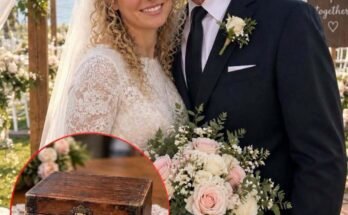
My husband and I came back to the hotel where we had spent our honeymoon 40 years earlier — and the receptionist looked at him and told me, “Welcome back.”
I laughed.
“I’m surprised you remember us. We haven’t been here in forty years.”
The receptionist’s smile disappeared.
She looked at my husband, Robert.
Then back at me.
“Oh. I thought Mr. Harris had stayed with us more recently.”
I turned toward him.
“What?”
Robert barely reacted.
“She must have me confused with someone else.”
But the receptionist was already checking her computer.
“No, I’m quite sure. Same name.”
Then she frowned.
“Mr. Harris usually requests the same room.”
“Usually?”
Robert interrupted her.
“We’d like to check in.”
Something in his tone made her stop talking.
And that unsettled me more than I wanted to admit.
It felt as though both of them knew something I didn’t.
I waited until we reached our room.
“You’ve been here without me?”
“No.”
“She recognized you.”
“She’s mistaken.”
I wanted to believe him.
Then, during dinner, I casually asked another employee how long the receptionist had worked there.
“Almost fifteen years.”
My stomach tightened.
There was no possible way she remembered Robert from our honeymoon.
The next morning, I waited until Robert went out.
Then I returned downstairs.
The same receptionist was behind the desk.
“I need you to tell me when my husband stayed here.”
Her expression changed.
“I’m sorry, ma’am. I can’t discuss a guest’s stays.”
“He’s my husband.”
“I understand.”
“Was he here with someone?”
She refused to answer.
“You said he usually requests the same room. How many times has he been here?”
She lowered her voice.
“Please. I can’t tell you anything.”
“Why?”
She glanced toward the elevators.
“Your husband already asked me not to discuss his previous visits with you.”
I stared at him.
“Asked?”
She looked away.
“Did he pay you?”
Silence.
“I’ll pay you more.”
“No.”
I walked away with more questions than answers, but one thing was obvious.
Robert was hiding something from me.
That evening, I sat across from him at dinner pretending everything was normal.
Forty years of marriage, and suddenly I was wondering how much of our life together I truly knew.
A waiter placed my plate in front of me and walked away.
A few seconds later, I noticed a small piece of paper tucked beneath the edge of the plate.
I waited until Robert lowered his eyes to his menu, then carefully pulled it free.
“I know your husband’s secret.
11 p.m. Back entrance. Come alone.”
I had no idea who the waiter was or why he wanted to help me.
But if he knew what Robert was hiding, this might finally be my chance to learn the truth.
At eleven, I quietly went downstairs.
The waiter was waiting outside.
“You didn’t hear this from me.”
“Just tell me.”
“I’ve seen your husband here several times.”
My chest tightened.
“With another woman?”
He hesitated.
“A young woman.”
I could barely breathe.
Suddenly, everything seemed to fit.
The secret trips.
The same hotel.
The receptionist refusing to talk.
Forty years of marriage, and this was how I was going to find out.
“How long?” I whispered.
The waiter frowned.
“You think they were having an affair?”
I stared at him.
“Weren’t they?”
“No.”
“What?”
“Mr. Harris booked the room under his name.”
“Then he was staying with her.”
“No. Your husband never went upstairs.”
I stared at him.
“Then why was he paying for her room?”
The waiter hesitated.
Before he could answer, I heard a familiar voice behind me.

PART 2
It was my son.
David was standing under the service light by the ice machine with his jacket over his arm, and beside him was a girl of about twenty in a nurse’s scrub top and a cardigan too big for her, with one hand flat on the front of her dress, and before I could say anything at all my son said:
“Nobody in this family ever thought it was an affair, Mom. We just let you think it.”
That is the sentence I have gone back to two thousand times. It was not relief. Relief would have been no, you’re being silly. What that sentence did was move the whole building, because it told me the lie I had been living inside for six years had been watched, and discussed, and agreed to, by people who eat at my table.
The girl said, “I made Theo leave the note. I’m sorry. I didn’t mean for any of this.”
And behind all three of us, in the doorway with his coat still on, my husband said, “She has Kate’s hands, Claire. Look at her hands.”
I looked. I don’t know what I expected — some trick of the eye. But she held up her hands because Robert asked her to, and she had long fingers and small square nail beds, and her left thumb bent back at the last joint about fifteen degrees, the way his does, the way David’s does when he holds a glass, and my mother-in-law’s photograph on our mantel has that thumb in it, and I have looked at that photograph four thousand times.
Her name is Sadie Kate Ellery. She is twenty-one. She is in her third year of a nursing program at the hospital nine blocks from this hotel, and she is engaged to the waiter, and Theo Marchetti had worked the dinner shift here for two years and had decided, on his own authority, that the woman paying his fiancée’s rent deserved to be told the truth.
“Come inside,” David said. “Please. There’s a letter.”
“I want to hear it from him.”
“There is no version of this where you hear it from him,” my son said, “because he has been trying for thirty-six years and every time he gets to the sentence he throws up. Sit down.”
There is a bench by the service door with a broken slat. My son, my husband, and a girl I had never met sat down in the back of a hotel at eleven-forty on a Tuesday night in October, and I stood, because I could not sit yet, and David told me about a woman named Katherine Ruth Ellery.
She was born in the spring of 1983. She was Robert’s daughter. She was two years old when I met him, and the only arithmetic that mattered in that corridor was that date, because I was twenty-five and alone in a bus station in Gadsden with a duffel bag, and Robert Harris was twenty-four and driving a truck with a car seat in the back that had been installed and uninstalled so many times the plastic had gone white.
He had been engaged once, to a woman named Lucia Vasik who worked the bookkeeping desk at a lumber yard. In the winter of 1982 she told him she was pregnant. Her father was a hard, frightened man with no papers, and he took his daughter out of the county in the middle of the night and put her with a sister in Tucson, and by the time Robert got out of the second contract the baby had been born and placed, in July of 1983, through a Catholic agency, to a family named Ellery two hundred and thirty miles away.
He signed the relinquishment in a room with a clipboard and a nun who kept calling him son, and she said to him the one sentence he has never once been able to repeat in front of me without stopping in the middle of it:
You will not be asked to be a father again if you do this, and I want you to understand that is a mercy, not a punishment.
He married me in June of 1985, in a church in Ashford with thirty-one people in it. He told me in the third month that there had been someone before me; I asked how long, and he said a year and a half, and I have believed that number for forty years because I wanted to, and because he said it looking straight at me.
He did not find Katherine until 2001. He wrote forty-one letters to that agency between 1983 and 2001 and every one came back. Then a woman at the agency retired, and kept a box, and called a number in a phone book, and Robert was forty years old and standing in a driveway in this town when a girl of eighteen came out of the front door with a paint shirt on and a can of primer in her hand, and looked at him the way you look at a man you have already decided you recognize.
On the lease, her name was Kate.
PART 3
David talked for forty minutes and I did not sit down once.
He is a lawyer. He gave it to me flat and factual, because he knew that if he made it soft I would stop hearing it.
Kate did not want a father. She wanted the two people who raised her, and she told Robert that in the driveway, in the first ninety seconds, and then she said the thing that decided the next ten years: You can be a man I know. You cannot be my dad, because I have one and he is in the house.
He agreed for nineteen years.
He paid for the trade school through a scholarship fund in his own mother’s name so she would never know. He drove nine hours to sit at the back of a graduation and left before the ceremony ended, because she had said she would not walk across a stage with him in the room. He kept a folder in a locked drawer for two decades, and in the folder was every photograph she ever allowed him to have, which was eleven.
“The year I found it I was nineteen,” David said. “I was looking for a phone charger and the drawer wasn’t latched, and I sat on his floor for an hour. And the reason I never said anything to you is that I understood, at nineteen, what it is to be a person who is kept on a shelf.” He put his hands together. “And I couldn’t say anything to you, Mom, because then you would have had to decide.”
“Decide what.”
“Whether you were married to a man who had a daughter and lied about it, or whether you were married to a man who had a daughter and had been abandoned by her.” He looked at me. “Both are true. He picked the second one so you’d only have to carry one thing.”
Then he told me about 2010.
Kate was twenty-eight. She had married a man named Roy, taught art to middle schoolers, had a baby girl, and in September of 2010 she went to a doctor about a fatigue she had been arguing with for seven months. In November the diagnosis came back. By the spring of 2011 she had gone into liver failure.
I put my hand on the wall.
“You remember the summer of 2011,” David said.
I was fifty-one, and I had been sick for four years, and everybody in this family knows what that is — the way your hands go yellow in June, and you cannot button a shirt, and your own husband carries a basket of laundry up eight steps because you cannot. Autoimmune hepatitis. Steroids, then mycophenolate, then a call at four in the morning that there is a liver and you must be at Mercy General within two hours. I had that call, and I had the surgery, and I have been alive fourteen years because of a stranger I was never given a name for, and I did not push, because I was thirty feet from dying and I did not want to embarrass anybody.
“There is one more thing you remember,” David said. “They told you that you had been placed on the living-donor list and had come off it. Do you remember that?”
I remember it. I remember my mother asking a nurse what come off it meant, and the nurse saying a donor matched and it isn’t available, and I remember Robert standing in that doorway in a green shirt from the gift shop, because he had been sleeping in a chair in a hallway for six days and had nothing clean.
“You had a living donor,” my son said. “She was compatible. She was not available because she was dying. She went into the room next to yours on the same Tuesday, and there were two surgical teams in that building and they made a decision about who operated first, and Kate Ellery gave part of her liver to you, and then they closed her up and took her to the fifth floor, and she asked the coordinator for a pen to write you a letter, and the coordinator said she could dictate it instead and it would be held for two years, because that is what the rule says.”
“She cut me open,” I said.
“She cut you open. She was two days from dying and she gave you fourteen years, and she made Dad promise her in that room, on the eleventh of October 2011, that he would never, ever tell you — because she said, and I have this from his mouth, ‘she’ll spend the rest of her life thinking she owes me, and I didn’t do it for a debt.'”
Robert had been sitting on the bench the whole time.
I turned to my husband, and this is the part people will judge me for, so I want it in the record exactly as it happened. I did not say how could you. I did not say forty years.
I said, “You were in the parking lot.”
“I was in the parking lot,” he said. “Twenty-one minutes. I sat there with my hands on the wheel, and I thought about going up to the fifth floor, and I did not, because she asked me not to — and because if I walked up that stairwell I would have had to say out loud, in front of your son and your daughter, that I have a child dying of the same thing that is killing my wife. I could not do that to you. I have never been able to do it to you.”
“You could have told me.”
“Claire.” He looked at me for the first time in a while, and his face was not the face I have slept next to for four decades. It was the face of a twenty-four-year-old man in a bus station. “I have been telling you my whole life. Every day of it. I have just never used the words.”
And then, in the back of that hotel at half past midnight, the girl with the bent thumb said, very quietly, “Mrs. Harris. I have something of my grandmother’s for you. I’ve had it in my locker two years. I don’t know how to say it, so I’m going to say it — he never gave those pages to you to keep them from you. He kept them because she told him to. And then he got sick, and I need you to sit down.”
PART 4
The words he got sick sat on the floor of that corridor and did not move.
“What does that mean?” I said.
Sadie looked at my husband. My husband looked at his son. And my son, who is thirty-eight and has a law license and a wife who thinks this weekend is about a reunion nobody in our family wanted, said, “It means it isn’t just Kate.”
Here is the rest, in the order I was told it, because in the eight hours after that corridor everything I owned got measured against these paragraphs.
Robert has been in this town six times since 2019.
He has never gone upstairs. Room 214 is the room the hospital uses to house family who have a patient on the fifth floor; there is a contract and a rate, and it is not romantic, and Wanda at the desk has been covering for a man for twenty-one months because he asked her to, and because, as she told me later, “I have seen him in that lobby at four in the morning with a sandwich he never ate.”
He comes here because he is stage three. His own liver — the one he has had all along — and it is not going well. And the reason he books 214 is that somebody’s granddaughter works on that floor and she is the only person in the state of Tennessee allowed to sit in a chair beside him during a biopsy and read him the number.
“You have been coming here to die,” I said. I said it in that corridor at twelve-fifteen in the morning, and I have no grace about it and I am not going to pretend I was dignified, because it came out like an accusation, which is what I had.
“I was going to tell you after Thanksgiving,” he said.
“After Thanksgiving.“
“I had it written in the car,” he said, and he reached into his coat and put a folded piece of paper on the bench between us, and I did not pick it up.
It was not a letter. It was a list, in pencil, of the sentences he had written down to say to me. There were six of them. On the fourth he had crossed out everything and written, Ask David to be there.
That is the most Robert Harris thing that has ever been put in front of me. My husband needed his son in the room to tell me he was dying.
“There’s more in the envelope,” Sadie said, and her voice had gone flat the way mine does at a bedside, and she took a manila envelope out of her bag with a law firm’s name on it, and she said, “My grandfather has paid for me to be here twenty-one years without ever being my grandfather. When my grandmother died, there was a thing in her estate that changed that.”
Three documents. I read all three at twelve fifty-two while my son held my elbow.
The first was a will, signed October 2019, eleven days before Kate Ellery died.
The second was a letter from a firm stating that under those terms Katherine Ruth Ellery had left “the whole of what I have, which is a house, a pension that is not much, and the money I was given by a man who is not my father and whom I loved for eighteen years and never once said it to” — everything — to two people.
One of them was a twenty-one-year-old girl in a cardigan.
The other was Claire Harris.
“I know that sounds strange,” Sadie said. “She wrote it in there. She wanted you to have the house in this town.”
I looked up at my husband, and he said, “Claire, there is one more page, and it is not a good one, and I need you to hear it from me.”
The last page was not a will.
It was a document out of a district court, dated February 2019, with a case number and two names. It said a petition had been filed in the matter of the guardianship of a minor, and that the person who filed it was Robert Lee Harris, and that in support he had submitted to the court a sworn statement declaring he was the biological father of a child and had concealed that child from his legal spouse for a period of thirty-two years.
The petition had been denied.
I read the date again. February 2019.
“You went to a judge,” I said.
“I went to a judge,” he said. “I asked him to make me somebody’s grandfather, and he read my file, and he said no. And then he told me that if I wanted to be in that child’s life I would have to do it in the daylight, in front of my wife. And I could not do it in the daylight.”
“Did you sign it?”
“I signed it,” my husband said.
“Then you stood in a court of law, in writing, on a public record, forever, and swore that you lied to me for thirty-two years, while I was in a house two hours away with your coffee still in the sink.”
“Yes,” he said.
And then my husband said the thing that ended that night.
“And in March I signed papers to take my name off everything, and if you want to leave, Claire, the account is already yours. I would have done it sooner. And I am going to ask you one question, and I need an answer before the doctor comes at seven.”
I said, “Don’t.”
“Would you sit with me,” he said, “while I tell our daughter and your sister and the whole of that church what I have been?”
PART 5
I said yes. And then I said the second thing.
“No,” I said. “Not in a hotel at one in the morning with a girl in a cardigan in the corridor. You are going to sit in a chair in my kitchen and tell me the whole of it in daylight. Then we do the family thing in whatever order I pick. And if you say one more word about the account you can take it back and put it in the river.”
He looked at me a long moment. And my husband, who had kept a daughter on a shelf for eighteen years because he could not make anybody choose, stood up off that bench, put his hand out to a twenty-one-year-old nurse, and said, in front of me, “This is Sadie. She has carried a bag of her grandmother’s things since Tuesday. I would like to be introduced properly. And I would like to say to my wife that I intend to be her grandfather by the front door.”
That is a sentence he had never said in his life.
We did not get a room that night. My son’s wife Lena drove down from Ashford at two in the morning, and it was Lena — a woman I met at a barbecue in 2011 and have never once disagreed with — who took my arm in that corridor, put me in the back seat, and said, “Claire, tonight you only have to decide whether you want tea.” I said yes to tea, and I drank out of a paper cup, and I did not speak until we were past the county line.
I got the eleven pages on Friday.
Robert mailed them to me himself, from our house, while I was at the store, and I want to tell you how they got where they got, because there is one paragraph that has quieted every argument in this family for a year and a half.
Kate dictated them from a bed on the fifth floor of Mercy General eight days after she cut me open. She could not hold a pen, so a coordinator named Ruth Vogel typed what she said, and then Ruth put the pages in an envelope and held them two years, because that is what the rule says, and in October of 2013 the center mailed them to the only family address on file.
That address was not mine. It was Robert’s, because in 2011 Robert Harris had signed himself onto a stranger’s chart as next of kin, and nobody in that building thought to ask him why. The letter came back to him, and he put it in the locked drawer with the eleven photographs, and it sat there twelve years, and he never once opened it where I could see.
It is not a nice letter. It is not a saint’s letter. She is angry in it. She says she hated her father for twenty-one years and forgave him in a parking lot in 2011 while they were both being driven into the same building on the same gurney, and that she thought about it in the car and decided hate was expensive.
Then she says this.
There is one thing I want you to know from me and not from him, because he will never get it right. When they brought me into the room next to yours I was scared, and I could not stop looking for a face in the chairs, and my Roy had to hold me up. And your husband came down the hall because he heard me. I don’t know what he said to my husband; my husband will never tell you. But I want you to know that your man had been in that hospital eleven days and never once been into your room, and he came into mine, and he stood in a doorway in a green shirt from the gift shop, and he cried in front of a woman he could not legally claim and a stranger he did not know, and he said one thing to me, and he said it looking at me the way you look at a man you have already decided you recognize.
He said, “I’m sorry I was late.”
I have thought about that for eight days, and I have decided what to do with it, and I am not going to tell you what that is, because it is mine, and it was expensive, and it’s fine.
Take care of his hands in the winter. He leaves them in cold water when he’s thinking. I got that from him.
At the bottom, in the coordinator’s type, was a line about the house. And beneath it, in pencil, shaky, added by a hand somebody had to steady:
Tell her she can sell it, or live in it, or put a bed in it for a girl who is going to be a nurse. I know she’ll be a nurse. She’s stubborn.
That was Kate’s own hand.
I did not sell it.
Here is what I have done with it, and then I stop, because this is long enough and I have already told the important part.
The house on Elm Street has four bedrooms and a bad porch, and it is two blocks from a hospital, and in August a judge in this county made a man a grandfather in the daylight, in a room with a stenographer, and those papers hang on my kitchen wall now with a coffee ring on the corner.
David came. He made his daughter cut the ribbon off the frame, and then my son, who does not cry at depositions, said, “Dad, you did it late.” And my husband said, “Yes.” That was the whole conversation, and it was enough, because they are both Harris men.
Roy came in September with a case of primer, because he said there was a wall somewhere Kate had always been mad at. Robert did the standing; Roy is seventy-two and has a bad back. They did not talk about 2011 either, and it was fine.
I have been alive fourteen years on account of a woman I did not know existed, and she is buried in this town, and every second Sunday I go to that cemetery with a girl in a cardigan who is in her last year now, and we do a thing that will sound ridiculous in print, so I am putting it down anyway.
We each bring one sentence.
Sadie says hers to her grandmother’s stone. I say mine out loud to a grave I did not know about three years ago, and it is the same sentence every time, and I am not writing it here, because it is not hers to read and it is not yours either, and a woman carrying somebody else’s liver in her body has earned one private thing.
Then I go home, and Robert is at the sink with the water running, both hands in cold water because he is thinking, the way he has done for forty years, and I say his name.
He looks up.
I have said this one hundred and six times, and I will keep saying it until I am the one in the chair in the hallway with somebody’s husband holding me up, because it is the only thing in this whole wretched, generous story he has never been able to say for himself.
“You weren’t late,” I say.
He never answers. He dries his hands, and comes, and puts one on the back of my neck, and that is how we have been since, which is not an ending, and which is not the same thing as forgiveness either.
It is what you build, in a kitchen, in the daylight, after the last secret in a house finally gets a chair.