My Husband Left Me in a Burning Cabin for $30 Million—Five Days Later, I Watched My Own Memorial
Part 1: The Locked Door
Five days after my husband left me to die, I watched him mourn beside my empty casket.
From a private hospital room forty miles away, I viewed the memorial livestream as Grant thanked two hundred guests for praying for me and our unborn son. Behind him stood Brooke Ellis—Northstar Air Rescue’s director of strategic planning and his mistress.
Five days earlier, Grant had taken me to our Cedar Ridge cabin for one final weekend before the baby arrived. I was thirty-five, eight months pregnant, and owned 68 percent of Northstar, the medical air-transport company my late mother, Evelyn, had built.
Grant was its CFO. I had trusted him with both my marriage and my company.
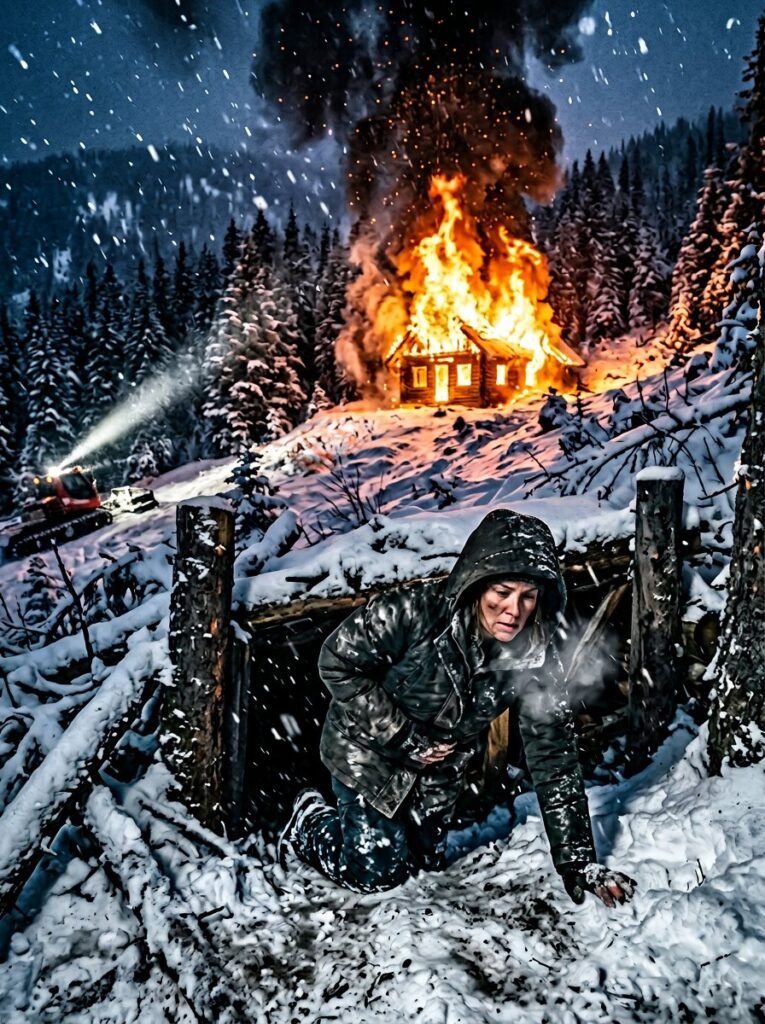
At 2:17 a.m., smoke woke me. Grant’s side of the bed was empty, flames glowed beneath the door, and both exits had been secured from outside.
Through the window, I saw Grant beside our SUV with Brooke.
“She’s awake,” Brooke whispered. “You said she wouldn’t wake up.”
Grant remained calm. “They’ll blame the propane system. Once the $30 million policy pays and her shares clear probate, we can start over.”
When Brooke asked about the baby, he glanced toward the burning cabin.
“If they die together, there won’t be a separate investigation.”
They drove away while flames spread across the ceiling.
Then I remembered the narrow Cold War passage behind the pantry shelves. My mother had shown it to me when I was nine, warning, “This isn’t a hiding place. It’s a way out when every normal door fails.”
I found the release, squeezed into the tunnel, and crawled through smoke and darkness with one arm protecting my stomach.
“Stay with me, Noah.”
I emerged beyond the trees as the cabin windows exploded. A contraction dropped me into the snow, and a white beam swept through the woods.
A tracked rescue vehicle stopped nearby. A silver-haired man wrapped me in a thermal blanket, called for a helicopter, then froze when he noticed the locket around my neck.
He opened it and stared at Evelyn’s photograph.
“Where did you get this?”
“It belonged to my mother.”
His hand began trembling.
“Evelyn?”
Then he touched my cheek and whispered:
“Your mother told me our baby never survived.”
The rest of the story is in the comments
PART 2
Noah was born at 4:38 in the afternoon, on the second day, five pounds four ounces, and he came out screaming like a man who had somewhere to be.
I put that first, because everything after it is paperwork.
They had to move fast. My blood had eleven percent carbon monoxide in it and there was soot in my throat, and a doctor named Ms. Achebe told me, with her hand on the bed rail, that the baby had been getting less than half of what he needed for four hours.
He needed a cpap for four days and a feeding tube, and someone to tell me he might have a lung that never quite catches up, and I said, “He’ll manage. He’s already had practice.”
That was about the whole of what I said for a day. It was not strength. It was that I had run out of the part of a person that talks.
The fire marshal came on the morning of the sixth day — the day after my own memorial.
Her name was Della Ruiz, forty-four, and she had been at Cedar Ridge for nineteen hours and come back with two evidence bags and a face like somebody who has stopped being polite.
The first bag held forty inches of braided steel cable and bolt cutters with fresh marks on the jaws.
“Both exits were secured from the outside,” Della said. “That is not a propane accident. That is a man who walked around a house at two in the morning with cable and then came back with a knife. Your husband told us the flex line failed at the fitting. It was cut with a blade, at an angle, and somebody hand-closed the shut-off at the tank — the handle was still warm. Nothing failed, Ms. Alden. Somebody shut the whole thing off and then started it in exactly the one place a tunnel was built to get you out of.”
I said, “Only my mother and I ever knew about that tunnel.”
“That’s what I’d expect,” she said. “Which is why I’m sitting in this room.”
Then she asked whether I wanted to know about the call.
I said I did.
“The emergency call came in at 6:41 in the morning, from a cell registered to Northstar’s corporate account, and it reported a structure fire at a residence with no occupants present.” She opened her notebook. “The fire started at 2:17. Your husband let that house burn for four and a half hours, and then he called in a building, and not a person. And here is the part I have not stopped thinking about since Tuesday.” She turned the notebook around. “The flight log for this hospital says a rotor-wing from Cedar Ridge set you down in our bay at 5:58 in the morning. He reported you dead-free and house-only forty-three minutes after he watched our helicopter take you off that mountain.”
There was a sound in the room I could not place until I realized it was the monitor reading my own heart.
“That is not grief,” Della said quietly. “That’s a timeline. A man does not make a mistake like that. A man makes a decision, and then the facts come along behind him and embarrass him.”
“We watched it,” she said. “Two hundred people, a closed casket, and a pastor who did not ask one single question. Which is why I am sitting in this room, and why I have one more thing for you, and then I am going to leave and let you rest.”
Standing up to leave, she told me the rest. They had pulled the ashes, and in the pantry they found the shelf they had propped over the tunnel release with a two-by-four. On that two-by-four, pressed into fresh soot from that morning, was a partial thumbprint.
It was not Grant’s.
That afternoon Hal Bricker came in with a man in a clean flannel shirt. Hal is seventy-one; he drew my mother’s trust in 1994 and every corporate document since. He set a manila folder on my blanket and said, “Evelyn taught me to keep originals in a fireproof box, and I have never once been so glad she was paranoid.”
The first page was an original death certificate. My name. A date of death — the second of February, at 2:17 in the morning. Cause, pending investigation. At the bottom, under Informant, in my husband’s careful block letters: Grant R. Alden, spouse.
Hal said, “He filed a petition in probate on Thursday for an emergency declaration of death and immediate appointment of a personal representative, which is him. And because he had that certificate, the hospital in Cedar Ridge let him be next of kin for a fetus that was not yet born, and he tried to sign a discharge on you, and they called my office, and I came.”
The man in the flannel shirt had not said a word. He is sixty-six, and he has the hands of a man who has spent his life carrying other people, and I remembered the snow and the thermal blanket, and something in my face came loose.
“I won’t do this in front of your lawyer,” Cass said. “But there’s a box in a storage unit in this town with forty years of letters your mother wrote me and never sent. I’ll bring them, and then you can tell me to leave, and I’ll leave.”
Hal cleared his throat. “One more thing in the folder. It’s the reason we came at all.”
My mother’s audit, dated eleven days before she died, with a note on the front in her hand: Grant — see the 2019 rotor, and the man named Pruitt. Do not let him file the Q3 reconciliation without me in the room.
Under it, every wire my husband moved out of Northstar’s maintenance reserve between 2018 and 2021. Nine hundred and sixty-one thousand dollars.
“He hollowed that company for years and your mother knew it,” Hal said. “Which means the thirty million was never the plan, Sloane. The thirty million was the rescue.”
PART 3
Here is what my mother knew, and it is not a story about a husband.
My mother hired Grant herself, in 2016, and it was not a mistake she made by accident. At the interview she asked him one question — what did you do with the maintenance accrual at your last job — and he answered her smoothly, and afterward she told Hal she wanted him anyway, because she wanted him where she could watch him.
She got five years out of watching him. In the last one she was ill, and he ran the numbers, and she died with an unfinished audit in a drawer and a list of names she had started to build.
What she found in 2020 was a maintenance record from March 2019, on an air ambulance whose gearbox had been signed off by a mechanic named Curtis Pruitt, who had been out on a shoulder injury for eleven days and had no idea his number was on it. That aircraft came down in a field with two crew and a patient. Three people died. The insurer settled, and Evelyn spent two years hunting for the one signature that had authorized the return to service.
It was in Grant’s hand. She found it four days before her own surgery and wrote to the family of the flight nurse who died and told them she had it. Then she died, and the letter sat in a drawer with the audit.
That is what the policy was really for. Grant was not buying a company. He was buying the ninety days a probate court needs to stop asking questions, a board that would vote a grieving widower in, and a strategy director who had been running his paper trail for him.
Brooke Ellis had a corner office and a condo Grant paid for under a vendor code. Hal found it. Della found the rest in a day.
On the fourth day Cass came back alone, at five in the evening, with a shoebox under his arm, and he sat in the chair by the window and did not open his mouth until I told him to.
“Your mother was twenty-six,” he said. “I was twenty-four and I was a pararescueman at Fairchild, and in the spring of 1989 she was going to marry me in the fall, and I got six months on a rotation, and I wrote her every week. In January of 1990 I got a letter that said the baby was stillborn at eight months and there was to be no service, and there was no return address on the envelope, and I never found out who wrote it.”
“Was it my grandmother?”
“It was a doctor’s letterhead in Tucson, and Evelyn never forgave me for believing it, and I have thought about that sentence for thirty-five years, because she was right to.” He put the shoebox on the bed rail. “I came back to this state because I wanted to learn to fly helicopters, and I ended up running a rescue crew on this mountain for twenty-two years. Which is how I knew where your mother’s cabin was, and which is how, on the night of the second of February, I was the only person awake on a mountain in a snowstorm who was driving the wrong way toward a fire.”
Then he said, “In 2017 a woman in Bellingham called me and said she was looking for her birth mother, and she gave me a date. The date was mine.”
Sloane is my name. I had not heard it in a voice that was not my husband’s in five days.
“Do not say anything,” I said. “Do not say anything until I ask.”
“All right,” said my father, and he sat in a chair in a hospital room with his hands between his knees while a nurse changed an IV, and did not touch me, because I had not asked him to.
Noah came off the tube on the ninth day. I held him skin to skin for an hour and forty minutes, and the nurses came in at dawn and pretended not to see.
At nine that night I asked for a phone.
Not mine. Grant has had access to my accounts and my cloud for eleven years, and a man who is good with numbers is good at software, and everything in my phone already belongs to him. Cass took his own out of his pocket and handed it over without a word.
I called my husband.
He answered on the fourth ring out of a restaurant, with music in it and a table of people laughing, and he said, “Hello?”
“Grant.”
There is a particular way a man’s whole body goes silent on a telephone, and I heard it from a hospital bed forty miles away.
“Sloane.”
“I have ninety seconds,” I said. “Hal tells me you took the week off to grieve. Who are you eating with, Grant?”
I heard a chair move. I heard a woman say who is it, and I heard him say nobody, and then he said, “This is a hospital room, Sloane. I will not be terrorized by—”
“Grant. I am going to ask you one question, and I want you to answer it like the man I married, and I promise you I will not use it.”
“Is this a joke? Is somebody—”
“You knew about the tunnel.”
The restaurant noise went on behind him, and I listened to a table full of people laughing three states away from a baby who was on my chest, and my husband said, very calmly, into a phone he believed was about to disappear:
“Where else would you have gone, Sloane?”
He did not say what tunnel. He did not say you’re hysterical. He asked me where else I had gone, which is a sentence from a man who had stood in a pantry with a two-by-four in his hand and thought about it.
“Cass Rutherford is sitting in the chair next to me,” I said. “Noah has your ears. And Cass has been recording on his own phone for eleven years, because that is what rescuers do after a crash.”
I heard the chair go over.
“Say one true thing, Grant. Say it now, out loud, and I will get up out of this bed and I will not make you say it in a courtroom in front of your mother.”
He said, “You should have stayed down in that tunnel and died there, Sloane.”
I hung up. My father’s phone had a red bar on it that had been running for two minutes and forty seconds, and Hal Bricker had the original chain of custody from a man who had carried a shoebox of my mother’s letters into that room two days earlier and who had already sent a copy of everything, notarized, to a state investigator named Yun, who was standing in the hallway outside my door when the recording stopped.
PART 4
I want to be careful about what happened next, because there is a version of this story where I am triumphant, and it is not that one yet.
The warrant came on Monday.
Not for Grant. For me.
At 8:40 in the morning, a woman from the county sheriff’s civil division came into my room with a folded paper and a face that told me she had already decided she was being used, and she put a temporary emergency custody order on the blanket, signed by Judge Ellenby, and it said that Noah Elias Alden was to be released to the sole legal custody of his father, Grant R. Alden, immediately upon discharge, and that the mother’s status was to be evaluated before she was given any access.
Hal read it twice, standing.
“This is built on a death certificate. He filed it Saturday night — four hours after I wrote him that his petition was defective. He is using your own paperwork to turn you into a patient instead of a parent.”
The part I did not want to hear, and he said anyway: a woman on oxygen, nine days out of a premature birth, with carbon monoxide in her blood and a baby on a feeding tube, is exactly the file a judge is handed by a smooth man in a good suit who says she is not stable, your honor.
He had not gone to the police. He had gone to family court, because family court is fast and runs on paper, and he had all of mine.
At four-fifteen that afternoon, an attorney out of Spokane named Petra Nunn — whom Hal has used for thirty years and who is the most aggressive woman in that county — filed an emergency motion to vacate the death certificate, an affidavit of live birth under a hospital seal, and a protective order under a state statute on economic abuse that nobody in my family knew existed. At six, the same judge signed a temporary hold that kept Noah inside those walls.
And at 8:52 that night, Brooke Ellis called the number Della Ruiz had given me and asked to be driven to a police station, and she brought a flash drive in her coat pocket and a lawyer she paid for herself, and she talked for five hours.
The flash drive had the reconciliation model Grant had used to build the policy claim, with a second worksheet in it labeled post-event and dated four days before the fire, and it had nine months of texts under a contact name of “Northstar Ops” and a nine-minute recording Grant made himself, on his own phone, in his own truck, on the night of the second of February, of a man sitting in the driver’s seat in a snowstorm talking to himself about a propane line.
Brooke gave them one more thing, and this is the part I have never been able to make anybody else understand, because it makes me sound cold.
She said Grant had already signed the transfer paperwork for the shares. Not to her. To a Cayman entity set up on the fifteenth of January, sixty-two days before the fire, and Brooke had notarized it, and she had thought it was a reorganization, and she kept the copy in a drawer, and the copy had a date on it, and a date is the only thing in this world that a person cannot survive if it is on the wrong side of a thing they swore they did not do.
Della Ruiz told me afterward that the whole plan had one flaw in it, and only a man who had never been inside a burning house could have designed it.
“He had to be certain of two things at once,” Della said. “That you would not wake, and that the tunnel was not real. He could not have been right about both, and he knew it, because he was still driving when he made the call. That’s why he reported a building. That’s why he called at 6:41 and not at noon, when a man who was grieving would have called. He did not come in to cover a murder. He came in to cover a mistake, and he got here first and did not yet know which one it was.”
They brought him in on Thursday at 6:05 in the morning, at his house, in his slippers, and the news had a body-cam clip of it that ran at six that evening with my face blurred and my baby’s name on the chyron.
Della’s report, the phone, the cable, the cut hose, the shelf with Brooke Ellis’s thumbprint in it, from a woman who had told two detectives she had never been within a hundred miles of that cabin, the predated model, the Cayman date, the recording in a truck in a snowstorm, and two women who talked — Brooke and my mother’s flight nurse’s widow, who came forward with Evelyn’s letter of 2021 that said I have the signature.
On Friday at two in the afternoon, in a courtroom in the county seat, a judge who had never met me read a sentence that started with Whereas the decedent is living and voided my death certificate.
Then they called the next matter, and it was a car seat, and my husband wanted it back.
PART 5
The order that made him give Noah to me was fourteen lines long, and it said, in the fourth one, that a mother who crawled three hundred feet through a smoke-filled tunnel, on hands and knees, to save a child she had not yet delivered, is not, in this court’s opinion, an unfit parent.
The rest is short, and I am going to tell it to you quickly, and then I am going to stop, because this has already cost me more than I want to spend in public.
Grant was indicted in November: attempted aggravated murder, insurance fraud, tampering with a record, and a conspiracy count on the shelf. The trial is not over in the year I am writing this. His attorney has filed that the state has “no corpus of harm,” which is a way of saying a man cannot be charged for a fire that killed nobody. That same week, Northstar’s general counsel put one paragraph on the website, and I had it printed and I keep it in a drawer: Evelyn’s audit is now a matter of public record.
The 2019 crash was reopened on the strength of that signature. A maintenance director went to prison for falsification, the family of the flight nurse finally got a letter, and Curtis Pruitt — whose number was on a book he never signed — got a call from me in April. The only thing he said back was, “She was a good pilot.” I said, “I know. I’m sorry they used your name.” That is the whole conversation, and I have thought about it every year since.
The $30 million policy never paid. A carrier does not pay on an arson claim where the insured is the suspect, and a life policy on a woman who is alive is a thing that becomes a lawsuit between an insurance company and its own underwriter, and it is over now, and I have not had one dollar from it, and I have never once wanted it.
Northstar’s board voted nine to nothing to remove him, and a judge in probate made me the executor of my own mother’s estate with the audit attached, and Hal Bricker retired six months later with a letter from me that said I’m keeping the audit open forever and he wrote back, That’s the first good decision you’ve made about her.
The two of us — the board and I — put a fund in Evelyn’s name at the academy, and it pays for the mechanic school, and there is a rule in the bylaws now, in my language, because I wrote it: a return-to-service sign-off may not be executed by anyone other than the technician who performed the work, and the file records the time. Six years and four hundred thousand flight hours later, the number of return-to-service signatures in that company that were not written by the hands that did the work is zero. Zero is the whole point.
Brooke Ellis took a plea in June of the second year and is out now. She applied to a nonprofit in Reno that trains rescue dispatchers. She did not ask me for a reference. She asked Della Ruiz, who gave her one, and I have decided not to have an opinion about that, which is the hardest thing in this entire story and I did it anyway.
Della Ruiz sent me the two-by-four in a museum-grade bag with a note: You should have something of your own from it. I did not keep it. I put it in the furnace. I have thought about that more than is reasonable and I have never once regretted it.
My father, Cass Rutherford, is seventy now and he has a bad back and a dog named Search, and he has a room in my house with a door that opens from the inside and a reading lamp he has had since 1991.
Noah is four years old in the year I am writing this, and he runs a tracked truck across the floor of a house in Bellingham that is ninety minutes from the mountain, and his grandfather has taught him how to open a carabiner with a gloved hand, which is not a thing small children should know, and which is the first thing he asked me for when he got here: let me teach him one useful thing a week.
In March, on the anniversary, I took him back. The chimney is gone, the foundation is a rectangle in a field, and there is a fireweed thing coming up where the pantry was.
I stood there with a four-year-old holding my hand and I said to Cass, “You don’t have to make up for thirty-five years in a day.”
And my father, who has been a quiet man in every room he has ever been in since a woman in a hospital bed told him to wait until she asked, said the one thing I have been carrying since the snow:
“You’re the thing that came out of that marriage,” he said. “She did the arithmetic and she was wrong, and you were worth being wrong about.”
I have had the passage in the new house rebuilt, twice as wide, behind a shelf of children’s books.
Every door in this house opens from the inside. Every single one.
And when my son asks me why there is a tunnel in our house, I tell him exactly what my mother told me, because it is the truest sentence in this whole story, and I want it said out loud in a house where nobody has to hear it:
This isn’t a hiding place. It’s a way out when every normal door fails.