PART 1
My son’s fiancée asked me not to wear blue to their wedding — then I saw what her mother was wearing.
My son Grant has always been the calm one.
He avoids arguments, rarely raises his voice, and would rather compromise than turn something into a fight.
Vanessa was much more outspoken.
I actually thought that was why they worked so well together.
She pushed him out of his comfort zone. He seemed to soften her rough edges.
A week before their wedding, Vanessa called me.
“Joan, could you please not wear blue to the wedding?”
I was confused.
I’d already bought a navy dress.
“Why? Is something wrong with it?”
“No, no. It’s beautiful. Blue is just part of the wedding palette, and I don’t want it to look strange in the photos.”
I didn’t want to make a big deal out of a dress, so I bought another one.
Then I arrived at the wedding.
And the moment I walked in, I stopped dead.
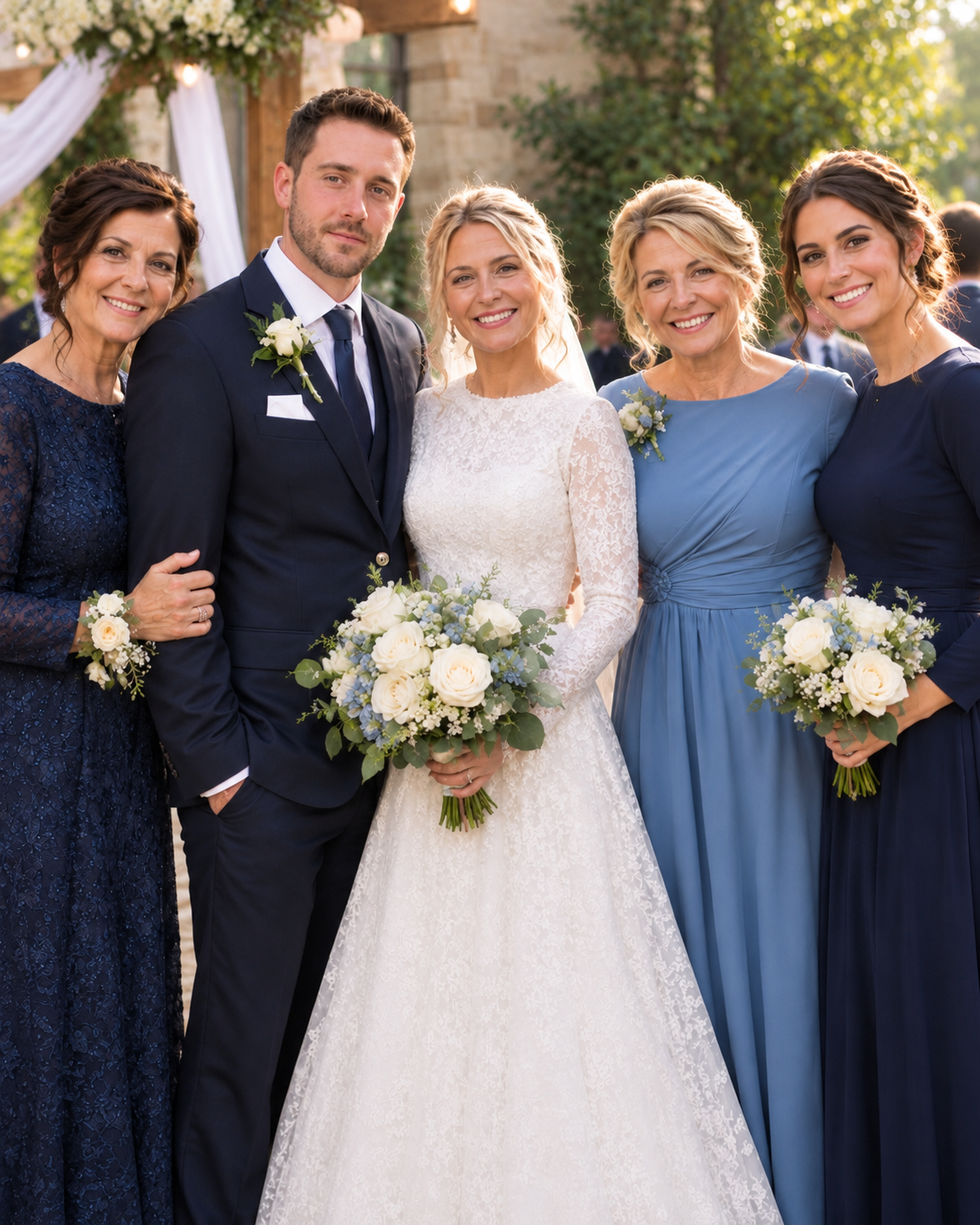
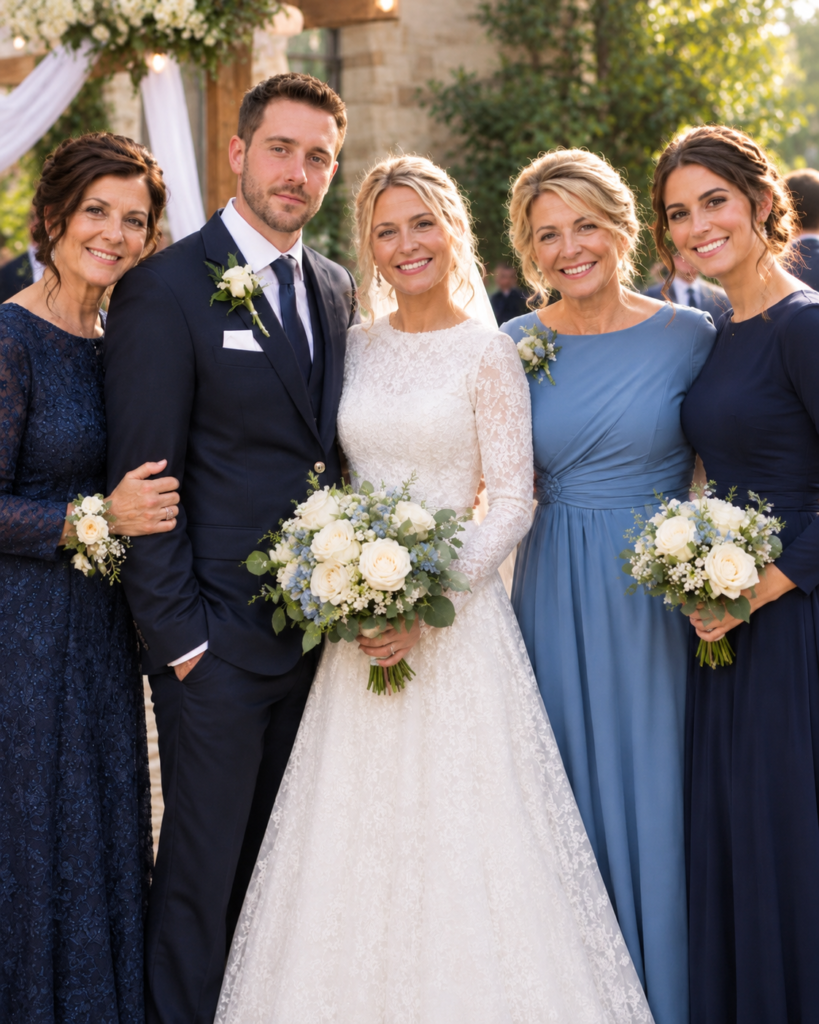
Vanessa’s mother was wearing blue.
For a second, I honestly thought I was seeing things.
I’d spent money on a whole new dress because Vanessa specifically asked me not to wear that color.
And now her own mother was standing there in a gorgeous floor-length blue gown like it was the most normal thing in the world.
What the hell?
I was already annoyed.
Then I looked around.
Even two of her aunts were wearing blue.
They all had matching little corsages too.
I found Vanessa before the ceremony.
“You told me no one was supposed to wear blue.”
She shifted uncomfortably.
“Not exactly.”
“Then why did you tell me not to?”
Before she could answer, her mother stepped closer.
“Blue is for family.”
I stared at her.
“I’m the groom’s mother.”
She gave me a tight little smile.
I turned to my son.
“Grant?”
He wouldn’t meet my eyes.
“Mom. Please. Not now.”
Fine. I wasn’t going to start a fight on my son’s wedding day.
But I started noticing things I hadn’t before.
When Grant suggested taking one photo with just the two of us, Vanessa immediately shook her head.
“We don’t have time for that.”
Grant glanced at me.
“Maybe just one—”
“Grant. We have a schedule.”
He went quiet.
At dinner, Grant started telling his uncle about their honeymoon.
Vanessa interrupted him.
“No, honey. That’s not what we’re doing anymore. Remember?”
A few people laughed.
Grant laughed too.
But I saw his face turn red.
Later, I pulled him aside.
“What is going on?”
“Nothing.”
“Forget the blue dress. I’m talking about you.”
“Mom—”
“I’ve watched her shut you down all day, and you haven’t said a word.”
“She’s stressed. It’s our wedding day.”
“Grant, look at me.”
He finally did.
“Are you actually happy?”
For a second, he looked like he wanted to tell me something.
Then Vanessa appeared.
“There you are! Grant, seriously? I’ve been looking everywhere. We have a schedule.”
Then she looked at me and laughed.
“And Joan, could you please stop stealing my groom?”
A couple of people nearby laughed.
Grant didn’t.
Instead, he followed Vanessa back inside without another word.
I stood there for a moment, furious.
Part of me wanted to grab my son, take him outside, and ask him one more time what the hell was going on.
But this was his wedding.
So I went back to my table and kept my mouth shut.
For the next twenty minutes, I watched Vanessa laugh with her family like nothing had happened.
Grant barely said a word.
Then suddenly, I heard the sharp clink of a spoon against a champagne glass.
I looked up.
Grant was standing.
My heart skipped a beat.
Vanessa looked up at him, clearly surprised.
“I’d like to make a toast,” Grant said.
Then he looked directly at me.
And that’s when I saw it.
Grant was furious.\
PART 2
Grant stood there with the champagne glass raised, and the room went quiet around him like water settling.
“I’d like to make a toast,” he said again, slower this time, and I saw Vanessa’s smile tighten.
“To my beautiful bride,” Grant began, and a few people clapped politely. “And to her family, who have been so generous and welcoming to me these past two years.”
He paused. His hand wasn’t shaking anymore.
“And who taught me a very important lesson this week.” He looked slowly around the room—at the blue dresses, at the blue corsages, at the blue gowns. “Blue,” he said, “is for family.”
You could have heard a pin drop.
Vanessa’s mother froze with her champagne halfway to her lips. Her eyes cut to Vanessa, then back to Grant.
“For the last month, I’ve been told this wedding had a color palette. Navy and champagne and sage. I didn’t question it, because a groom in a rented tuxedo doesn’t get to weigh in on tablecloths.”
A nervous laugh rippled through the room and died.
“But it was never about the palette.” Grant turned and looked straight at Vanessa. “It was about my mother’s dress.”
Vanessa’s face went pale. “Grant, everyone is watching—”
“You called my mother last week and told her not to wear blue,” Grant said, “and then you put your mother in a floor-length blue gown, and your aunts in blue, and you gave them all matching corsages. Do you know what that made my mother? The only person in the room who didn’t look like she belonged.”
I sat frozen in my chair. I hadn’t cried all day, and I wasn’t about to start now.
“Did you think I wouldn’t notice?” Grant asked. “Did you think I was that far gone?”
Vanessa’s mother stepped forward, one hand raised like she could smooth the whole thing over. “Grant, sweetheart, you’re making a scene—”
“I’m making a speech,” Grant said, without looking at her. “And I’m not finished.”
He reached into his jacket, and for a second my heart stopped, because I had no idea what he was about to do. What he pulled out was a folded piece of paper. He smoothed it against his palm and held it up.
“Do you know what this is?” he asked the room. “It’s the seating chart. The one I never saw until this morning. The one that put my mother at table eleven, in the back corner, behind a floral arrangement taller than she is, while her family got the tables by the front.”
He let the paper drop onto the table.
“I told myself that was a mistake. I told myself a lot of things were mistakes.” He looked at Vanessa. “They weren’t mistakes. They were decisions. Every single one of them.”
“Grant, you’re making a scene—” Vanessa’s mother said again, stepping forward.
“Mom has been waiting twenty minutes for me to finish making a scene,” Grant said, without looking at her. “She can wait one more.”
He turned to me then, and for the first time all day, he actually looked at me.
“I heard you, Mom. You asked me if I was happy. And I didn’t answer you, because I didn’t want to say the truth out loud.”
He set the glass down with a small, sharp clink.
“Two nights ago, I came home early. Vanessa was on the phone with her mother in the kitchen, and she didn’t hear me come in. I heard the whole thing.” His voice stayed level, which somehow made it worse. “I heard them planning it. Laughing about it. ‘She’ll wear her sad little navy dress and sit in the corner and know exactly where she stands.'”
Vanessa made a small sound. I think it was supposed to be my name.
“And I heard your mother say, ‘That woman has had Grant to herself for thirty years. Now it’s our turn.'”
Grant looked at his new wife.
“I’ve spent the last year telling myself you were just stressed. That you loved me. That all the little ways you shut me down—the honeymoon, the photos, the way you correct me in front of people—were just… how you are.”
He shook his head slowly.
“But this wasn’t stress. This was a plan. And I stood there in the kitchen doorway and listened to you both laugh about making my mother feel unwelcome at her own son’s wedding.”
He reached up and loosened his tie.
“And that’s when I realized I’ve been lying to myself about a lot of things.”
Then he looked at Vanessa, and his voice dropped.
“I can’t do this.”
The room exploded.
PART 3
What happened next happened fast.
Vanessa’s father, Frank Callahan, was on his feet before Grant had finished speaking. He’s a big man, a builder, the kind of man who’s used to people standing up when he walks into a room.
“Grant,” he said, and it wasn’t a question. “Outside. Now.”
Grant didn’t move. “I’m not going anywhere, Frank.”
“Like hell you’re not. You don’t humiliate my daughter in front of three hundred people and then stand there with your hands in your pockets.”
“I think you’ll find,” Grant said quietly, “that I’m not the one who humiliated anyone.”
Vanessa started crying then—not the real kind, I’d learned to tell the difference, but the kind that gets people to look at you—and her mother rushed over and wrapped an arm around her and glared at me like this was somehow my fault.
And maybe, in their minds, it was.
I’ve spent my whole life being the woman who keeps the peace. Who lets things go. Who smiles and swallows whatever’s stuck in her throat because it’s easier for everyone else. My husband, God rest him, used to call me “the diplomat.”
But something in me had snapped at that dinner table, and it wasn’t snapping back.
I stood up.
“Joan, sit down,” my sister whispered, pulling at my sleeve.
I didn’t sit down.
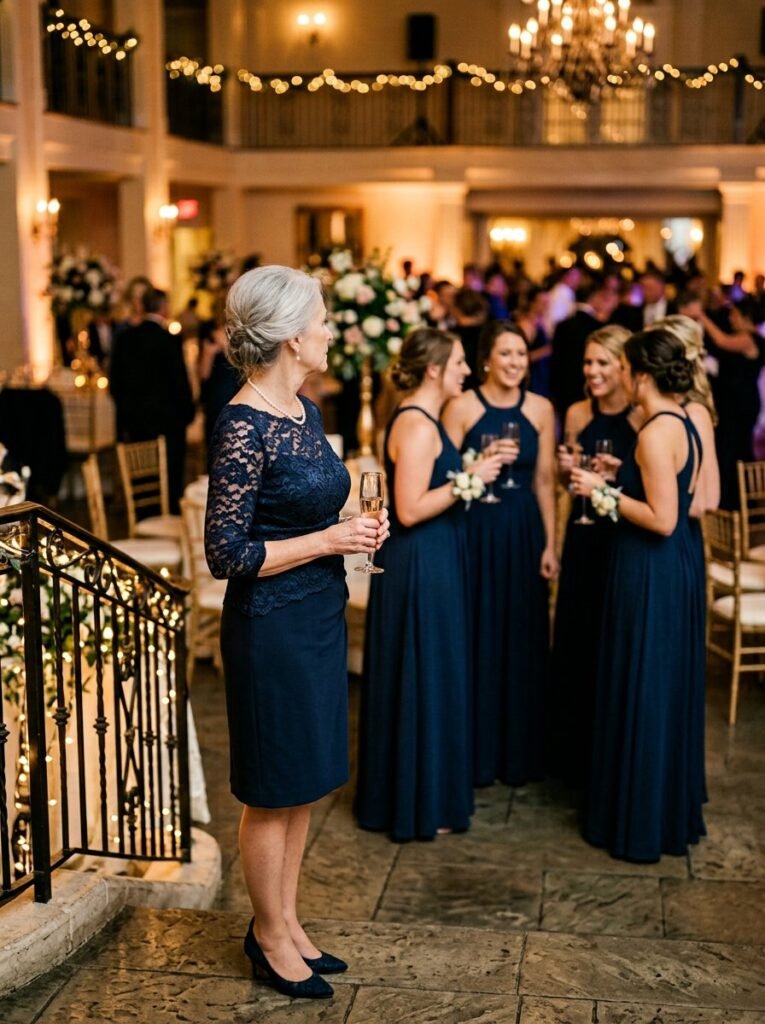
I walked across that dance floor—past the centerpieces, past the blue dresses, past my stunned cousins—and I stopped in front of Vanessa and her mother.
“Two days ago,” I said, “you called me and asked me, so sweetly, not to wear blue. And I didn’t. I went and bought another dress, because I believed you when you said it was about the photos.”
Vanessa’s mother opened her mouth.
“I wasn’t finished,” I said, and she shut it.
“I have done nothing to you. Nothing. I welcomed you into my family. I hosted your engagement party in my home. I took you dress shopping when your own mother was ‘too busy.'” I looked at Margaret then. “She wasn’t too busy, was she? She just didn’t want to be seen with me.”
Margaret’s face went a satisfying shade of pink.
“And through all of it, I kept my mouth shut. Because I thought that’s what a good mother does. She steps back. She lets her son’s wife have her place.”
I shook my head.
“But you don’t get to erase me. I am Grant’s mother. I raised that boy. I was there for every fever, every scraped knee, every graduation, every single day of his life before you ever met him. And you don’t get to dress me in navy and shove me to the edge of the photos and pretend I don’t exist.”
I turned to my son.
“And you,” I said, and my voice finally cracked. “You let her.”
Grant’s face crumpled. “I know, Mom.”
“No.” I held up a hand. “Not ‘I know.’ You stood there this morning and watched your mother stand alone in a room full of strangers in blue and you said, ‘Not now, Mom.'”
I stepped closer to him.
“I need you to hear me, Grant. I didn’t raise you to be someone’s doormat. And I didn’t spend thirty years loving you just to watch you disappear into someone else’s life.”
The room was dead silent.
And then Grant did something I didn’t expect.
He took off his wedding ring.
PART 4
Frank saw the ring come off, and something in him changed.
“Grant,” he said, and his voice was calm now, which was worse. “You work for me. You’ve worked for me for six years. I built that company with my own two hands, and I brought you in because you were going to be family.”
He took a step forward.
“Now, I’m going to ask you once, and only once. Put that ring back on, sit down, and finish this wedding like a man. Or walk out of here, and I promise you, you won’t just be walking out on my daughter. You’ll be walking out on your job, your future, everything you’ve spent the last six years building.”
Grant stared at him.
“You’d do that?”
“I’d do a lot worse,” Frank said. “Try me.”
And I watched my son’s face, and I saw it happen—the old fear coming back. The fear that had kept him quiet for a year. The fear of losing everything, of starting over, of disappointing people. I knew that look. I’d put it there, in my own way, all those years I taught him to be the calm one, the one who doesn’t make waves.
But before Grant could answer, Vanessa spoke.
“Grant.” Her voice was small and wet. “I’m pregnant.”
The room went so quiet I could hear the ice settling in the glasses.
She put a hand on her stomach and looked at him with those big eyes.
I didn’t believe her. Not for a second. I’d spent enough years around that family to know when a Callahan was reaching for the biggest weapon in the room. But I also saw the way Grant’s face changed—the way a man’s face changes when you hand him a future he thought he’d already lost—and I knew, in that moment, that this was the real test. Not the blue dress. Not the toast. This. Whether he would trade his whole life to keep a family he’d never truly been part of.
“That’s why I’ve been so stressed. That’s why I wanted everything perfect. I was going to tell you tonight, after the wedding.” She sniffed. “I wanted to tell you as a married couple.”
Margaret clutched her chest. Frank looked like he’d been hit in the face.
And I stood there, my heart pounding, watching my son look from his wife to her father to the ring in his hand, and I could see him calculating—the job, the baby, the life he’d planned, the life he was about to lose.
Nobody spoke.
Then Grant looked at me.
And in that look, I saw the question he’d been asking me his whole life, the one he’d never said out loud: Mom, what do I do?
But before I could answer, before I could do anything, Vanessa’s mother turned to me, and her face was ugly with triumph.
“Well, Joan?” she said. “You wanted to destroy my daughter’s wedding. Congratulations. You’re about to destroy your grandchild’s family too.”
She stepped closer, and her voice dropped so only I could hear.
“I told you blue was for family. And you—you will never be family.”
And I opened my mouth to answer, and I realized I had no words, because every word I had was caught behind thirty years of being told to be quiet, and for one horrible, frozen second, I thought I was going to lose him—lose him to her, to them, to everything they’d built to shut me out.
Grant was still looking at me.
PART 5
Then Grant did something I will remember for the rest of my life.
He didn’t put the ring back on.
He walked past Vanessa’s father without looking at him, past Vanessa and her mother, across that silent dance floor, and he stopped in front of me.
And he took my hand.
“Mom,” he said, “you asked me if I was happy.”
I couldn’t speak. I just nodded.
“I’m not,” he said. “I haven’t been happy in a long time. I’ve been scared. Scared of losing my job. Scared of disappointing everyone. Scared of being alone.” His voice shook. “And somewhere along the way, I got it all backwards. I started believing that being a man meant keeping my mouth shut and going along with everything, no matter how much it cost.”
He squeezed my hand.
“That wasn’t something you taught me. That was something I learned, on my own, in a house where I was slowly disappearing.”
Behind him, Vanessa let out a sound. “Grant, the baby—”
Grant turned to her, and his voice was steady.
“Then I’ll be the best father I can be,” he said. “But I will not raise a child in a home where I’m not allowed to speak. And I will not raise a child who watches his grandmother be humiliated and thinks that’s what family means.”
Vanessa’s face crumpled, and for once, I thought, maybe the tears were real.
Frank stepped forward, red-faced. “You’ll be on the street by Monday. I’ll make sure of it.”
“Then I’ll be on the street by Monday,” Grant said. “But I’ll be a man my mother can be proud of.”
And then he turned to me, and he pulled me into his arms, and I held my boy—my grown, hurting, brave boy—in the middle of that ruined, silent wedding, and I cried. Thirty years of holding it in, and it all came out on his shoulder.
“I’m sorry, Mom,” he whispered. “I’m so sorry.”
“You have nothing to be sorry for,” I said. “You found your way back.”
He pulled back and looked at me, and there it was—the boy I raised. The one with the steady hands and the soft heart and the stubbornness he got from his father. He was still in there. He’d just been lost for a while.
The wedding fell apart after that, the way weddings do when the groom walks out with his mother. There were raised voices, slammed doors, a lot of very expensive flowers left to wilt. Margaret called me a name I won’t repeat. Frank threatened to sue over the deposits.
Grant and I didn’t stay for any of it.
We walked out into the warm evening, the two of us, and for the first time in a year, he told me the truth—all of it. The money he’d been quietly putting aside, because something in him knew. The texts he’d found on her phone. The way she’d slowly cut him off from every friend he had.
“I knew,” he said quietly. “I knew a long time ago. I was just too scared to do anything about it.”
We walked for a long time, and we didn’t say much, and that was okay, because we didn’t need to.
And as the sky turned pink over the city, I looked at my son, and I finally understood what I’d been fighting for all along—not a wedding, not a color, not a place in some photograph.
Just him.
It’s been six months now. Grant has a new job—a better one, as it turns out, with a man who’d been trying to hire him for years. He sees his daughter every week. And every Sunday, he comes to my house for dinner, and he laughs, really laughs, the way he used to before any of this.
Last week, he told me he’s happy.
And that, more than any apology or any blue dress, is all a mother ever wanted to hear.