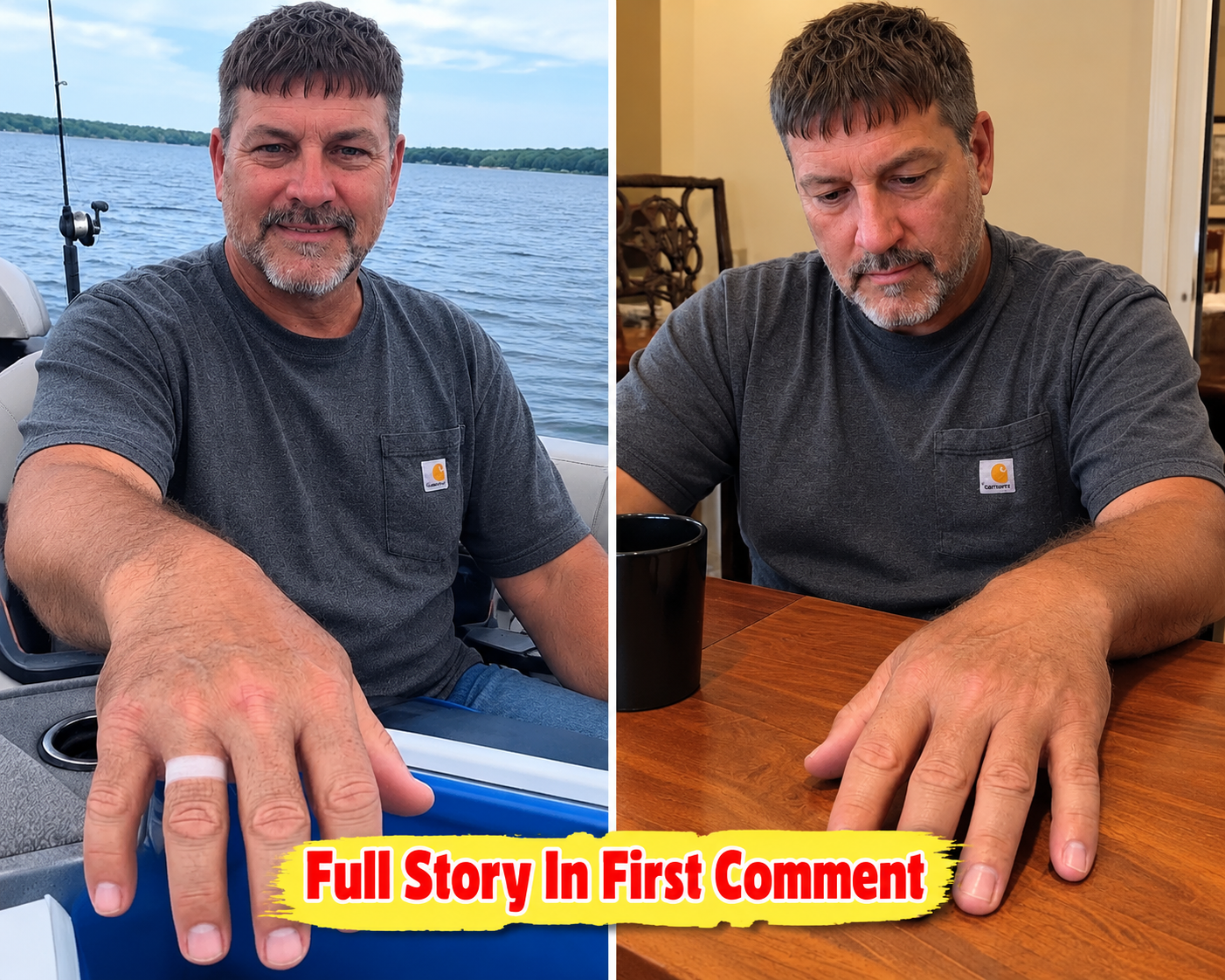
My husband returned from his annual three-day fishing trip with a strange white circle around his left ring finger.
At first glance, it looked like an ordinary wedding-ring tan line.
But there was one enormous problem.
My husband hadn’t worn his wedding band in twelve years.
When I asked him about the mark, his face went blank. He hesitated before claiming it was caused by holding his fishing rod.
I didn’t believe him.
Then I discovered a hotel key card and a jewelry receipt for more than $2,000 concealed in his luggage.
The hotel room was the exact same one where we’d spent our honeymoon twenty-six years earlier.
My first thought was that he had taken another woman there.
But when I finally uncovered what Mark had been keeping from me, I wished with all my heart that an affair had been the explanation.
Because his secret was something far more frightening.
And just one hour after I learned the truth, my phone rang.
It was my husband.
His voice shook as he whispered,
“Lee… I’m scared. I don’t know where I am.”
For nine consecutive summers, my husband, Mark Ellison, had enjoyed the same tradition.
Every year, he traveled to Loon Lake with three longtime friends for a weekend of fishing.
They always stayed in the same inexpensive motel, rented their boat from the same marina, and spent three days enjoying the outdoors.
Mark usually returned home on Sunday evening looking sunburned, relaxed, and happier than when he’d left.
He would excitedly show me pictures of his catch, complain about his friends’ terrible fishing techniques, and proudly present me with a jar of blueberry jam from his favorite roadside shop.
I had never questioned those weekends.
After twenty-six years together, I believed I knew my husband better than anyone.
But this time, something had changed.
When Mark arrived home that Sunday, he didn’t come into the kitchen to kiss me as he normally did.
Instead, he offered a distracted greeting, hugged me briefly, and carried his bag upstairs.
“How was the fishing?” I called after him.
“Pretty good. I’m just worn out.”
That was all he said.
At dinner, he barely spoke.
I asked whether the men had caught anything.
“A little.”
I asked how his friend Paul was doing.
“Fine.”
I mentioned the beautiful weather they’d had.
He nodded without looking at me.
I watched him push food around his plate.
Something was bothering him.
I could feel it.
But I convinced myself that he was simply tired from traveling.
Then he reached across the table for his glass.
And I noticed his left hand.
There was a narrow, unmistakable band of pale skin around his ring finger.
The surrounding skin had darkened in the sun.
But that single strip remained almost white.
It was exactly what someone’s finger looked like after removing a ring that had protected the skin from sunlight.
I stopped eating.
Twelve years earlier, Mark had badly injured that same finger in an accident at work.
The bone had fractured in several places, leaving the knuckle permanently misshapen.
Although we’d repaired his damaged wedding band, it became too uncomfortable for him to wear.
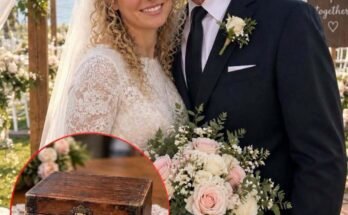
Eventually, he placed it inside a wooden keepsake box in our bedroom.
It had remained there for more than a decade.
At least, I thought it had.
“Mark,” I asked, trying to sound casual, “what’s that white line around your finger?”
He glanced down.
For one brief moment, he stopped moving.
Then he forced a little laugh.
“What line?”
“The one where a wedding ring would sit.”
He rubbed his fingers together.
“Oh, that? Must be from fishing.”
I stared at him.
“Fishing?”
“Sure. I held the rod so much that part of my finger probably didn’t get any sun.”
He immediately looked down at his dinner.
“These potatoes are great, by the way.”
I didn’t respond.
I’d fished with my grandfather often enough to know that gripping a fishing rod didn’t create a perfectly circular tan line around a single finger.
Something had been wrapped around Mark’s finger.
Something shaped exactly like a ring.
And he’d lied about it.
The next morning, after he left for work, I went upstairs and opened his dresser.
The old wooden jewelry box was still there.
Inside lay the same scratched wedding band.
I recognized the tiny repair seam on its underside.
The ring hadn’t moved.
I stood holding it for several minutes.
Whatever Mark had worn during that weekend, it hadn’t been the wedding band I’d given him on our wedding day.
I put it back and closed the drawer.
Then I began looking for another explanation.
That afternoon, I checked the photographs his friends had shared from the trip.
There were pictures of boats, fish, sunrise over the lake, and the four men laughing around a campfire.
But Mark appeared in only two.
In the first picture, he sat in the boat with his left hand tucked inside his jacket.
In the second, he stood near the fire with one arm around a friend and his other hand hidden behind his back.
I enlarged the images.
Neither revealed his ring finger.
Perhaps it was coincidence.
But after his strange excuse at dinner, I couldn’t ignore it.
Then I noticed another photograph.
It had been taken on Saturday morning outside Gull’s Nest Café, a small restaurant near the marina.
Three of Mark’s friends were eating breakfast.
Mark wasn’t in the picture.
Yet I counted four plates and four cups of coffee.
One place at the table was empty.
The meal in front of it appeared untouched.
Maybe he’d gone to the restroom.
Maybe he’d stepped outside.
There were several perfectly harmless possibilities.
Still, curiosity got the better of me.
I found the café’s telephone number and called.
A friendly woman answered.
“Gull’s Nest Café. Carol speaking.”
“Hello. I’m wondering whether my husband might’ve left something behind when he visited on Saturday morning.”
“Of course, dear. What’s his name?”
“Mark Ellison.”
The woman stopped speaking.
For several seconds, I heard only distant restaurant noises.
“Hello?” I asked.
Then she spoke again.
Her voice had lost all its cheerfulness.
“Are you Mark Ellison’s wife?”
“Yes. Why?”
Another silence.
Then she whispered,
“Oh, sweetheart…”
There was such sadness in those two words that my stomach twisted.
I recognized pity when I heard it.
And I suddenly couldn’t bear the thought of what she might tell me.
I ended the call.
For several minutes, I stood motionless beside the kitchen counter.
Why had that woman recognized Mark’s name?
Why did she sound so upset?
And why did she seem to know something about my marriage that I didn’t?
When Mark returned from work that evening, he acted entirely differently.
He kissed me on the forehead.
Asked how my day had gone.
Told me a funny story about one of his coworkers.
He even helped wash the dishes without being asked.
Under normal circumstances, I would’ve appreciated the attention.
But after his withdrawn behavior the previous evening, his sudden affection made me uneasy.
It was as though he were working very hard to convince me that everything was normal.
Later, we watched television together.
He put his arm around my shoulders.
I leaned against him, listening to the familiar rhythm of his breathing.
I wanted to believe I was imagining everything.
We’d survived so much together.
Financial difficulties.
Family losses.
The challenges of raising a daughter.
The ordinary arguments and compromises of a long marriage.
Surely he wouldn’t throw all that away.
But the ring mark remained.
So did the photographs.
And Carol’s strange reaction on the telephone.
That night, after Mark fell asleep, I quietly opened our closet.
His travel bag was still sitting near the wall.
That was unusual.
Mark ordinarily unpacked as soon as he returned from a trip.
He disliked leaving dirty clothes inside his luggage.
I carried the bag into the hallway and unzipped it.
Inside were all the things I expected.
Jeans.
Socks.
A sweatshirt.
Fishing clothes.
Sunscreen.
Toiletries.
Nothing suspicious.
Then I slipped my hand into a small side compartment.
My fingers touched a plastic card.
I pulled it out.
A hotel room key.
Printed across the front were the words:
LAKEVIEW INN — ROOM 12
My breath caught.
Mark always stayed at the Pine Rest Motel with his friends.
But the Lakeview Inn was an entirely different place.
It was a beautiful lakeside hotel with private balconies, elegant rooms, and spectacular views.
And Room 12 wasn’t unfamiliar to me.
Quite the opposite.
It was where Mark and I had spent our honeymoon twenty-six years earlier.
I still remembered the fireplace.
The balcony overlooking Loon Lake.
The rain that fell during our second evening.
And the promise Mark made as we stood together beside the window.
“One day, Lee, we’re coming back here.”
He’d said it with that familiar smile I’d fallen in love with.
Now I was holding a key card to our honeymoon room.
And I hadn’t been the one staying there.
Had Mark taken another woman to the place where we’d begun our married life?
My hands started shaking.
I reached into the pocket again.
This time, I found a folded receipt.
It came from a jewelry shop not far from the lake.
The purchase had been made on Saturday.
The total was more than two thousand dollars.
On the back, someone had written:
Personal engraving completed. Congratulations, Mr. Ellison.
I reread the message several times.
Congratulations?
What was he being congratulated for?
There was the mark from a ring.
An expensive jewelry purchase.
A hotel room filled with our honeymoon memories.
And a woman at the café who sounded heartbroken when she realized I was his wife.
My thoughts turned toward the explanation I feared most.
Another woman.
Perhaps a proposal.
Perhaps even a secret marriage.
I sank onto the hallway floor, holding the receipt.
For twenty-six years, I’d believed Mark was the one person I could trust without question.
Now I wondered whether he had been giving someone else the promises he once gave me.
I carefully returned the items to his bag.
Then I put everything back in the closet.
I didn’t wake him.
I didn’t confront him.
Not because I wasn’t furious or frightened.
But because I needed to know exactly what was happening before I accused him of something that could destroy our marriage.
The next morning, after Mark left for work, I entered his home office.
His laptop sat on the desk.
I opened it.
A password screen appeared.
For years, he’d used a combination involving our daughter’s name and the year she was born.
I tried it.
Incorrect.
Next, I entered our wedding anniversary.
Incorrect.
I tried another old password.
Incorrect.
A warning appeared.
Only one attempt remained.
I stared at the screen.
Mark had never been secretive about his computer.
Why would he suddenly change the password?
I thought about the weekend.
The hotel.
The jewelry store.
The strange ring mark.
Then I remembered the place where he’d supposedly spent the entire trip.
Loon Lake.
I typed those two words.
Pressed Enter.
The laptop unlocked.
My pulse quickened.
Most of the desktop looked familiar.
Work invoices.
Construction estimates.
Family photographs.
Tax documents.
Then I spotted a folder I’d never noticed before.
It had no ordinary name.
Only a small golden wedding-ring icon.
My hand hovered over the mouse.
For a moment, I considered closing the computer.
Maybe I didn’t want to know.
Maybe whatever I found would permanently change the way I saw my husband.
But I couldn’t go on living with so many questions.
I opened the folder.
Inside were photographs, videos, financial spreadsheets, and several documents.
At the very top was a video file.
Its title made my heart stumble.
START HERE — FOR LEE.
Lee.
Mark’s private nickname for me.
He’d called me that since we were teenagers.
Almost nobody else knew it.
I clicked on the video.
My husband appeared on the screen.
He was sitting in the same office chair I occupied.
But something about him looked different.
His face was pale.
His eyes were red.
He seemed older and more exhausted than I’d ever seen him.
He stared at the camera for several seconds before speaking.
“Hi, Lee.”
His voice trembled.
“If you’re watching this, there’s something I’ve been afraid to tell you.”
He paused, wiping his eyes.
“Before I explain anything, I need you to know that every single thing in this folder was meant for you.”
I leaned closer.
Mark took another breath.
“I should’ve told you months ago. I know that.”
He looked down at his hands.
“But I kept believing I had more time.”
More time?
What did he mean?
My chest tightened.
He looked into the camera again.
“I never wanted you to find out this way.”
Then he began explaining the secret he’d been carrying for months.
Something he’d concealed behind ordinary conversations, work schedules, and reassuring smiles.
And within moments, I felt the blood drain from my face.
Suddenly, the strange tan line wasn’t evidence of another woman.
The expensive jewelry receipt wasn’t what I’d believed.
Neither was the hotel key.
Even the woman’s reaction at Gull’s Nest Café began to make sense.
Mark hadn’t been secretly building a future with someone else.
He’d been desperately trying to protect the future he thought we were losing.
I sat motionless before the screen, struggling to comprehend what he was telling me.
For twenty-six years, I’d trusted that whatever happened, Mark and I would face it together.
Now I understood that he’d been fighting something terrifying without me.
And he hadn’t known how to ask for help.
Exactly one hour after I uncovered his secret, my phone rang.
Mark’s name appeared on the display.
I answered immediately.
“Mark? Where are you?”
At first, I heard nothing except unsteady breathing.
Then he whispered my nickname.
“Lee?”
“I’m here, sweetheart.”
His voice broke.
“Something’s happening.”
I gripped the phone.
“What’s wrong?”
He was silent for several seconds.
Then he said the words that changed everything.
PART 2
“Lee… I’m scared. I don’t know where I am.”
“Put both hands on the steering wheel,” I said. “Don’t move the truck. Is it in park?”
A pause. “Yes.”
“Tell me what you can see.”
He described it the way a child describes a room in the dark. A gravel lot. A blue sign with white letters. Water through the trees.
“Can you read me the sign?”
Silence, and then, in a voice I did not recognize: “I can see it. I can’t make it say anything.”
That was the sentence that told me more than ten thousand dollars of doctors ever would.
I said our address three times and asked him to say it back, and he could not, and I told him that was all right.
Then I pressed the button in the app I had put on his truck four years earlier — the one he laughed at when I did it, the one called Locate My Vehicle — for the first time in my life. A blue dot sat behind the Pine Rest Motel, six miles past the lake turnoff — the motel he could have found blindfolded, in the rain.
He was still sitting in the truck when I got there, hands on the wheel, and he looked up through the windshield with the relief of a man who had been waiting for hours and said, “There you are.”
Twenty minutes later, in the passenger seat of my car, he was Mark.
That frightened me more than anything he said, because a man who has just been rescued from a parking lot does not sound like that unless he has been there before.
Around five o’clock he stopped in the doorway of his office with his back to me. The folder was still open on the laptop. I had not hidden it.
“You watched it,” he said.
“How far do you think, Mark.”
Then my husband put his face in his hands and made a sound I have heard only once before, in a hospital hallway in 2009.
March 4th, at a neurology suite in Rochester, paid in cash so the insurance statement would not come to this house. A scan where they look for what they look for, find none of it, and tell you anyway.
“Early-onset,” he said. “They call it that because I’m fifty-four. Seven months, Lee. Seven months, and every morning I could still make you a pot of coffee and go to work, and I counted the day a win.”
The ring, then. Not our old band with the repair seam from the accident that wrecked his knuckle. In August he had called around until he found a jeweler at the lake and had a band made — weighted, built to sit on top of the misshapen knuckle instead of bending around it. Two thousand one hundred dollars, engraved inside in script so small I needed my reading glasses.
It was for the twenty-sixth of October. In June he had reserved Room 12 at the Lakeview Inn for one night, at the off-season rate, and asked, in his careful way, whether the balcony had been repainted.
He wore it fishing all weekend to test it, then took it off in the truck before he came in the door, because he could not have his wife see the ring in September when he meant to put it on her finger in our old room, with the fire going.
“I wanted to say it right,” he said. “I had the whole thing written down.”
I called Carol the next morning from the driveway. On Saturday morning she had asked him whether his wife knew. “No,” he told her. “And I’ve got one thing left to do first. I need to know if this is the place with the round table.”
“Oh, sweetheart,” Carol whispered to me over the phone, and I finally understood the two words from Tuesday, and sat in my own driveway and cried where my sleeping husband could not hear it.
That night, in the dark, he told me the folder was not letters. It was instructions — the mortgage, the pension, our daughter’s tuition, and the name of every person I would have to call.
“Best case, four years. And one of these days I’m going to walk out of this house and the road is going to stop making sense. That’s how you’ll know it’s started, in case all the other things haven’t told you yet.”
Then, into the dark: “I was going to tell you in October. In our room. With the fire on.”
Seven months, alone. It took a gravel lot six miles past the lake turnoff to hand it to me. There were nine pages behind the video, and I had read four.
PART 3
I made him go back to Rochester, and I made him take me with him.
“Lee, they’ve already told me everything.”
“Then they can tell me everything too. I’m the one who’s going to be living here.”
We drove up the last Tuesday in September. At the exit he said, without looking at me, “I don’t want them to see me like this.” I said, “They’ve already seen you. That’s their job.”
The clinic is on the fourth floor of a building attached to the hospital by a skybridge. Dr. Renu Bakshi was a woman our age, and when I walked in behind my husband I saw her face do three things in one second — recognition, pity, relief. A man who comes to a memory clinic alone for seven months is a specific kind of patient.
She is the one who told me the word. Young-onset Alzheimer’s disease. Before sixty-five. No history in either family. It is not stress and it is not anything he did, and there is no one to be angry at, which is the part nobody warns you about.
“Most of my patients spend the first year arguing with the diagnosis,” she said. “Your husband spent his first seven months getting his affairs in order.”
Then she asked what I wanted to know, and I found out I had a list. What he can still do, and how long. Driving, and when. The medications — donepezil, prescribed in April, still being refilled, which was when I understood that he had been driving to a pharmacy in another town and paying cash so that a bottle of pills would never show up on a statement I might open.
Whether he would know me in a year. Whether he would know our daughter at her wedding.
The last one I asked with my voice doing something I did not recognize.
“He may not,” she said. “What I can tell you is that he’ll keep something, and it isn’t usually what the family expects. It’s often the oldest thing in a person. The thing that went in first.”
A name. A song. A place.
Mark sat beside me with his hands folded, and when she said that, he looked up at the wall clock, and I knew exactly which place he was thinking about.
Out in the parking lot he stopped walking. “You shouldn’t have come. You have no idea what you just signed up for.”
“You spent seven months protecting me from something that isn’t coming for me,” I said. “It’s coming for you, Mark. Only for you. You don’t get to do this one alone, and if you ever try it again, I’m selling the boat.”
He laughed in that parking lot, eleven days after he could not read the word on a blue sign, and then he put his arms around me in front of a woman getting into a Prius.
We told Nora that weekend. She is twenty-two, four hours away, and has her mother’s temper and her father’s way of writing things down. He told her himself, in a coffee shop, because he would not do it in her apartment, and he did it better than he ever told me.
She asked what could be done, and then the two questions I had already asked: whether it came from somebody, and whether it was in her. It can be tested, entirely her decision. Then she asked the question he had not prepared for: “Dad, what do you want to do with the time?”
That is how we found out that in June, when he was still telling himself he had time, my husband had made a reservation for four.
Room 12 for the twenty-sixth of October. And one thing he had confirmed with a woman named Rosa at the front desk: on decent nights, the inn lets people stand out on the breakwater at the north end, where the lantern is. The spot where he proposed to me twenty-six years ago. He has never once forgotten it, and he has never once taken me back.
I said we were going. He said something about what a person is supposed to do with a date on a calendar when everything behind it is a question. I said we were going, the way I had said we were going to Rochester.
The two weeks that followed were the most ordinary we have had since the summer. He worked nine of the days. He mowed the lawn twice, and the second time in diagonal stripes for the first time in twenty-six years, because the neighbor’s grandson had done theirs that way.
Then, on the twenty-eighth of September, he left the house at 9:15 in the morning to drive to the roadside shop for blueberry jam — a thing that takes eighteen minutes and one left turn.
I did not notice he was gone until 11:40, when I got up from a conference call and saw that the truck was not in the drive.
At 11:44, I opened the app.
PART 4
At 12:06 I was standing at the door of Room 12, ninety-one minutes from home, with a key the girl at the front desk had handed me without a single question.
The fire was on. On the little table by the window, set out in a line the way a man does when he is doing something in order: the wooden ring box from our dresser, the new band inside it, the printed confirmation for the twenty-sixth of October, and a jar of blueberry jam.
He was sitting on the end of the bed in his fishing jacket with the reservation page in his hands, and when he heard the door he looked up politely.
“I’m sorry,” my husband said. “Have we met?”
“No,” I said, because I was not going to lie to him, and because I could not think of a single one of the true things to say.
I sat down in the chair by the window and did the thing I have been learning since September, which is to slow every motion down to the size of the room he is in.
“You’re in Room 12 at the Lakeview Inn. It’s the twenty-eighth of September. You drove up this morning to buy jam, and you booked this room, and I came because I was worried, and the woman at the desk gave me a key because I told her our names.”
He listened to all of it. He is a courteous man. Then he looked back down at the paper in his hands.
“It says October,” he said. “Two-six.”
“That’s our anniversary. That’s the date you picked.”
It was the word our that did it. Not his own name, not the address, not the year. I have thought about that for a year.
He asked me, in a very small voice, what his own name was.
I told him his name. Then our address. Then our daughter’s name, then the street outside the movie theater where we met in 1995, which has been a mattress store for a decade. He came back to me forty minutes later, around four in the afternoon, and said one word: “Lee.”
Three weeks after that, a state trooper found him at the end of our own road, in the truck with the engine running, holding a fishing rod. Nine days later, Dr. Bakshi took his license. I will not describe what he said to me in the car.
By the middle of October I had stopped measuring this as a story and started measuring it as a job. I did the paperwork he had done twice, and learned that a man who prepares a folder in June, when he can still read and write and remember, does not prepare it again in January, when he cannot.
Every one of the forty days that followed, one thing stayed on the calendar, because I kept it there. The twenty-sixth of October.
I spoke to Rosa at the inn twice. The reservation had been paid in full in June, and a man had called her in September to ask whether the lantern at the north end would be lit in late October, and whether a man with cold hands could get out along that breakwater or would need somebody to put an arm through his.
On the twenty-fifth, the day before we were supposed to leave, I went through Mark’s canvas work bag for his wallet and found, in the small side compartment — the same pocket where I had found a key card and a receipt in September — the wooden keepsake box, the new band, and one thing I had never seen in my life: a thin gold ring, a woman’s ring, and a scrap of paper in my husband’s handwriting that said, “for the twenty-sixth, if I still know her.”
I sat down on the mudroom floor with it in my hands.
At 9:41 that night, my phone rang, and the name on the display was the memory clinic in Rochester. I let it ring. Then I answered it.
It was not the nurse. It was Dr. Bakshi herself. She said my name, and then she said the sentence I have been holding in my hands ever since.
“Lee, I want you to sit down before I say this, because I have been studying his scans for three weeks, and I think we may have gotten one thing wrong about how fast this is going to move.”
Behind her voice, I could hear a door closing.
PART 5
The doctor did not save my husband. I want that said plainly, because for a week I let myself hope in a way I have never let myself hope about anything, and hope is expensive when it is wrong.
What she had was a second opinion on the first one. Not the diagnosis — that held. The rate. His scan from March and his scan from September, side by side. The change between them was smaller than it should have been, and a man with work to do holds what he has a little longer.
“I can’t tell you years,” she said. “I can tell you that when we tested him in September, he did better than he did in June. And he is one of the few patients I have who walked in with everything already written down.”
It did not change the direction we were walking in. It changed the pace, and it changed the day.
People have asked why we went, and the honest answer is this: he bought it in June, when he could still read and drive, and there was still a man in that house who had written “for the twenty-sixth, if I still know her” next to a woman’s ring, and I will be damned if the only person who ever reads that line is me.
Nora drove up on the twenty-fifth. She held his hand in the car for the whole ninety-one minutes.
Rosa had the fire on when we got there. Room 12, rain all afternoon, the balcony repainted, and a jar of blueberry jam on the window table that I had bought that morning — not from the old man’s roadside shop, because he sold out in January to a family from Iowa, and it is not the same jam, and Mark has never once mentioned it.
We ate at the old dining room’s table by the window. He was tired, and he was in there, and there is no better way to say it: for ninety minutes he told Nora the story of the summer he taught her to swim in that exact lake, and she laughed with her whole chest, and I let the two of them have that hour without me in it.
At 8:40, the rain stopped.
The breakwater at the north end is a quarter mile of rock, and at the end of it there is a lantern on an iron post, red on the bottom half and white on top. The man who keeps it lit it that night because Rosa asked him to, and because his brother had called him in September to ask about it.
Nora and I walked him out with an arm through his on each side, at the pace of a man who counts his steps.
And Mark said, out loud, with his hands cold and his eyes on the water, the sentence he said in that exact spot on the night he asked me to marry him.
“One day, Lee, we’re coming back here.”
He did not say it to me. He said it to the lake, the way he had the first time.
Because he had not come back to remember it. He had come back to say it again.
I took the small wooden box out of my coat and told him who he was. My name. Nora’s. Our address. The date, the year, and that it had been twenty-six years since this rock. I told him the ring in the box was his, made in the summer, in an order he placed when he could still work a telephone and pay in cash.
He listened. He looked at the box. He asked me, very seriously, whether I would mind if he sat down on the stones first.
Then my husband of twenty-six years put his own ring on his own finger, over the knuckle that made our first band useless, and it fit, and he sat there on the breakwater with his hand out in front of him and looked at it for a long time in the lantern light.
He never put the thin gold ring on my finger. It is in the box in my coat pocket as I write this, and it will be there for a while yet.
Nora went up at ten for tea and warm socks, and for eleven minutes my husband and I were alone at the end of that breakwater.
He did not know the rain from 1999. He did not know the fireplace or the balcony or the name of the motel where he slept for nine summers, or how he had gotten to that rock.
He knew my name. He knew the water. He knew the sentence.
A name. A song. A place.
I have his scans in a folder on the same desk where he kept nine pages for me, and a medication schedule taped inside a cabinet door.
I also have one night in Room 12 at the Lakeview Inn, twenty-six years and twenty-four days after the first one, in which my husband put on the ring he had made for himself and said the promise again, at the end of a rock in a lake.
He cannot say it to me anymore. He has not said it in five months.
But he did not lose the last thing. He came back to the place where he started with me and said it one more time, with the ring on his hand, on a night when he did not know my address or his own.
Twenty-six years ago on that breakwater, he asked me for one day.
I’m writing this in the dark, in the room with the fireplace, next to a man asleep with his hand on the blanket.
It’s today, Mark.
We made it.