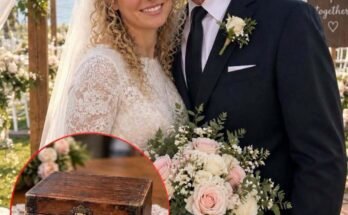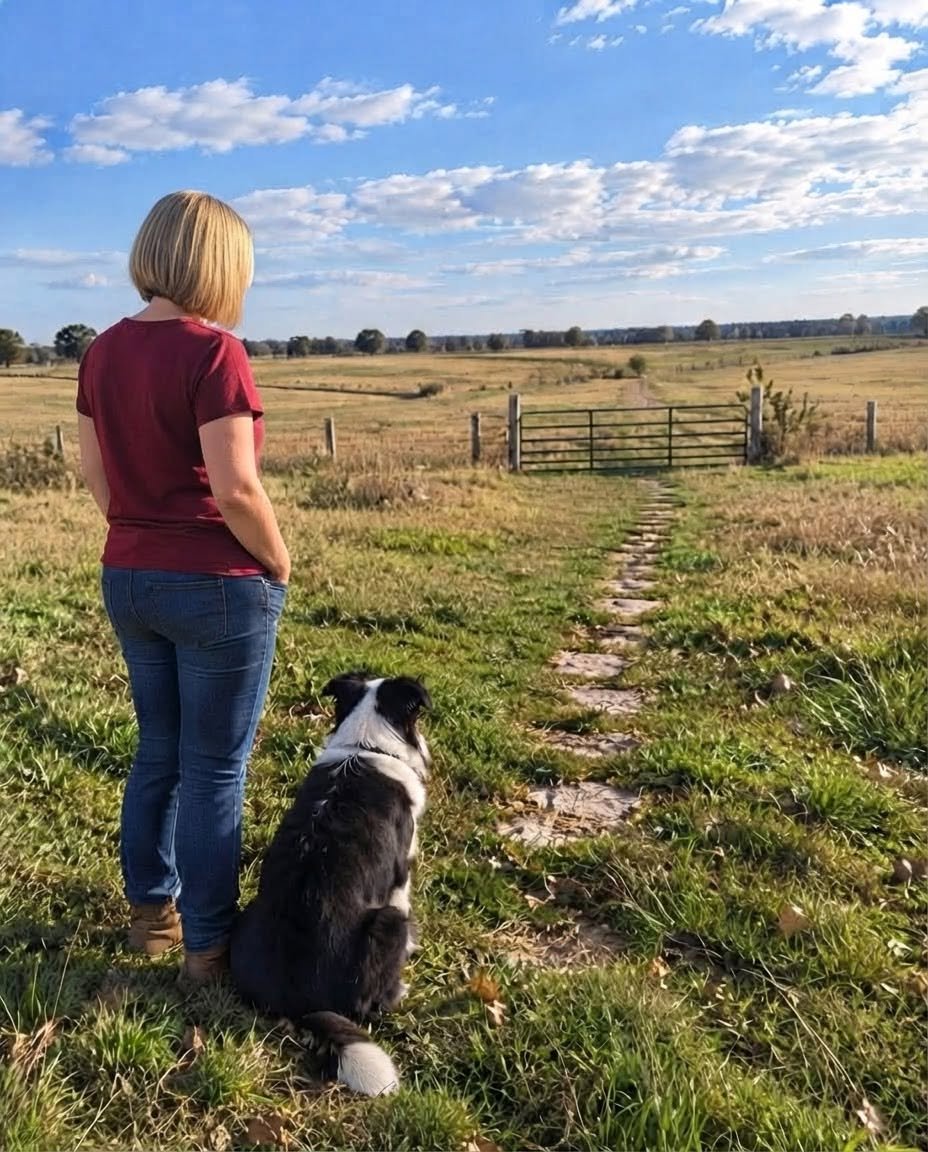
Just three days after we buried my husband, his brother took the hay Tom had harvested before his death and sold all 212 bales for $1,700 without asking me.
Then Dwayne walked into my kitchen, sat down at the table, and said something I will never forget.
“Karen, your husband is gone. You don’t need all that hay anymore.”
I could barely believe what I was hearing.
The hay was worth almost $15,000. Worse, it was the winter feed for our forty cow-calf pairs.
Without it, I might be forced to sell the herd my husband and I had spent decades raising.
But I didn’t raise my voice.
I didn’t threaten Dwayne or demand the money.
Instead, I looked him straight in the eyes and asked one simple question.
“Dwayne, can you tell me exactly who bought our hay?”
He casually gave me three names.
He had no idea that his answer would set something in motion that could save everything Tom had left behind.
Eleven casserole dishes sat untouched across my kitchen counters.
Neighbors had been bringing food ever since Tom’s funeral, hoping to ease a grief that no amount of cooking could touch.
It had been three days since we laid him to rest.
That morning, I’d driven out to our northern eighty-acre field.
Tom had mowed it the Monday before his death.
He passed away the following Tuesday, and we buried him on Saturday.
I expected to see hundreds of round hay bales waiting to be brought into storage.
Instead, I found bare ground.
Deep tire marks cut across the field, and pieces of baling twine lay scattered in the grass.
Not a single bale remained.
I already had a terrible suspicion when Dwayne showed up that afternoon.
“Got that hay taken care of for you,” he said, helping himself to a seat at my kitchen table.
I stood beside the counter.
“What exactly did you do?”
“Had it baled and sold everything.”
He said it as though he deserved a thank-you.
“How much did you sell it for?”
“Seventeen hundred dollars.”
For several seconds, I couldn’t find my voice.
Two hundred and twelve enormous round bales.
He’d sold them for approximately eight dollars apiece.
Good hay around us was selling for close to seventy dollars per bale.
Tom’s final harvest had been worth almost fifteen thousand dollars.
And Dwayne had practically given it away.
“After fuel and baling expenses, there wasn’t much left,” he continued.
I gripped the counter.
“So where’s the money?”
“Expenses ate it up. Just about broke even.”
Then he shrugged and added,
“Anyway, you’ll probably be getting rid of the cattle before fall.”
I felt something twist inside my chest.
Our herd wasn’t just livestock.
Those forty cow-calf pairs represented years of work, thousands of early mornings, and every sacrifice Tom and I had made to keep our little operation alive.
Dwayne knew what those cattle meant to us.
He’d been raised on a farm himself.
Yet he was speaking as though my husband’s death had automatically made our farm disposable.
Then he leaned forward.
“When you decide to put the land on the market, come to me first. We can work something out without involving an agent.”
I stared at him.
My husband had been buried less than a week.
His boots were still beside our back door.
His coffee mug was still sitting on the shelf.
And his own brother was already helping himself to our harvest and positioning himself to buy our property.
I wanted to ask him how he could possibly justify what he’d done.
But I was exhausted.
For days, I’d barely slept.
Every room in that house reminded me of Tom, and every conversation seemed to require strength I no longer possessed.
Besides, fighting with Dwayne wouldn’t put food in front of our cattle.
So I kept my expression calm.
“Well, thank you for taking care of the field.”
Dwayne relaxed immediately.
“Figured somebody needed to handle it.”
I pulled out the chair opposite him.
“Just one thing. Who bought those bales?”
He answered without hesitation.
“Arlen got eighty. Gene Pokorny bought a hundred. And that young husband and wife south of town took the last thirty-two.”
I recognized every name.
Arlen was seventy-eight and had been Tom’s friend for most of his adult life.
At the funeral, he’d stood beside me while I struggled to remain on my feet.
Gene was a longtime cattleman whose family had farmed nearby for generations.
And the young couple had recently purchased their first piece of farmland.
These weren’t strangers.
They were people who knew us.
I studied Dwayne carefully.
“What did you tell them when you offered the hay?”
His face changed.
Only slightly.
But I noticed.
“Told them you were winding things down.”
My fingers went cold.
“Winding what down?”
“The farm. The cattle. Everything.”
I stared at him.
“You told our neighbors I was closing the farm?”
“Well, that’s what most women would do in your situation, isn’t it?”
Suddenly, I understood.
Those buyers hadn’t knowingly taken advantage of a grieving widow.
They thought Dwayne was handling a legitimate sale on my behalf.
They believed I was selling off feed I would no longer need.
And because Dwayne was Tom’s brother, they trusted him.
I leaned forward.
“Dwayne, I’m going to give you one chance to make this right.”
His smile disappeared.
“What are you talking about?”
“I want all 212 bales returned by Sunday. If you can arrange that, we won’t have to take this any further.”
He let out an irritated laugh.
“Karen, they’ve been sold.”
“Then explain the situation to the people who bought them.”
“I’m not going back to three different farms asking for hay I’ve already sold.”
“You didn’t have permission to sell it.”
His jaw tightened.
“Look, I was helping you. If you don’t appreciate it, that’s your problem.”
He stood so abruptly that his chair scraped against the floor.
“The deal’s finished. I’m not discussing it again.”
Then he walked out.
The screen door slammed behind him.
I remained seated, listening to the silence.
A few moments later, my seventeen-year-old son, Ben, appeared in the doorway.
He’d been working in the machine shed and had apparently heard more than I realized.
His face was red with anger.
“Mom, you need to call the sheriff.”
I shook my head.
“Ben—”
“No! Uncle Dwayne stole Dad’s hay. He can’t just sell our stuff and walk away!”
He was right.
Every word.
But I had barely survived burying Tom.
The thought of turning his brother over to the authorities while funeral bouquets still filled our house made me feel physically sick.
More importantly, even if Dwayne faced consequences, we would still be missing the feed our cattle needed.
Legal proceedings could drag on.
The temperature would keep dropping.
And the animals wouldn’t care who was responsible.
They would simply need to eat.
“I’ll handle it,” I told Ben.
“But Mom—”
“I promise you, I’m not letting him take the farm.”
Ben looked at me for a long moment before quietly returning to the workshop.
I walked toward the mudroom.
Tom’s brown canvas work jacket hung from its usual hook.
The sleeves were faded, and one pocket had a small tear I’d been meaning to repair.
I reached into that pocket.
My fingers touched something familiar.
His notebook.
Tom carried that little book everywhere.
He wrote down breeding dates, hay yields, fencing repairs, veterinary expenses, and reminders about work that needed doing.
I opened it.
The final page contained an entry written the day before he died.
“North 80 finished. Excellent yield. Plenty to get Karen and the herd through winter, with some to spare.”
I sat down on the floor.
I read those words over and over.
Even in what turned out to be the final hours of his life, Tom had been thinking about keeping us safe.
He’d been making sure there was enough feed.
Enough for the cattle.
Enough to keep the farm running.
Enough to give Ben and me a future.
I pressed the notebook against my chest.
And for the first time since the funeral, I completely broke down.
I cried for the man who had shared my life.
For the empty place at our dinner table.
For the father Ben would never again work beside in the fields.
And for the fear that I might lose everything we’d built together.
Eventually, I dried my eyes.
I looked at Tom’s handwriting one more time.
Then I stood.
Dwayne might have believed I was a helpless widow who would quietly sell the land.
But he had made one very serious mistake.
He assumed that losing my husband meant I’d lost my determination, too.
That afternoon, I walked out to the rhubarb patch near our old windmill.
The plants were thriving.
I gathered enough stalks to make three homemade pies.
One for Arlen.
One for Gene.
And one for the young couple who had purchased the remaining hay.
My mother always taught me that when you had difficult news to deliver to a neighbor, you should arrive with kindness rather than accusations.
By the time the last pie came out of the oven, it was nearly one in the morning.
I slept for a few hours.
At eight the next morning, I was standing on Arlen’s front porch with the first pie in my hands.
He opened the door wearing faded jeans and an old plaid shirt.
“Karen! Well, this is a nice surprise.”
I lifted the pie.
“Made some rhubarb pie yesterday. Thought you might enjoy one.”
His face brightened.
“You know that’s my favorite. Come inside.”
He led me into his kitchen and brought out two plates.
Within minutes, we were sitting across from each other, each with a warm slice of pie.
For a little while, we talked about the weather.
Then he asked how Ben was managing.
I told him my son was doing his best.
Arlen nodded sadly.
“Tom was a good man. One of the best I’ve known.”
My throat tightened.
“I know.”
I set down my fork.
“Arlen, there’s something important I need to tell you about the hay you bought.”
He looked at me.
I took a slow breath.
“I’m not selling the farm, Arlen. And I never gave Dwayne permission to sell a single bale.”
His hand stopped halfway to his coffee cup.
“What?”
“Those eighty bales you purchased were part of our winter feed. Dwayne sold them without telling me.”
Arlen frowned deeply.
“He said you were getting out of cattle.”
“I know he did.”
“He told me you wanted the field cleared so you could start selling things off.”
I shook my head.
“That was never my decision.”
Arlen stared down at his plate.
I continued carefully.
“I’m not blaming you. You had no reason to think Tom’s brother wasn’t acting with my permission.”
He looked up again.
“Karen, I had no idea.”
“I believe you.”
I swallowed hard.
“But there’s something else I wanted you to know.”
My voice began to shake.
“Those bales came from the final field Tom ever harvested.”
Arlen went completely still.
“He cut it the Monday before he died. I found his notebook yesterday. He’d written that the harvest was enough to feed our cattle through winter.”
I glanced down, struggling to keep my composure.
“That hay was one of the last things my husband did for us.”
For several moments, neither of us spoke.
Then I said quietly,
“I didn’t come here to demand anything. You paid for those bales in good faith, and I understand that.”
Arlen remained silent.
“I just didn’t want you hearing some story around town that I was selling everything and walking away from the life Tom and I built.”
I tried to smile.
“That’s not happening. Not if I can help it.”
Arlen looked at me for a long time.
Then he slowly pushed his chair away from the table.
He stood without saying a word.
Walked across the kitchen.
And took his old felt hat from a hook beside the door.
I assumed I’d upset him.
“Arlen, I’m sorry if this has made things uncomfortable.”
He didn’t answer immediately.
Instead, he turned around with the hat in his hands.
His expression had changed.
The gentle, grandfatherly look I’d known for years was gone.
In its place was something far more determined.
Then he said something that made me realize my visit had taken a turn I never expected.
And by the end of that day, I would discover that Dwayne had badly underestimated more than just his brother’s widow.
PART 2
Arlen looked at the hat the way a man looks at a tool he has not needed in a while, then hung it back up and walked to the sideboard.
“Karen,” he said, “I lied to you about one thing.”
“What do you mean?”
He pulled out a leather ledger thick as a Bible and set it between the two pie plates. “I didn’t pay eight dollars a bale. Dwayne told me sixty-five.”
I sat very still.
Sixty-five dollars a bale, for eighty bales. Five thousand two hundred dollars. I had spent three days believing the whole harvest had gone for seventeen hundred.
His hay book went back to 1991 — every load, every buyer, every price. There at the bottom, dated the Wednesday after Tom’s funeral: eighty bales, Vance place, north field, sixty-five dollars, five thousand two hundred. And below it, one line that turned my stomach in a completely different way than before. Settled to D. Vance, cash, receipt 1441.
“Dwayne told you the money was coming to me,” I said.
“Dwayne told me,” Arlen said, with the terrible patience of a man reading his own figures back, “that you’d asked him to sell the north cut and get what he could, because you couldn’t bring yourself to be there for it.” He shut the ledger. “And I said that seemed like a kind thing for a brother to do.”
I reached into my coat and took out the notebook and read it to him in Tom’s words:
“North 80 finished. Excellent yield. Plenty to get Karen and the herd through winter, with some to spare.”
Arlen read it again, then sat with his hands flat on the table and did not look up.
“He came by here the Tuesday before,” he said. “Drank a cup of coffee standing at that counter and told me the north field did better than anything he’d ever cut.” He looked up. “Then he went home and died.”
“Yes,” I said.
“I’m not blaming you, and I’m not asking you for anything,” I said. “I came because I want you to hear what’s true from me and not from town.”
Arlen stood up and took his hat off the hook. When he turned around I did not recognize his face. The gentle man who had stood beside me at the cemetery was not in the room.
“Karen, how many bales did I take?”
“Eighty.”
“Then eighty is going back,” he said. “That’s not your money and it isn’t Dwayne’s. I’ve got a barn full of hay I’ve been holding for February.”
“Arlen, you don’t have to—”
He put his hat on. “That’s what makes it worth doing.”
Arlen dialed the wall telephone from memory. The first call began: “Gene, it’s Arlen. Did Dwayne Vance tell you a price on that hay you bought, or did he tell you it was a favor to a widow?”
He listened for a while, and his jaw worked.
“Uh-huh. That’s what he told you.” Then, “You didn’t do anything wrong. I’ll be by at nine.”
The second call was shorter. “Wayne, it’s Arlen. I need twenty minutes of your Saturday.” Then a young man’s voice through the receiver, and Arlen answering: “Son, you bought a dead man’s last harvest at a quarter of what it’s worth, and nobody blames you for it. I’m asking for the bales back as a courtesy, not a threat.”
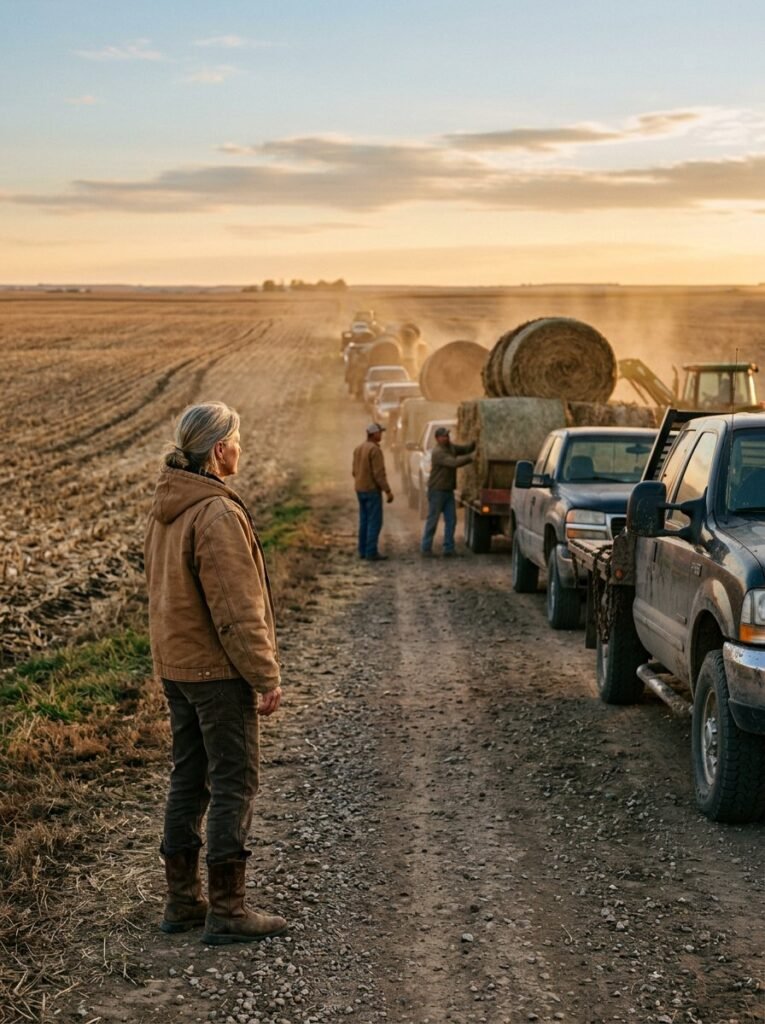
By quarter to nine that Saturday there was a column of trailers in the lane at our north forty.
Arlen came first with his gooseneck, one hand up off the wheel like a man driving to church. Gene Pokorny came second. Wayne and Melody Frank came last with their six-year-old between them holding a bag of peppermint candy, and Melody hugged me before she even looked at the field, and then asked me, in the smallest voice, what the hay was worth.
“Wayne paid him four hundred for thirty-two bales,” she said. “I thought it was the deal of the year.”
And Dwayne was there.
He was already in the field, of course, helping the man with the skid loader — what a person does when he wants to say later that he was only trying to help.
The first bale came off the first trailer and dropped onto that bare ground with the sound a bale makes, soft and final. Dwayne turned around and saw his brother’s harvest coming home behind him, bale by bale, from three directions at once.
Arlen got out and walked over to him, and did not raise his voice, and did not have to.
“Sixty-five dollars a bale, Dwayne,” he said. “That’s what you told me, and that’s my book right there. Which means the widow of the man who cut this hay is out thirteen thousand nine hundred dollars.”
Then a tailgate shut behind all of us, and every eye in that field turned.
There was a sheriff’s deputy walking across the stubble toward us with a clipboard in his hand.
PART 3
His name was Delroy Adams, and he had been to our house once before, in June, about a generator that walked off out of the machine shed.
“Mrs. Vance,” he said now.
“Karen,” I said.
“Karen.” He looked out at the field and did not react to it at all, which is what people who take statements are trained to do. “I need to hear the situation from you, and then I need to hear it from each of these folks, and then I’d like to hear it from Mr. Vance here, in that order, in my vehicle, one at a time.”
Dwayne said, “Now hold on—”
“One at a time,” Deputy Adams said. “Mr. Vance, you’re last.”
It took an hour and a half. I sat in the front seat of a county truck and said the facts, and he wrote them down and did not sympathize with me once.
When it was over, he came back to me on the edge of that field with his hat in his hand.
“Mrs. Vance, I want to be straight with you about a couple of things, because I don’t want to say one thing today and another thing next month.”
“All right.”
“First thing: what Mr. Vance did to you and what he did to these people are two different matters.” He looked at the clipboard. “For the hay, it’s civil unless the county attorney wants to argue theft by deception. That’s not my call.”
“And the second thing?”
“Second thing: the money paid to him.” He tapped the page. “Arlen Batts says five thousand two hundred. Gene Pokorny says six thousand and change. The folks in the red pickup say four hundred. That’s near eleven thousand dollars I’ve been told about this morning.” He looked up. “If a man tells you a sale came to seventeen hundred and it came to eleven thousand, that’s not a bookkeeping mistake. That’s mine, and I’d like your permission to look at it.”
“Look at it,” I said.
By Monday afternoon there were three hundred bales in my north stack instead of two hundred and twelve, because Arlen had sent over eighty-eight extra out of his own barn the moment he understood the line in Tom’s notebook about “with some to spare.”
And on Tuesday, Dwayne came into my kitchen again without knocking, the way he had the first time, and stood at the end of my table with his arms crossed.
“You want to explain why there’s a deputy asking my wife questions?”
“Sit down or leave,” I said. “I’m not doing this standing up again.”
“I’ll tell you what I think happened,” he said. “A bunch of old men got together and made a criminal out of the only family you’ve got left.”
“You told three households the same story about me. You told them I was closing the farm.” I set down the glass, because my hands were not steady. “Think before you answer, because Ben is asleep down the hall and I’m the only person left in this house who decides what he hears. Why?”
For the first time in the eleven years I had known my brother-in-law, Dwayne stopped talking and looked at the floor.
“Because Tom was going to give Ben the north eighty when he turned eighteen,” he said.
I did not understand him at first. “What?”
“Back in the spring. Said it at the sale barn, in front of two other men. His boy was going to run that ground.” Dwayne’s jaw worked. “Aunt Ruth left us that piece together in eighty-one. Half of it was mine until Tom bought me out in ninety-four, and he never let me forget he paid me full money for land that was half mine.”
“Fifteen thousand dollars,” I said. “He paid you fifteen thousand, and you’ve been waiting thirty years for something worth taking.”
“I wasn’t taking anything. I was owed.”
“Sixty-eight thousand dollars is what you were owed?” I heard my own voice come out low and steady. “You sold my husband’s last harvest to his best friend at a quarter of its worth, you told the neighbors his widow was closing the farm, and you’ve stood in my kitchen for three weeks telling me I’m a woman who doesn’t need hay. So listen, because I’m saying this once.”
He looked up.
“The hay is back, every bale, and you’re going to pay back every dollar those people gave you. I’m not selling you anything, Dwayne. Not the hay, not the land, not one blade of grass, and not one season of my life.”
“You can’t do that.”
“I can,” I said. “And you should know that the girl who used to ride in the tractor beside her dad on the north eighty is the one doing it. That’s Ben’s land. It was Tom’s. It never once was yours. Get out of my kitchen.”
He got out of my kitchen, and did not slam the door.
PART 4
It took twelve days for the county attorney’s office to decide they couldn’t leave it alone, and I want to be careful about those twelve days, because it is easy to hear a story like mine and believe a few good neighbors make everything easy.
I had forty cow-calf pairs, four hundred bales, a seventeen-year-old son, one hired man who was seventy-two himself, and 112 days until the first hard freeze. The hay was back, and solving one problem reveals the size of the other nine.
The winter feed was only half of what Tom had planned. He had intended to buy forty bales of alfalfa in November from a man in Ord, and I knew about that arrangement because every night for thirty-one years Tom came in from the barn and told me the shape of the whole day.
The deed was a different matter, and it was worse than I had expected.
Two days after Dwayne left my kitchen he filed a claim against the estate — a petition claiming an oral agreement and a right of first refusal on the north eighty, on the strength of that 1981 will and a conversation at a sale barn. Henry Nesbitt told me it was thin, and that thin filings cost money anyway.
“He’s not trying to win it, Karen,” Henry said. “He’s trying to make it expensive for you to keep it. The petition asks the court to freeze the north eighty until it’s heard. You cannot sell it, borrow against it, or use it as collateral to finance your winter. Unless you want to sell cattle.”
The freeze changed everything, and I have never told this part to the neighbors, or to Ben, or really to anyone.
It made me tired in a way I had never been tired. I heated a neighbor’s casserole and ate it standing at the counter and cried in the middle of eating and made myself finish it anyway, because the cattle were going to need me at four-thirty regardless of what was in my chest.
That night I sat at my kitchen table with a spiral notebook and did what Tom had done every Sunday night for thirty-one years. Line by line. Feed on hand, feed needed, nineteen of the forty cows due to calve in February, fuel, the vet bill in a bad year and a worse one.
The number at the bottom of that page was eleven thousand four hundred dollars, and I did the arithmetic twice because I wanted to be sure it was not wishful thinking. Both times it came out the same.
Gene Pokorny’s money had not gone to Dwayne’s expenses. It had not gone to fuel or baling. All eleven thousand four hundred dollars was still sitting in an account at the Farmers State Bank with both names on it, from the years when Dwayne and Tom ran a few head together, and the county attorney had told me Friday that a hold had been placed on it.
The money was not missing. It was frozen with the rest, and I understood for the first time what Dwayne had done with his brother’s harvest. He had not stolen it for the price. He had tried to sell it cheap enough to be invisible, take the difference, and let the whole county believe a widow’s last harvest was worth nothing.
And the man who stopped him was a seventy-eight-year-old with a hay ledger going back to 1991.
At 5:20 in the morning, the phone rang. It was the man in Ord, calling about the alfalfa Tom had arranged in September. He had been holding forty bales, he said, and had heard about the funeral.
“It’s still on,” I said. “But I’m going to need more than forty.”
“How much more?”
“Eighty,” I said. “And I’m going to pay for it in March, not on delivery.”
“Tom Vance’s wife,” he said finally. “All right. I’ll bring eighty. And I’ll take ninety days, same as I’d have done for him.”
I put down the phone and looked out the kitchen window at the north eighty in the dark.
And then I said, out loud, to a room with nobody in it: “All right, Tom. Now we go to the hearing.”
The hearing was set for the fourth of November, and the day before it, Dwayne Vance did the one thing I truly did not expect.
He called my son.
Ben came in from the shop at nine that night with his phone in his hand and his face white, and stood in the doorway, and then said, “Uncle Dwayne wants me to sign something.”
PART 5
“Sit down,” I said. “Hand me the phone.”
There was a photograph of a document on the screen — three pages, a signature line at the bottom — and two sentences above it: “Your dad would want this settled. Sign and we can stop all this.”
I read it twice.
It was an offer of settlement from an attorney in Grand Island: he would withdraw the petition, and in exchange my son — Benjamin Vance, seventeen — would convey his interest in the north eighty to Dwayne upon his mother’s death or marriage. Henry Nesbitt called it practically unenforceable and morally obscene.
Ben had come into that room white as a sheet, unable to say the sentence out loud, and I have never been prouder of anyone. I put my hand on his cheek and asked what he wanted to do.
“I want to show it to the judge,” he said.
“Then that’s what we’re going to do.”
The hearing was the fourth of November.
Arlen testified for forty minutes with the ledger. Gene Pokorny brought his cancelled check. Wayne and Melody Frank came in with their six-year-old in a dress and told the court, in a very small voice, what “the deal of the year” had cost them. Deputy Adams testified about eleven thousand four hundred dollars of cash receipts and figures that did not add up the way Dwayne told me they added up.
Dwayne’s attorney, paid out of what was left of the money, put my husband’s brother on the stand and let him talk too long, which is how these things usually come undone.
The judge let him talk, and then asked four questions, and the fourth one was: “Mr. Vance, when you told these three households the sellers’ widow was winding down her farm, were you stating a verified fact, or a hope you intended to arrange?”
“Your Honor,” he said, “in this family we take care of our own.”
The ruling came eleven days later in writing, and I read it standing in my own kitchen. The petition was dismissed, costs taxed against the petitioner. The court found no evidence of any interest or agreement superior to the title held by Thomas and Karen Vance in joint tenancy, and — this was the line I read out loud to Ben twice — further found that the settlement offer sent to a minor heir was an improper attempt to obtain a reversionary interest, and that any such instrument, executed or not, was void and of no effect.
The eleven thousand four hundred dollars came home in December, less the attorney’s fees a court ordered taxed against a brother.
He did not go to jail. In the versions of this story told around town, Dwayne always ends up in handcuffs, and I want to be honest: he did not. He pleaded to a misdemeanor, paid a fine and restitution, and served no time. I stood in that courtroom and felt nothing, which surprised me, and then I felt all of it at once in the parking lot, and Arlen stood beside the truck and looked at the grain elevator until I had finished.
What happened to Dwayne after that is his business. Two of his daughters stopped speaking to him, which was not my doing. His wife Bernice stayed, and has been kind to Ben, and none of this was ever Bernice’s. I have seen him at the co-op twice and nodded.
The alfalfa came in December — eighty bales from a man in Ord I have still never met. Ben and I unloaded it in the dark with the skid loader, and when the last one was stacked he looked at me with straw in his hair and said, “That’s the whole winter, Mom.”
“That’s the whole winter.”
The herd went through February fine. Nineteen calves, no losses, two cold nights in a barn in a lawn chair, and by March the whole thing looked like something a woman does and not something a woman survives.
I filed the final estate papers in June with the notebook in my bag, because the clerk asked for a signature and I gave them his, on the last page, right under “North 80 finished.”
In June we put tables in the yard under the windmill where the rhubarb grows, and the young couple who bought my husband’s last harvest at a quarter of what it was worth came back for supper and ate like neighbors do.
Arlen Batts is eighty-one now and still keeps the ledger. Last winter I sat in his kitchen and asked him, “Why did you go back out to that field?”
He thought about it.
“Karen,” he said, “when your husband’s best friend sells you eighty bales at a quarter price and tells you it’s a kindness to a widow, you should have a look at the book. That’s all I did. I looked at the book.”
Dwayne Vance made exactly one mistake, and it was not the price. It was that he did business in a county where people write things down. Every buyer had a receipt, and the man who had kept the best books in this county was Tom Vance’s oldest friend.
I keep the notebook in the kitchen drawer now, near the pens. Some nights I take it out, and on the last page, under “with some to spare,” I write down what we did with the year: the calves, the hay, the boy, the ninety-day alfalfa from a stranger in Ord, and Dwayne Vance’s name in a courthouse with the word void after it.
It says: Karen and the herd got through winter.
And both of us were right.