My 82-year-old mother was clutching her hospital bag, when my wife refused to let me borrow her car. “Your mother isn’t my responsibility,” she said coldly. I stared at her, unable to believe what I had just heard. I didn’t argue. I simply took Mom’s hand and walked away. But the following day, my wife called me thirty-eight times, desperate for an answer she never expected.
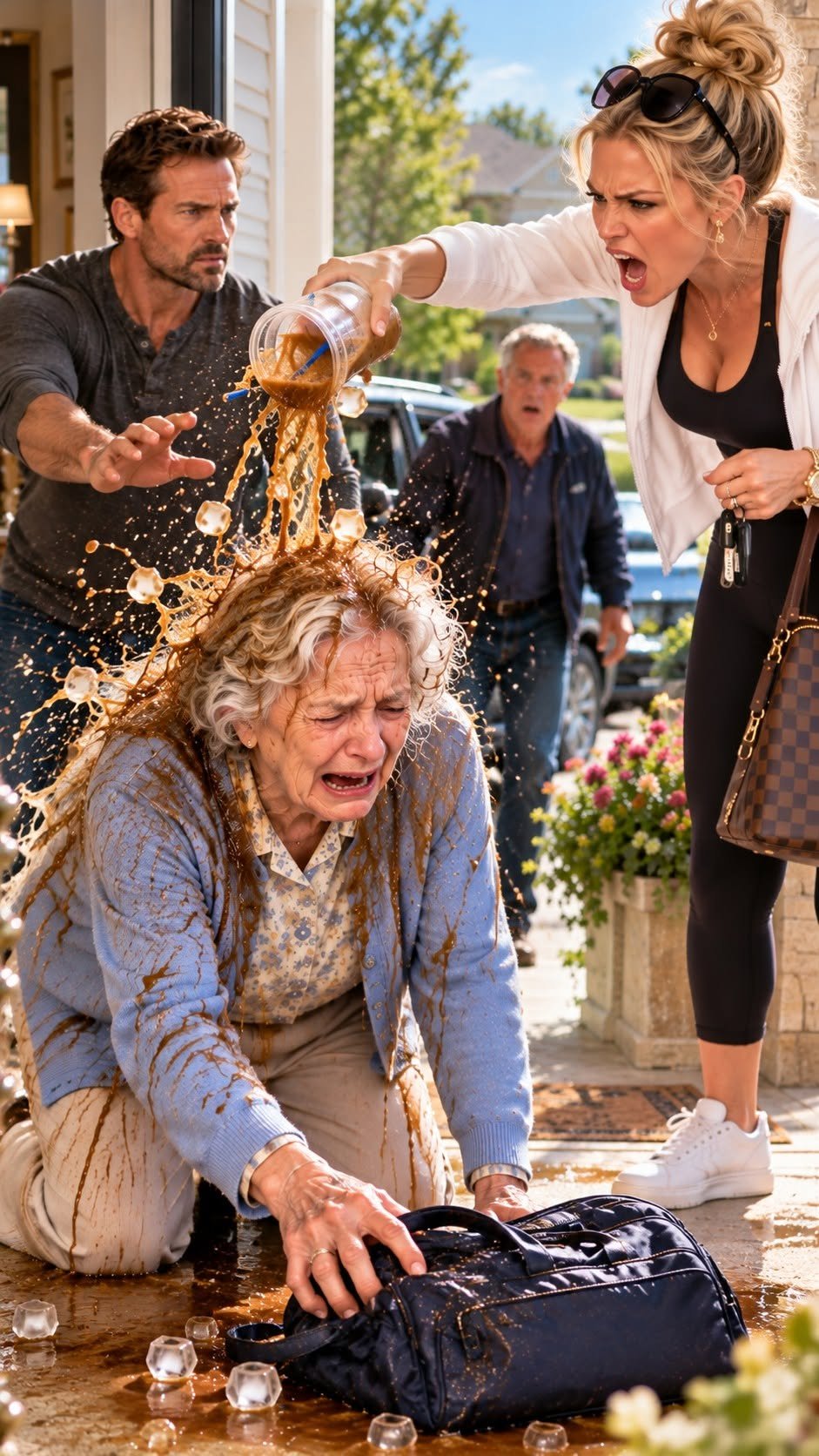
My eighty-two-year-old mother stood in our hallway clutching her hospital bag when my wife threw coffee at her and said, “Your mother isn’t my responsibility.” Her appointment was only forty minutes away.
My car was in the repair shop.
The SUV in our driveway was our only available vehicle.
For years, I had made excuses for Vanessa.
But when I saw my mother lower her eyes in embarrassment, something in me changed.
I didn’t argue.
I took Mom’s hand and walked away.
The next day, Vanessa called me thirty-eight times, desperate for an answer she never expected.
“Vanessa, she needs to see her specialist,” I said. “We’ve been waiting three months for this appointment. I only need the car for a couple of hours.”
My wife barely looked up from her phone.
She was dressed for brunch in expensive yoga clothes, an iced coffee in one hand.
The SUV keys sat beside her designer purse.
“Then find another way,” she said. “I have plans with my friends, and I’m not rearranging my whole day because your mother can’t manage her own appointments.”
I stared at her.
My mother had never treated Vanessa with anything but kindness.
She had been awake since five that morning.
She had chosen her favorite blue cardigan.
Packed her medical records.
Her medications.
A bottle of water.
The night before, she had even baked Vanessa’s favorite banana bread.
She wrapped two slices separately because she remembered Vanessa sometimes skipped breakfast before meeting her friends.
“It’s all right, David,” Mom said, touching my arm. “We can reschedule. I don’t want to cause trouble between you two.”
That hurt more than Vanessa’s refusal.
My mother had spent her entire life putting other people first.
Now she was apologizing for needing a ride to a medical appointment.
I turned back to my wife.
“You know how important this visit is. The doctor needs to review her latest test results.”
Vanessa picked up her purse.
“And you know how tired I am of everything revolving around your mother.”
She looked at me.
“She’s eighty-two, David. You can’t expect the entire world to stop whenever she needs something.”
My jaw tightened.
But I wasn’t going to argue in front of Mom.
I took out my phone and called Mr. Bellamy, our neighbor two houses down.
A retired paramedic.
He answered almost at once.
When I explained the situation, he didn’t ask questions.
“I’ll be there in five minutes,” he said. “Tell your mom not to worry. We’ll get her there.”
Vanessa rolled her eyes when I ended the call.
“Unbelievable. You really had to involve the neighbors just to make me look bad?”
I looked at her for a long second.
“You managed that without any help from me.”
Her face hardened.
Before she could answer, Mr. Bellamy pulled into the driveway.
I picked up Mom’s hospital bag and helped her toward the door while she thanked him over and over.
As we were leaving, Vanessa called after us.
“And David, don’t use my credit card for hospital parking again. I’m not paying for your mother’s expenses.”
I stopped with my hand on the door.
The SUV was registered in both our names.
But I had made every payment.
Paid the insurance.
Covered the maintenance.
I had also kept Vanessa’s boutique afloat through some of its worst years, including the period when her business nearly collapsed.
What she seemed to have forgotten was that my mother had helped us too.
Three years earlier, when Vanessa’s boutique was struggling to make payroll, Mom had stepped in.
She gave us enough money to cover three months of our mortgage.
Called it a family loan.
Refused interest.
And never once embarrassed Vanessa by mentioning it in front of anyone.
At the hospital, Mom’s specialist reviewed her condition and adjusted her treatment plan.
The results were more encouraging than we had feared.
But the doctor stressed that she needed regular monitoring.
And less emotional stress.
Mom smiled when she heard that.
But when we returned to the waiting area, I noticed her hands were shaking.
At first, I thought she was exhausted.
Then she reached into her purse.
And pulled out a folded bank statement.
“David,” she said, “there’s something I need to show you.”
PART 2
The statement was folded in thirds and soft at the creases, the way paper gets when somebody has been carrying it around a while.
“Read the top of the second page,” Mom said.
I read it twice, then stood at the window with my back to her, because I did not want my mother to see my face.
Forty-one transfers of six hundred dollars, every month, out of an eighty-two-year-old woman’s savings and into the account at the top of the page labeled VERA & VINE LLC — the boutique on Franklin Road that my wife opened nine years ago, and that I have paid the rent on four times.
Two years and five months of them. Twenty-four thousand six hundred dollars.
Below that, three payments of two thousand one hundred and fifty dollars from the fall of 2022, marked MORTGAGE — SUTHERLAND. The mortgage payments Mom made for us, and that Vanessa told me at our own kitchen table had been “taken care of out of the spring numbers.” They never were.
And then the last line, which I had to read twice:
RESNICK PRIVATE LENDING — INTEREST ONLY — $3,200.00. Dated the sixth of last month.
My mother has never had a credit card. She pays cash for groceries and keeps her receipts in a shoebox by month, in order, the way my father did.
“Mom,” I said. “What is this last one?”
“I don’t know what that is,” she said.
“You don’t know.”
“David, I’ve never borrowed a dollar in my life. The only thing I’ve ever signed at a bank in fifty years was the papers when your father passed.” She took the page back and held it with both hands. “Vanessa asked me to sign some things in the spring. For the business insurance. I was in the hospital for my hip — she came in with a folder and said it was the insurance. I signed three pages and I never read them. My glasses were on the table.”
I sat down beside her, in the blue cardigan with the coffee stain she had tried to blot out at the clinic, and asked the question I had avoided for nine years.
“Mom. Why didn’t you tell me about the money?”
“Because she told me not to,” she said.
“Vanessa told you.”
“She came to the house. She sat where your father used to sit, and she said the boutique was going to fold, and that if you found out the two of you would lose everything, including the house, and that it would be her fault and she couldn’t stand to be that.” My mother smoothed the statement flat on her lap. “And then she said if you knew she’d asked me for help, you’d never look at her the same.”
“Mom—”
“She’s your wife, David.” My mother looked up at me. “What was I supposed to do?”
I folded the statement into my jacket and asked one more question as lightly as I could.
“Did she ever bring anybody else with her? To the house, or to the hospital, when you signed things?”
“Once,” Mom said. “A woman with a stamp. For the notary.”
Vanessa called thirty-eight times that day, starting at 8:04 in the morning. Twenty-one came in the first hour. The voicemails did not stay at a normal volume: “Where are you.” “The bank called me, what did you do.” The ninth was twelve seconds of silence and then my wife telling me I had no idea what I was starting. The nineteenth was crying.
I answered the twenty-third call at 4:52, from the parking lot of a title company I had walked into on a hunch I could not have explained.
“Thank God,” Vanessa said. “David. Where are you. What are you doing.”
“I read Mom’s bank statement,” I said. “And the county recorder’s office has a document search desk, so I’m standing outside it now, waiting for them to open the file on Rosewood Lane.”
There is a silence a telephone makes when the person on the other end has put their hand over the speaker. I stood in that parking lot and listened to my wife talk to someone else, in a room I was not in.
“David,” she said, when she came back, in a voice I had never heard her use with me. “Whatever you think you’re doing, stop. You don’t understand what’s at stake.”
“No,” I said. “That’s the part that changed.”
She said one more sentence, and it is the reason I did not sleep for three nights.
“Then you should know what your mother signed in March. Because if you go after me with this, it takes her down with it.”
PART 3
I got the file at 9:15 the next morning, and I will describe what my wife had done in the order I learned it, because the order is the whole story.
The first thing the clerk pulled was the mortgage.
My mother’s house was paid off in 2009, and I sat beside her at the bank while the officer stamped the paperwork. It was the only good noise that year.
On the twenty-eighth of last month, an instrument was recorded against it in favor of Resnick Private Lending, LLC, in the original principal amount of eighty-five thousand dollars, first lien, with a term of twelve months and an interest rate of eighteen percent, secured by the property at 1147 Rosewood Lane.
Eighty-five thousand dollars against a house my mother inherited, paid off, and has never once used as collateral in her life.
The second thing the clerk pulled was the paper that made it possible: a limited power of attorney dated the twelfth of March, executed by Evelyn M. Sutherland, appointing one Vanessa M. Sutherland as her agent, with authority to “convey, mortgage, encumber, and otherwise deal with” the property at 1147 Rosewood Lane.
March the twelfth is the day my mother was admitted for her hip, on two painkillers, with her glasses on the bedside table. The witness signature on that document belongs to a young woman named Amber Keel, who has worked Saturdays at the boutique for three years and who, according to the notary block, was not in the room.
I sat in that office and looked at my mother’s signature on a power of attorney that encumbered her house for eighty-five thousand dollars, and what I felt was not rage. It was shame — the particular shame of a son who realizes the machine that did this to her is one he brought home for Thanksgiving for nine years.
Then I went home and had the conversation with Vanessa, and I will keep it to four things.
The first thing: I put the statement on the island and asked what the six hundred dollars was for.
“Your mother offered,” she said. Her hand did not shake. That is what I remember most about that conversation. “She wanted to help. She loves the boutique. It was a loan, and I was paying it back.”
“Forty-one months,” I said. “Was she aware she was paying for your payroll, or did she think she was paying her mortgage?”
“Don’t be dramatic.”
“Was she aware in March that she signed a power of attorney?”
That was the second thing, and it is the one that told me what I was dealing with. Her face changed for one second, and then she said: “She signed everything I put in front of her, David. She’s eighty-two. That’s what she does.”
The third thing: Mom was moving in with me at the end of the month.
And the fourth thing: I told her the marriage was over.
I never raised my voice in that kitchen, not out of dignity, but because my mother was sitting in the car in the driveway with her hands folded the way she folds them when she is trying not to be trouble.
Vanessa followed me to the front door.
“Fine,” she said. “Go ahead. But you should know that Resnick doesn’t forgive, and he doesn’t negotiate, and this house isn’t the only thing your mother signed.”
“What else.”
She opened the door for me and held it, and I have thought since that she was proud of the sentence she said next, because it was the only thing in nine years she ever said to me that I could not answer on the spot.
“Ask him to show you the contract for deed,” she said. “And ask your mother how she’s going to explain to the state why her signature bought a stranger four acres.”
PART 4
I called Resnick Private Lending from a gas station at 6:40 the next morning. A man picked up on the second ring and sounded like a middle-aged man in a bad office chair.
“Son isn’t power of attorney,” Ivan Resnick said. “Your mother has an agent. I don’t take calls from sons.”
“I know about the agent. That’s why I’m calling.”
There was a long pause, and then he told me the truth in about ninety seconds, priced the way he prices money.
He met Vanessa in June, with a boutique and a plan he thought was thin. What interested him was the collateral: her mother-in-law’s house, debt-free, and an agent’s authority to encumber it.
“Eighty-five at eighteen points, interest only, twelve months,” he said. “I make that loan twice a month. The instrument was clean on its face. Recorded, notarized, witnessed.”
“And the contract for deed?”
“She wanted the next piece structured. Sell the house to an entity I control, on paper, possession at closing, then lease it back to the mother. I told her I’d need the old lady at the table to sign in person.”
“When is closing?”
“Two weeks from Friday. And look — if that authority isn’t good, my instrument isn’t good, and I want to hear that from a lawyer on paper, not from a son who’s upset.”
“Did she ever tell you the old lady signed that power of attorney in a hospital bed, on painkillers, with a notary who wasn’t in the room and a witness who wasn’t in the building?”
This time the pause was very long.
“Eleven o’clock,” he said. “Bring me a copy of that paper and I’ll bring the file and my own counsel, and let’s all look at it before a judge does.”
I drove to my mother’s house at seven the next morning, because I wanted to be the one who told her.
She made me coffee, in the blue cardigan. When I put the recorded documents on her table and asked whether she remembered signing three pages in March, she put on her glasses, read the whole thing slowly the way she does everything, and then pressed both hands flat on the tabletop, the way she does when she is keeping herself steady.
“David,” she said. “There’s a stamp on the back.”
The notary’s name was Sandra Quill. Under her stamp, in the space where a notary writes the place and date: Sworn and attested at the offices of Rosewood Title Services, March 12, 3:40 p.m.
Not a hospital room. An office. On a day my mother was in surgery.
My mother put her hand on my arm and asked if I was all right, because I had gone white, and because that is who she is.
Then my phone rang, and it was the title company, and I have never answered a telephone faster in my life.
The escrow officer, Ms. Fenwick, had gone looking for one thing and found another.
“The purchase agreement attached to that contract for deed was signed by the agent on the second of this month. There’s a signature line for the seller at the bottom and it’s executed — Evelyn M. Sutherland, dated the sixth. Our requirement on a sale this size is that the seller signs in front of our own notary, and we have no closing on the book.”
“My mother was at her cardiologist on the sixth,” I said. “Nine until noon. The appointment card is on my refrigerator.”
“I understand,” Ms. Fenwick said. “That’s why I’m calling.”
Then she read me the rest. The buyer was Rosewood Holdings LLC, care of Ivan Resnick. There was a lease-back addendum: on closing, the seller agreed to lease her own property back for twelve months at twenty-one hundred dollars a month, signed on the seller’s behalf by the agent.
Her house has been paid off since 2009. Twenty-one hundred a month is more than she has ever paid for anything except my father’s funeral.
Then she said one more thing, and it is what turned that whole morning.
“The agent called here twenty minutes ago and asked me to move the closing up to this Friday. She said the seller was traveling. Would you like to know what I told her?”
PART 5
I filed on Wednesday. My mother filed on Thursday.
Her attorney was a woman named Grace Aduba who does nothing but elder law and who said one sentence I have repeated for a year: “The good news is that your wife’s paperwork is so aggressive that it’s going to be very easy to unwind. The bad news is that your mother is the one who has to sign the complaint.”
She read my mother every line of it at her own kitchen table, and my mother signed five times in the wavering hand her arthritis makes — a hand that appears nowhere on any document dated March the twelfth.
The temporary restraining order was granted Friday at 9:40 a.m. The closing Vanessa had moved up was set for ten. It never happened.
That winter was not clean. Six weeks of paperwork, two hearings, and one afternoon when Vanessa’s lawyer argued in open court that my mother had been “a willing participant in the financial support of a family business she was proud of.” My mother sat and listened without crying, and I have never been that angry at any hour of my life.
Sandra Quill lost her commission and testified that she stamped the acknowledgment at her office without the signer present, because Vanessa brought her the page and said the old lady had already gone home. Amber Keel, the witness, testified she had been at the boutique that morning and had never been to any hospital.
Resnick discharged the mortgage in February. Vanessa was charged with financial exploitation of a vulnerable adult, forgery, and theft, and pleaded guilty in August: ninety days in work release, five years of probation, and one hundred forty-one thousand dollars in restitution, payable out of a boutique that closed in October.
The divorce was final in the spring. She asked for the house. She got the SUV, her clothes, the lease on the shop and the debt on the shop, and four months of a storage unit I paid for, because I have a hard time leaving a person with nothing.
In April I took Mom to the recorder’s office and we watched the discharge go on the record and her name go back on the deed alone. Then we sat in the truck and she said, “I don’t want to do this again.” Not the paperwork. All of it.
“We’re not ever doing it again,” I said. “I’m the only one who signs anything for you from now on, I look at your accounts every month, and if anybody comes to your door with a folder, you call me before you open it.”
“And the six hundred dollars?” she said.
That is the only thing in a year that made me laugh. My mother, who spent two years and five months paying her daughter-in-law’s payroll in secret to hold together a marriage she had read better than I had, asked about the money first.
“It comes back slow,” I said. “As restitution. The money was never the part of this I lost.”
The room at the end of my hall isn’t a storage room anymore. Her bed is in it, my father’s chair, and the shoebox of receipts in the top drawer where she wanted it.
Mr. Bellamy comes on Thursdays with a thermos and they sit on the porch. One afternoon I heard him ask how the new rail felt — I replaced it the weekend I moved her in, did a bad job, and went back and did it again.
She said it felt fine. Then she said something I was not supposed to hear.
“He thinks he was taking care of me. He’s nine years behind. I’ve been the one taking care of him since the day he brought her home.”
Here is what my mother did, and I want it written down. When her daughter-in-law threw coffee at her and told her she was not a responsibility, my mother apologized. She packed her own bag for an appointment she had waited three months for. She had been carrying that folded statement for nine days.
Not to hand me a weapon. She was waiting to give me an out — to tell me, on whatever afternoon I finally gave her alone, that there was a reason to leave and that she would be fine. Because that is what she spent fifty-one years on Rosewood Lane being.
My wife said the words out loud first. I read a statement in a hospital waiting room. And it turned out the last thing my mother had left to protect was me.
There is no deed to the room at the end of my hall. There is a room, a good chair, a rail I replaced twice, and a woman who apologized for needing a ride.
A year ago, in a hallway, when my mother lowered her eyes and my wife picked up her purse, I walked away holding my mother’s hand instead of holding an argument.
I have kept walking ever since, in the only direction available to me.
Toward her.