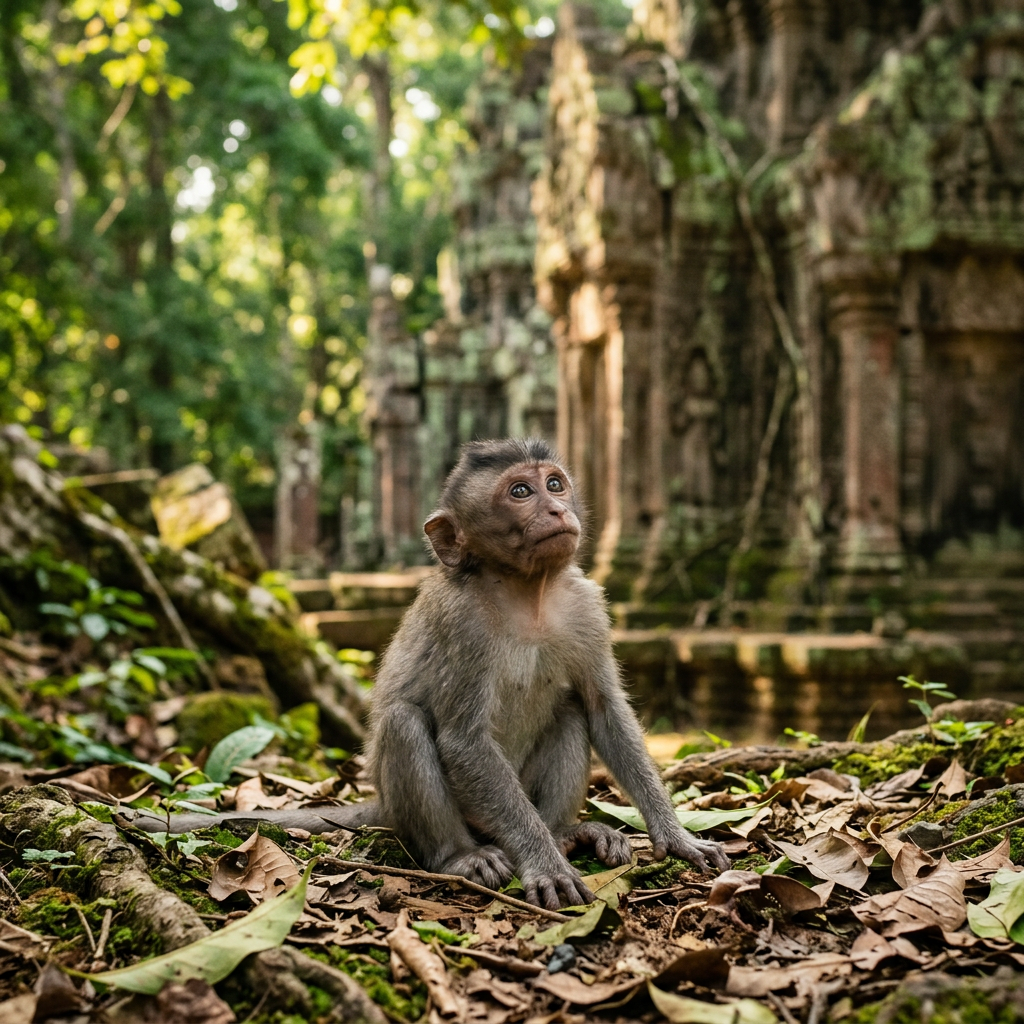
The Baby Monkey Waited Beneath the Ancient Trees for a Mother Who Never Came
(14 words — one gut-punch, no curiosity gap)
Deep in the Angkor Wat forest, where enormous tree roots wind through the earth and the morning light filters softly through the leaves, a tiny newborn monkey sat almost completely still.
He was small enough to disappear among the fallen leaves.
At first, I noticed him because the forest around him seemed strangely quiet. Other monkeys moved through the branches overhead, jumping from one limb to another and calling occasionally to one another. But the little newborn remained on the ground.
He looked upward several times.
Each time, his eyes followed the movement of the branches.
It was almost as though he was waiting for someone to come back.
I stayed at a respectful distance and watched. The baby did not seem interested in exploring. Instead, he pulled his little body closer to himself and occasionally reached toward a nearby root.
There was something profoundly moving about such a small animal trying to understand a world that was already demanding so much from him.
The ancient forest continued around him.
Leaves moved in the breeze. Birds called from somewhere beyond the trees. Sunlight slowly shifted across the ground.
Then the baby began moving.
His first attempts were uncertain. He placed one tiny hand forward, paused, and then moved another step. After several attempts, he managed to climb onto a low root.
It was not a dramatic moment.
But it felt important.
For a newborn, even a few careful steps can be a remarkable beginning.
He stopped again and looked toward the trees.
Perhaps he was searching for his mother. Perhaps he was simply following sounds he recognized. We cannot know exactly what was happening inside his little mind.
What we can see is that he continued trying.
That is what stayed with me.
The forest did not become easier for him. The branches were still high, the ground was uneven, and the sounds around him were unfamiliar.
But he kept moving.
Eventually, another monkey appeared farther away. The baby noticed immediately and turned his head.
For a few seconds, he watched.
Then he slowly moved toward the sound.
The moment reminded me that wildlife stories do not always need dramatic events to be meaningful. Sometimes the most emotional scenes are the quiet ones—a tiny animal taking another step, looking toward the trees, and continuing forward.
The Angkor Wat forest has witnessed countless generations of wildlife.
Among the giant roots and ancient stones, this little newborn was simply trying to find his place.
And for a moment, his tiny journey seemed to say something strangely human:
Sometimes strength begins with nothing more than taking one more small step.
PART 2 (escalation, new revelation — normal WordPress spacing)
The monkey at the edge of the clearing was not his mother.
I knew it before the baby did. She was younger, thinner, with a scar across one ear. She stopped when she saw him, tilted her head, and studied him the way the forest studies everything that is small and alone.
The baby called out. It was a thin, high sound, the kind a newborn makes when it has used up its voice calling.
She did not come closer.
She sat down a few body-lengths away, watched him for a long moment, and then turned and walked back into the trees without once looking behind her.
The baby watched her go. He did not follow.
The light was leaving the forest by then. The birds grew quiet first, then the insects, and one by one the sounds of the day folded themselves away. The shadows beneath the ancient roots turned deep and soft, and somewhere beyond the stones of Angkor Wat, the first night sounds began.
He pressed himself against the base of the great tree, the one whose roots rose out of the earth like the arms of something older than memory. He made himself as small as he could and waited.
We cannot know what a newborn monkey understands of night. But I can tell you what I saw: he did not sleep. His eyes stayed open, fixed on the dark between the roots, and every time something moved in it, he pulled himself tighter.
And once, in the deepest part of the night, I heard him call again. Not to the forest. To her.
There was no answer.
I stayed until the moon climbed over the temple walls. It is a hard rule among those of us who watch wild things: you do not interfere. A wild animal’s life is not yours to change. So I watched, and I waited, the way he was waiting, and I did nothing.
Morning came the way it always does in that forest — slowly, gray, then gold.
The baby was still there. He had survived the night.
A little after sunrise, a caretaker named Sok came down the path with a broom and a bucket, the way he did every morning to sweep the stones in front of the old library building. He saw me looking and came over.
“The little one,” he said, following my gaze. “Two days now.”
“Two days?”
“The mother,” he said, “was struck by a vehicle on the road outside the sanctuary. They said she did not survive. The baby was found by the roots that evening, waiting.”
He said it the way you say a thing you have already said many times, to many strangers, in many seasons.
“She will not come back,” he said gently.
I looked at the baby, who had pulled himself up onto the same low root he had climbed the day before, and was staring into the trees with the patience of something that has not yet learned what hopeless means.
“The forest knows,” Sok said. “It is the baby who does not.”
The troop came down from the high branches later that morning. Twenty or thirty long-tailed macaques, mothers with infants of their own, young males wrestling, an old female moving slowly at the rear. They crossed the clearing the way a river crosses a plain — together, unhurried, certain.
The baby watched them.
And then, for the first time, he left his root.
He followed them. Not to join them. He did not know how. He simply followed, keeping his distance, watching the way the mothers carried their babies and the way the babies clung, as though somewhere in his small body he remembered a lesson he had never been taught.
He had been waiting for a mother who was never coming back.
But he had decided, in the only way a creature that small can decide anything, that he would not stop trying.
PART 3 (confrontation, turning point — normal WordPress spacing)
The troop did not want him.
I watched it happen the way you watch something break that you cannot reach in time to catch. The baby followed them to the edge of the old causeway, and one of the young males turned, bared his teeth, and rushed at him. The baby fell backward into the leaves and lay there, tiny and stunned, and the male stood over him, hard-eyed, until the baby rolled away.
The mothers watched. Some of them had infants of their own on their backs. None of them moved.
The troop moved on. The baby sat where he had fallen and watched them go, and I saw him understand, in whatever small way a creature that young can understand anything, that the thing he wanted most was also the thing he was not allowed to have.
He did not cry. He had learned already that crying brought no one.
He found a place near the moat, where the water lay still and green and the stone carvings of the old temple wall rose out of the earth. There he sat, and there he stayed, and the forest went about its business around him.
It was Sok who told me about the water.
“Last year,” he said, “a monitor came up out of the moat. Bigger than my arm. It took a duck from the reeds. And a few seasons ago, when the water was low, it took something smaller.”
He did not say what. He did not have to.
“Where is it now?” I asked.
“In the water,” he said. “The water is deep there. It waits.”
That evening I saw it. The baby had crept down to the water’s edge to drink — his first time, I think, away from the root where he had hidden all day. He put his mouth to the green shallows, and the surface barely rippled.
A little way out, something moved.
I could not see it clearly. Only a darkness under the surface, a slow, patient shape, drifting toward the shallows the way shadows drift toward light.
The baby lifted his head. He had not seen it yet. He was too small to read water the way the old ones read it.
I opened my mouth. I closed it. The rule held me harder than my fear.
And then, from the roots above the bank, an old female monkey moved.
She had been sitting there all along, motionless as stone, scarred across the muzzle, one ear torn. I had not noticed her. The forest is full of things you do not notice until they choose to be seen.
She came down the roots without a sound, crossed the bank, and sat down between the baby and the water.
The shape in the shallows stopped.
For a long moment, the old female and the dark shape regarded each other. Then the shape turned, slow and heavy, and sank back into the deep water.
The old female did not move. The baby, startled by her nearness, had frozen with his mouth still wet.
She looked at him. He looked at her.
Then she reached out and groomed his head, once, twice, the way a mother would — the way she had once groomed a baby of her own.
Sok was standing behind me. He had seen everything.
“That one,” he said quietly, “lost her infant on the road two years ago. Same road. Same season. She still goes to the water at dusk, and she still calls at night, and she has not been accepted back into the troop since.”
The old female finished grooming the baby. Then she sat down in the grass beside him, put her body between him and the water, and closed her eyes.
The baby looked up at her.
Then, slowly, carefully, he moved against her side and pressed himself into the warmth of her fur.
We cannot know what she remembered in that moment. We cannot know what he understood.
But she stayed.
And for the first night since his mother died, the little monkey did not sleep alone.
PART 4 (stakes at highest, cliffhanger, zero resolution — normal WordPress spacing)
For three days, the old female did not leave him.
She led him along the roots and the low walls, teaching him without teaching, the way old ones do — showing him which stones held the sun, which branches could bear a weight as small as his, which pools were safe to drink from. He followed her everywhere, stumbling, falling, getting up, learning what his legs were for.
He grew bolder. By the third morning, he was climbing on his own, and I watched him reach a branch higher than his head for the first time, wobbling, gripping, refusing to fall. The old female sat below, watching, patient as the roots themselves.
But the troop was still watching too.
That afternoon, the matriarch came down from the high branches with four females behind her, and they surrounded the old female and the baby at the edge of the causeway. There was no screaming, no fighting. There did not need to be. The matriarch simply sat, and looked, and the old female lowered her eyes and moved the baby behind her, and I understood that they were being told to leave.
The outcasts moved to the far side of the temple, past the old library, past the stones where the carved dancers still smiled in the half-light. The baby did not understand. He kept looking back at the troop the way he had once looked for his mother. The old female did not look back at all. She had been through this before. She knew exactly what the troop was, and exactly what it cost to be loved by it.
The sky turned the color of old bronze that night.
I woke to thunder. Not the distant kind — the kind that rolls straight through you. The rain came down on Angkor Wat like a wall coming down, and the moat began to rise within the hour, and the wind tore at the branches of the strangler figs until the whole forest sounded like it was being shaken.
I should not have been out there. I went anyway, rain streaming off my hat, boots filling with water, and I found them at the base of the great tree near the old wall — the one whose roots rose out of the earth like the arms of something older than memory.
They were pressed into the hollow beneath the roots, the baby inside the curve of the old female’s body, her back to the storm. Water ran over them in sheets. The baby was shaking. She held him still and took the storm on her own back, the way she had taken the shape in the shallows, the way she had taken everything.
Above them, the wind found the dead limb.
I saw it go. A whole branch, thick as a man’s leg, torn loose and falling — and the old female heard the air break and threw herself sideways, shoving the baby clear of the hollow with her head, and the branch came down where they had been.
The baby scrambled free. He turned, calling for her.
She did not come out.
The branch lay across the hollow, and beneath it, at the edge of the rising water, the old female lay still.
The rain kept falling. The moat kept rising. The baby crouched at the edge of the hollow, calling the way he had called for his mother, his voice thin and high and swallowed by the storm.
She did not move.
He crawled to her and pressed himself against her side, the way he had pressed against her every night, and he called, and he called, and he would not leave her.
And the storm gave him no answer.
PART 5 (full resolution, ends on final emotional line only — normal WordPress spacing)
Dawn came gray and exhausted.
I was there before the light, and Sok was there before me. He had seen the storm from the caretaker’s house and come out with a lantern, and when we reached the great tree he stood very still and held the lantern up, and neither of us said anything for a long time.
The old female was alive.
The branch had caught her across the hind leg, and the leg was broken, but her chest rose and fell, slow and stubborn, and beside her the baby was curled so tightly against her that at first I could not tell where one of them ended and the other began. He had stayed with her all night. All night, in the rain, in the dark, he had stayed.
We did not touch her. The rule held even then. But Sok went back to the house and returned with water and soft cloth, and he set the water where she could reach it, and he left the cloth near her, and we stepped back and waited, the way you wait for a thing you love to decide to stay.
She drank at noon.
She ate nothing until evening, when Sok left fruit on a flat stone and she dragged herself to it, one leg useless, and ate, and went back to the baby.
And then, the next morning, the matriarch came.
She came alone, down the roots of the great tree, and she stopped at the edge of the hollow and looked at the old female — at the broken leg, at the baby pressed against her — and the old female looked back, and the two of them regarded each other the way old enemies regard each other across a field, and something passed between them that I will never be able to put into words.
The matriarch turned and walked back up the roots. At the top, she stopped and looked back once.
Then she waited.
Sok exhaled. I had not realized I was holding my breath.
“She is telling her to come,” he said. “The troop will take them.”
The old female looked at the baby. The baby looked at the matriarch, then at the old female, then at the high branches where the troop was gathering, mothers and infants and young males, all of them watching.
Slowly, the old female pulled herself up on three legs.
And slowly, the baby followed her.
I did not see the moment they were accepted. I was too far away, and the roots were too many, and it did not matter. What mattered was what I saw for weeks afterward, every time I came back to the forest: the baby, learning to climb the high branches the way the other infants climbed, the old female limping after him, the matriarch letting them eat at the edge of the troop, and the mothers, one by one, letting the baby sit near their own.
He did not ride on her back at first. He was too old for that, and too proud, in the way of all young things. But he stayed close to her, always, and she stayed close to him, and the troop went on around them, and the forest went on around them, and the world, which had been so enormous and so unkind to such a small creature, went on.
On the last morning, I found them at the great tree.
The baby — no longer a baby, really — was climbing. Not the low root he had climbed on his first day, and not the branch above his head. The high branches, the ones the mothers and the young males used, where the morning light filters softly through the leaves and the whole forest lies below like a green sea.
He climbed without hesitating now. He knew what his hands and feet were for. He knew what the branches could bear.
At the top, he stopped and looked back down.
The old female sat at the base of the roots, watching him, scarred and gray and patient, the way she had watched over everything, from the shape in the shallows to the storm to this.
He looked at her. She looked at him.
Then he looked toward the trees, the way he had looked on his first day, when he had been so small he could disappear among the fallen leaves.
He took one more small step.
And this time, he did not take it alone.