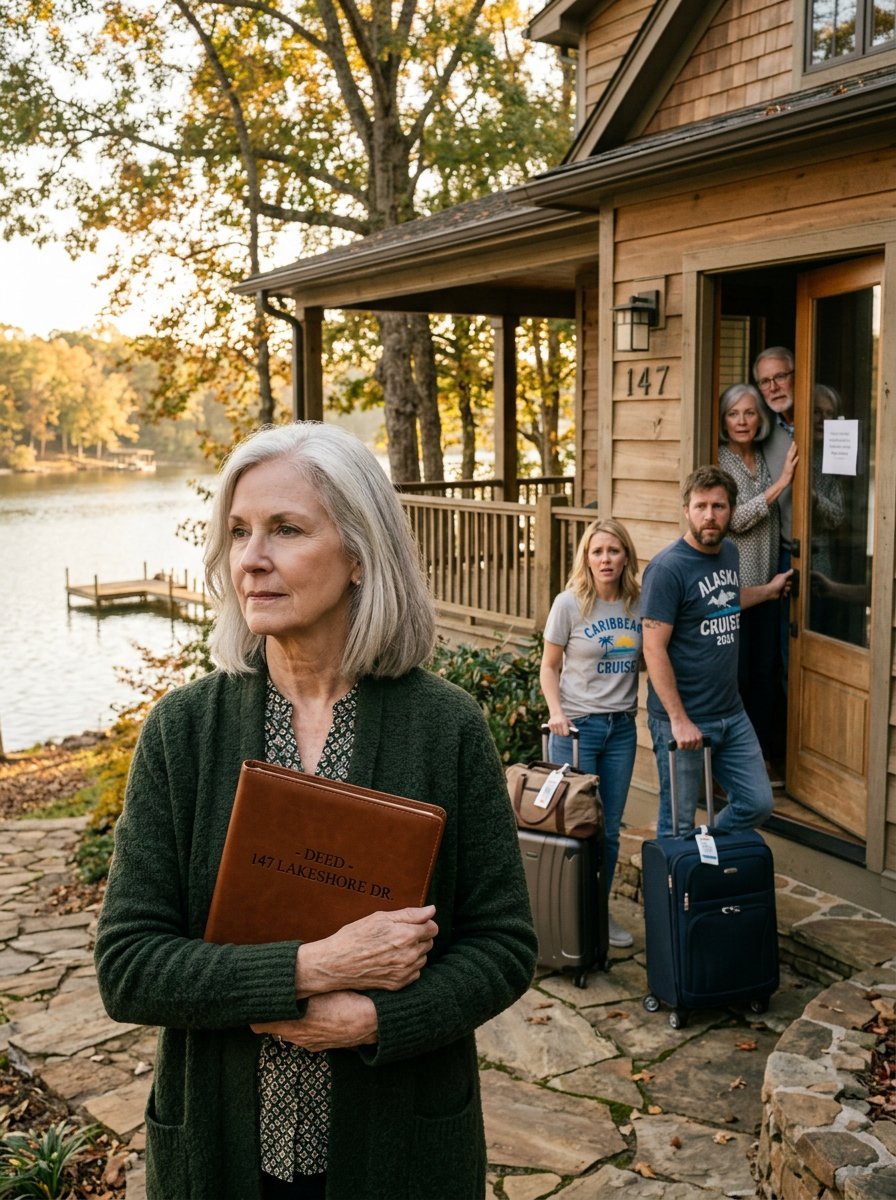
That morning, my son texted, “Plans changed—you’re not coming on the cruise. My wife wants only her family.” I didn’t argue. The next day, I canceled every payment I had been covering, sold the house, and quietly left town. When they returned from their perfect vacation, the key no longer worked—and a note on the door revealed exactly who the new owner was…
For ten years, Daniel had called my house “the family home.” He used the guest room whenever his townhouse was being renovated, stored holiday decorations in my basement, and gave the lake-view address to relatives as though it belonged to all of us. It did not.
My late husband, Thomas, and I had purchased the house outside Charlotte after thirty-two years of careful saving. When he passed, the deed transferred solely to me. Daniel knew that. His wife, Vanessa, simply behaved as though time would eventually turn my property into theirs.
The cruise had been Vanessa’s idea. Seven nights through the Caribbean for Daniel’s fortieth birthday. I paid for my cabin, upgraded the family package, and covered half the cost of the grandchildren’s tickets. The night before departure, my suitcase stood beside the kitchen island. My passport rested in my purse, and a new sun hat Vanessa had chosen for me sat inside a gift bag.
Then Daniel’s message appeared.
Plans changed—you’re not coming on the cruise. Vanessa wants only her family. Please don’t make this difficult.
I read it twice. My hands did not shake until I noticed the second message.
We’ll explain after we get back. Can you still take care of the balance on the kids’ excursions? It’s already linked to your card.
That sentence made everything clear. They did not want my presence. They still wanted my payment information.
I replied with two words.
Enjoy yourselves.
Daniel sent a thumbs-up. No apology. No call. No acknowledgment that I had spent months believing I was part of the celebration.
At seven the next morning, I watched their rideshare pull away from Daniel’s townhouse. Vanessa posted a photograph from the airport before they reached security. Her parents stood beside her wearing matching cruise shirts. The caption read, “Family only. Exactly how it should be.”
I closed the app and opened my banking portal.
The excursion card came off first. Then the automatic payment for Daniel’s luxury SUV. The monthly transfer covering the grandchildren’s private-school activity fees. The streaming packages. The family phone plan. The storage unit Vanessa used for furniture she refused to sell.
For years, each payment had begun as temporary help. Daniel’s business had a slow quarter. Vanessa was changing careers. The children needed stability. A car repair arrived at a bad time. I kept paying because helping my son felt natural. Eventually, gratitude disappeared and expectation took its place.
By nine, I had ended every expense that legally belonged to them.
Then I called my realtor, Claire Morrison.
“Is the Henderson offer still open?” I asked.
There was a pause. Claire had brought me an unsolicited offer two weeks earlier from a local couple who restored older lake homes. I had rejected it because Daniel insisted the house should remain in the family.
“They increased it yesterday,” Claire said. “Cash closing. They can move quickly.”
“How quickly?”
“The title work is already prepared because they were serious. But Margaret, are you sure?”
I looked around the kitchen. Thomas’s coffee mug sat above the sink. Pencil marks measuring Daniel’s childhood height remained inside the pantry door. Family photographs covered the hallway wall, though lately Vanessa had begun suggesting which ones should be removed when “we modernize.”
“I’m sure.”
The house had become valuable enough to fund the rest of my life comfortably. More importantly, it had become the center of an inheritance Daniel and Vanessa were already spending in their imagination.
Claire arrived that afternoon with the offer folder. I signed at the same kitchen table where Thomas and I had once calculated whether we could afford the original mortgage. The closing would happen eight days later, one day before the cruise returned.
I packed only what mattered. Photographs. Letters. Thomas’s watch. My mother’s dishes. A wooden box containing the grandchildren’s first drawings. Everything else went to an estate company or into the sale agreement. The Hendersons wanted the furniture, the dock equipment, and even the old canoe Daniel claimed he would restore someday.
On the third day of the cruise, Daniel texted.
The excursion desk says your card was declined. Can you fix it?
I answered after lunch.
No. You’ll need to use your own card.
His response came immediately.
Seriously? The kids are standing here.
Then Vanessa messaged.
This is unnecessary. Whatever feelings you have about the invitation should not affect the children.
I placed my phone facedown. The children were not responsible. Neither was I responsible for financing a vacation from which I had been removed.
That evening, another alert appeared. Daniel’s car payment had failed. Then the school portal notified him that the activity account needed a new billing method.
The messages became less polite.
Mom, what are you doing? You can’t cancel everything without warning. We’re in the middle of the ocean.
I sent one final reply.
The accounts are yours. I have simply removed my payment information.
After that, I muted the family chat.
The house grew quieter as boxes disappeared. On Friday, I walked through Daniel’s old bedroom. Vanessa had already placed paint samples on the dresser—soft gray, coastal white, pale blue. She had written “future office” on the back of one card.
Inside the closet were four suitcases, a box of her winter clothes, and a folder from a remodeling company. The estimate included a new kitchen, expanded primary suite, and glass doors opening to the lake. The customer name at the top was Vanessa Collins. The property owner line was blank.
I photographed the estimate and placed it inside the box with her belongings.
Claire arranged professional movers to take Daniel and Vanessa’s stored items to the secured unit they had been using. The first month was prepaid. After that, the bill would be theirs.
At closing, the Hendersons signed every page carefully. Michael Henderson was a quiet architect in his early sixties. His wife, Ruth, taught art at a community college. They wanted the house because their daughter and grandchildren were relocating nearby.
“We hope you know we’ll take care of it,” Ruth said.
“I believe you will.”
Claire slid the final document toward me. Once I signed, the house was—
PART 2
The deed was signed, the notary seal stamped, and the Henderson wire transfer of one point two million dollars landed in my private, unlinked account at four-fifteen on a Tuesday afternoon. Claire handed me the cashier’s receipt, her eyes full of quiet understanding. “It is completely out of your hands now, Margaret,” she said softly. “The deed is recorded with the county.”
I didn’t linger. I walked out to my ten-year-old sedan, started the engine, and drove away from the lake road without looking back in the rearview mirror. I had already leased a quiet, sun-filled saltbox cottage on the North Carolina coast near Beaufort, paid a full year in advance. For the first time in eight years, my chest didn’t ache with the weight of unpaid debts that weren’t mine.
Five hundred miles away in the blue water of the southern Bahamas, Daniel was standing at the upper-deck lounge of the cruise ship with a chilled glass in hand. He had no idea the foundation beneath his feet had already turned to dust.
The first crack in his luxury illusion had happened at the onboard purser’s desk when the ship’s accounting system attempted to run the daily incidental authorizations. Because I had permanently detached my card, Daniel’s automatic daily service fees, port taxes, and the four-hundred-dollar-a-night beverage packages he had generously ordered for Vanessa’s parents were flagged. The onboard credit line froze instantly.
When Daniel went to order a celebratory bottle of vintage champagne for Vanessa’s mother, the bartender smiled politely and slid the metal card back across the teak counter. “I’m sorry, Mr. Collins. This card has been declined by the authorization network. Guest Services requests that you step down to Deck Four to settle your balance.”
Vanessa was sitting in a private cabana under the Caribbean sun, wearing oversized designer sunglasses and holding her phone aloft to find a weak satellite signal. When Daniel walked over, red-faced and whispering, her smug posture stiffened into immediate outrage.
“What do you mean declined?” Vanessa snapped, keeping her voice low so her mother wouldn’t hear. “She wouldn’t dare. Margaret wouldn’t leave us stranded in the middle of international waters. Call her again.”
“I told you, she muted the thread,” Daniel hissed, running a hand through his thinning hair. “And when I checked our banking app, the auto-draft for the car bounced. The school sent an automated warning about the registration hold. Vanessa, she cut everything off.”
“Then she is having an episode,” Vanessa whispered coldly, her teeth clenched behind painted coral lips. “That’s the only explanation. She’s seventy-one, Daniel. She’s alone in that big house, grieving Thomas, losing her mental grip because she didn’t get invited on one trip. When we get back to Charlotte on Sunday, we’re taking control of the estate. I already talked to Richard in estate planning. We file an emergency conservatorship, we transfer the lake deed to protect the assets from her erratic behavior, and we put an end to this childish nonsense once and for all.”
What Vanessa didn’t know—and what Daniel had been too cowardly to investigate—was that I hadn’t left behind an empty house waiting for their legal takeover.
Before I left Charlotte, Claire Morrison had handed me a manila folder Vanessa had accidentally left behind during her last weekend stay at my home. Inside that folder was an email exchange between Vanessa and a local private elder-care facility located forty miles outside the city limits. The subject line read: Inquiry for Memory Care and Assisted Living Placement — Margaret Collins.
Attached to the inquiry was a handwritten budget spreadsheet Vanessa had drafted two months earlier. In neat, precise columns, she had calculated my late husband’s life insurance proceeds, my monthly pension, and the exact square footage of my lakefront house. Beneath the numbers, in Vanessa’s distinctive cursive, was a single note: Once M is transitioned to the facility by November, Mom and Dad take the lower lake suite. Daniel and I renovate the second floor. House equity covers private school through graduation.
They hadn’t just uninvited me from a cruise. They had been drafting the blueprint to erase me entirely from my own life, strip my dignity, lock me into an institution, and hand the home Thomas had built with thirty-two years of sweat to Vanessa’s parents.
Sitting in the quiet diner sixty miles down the interstate, eating a warm bowl of soup, I looked down at Vanessa’s handwritten spreadsheet. My late husband Thomas had always told me: When people show you who they are through their greed, do not argue with them. Let them run full speed into the wall they built themselves.
I folded the spreadsheet, placed it back into my leather handbag, and took a slow sip of hot tea. Daniel and Vanessa were still sailing across turquoise water, basking in the sun, convinced that upon their arrival in Charlotte, a meek, apologetic widow would be waiting on the porch with a hot dinner and an open checkbook.
They had twenty-four hours left of their cruise. And every single lock on the lakehouse had just been drilled out, replaced, and coded to an architect who had never heard Daniel Collins’ name.
PART 3
The sun was setting behind the pine trees on Sunday evening when two rental sedans pulled up the long gravel driveway of the lake house.
Because Daniel’s luxury SUV had been locked out at the airport terminal parking deck due to the repossession flag on the delinquent lease, he had been forced to spend eight hundred dollars on high-interest emergency rental vehicles just to transport Vanessa, her parents, the children, and ten oversized suitcases back from the airport.
Vanessa stepped out of the lead rental car first, wearing a linen resort dress, her posture brimming with rehearsed indignation. Her mother, Evelyn, climbed out behind her, looking up at the sprawling cedar-shake exterior with admiring eyes.
“Oh, Vanessa, the wraparound porch is magnificent,” Evelyn said, adjusting her pearl earrings. “It’s going to look wonderful once we paint the shutters navy blue, just like you showed me in the catalog.”
“Don’t worry, Mom,” Vanessa said loudly, ensuring Daniel heard every word as he hauled the heavy luggage from the trunk. “Daniel is going to handle his mother tonight. By next month, the lower suite will be completely cleared out and repainted for you and Dad.”
Daniel walked up the stone steps toward the front door, his jaw tight, rehearsing the speech he had practiced the entire flight home. He reached into his pocket, pulled out the brass key he had carried on his ring for a decade, and jammed it into the deadbolt.
The key did not turn.
Daniel frowned, pulling it out and looking at the jagged teeth in the fading twilight. He tried again, pushing with his shoulder against the solid oak door. The key refused to seat inside the cylinder. That was when he noticed the deadbolt wasn’t brass anymore. It was a brushed-nickel electronic keypad with a glowing digital display.
“What is taking so long, Daniel?” Vanessa called out impatiently from the walkway, holding a pair of matching leather duffel bags. “It’s humid out here, and the kids need dinner.”
“The key isn’t fitting,” Daniel muttered, his frustration boiling over. He slammed his palm against the heavy oak wood. “Mom! Open the door! Stop playing these ridiculous games! We’re home!”
The heavy knock echoed through the empty hallway inside.
Vanessa marched up the steps, pushed Daniel aside, and pounded on the frosted glass side-panel with her fist. “Margaret! Open this door right now! You’ve made your point, and it’s completely unacceptable! You have your grandchildren standing on the porch after a seven-hour travel day! Open this door!”
From inside the foyer, the sound of heavy footsteps approached. The brass interior handle turned, and the solid oak door swung inward.
Standing in the entryway was not a frightened, tearful seventy-one-year-old widow.
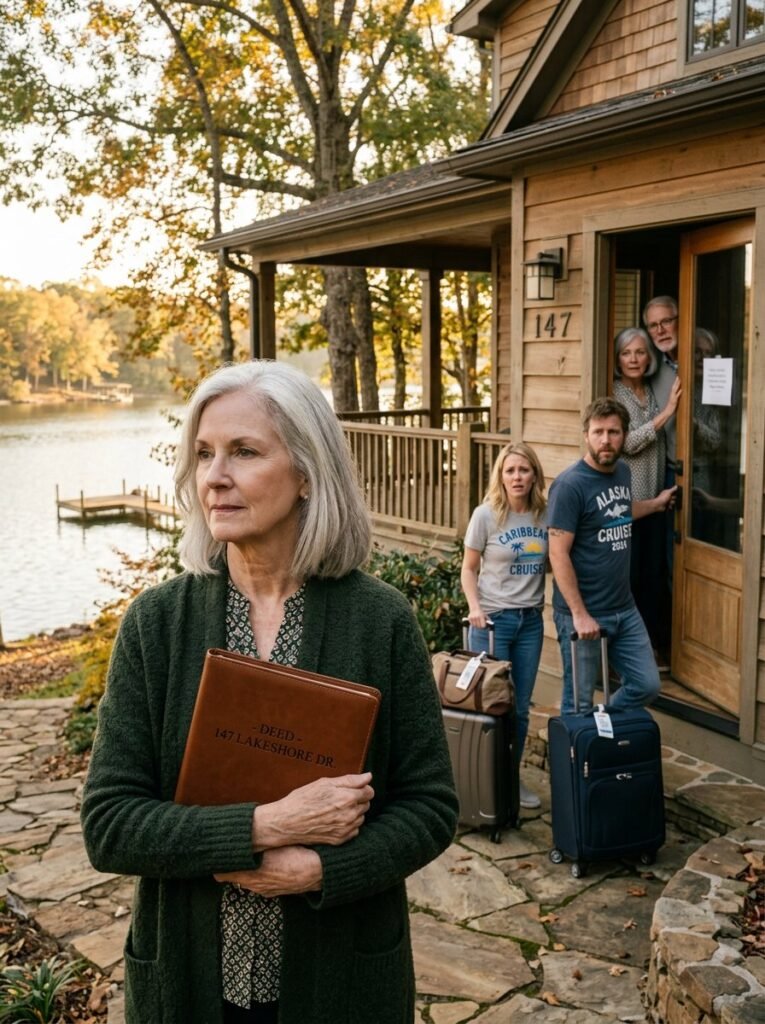
Standing there was a broad-shouldered man in his early sixties, wearing work jeans, a flannel shirt, and an architect’s canvas tool belt. In his hand, he held a laser measuring tape. Behind him in the kitchen, modern pendant lights were on, and the walls were already stripped of Margaret’s framed botanical prints.
Daniel froze. Vanessa’s mouth dropped open.
“Can I help you folks?” Michael Henderson asked calmly, looking at the luggage piled on the porch and the hostile expressions staring back at him.
“Who the hell are you?” Daniel demanded, stepping forward aggressively. “What are you doing inside my mother’s house? Where is Margaret?”
Michael looked Daniel up and down with quiet, steady composure. He reached into the pocket of his canvas vest, pulled out a laminated card, and held it up. “My name is Michael Henderson. And you must be Daniel.”
“This is private property,” Vanessa shrieked, her voice echoing across the quiet cove. “Get out before we call the police! You’re trespassing in our family home!”
Michael didn’t flinch. He didn’t raise his voice. Instead, he reached over to the foyer table, picked up a sealed manila envelope, and stepped out onto the porch.
“Mrs. Collins left this for you,” Michael said, handing the envelope directly to Daniel. “And for the record, this is not your family home. My wife Ruth and I purchased this property last Tuesday. The deed was recorded with the Mecklenburg County registrar at four o’clock. We closed with full cash. Margaret Collins is no longer the owner, and neither are you.”
Daniel’s face drained of all color. His hands shook as he ripped open the envelope.
Inside was a certified copy of the recorded deed showing the sale price of $1.2 million, a receipt from SecureStorage Facility on Highway 16 showing one month of prepaid rent for Units 412 and 413 where all of Daniel and Vanessa’s stored possessions had been moved by bonded professionals, and a handwritten letter written on Margaret’s personal stationery.
Daniel read the letter aloud, his voice cracking:
Daniel,
When you texted me that plans had changed because Vanessa wanted ‘family only,’ you showed me with absolute clarity where I stand in your life. You did not want a mother; you wanted an unpaid ATM who lived in a house you intended to claim before I was even cold in the ground.
I have granted your wish. You are now free to enjoy your family without any interference from me. The house is sold. The debts you accumulated in my name are canceled. The stored furniture is safe for thirty days. After that, the bill belongs to you.
Do not look for me.
Mom.
Vanessa grabbed the deed from Daniel’s hands, her eyes scanning the official county seal in wild disbelief. “No! This is illegal! She can’t sell this! She’s mentally unstable! Daniel, do something! This house belongs to us!”
Behind them, Vanessa’s parents stood on the driveway in stunned silence. Evelyn’s face was flushed with deep humiliation as she looked from the ‘SOLD’ sign hidden behind the rhododendron bush to the luggage piled on the gravel.
“Mr. Collins,” Michael Henderson said with firm, unyielding authority, pointing toward the driveway. “You have five minutes to load your bags back into those cars and leave my driveway. If you are still on my property at seven-fifteen, the county sheriff will escort you off in handcuffs.”
Michael stepped back inside, pulled the heavy oak door shut, and the electronic lock engaged with a sharp, echoing click.
PART 4
Within seventy-two hours of the lakehouse confrontation, the fragile house of cards Daniel and Vanessa had spent a decade constructing collapsed completely.
Without Margaret’s financial buffer absorbing their lifestyle, reality struck with ruthless precision.
On Tuesday morning, the headmaster of St. Jude’s Academy called Daniel’s office. Because the automatic monthly tuition transfer from Margaret’s trust had bounced, and because Daniel had failed to provide an alternative corporate guarantor, the school placed an immediate academic hold on both grandchildren. If twenty-two thousand dollars in back tuition and semester fees were not settled in certified funds by Friday at noon, the children would not be permitted on campus.
By Wednesday afternoon, the repossession flatbed finally located Daniel’s luxury German SUV parked outside his downtown office. In full view of his colleagues and junior partners, two repo agents hooked the chains to the axles and hauled the vehicle away for three consecutive months of non-payment.
That evening, Vanessa’s father confronted Daniel in the cramped living room of Daniel’s rented townhouse. The air was thick with fury.
“You told us you owned that lakehouse free and clear,” Arthur barked, his face crimson. “You let us break our apartment lease in Raleigh! You let Vanessa take twenty thousand dollars from our retirement savings to put down on kitchen cabinets for a house that was never yours! Where is that money, Daniel?!”
“Vanessa was the one managing the remodeling contracts!” Daniel shouted back, clutching his head in exhaustion. “I thought Mom would never sell! She loved that house! She gave me everything for forty years! How was I supposed to know she would stab me in the back over a damn cruise?!”
“You didn’t just exclude her from a cruise, you idiot,” Arthur spat, shaking his head with disgust. “You treated your own mother like a beggar while spending her husband’s life savings. And now my daughter is married to a broke fraud.”
Vanessa didn’t spend the night comforting her husband. Instead, she spent the night searching court registries and calling high-end litigation attorneys. By Thursday morning, she had convinced Daniel to retain Harold Vance, an aggressive probate lawyer known for ruthless estate battles.
At two o’clock on Friday, a formal legal notice arrived via certified courier at the Beaufort cottage where Margaret was sitting on her screened porch, listening to the ocean breeze.
The lawsuit was eighty pages long.
Daniel Collins was suing his seventy-one-year-old mother for fraudulent conveyance, breach of fiduciary duty to the family estate, and elder mental incompetence. The filing alleged that Margaret had suffered severe cognitive decline following Thomas’s passing, that she had been unduly influenced by a predatory real estate broker, and that the sale of the lakehouse was an act of irrational spite caused by senile dementia.
The filing demanded an immediate emergency court injunction to freeze the 1.2-million-dollar proceeds from the sale, place Margaret under temporary financial guardianship with Daniel appointed as sole conservator, and compel the Henderson family to reverse the property transfer.
Attached to the summons was a voicemail Daniel had left on Claire Morrison’s office phone, knowing Claire would forward it to Margaret:
“Mom, you listen to me. You think you’re clever hiding down at the coast, but you have no idea what kind of legal hell you’ve started. Vance is going to drag you into a Charlotte courtroom next Tuesday. Every bank account you have will be frozen by court order. If you don’t wire the sale proceeds into a joint escrow account by Monday morning and sign the power of attorney over to me, I will have the state declare you legally unfit to take care of yourself. You will spend the rest of your life in a secured ward. You have until five o’clock on Monday. Make your choice.”
Margaret listened to the voicemail once through the speakerphone. Her hands did not tremble. Her heart did not race.
She stood up, walked into the small guest bedroom of the coastal cottage, and pulled a heavy metal lockbox from the top shelf of the closet.
She unlocked it with a small brass key that had hung on Thomas’s key ring for forty years.
Inside the box were two items: a sealed manila envelope labeled In Case Daniel Forgets Himself, dated eight years earlier, and a digital audio recorder containing the calm, resonant voice of Thomas Collins, recorded six months before his heart finally gave out.
Margaret picked up the envelope, looked at her late husband’s neat handwriting, and dialed Claire Morrison’s attorney, Marcus Sterling.
“Marcus,” Margaret said, her voice like polished steel. “Daniel has filed the petition. Tell the judge we do not need until Monday. We will see them in court on Tuesday morning.”
The stage was set, the trap was laid, and Daniel had walked straight into the one courtroom battle he was never equipped to survive.
PART 5
On Tuesday morning at ten o’clock, Courtroom 4B of the Mecklenburg County Superior Court was dead silent except for the rustle of legal briefs.
Daniel and Vanessa sat at the plaintiff’s table with Harold Vance. Vanessa wore a modest black dress, clutching a handkerchief, playing the role of the devoted, grief-stricken daughter-in-law concerned for an aging matriarch’s wellbeing. Daniel sat with his arms crossed, staring straight ahead, refusing to look across the aisle where his mother sat alone beside her attorney, Marcus Sterling.
Judge Evelyn Vance-Myers adjusted her reading glasses and tapped her gavel. “We are here on an emergency petition for temporary conservatorship and an asset-freezing injunction regarding the estate of Margaret Collins. Counsel for the plaintiff, you may present your urgent grounds.”
Harold Vance stood up with theatrical gravity. “Your Honor, this is a tragic case of sudden cognitive deterioration. Mrs. Margaret Collins, a seventy-one-year-old widow, without warning or consultation, liquidated the family’s primary estate of thirty-two years for cash, abruptly canceled essential familial obligations, and fled the jurisdiction. We have affidavits demonstrating that she has acted out of extreme emotional volatility, placing her entire financial future—and the stability of her grandchildren—in severe peril. We request an immediate freeze on all accounts and a court-ordered psychiatric evaluation.”
Judge Vance-Myers looked over her glasses at the defense table. “Mr. Sterling?”
Marcus Sterling stood up smoothly. “Your Honor, we welcome a review of the facts. In fact, we have brought them with us today.”
Marcus walked to the bench and handed four bound exhibits to the clerk.
“Exhibit A,” Marcus stated clearly, “is a comprehensive neuropsychological evaluation conducted six days ago by Dr. Raymond Keller, Chief of Geriatric Psychiatry at Duke Medical Center. Dr. Keller found Mrs. Collins to possess one hundred percent cognitive clarity, superior executive functioning, and zero signs of dementia or impairment. She is, quite simply, sharper than most people half her age.”
Vanessa shifted uncomfortably in her chair. Daniel’s brow furrowed.
“Exhibit B,” Marcus continued, “is an eight-year accounting audit of Mrs. Collins’ personal accounts. It demonstrates that over the past decade, Mrs. Collins has gifted three hundred and forty-two thousand dollars to her son, Daniel Collins, covering his personal vehicle leases, luxury vacations, private country club dues, and private school tuitions—none of which were legal debts of Margaret Collins. She did not ‘abandon obligations’; she merely stopped funding an adult son’s lavish lifestyle after he explicitly informed her she was no longer considered part of his family.”
The judge’s eyes narrowed as she skimmed the accounting ledger. “Three hundred and forty thousand dollars?”
“Yes, Your Honor,” Marcus said. “And Exhibit C is a certified copy of the deed. The property was titled solely in Margaret Collins’ name with full survivorship rights following Thomas Collins’ passing. Daniel Collins held zero legal equity in the property.”
Marcus paused, turning slightly to look at Harold Vance. “Finally, Your Honor, we present Exhibit D. It is a certified testamentary affidavit and video deposition executed by Thomas Collins eight years ago, witnessed by two independent attorneys.”
Marcus tapped the tablet on the podium. On the courtroom monitor, the screen flickered to life.
Thomas Collins appeared on the screen, sitting in his favorite armchair in the lakehouse living room, his voice deep, calm, and utterly unmistakable.
“My name is Thomas Collins. I am making this recording with sound mind and clear intention. I have watched my son Daniel develop a sense of entitlement that ignores the sacrifices his mother and I made to build our life. He treats our home as his future prize and his mother as a convenience. Therefore, I state for any court or person who ever questions her actions: this home and all our assets belong solely to Margaret. If she chooses to sell this property, give away every dollar, or disinherit Daniel completely, she does so with my full knowledge, blessing, and explicit instruction. Daniel has earned nothing here except what he builds with his own hands. Do not let him bully my wife.”
The courtroom was so quiet you could hear the tick of the wall clock.
Daniel slumped back in his chair, his face completely gray. Vanessa buried her face in her hands, her handkerchief no longer an act of grief, but of utter, ruinous humiliation.
Judge Vance-Myers closed the folder with a sharp thud that echoed off the mahogany walls.
She looked down at Harold Vance with cold fury. “Mr. Vance, this petition is one of the most disgraceful abuses of the probate court I have witnessed in fifteen years on the bench. You have brought a baseless, predatory action against an independent, fully competent woman who has done nothing more than exercise her legal right to her own property.”
The judge slammed her gavel down with thunderous finality. “The petition for conservatorship is DENIED with prejudice. The motion to freeze assets is DENIED. Furthermore, I am assessing all defense legal fees and court costs directly against the plaintiff, Daniel Collins. Mr. Vance, expect a formal inquiry regarding the good-faith basis of this filing. We are adjourned.”
Outside the courtroom, Daniel chased Margaret down the marble hallway. “Mom! Please! You have to listen to me! They’re taking my car, the kids are getting kicked out of school, and Vanessa’s parents are suing me! We have nothing left! You can’t just walk away from your own son!”
Margaret stopped. She turned around slowly, her posture straight, her gaze steady and serene.
She looked at the forty-year-old man standing before her—a man who had tried to lock her away in a nursing home so his in-laws could have a lake view.
“You told me that plans changed, Daniel,” Margaret said softly, her voice carrying the quiet, unbreakable weight of thirty years of dignity. “And you were right. They did.”
She turned, walked through the double glass doors of the courthouse into the bright morning sunshine, and drove home to the ocean.