My mother-in-law showed up at my restaurant with 38 friends and announced, “Order the most expensive things. I’m treating everyone today,” even though she knew she had no intention of paying. Instead of throwing them out, I looked at the manager and said, “Serve them everything.” Three hours later, when she saw the $23,289 bill and the folder I placed on the table, she stopped smiling.
“Come in, ladies, don’t be shy. My daughter-in-law’s restaurant is practically a family business. Today we’re eating like queens… and I’m paying for everything.”
My mother-in-law’s voice rang across the dining room at one-thirty in the afternoon, just as my restaurant was packed.
Behind Beatrice came thirty-eight perfectly dressed women, carrying expensive handbags, wearing strong perfumes, and walking with the confidence of people who believed someone else would take care of the bill.
Gavin, my manager, came rushing over to me.
“Camilla, they don’t have a reservation. We have every table occupied. Should I tell them we can’t accommodate them?”
I looked at Beatrice. She was already removing a “Reserved” sign from a table and ordering the staff to bring over more chairs.
“No,” I replied. “Take care of them.”
Gavin’s eyes widened.
“All thirty-nine of them?”
“All of them. And give them exactly what they ask for.”
He didn’t understand. No one did.
I knew that this would be the last day Beatrice walked into my restaurant believing she owned something she had never built.
I had built Lumina, my restaurant in San Diego, after working for years as a cook, sous-chef, and finally executive chef. I had saved every dollar of the initial capital. I had chosen the ovens, hired the staff, developed the menus, and spent countless nights calculating costs.
Lucas, my husband, had never invested a single dollar.
But Beatrice told a very different story.
“My son gave her the business,” she always bragged. “Camilla just cooks.”
For years, she would show up without a reservation, order steaks, seafood, desserts, and wine, and leave without paying.
Whenever I complained, Lucas always gave me the same answer:
“She’s my mom. Besides, she gives you publicity. Don’t make such a big deal over a few thousand dollars.”
My mistake was staying quiet for too long.
That Friday, Beatrice decided to find out just how far my patience would go.
“I want the most expensive tasting menu for everyone,” she ordered. “And open the special reserve bottles from the cellar. Nothing cheap.”
Her friends applauded.
“How generous you are, Beatrice!”
“That’s what happens when you have a family restaurant,” she replied, looking at me with a smile.
The bill could easily exceed twenty thousand dollars.
Gavin came over again.
“We can still stop this.”
“No. Serve everything.”
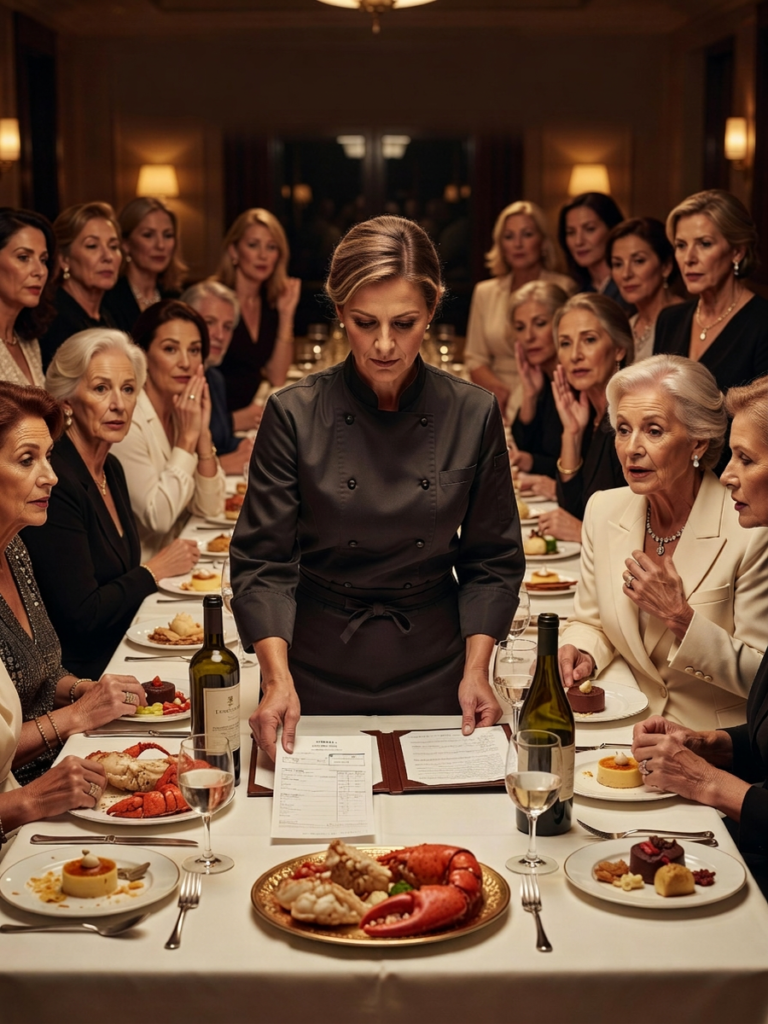
Beatrice took over the private dining room and started behaving like the hostess. Scallops, tuna tartare, flatbreads, steaks, sauces, and the first bottles from the wine cellar began arriving.
I personally brought out one of the finest bottles.
Beatrice watched me as I filled the glasses.
“Just look at that,” she said. “The great chef also knows how to wait tables.”
Several women laughed.
“She cooks well,” one of them commented, “but she seems so ordinary.”
Beatrice took a sip of wine.
“Camilla has always been like that. She’s great at working. That’s what you want her for.”
I tightened my grip around the bottle, but I kept smiling.
Then one of her friends asked:
“And Lucas? I haven’t seen him in a long time.”
Beatrice leaned toward them as if she were about to share the best gossip of the year.
“My son is doing better than ever. He even has a beautiful young girl who has him completely smitten.”
The room fell silent.
So did I.
Beatrice burst out laughing.
“Oh, don’t make those faces. Camilla is never home. She lives here at the restaurant. Besides, Lucas knows how to have fun.”
Another woman asked:
“And with what money?”
Beatrice raised her glass.
PART 2
“With money from this restaurant, of course,” Beatrice said. “In the end, it all stays in the family.”
That sentence confirmed what my attorney and forensic accountant had suspected.
Three months earlier, I had found transfers leaving Lumina’s operating account for hotel suites, jewelry, and payments to a credit card I did not recognize. Lucas had access because I once authorized him to pay vendors while I recovered from surgery. I revoked that access when the first irregularity appeared, but by then he had copied my credentials and redirected statements to a private email address.
He called every charge a bookkeeping error.
I hired an accountant instead of arguing.
By the morning Beatrice arrived, we had documented $47,860 in unauthorized transfers. A private investigator had also photographed Lucas entering a La Jolla hotel with the young woman Beatrice had just mentioned. The dates matched charges on Lumina’s account exactly: a suite, a bracelet, room service, and a rental car. This was not careless spending. Lucas had created a second life and made my kitchen finance it.
At nine that morning, my attorney filed for divorce and obtained a temporary order barring Lucas from moving marital assets. Lumina itself was not marital property. I had opened it two years before our wedding, and the company records named me as its sole owner.
Beatrice knew none of that.
She also did not realize that Gavin had followed our large-party policy before the first course. He had placed a host-responsibility agreement in front of her, copied her identification, and asked for a payment card.
She signed without reading. Gavin had pointed to the line stating that the host accepted responsibility for all unpaid charges. Beatrice initialed it while telling her friends that paperwork was for people without real money.
“Family doesn’t need paperwork,” she had said, handing it back.
The card had declined during the third course. I told Gavin to continue service because Beatrice’s signature made her responsible and because I wanted every witness to hear what she said when she believed I would remain silent.
For another two hours, she performed generosity. She ordered extra reserve bottles, imported cheese, truffle supplements, desserts, and aged cognac. Her friends toasted her elegance while my staff recorded every item.
At 4:42 p.m., the total reached $23,289.
I walked into the private room carrying a leather folder and the itemized bill.
“Ladies, I hope you enjoyed everything.”
Beatrice leaned back. “Wonderful. Charge it to the family account.”
“There is no family account.”
I placed the receipt in front of her.
Her smile faltered when she saw the total, then returned as a laugh.
“Don’t be theatrical, Camilla. Lucas will handle it.”
I opened the folder.
The first page was the host agreement bearing her signature. The second was Lumina’s ownership certificate. The third summarized Lucas’s transfers. The fourth was my filed divorce petition.
The room went quiet enough to hear the kitchen printer through the wall.
Beatrice looked at the petition twice. “You cannot divorce him over a few expenses.”
“The theft would be enough. The affair simply ended any remaining confusion.”
She shoved the folder back. “Call Lucas. He’ll explain who this restaurant belongs to.”
“That sounds perfect.”
She put him on speakerphone.
Before he answered, I nodded to Gavin. He placed a small recorder on the table. California required every participant’s consent, so Gavin spoke clearly.
“This call is on speaker in a room with thirty-nine guests and will be recorded. Do you consent?”
Beatrice snapped, “Yes.”
Lucas answered after the third ring and agreed impatiently.
His mother launched into a demand that he pay the bill, stop my divorce, and force me to recognize that Lumina was family property.
A long silence followed.
Then Lucas said, very softly, “Mom, what exactly did you tell those women?”
PART 3
Beatrice stared at the phone. “I told them the truth.”
“No,” Lucas said. “You told them what you wanted to be true.”
Thirty-eight women stopped moving.
I asked him one question. “Do you own any part of Lumina?”
“No.”
“Did you invest in it?”
“No.”
“Did I authorize the transfers from its account?”
He hesitated.
Beatrice barked his name.
“No,” he finally said.
The confession settled over the table more heavily than the bill.
Lucas tried to explain that he had intended to replace the money after receiving a promotion. The hotel rooms and jewelry were “temporary mistakes.” His personal debt had grown beyond forty thousand dollars, and he believed controlling Lumina’s cash flow would solve everything.
One of Beatrice’s closest friends asked about the young woman.
Lucas admitted the affair.
Beatrice’s face hardened, not because he had betrayed me, but because he had embarrassed her.
“Pay the restaurant and we’ll discuss this privately.”
“I can’t,” he said.
She looked around the table as though someone else might volunteer twenty-three thousand dollars to rescue her pride.
I reminded the room that no guest was being detained. Anyone could pay for her individual food and wine, receive a receipt, and leave. Beatrice remained responsible for whatever balance remained under the agreement she had signed.
The performance of friendship ended quickly.
Women who had applauded Beatrice’s generosity began calculating their shares. Several confronted her for inviting them under false pretenses. One quietly apologized to me for laughing earlier. Another woman, Ruth, admitted that Beatrice had hosted three previous lunches while claiming Lucas was paying from “his restaurant.” She opened her banking app and showed me messages proving Beatrice had been using Lumina’s name to build her social status for more than a year.
Beatrice refused to produce another card.
Gavin called the police only after she stood and announced that everyone should leave. The responding officers reviewed the signed agreement and the security footage of her repeatedly promising to pay. They explained that the immediate dispute was civil, but leaving after ordering under a false promise could become evidence of fraud.
That was when Lucas arrived.
He entered through the private door in a wrinkled suit, looking furious until he saw the officers. Then he looked frightened.
He asked to speak with me alone.
“No,” I said. “Your mother wanted an audience. She can hear the truth with everyone else.”
Lucas blamed Beatrice for encouraging the affair and presenting him as wealthy. Beatrice blamed Lucas for assuring her that my restaurant would eventually become his. Within minutes, their loyalty dissolved into accusation.
Then Lucas revealed where more than half the missing money had gone.
He had transferred $26,000 to Beatrice over fourteen months.
She used it for handbags, weekend trips, and elaborate lunches for the same social circle sitting around her. Some of the “generosity” they admired had been purchased with money taken from my payroll and vendor accounts.
Beatrice slapped the table. “You said that money was yours.”
“You knew where it came from,” Lucas replied. “You told me Camilla owed us.”
Gavin’s recorder captured every word.
By six o’clock, thirty-five guests had paid their individual shares. Three disputed the wine charges, and my staff adjusted only what the records supported. Beatrice’s unpaid balance remained $8,714. The police documented her refusal and escorted her out after she began threatening the servers.
Lucas followed me to my office.
“I’ll sign away any claim to Lumina if you drop the theft complaint.”
“You have no claim to sign away.”
His face changed.
Then he reached into his briefcase and placed a lender’s notice on my desk.
Without my knowledge, he had pledged Lumina’s equipment and future revenue as collateral for a $480,000 business loan.
The lender intended to take control on Monday.
PART 4
My attorney, Priya Shah, read the notice twice.
Lucas had submitted a personal guarantee carrying my signature, a company resolution naming him managing partner, and a notarized statement claiming Lumina had approved the loan. Every document was false, but the lender had already filed a lien against the restaurant.
If we could not stop enforcement, Lumina’s accounts could be frozen and its equipment seized while the fraud was litigated.
Lucas claimed he never expected the lender to act so quickly. He had planned to use the money to clear his debts, reimburse the restaurant, and support a second location that existed only in his proposal.
“Forgery was your rescue plan?” I asked.
He lowered his eyes.
The next morning, Priya sought an emergency injunction. The lender’s attorney argued that I had allowed Lucas to represent the restaurant for years. Beatrice’s free meals, Lucas’s vendor access during my surgery, and photographs of him at company events were presented as evidence of apparent authority.
My silence had become part of their case.
We produced the sole-ownership certificate and proof that I revoked Lucas’s access. The lender produced a video of me at an anniversary dinner thanking my “family” for supporting Lumina. One warm sentence had been edited to sound like a business declaration.
The judge froze the loan proceeds but refused to remove the lien without proof that the signatures were forged. A court-appointed receiver would take temporary control of Lumina at five o’clock Monday unless we authenticated the fraud.
Then the notary named on the documents vanished.
Her name was Helena Ward.
I recognized it from Beatrice’s banquet receipt. Helena had been one of the thirty-eight guests.
Security footage showed her and Beatrice speaking privately near my office while dessert was served. After the police arrived, Helena paid her portion in cash and left before giving a statement.
Priya obtained the group messages used to organize the banquet. Most were shallow comments about wine and clothing. One message from Beatrice was different.
By Friday, Camilla will understand that the restaurant belongs with Lucas. Helena is bringing what we need.
It proved coordination, but not what Helena had notarized.
On Monday morning, my employees arrived without knowing whether they would still have jobs by dinner. Vendors paused deliveries. Two reporters waited across the street. I watched a server remove her children’s photographs from her locker because she feared the receiver would close us permanently. My sous-chef postponed signing a new apartment lease. Lucas called the loan a paperwork problem; thirty-two employees were living inside the consequences.
Beatrice told anyone who called that I was destroying the family over a harmless loan.
At noon, Gavin found a gap in the office-camera archive from the night the loan papers were dated. Someone had erased forty-three minutes.
Our backup server should have preserved the footage. When the technician opened it, the relevant folder was empty.
At 3:30, Helena’s attorney informed us that she would invoke her right to remain silent.
At 4:15, the judge ruled that the lender had presented enough facially valid documentation for the receiver to assume control until a full hearing.
Gavin stood beside me in the dining room while staff watched the clock.
At 4:52, the receiver entered carrying an inventory order and asked for my keys.
Then Beatrice walked in behind him wearing the same triumphant smile she had worn at the banquet.
“I told you,” she said, “family always gets its share.”
I placed my keys on the host stand.
For the first time since opening Lumina, I was ordered to leave my own restaurant.
PART 5
The receiver had authority over Lumina, but not over the building next door.
Our pastry kitchen occupied a separate leased space with its own security system. Gavin remembered that its delivery camera faced the narrow service corridor outside my office. The camera was old, motion-activated, and not connected to Lumina’s main server.
Its archive had not been erased.
At 5:18, while Beatrice watched the receiver inventory my dining room, Priya opened the pastry-kitchen recording on her laptop.
The video showed Lucas entering my office on the night the loan papers were dated. Helena followed carrying a notary case. Beatrice stood in the corridor as lookout.
Twenty minutes later, Lucas emerged with my company seal and a signature stamp used only for supplier certificates. Helena filmed him pressing both onto the false resolution. Beatrice held up her phone so Lucas could copy an old image of my signature.
The camera had no sound, but it did not need any.
Priya sent the file to the judge, the lender, and the detective handling the stolen transfers. At 6:07, the judge suspended the receivership and ordered Lucas, Beatrice, and Helena to preserve every device and document.
I walked back through Lumina’s doors before dinner service ended.
Beatrice’s smile disappeared when officers asked her to remain for questioning.
Helena surrendered the next morning. Her phone contained messages from Lucas offering ten thousand dollars to notarize documents without my presence. It also contained Beatrice’s promise that once the loan closed, Helena’s banquet debt and a private loan would be forgiven.
The lender released the lien after confirming fraud. Its internal review found that Lucas had exaggerated Lumina’s revenue and submitted altered tax statements. No loan money ever reached him.
Over the following months, prosecutors filed charges tied to the forged documents, unauthorized transfers, and attempted loan. Lucas accepted a plea requiring restitution and permanently surrendered any claim he tried to assert against my company. Our divorce became final without him receiving a share of Lumina. The court also prohibited him from using the restaurant’s name, accounts, or reputation to obtain future credit. For the first time since the transfers began, every dollar earned beneath my roof stayed where it belonged.
Beatrice avoided jail through a restitution agreement, but avoiding jail did not mean avoiding consequences. She sold her luxury car and most of her designer collection to repay the $26,000 she had received from Lucas and the $8,714 remaining from the banquet.
Her thirty-eight friends did not rally around her. Several provided messages to investigators. Others disappeared as quickly as the money financing Beatrice’s generosity.
I refunded the three disputed wine charges only after reviewing the service record, not because Beatrice demanded it. Every employee received the wages and tips owed for the banquet. Gavin received a promotion and authority to refuse service to anyone who used my family name as a substitute for a reservation.
Lumina also changed.
No spouse, relative, or friend could access company accounts without two approvals. Large groups required a verified deposit. The office signature stamp was destroyed. I created an employee profit-sharing plan because the people who had protected the restaurant deserved more than thanks.
Six months later, we hosted an anniversary dinner for the staff and their families. Thirty-nine seats filled the private room again, but this time every guest had been invited by me.
Gavin raised a glass to the dishwasher who had stayed late during the banquet, the servers who documented every bottle, and the pastry chef whose forgotten camera saved the restaurant.
Then he toasted me.
I looked around the room I had once been ordered to leave. The ovens were humming. The dining room was full. No one was laughing at my work or calling it ordinary.
For years, Beatrice treated my silence as proof that she could take more. Lucas treated my marriage as permission to reach into everything I built. I had mistaken endurance for peace.
That night, I understood the difference.
Lumina had never been a family gift—it was the life I built, and no one at my table would ever mistake my silence for permission again.