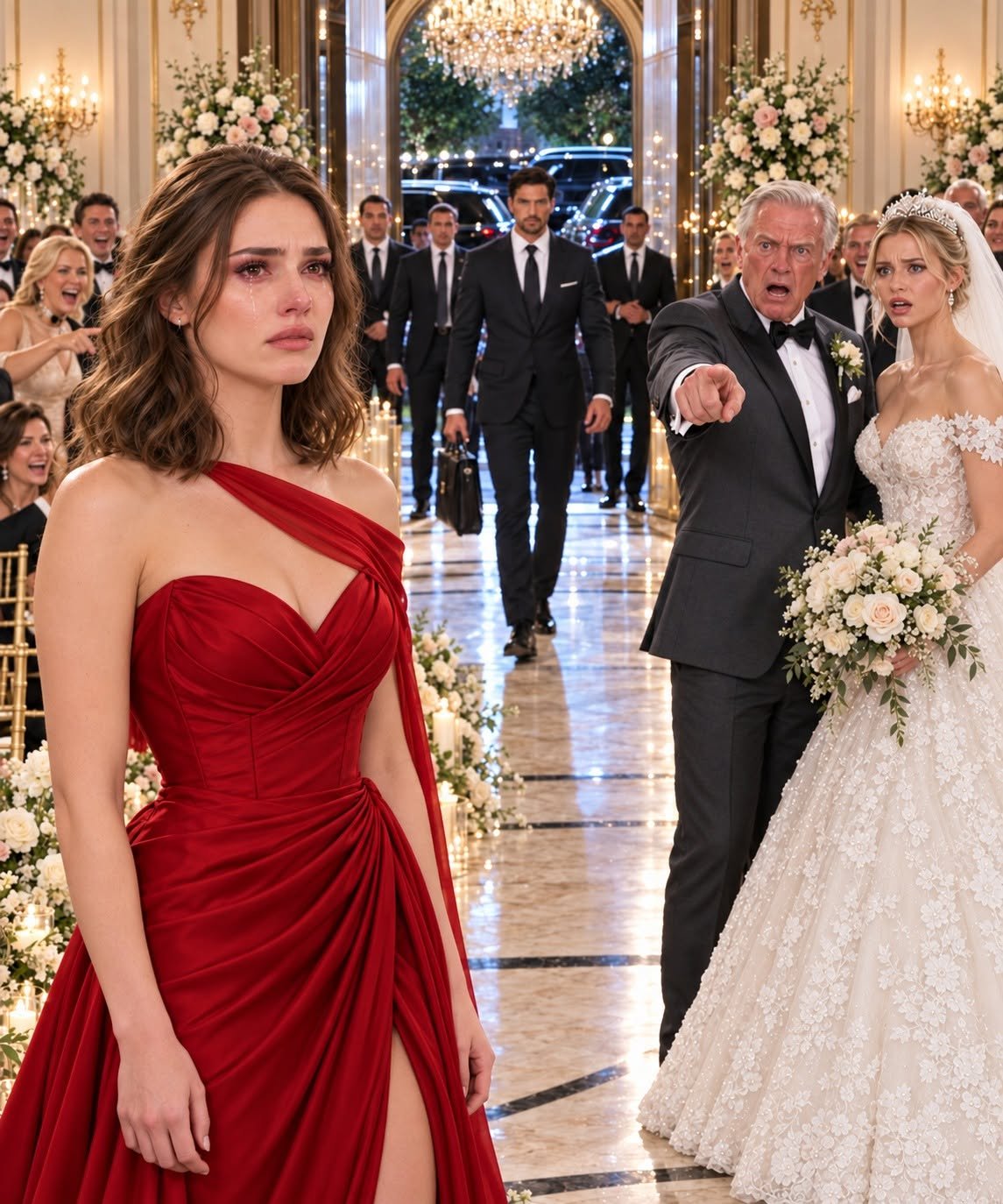
My entire family burst into laughter when I arrived alone at my sister’s lavish wedding. My father deliberately shouted, “She couldn’t even find a man willing to come with her!” My sister smirked as the guests whispered. I stayed silent until a convoy of black luxury cars stopped outside. A powerful man stepped out, and my father suddenly went pale. My boyfriend had arrived—and what he whispered to my father was only the beginning of their nightmare…
Everyone laughed when I walked into my sister Vanessa’s wedding alone.
Not politely. Not softly. The kind of laughter that sliced through a ballroom, bounced off crystal chandeliers, and made strangers turn their heads just to see who had become the joke.
My father raised his champagne glass like he had been waiting all night for this moment. “Look at that,” he said loudly, his voice carrying over the string quartet. “My younger daughter couldn’t even find one man willing to come with her.”
A few guests covered their mouths. My mother looked down at her lap, pretending to adjust her bracelet. Vanessa, glowing in her designer gown, gave me a slow, satisfied smile from beside her groom.
“Don’t be cruel, Dad,” she said sweetly. “Maybe Emma’s date got lost.”
More laughter.
I stood at the entrance in my simple navy dress, rain still clinging to my coat, my fingers wrapped around the small silver clutch in my hand. Inside it was my phone, three signed documents, and a flash drive that could destroy every lie my family had built over the last six years.
But I didn’t reach for any of it.
Not yet.
My father, Richard Hale, loved audiences. He had humiliated me at Christmas dinners, company parties, charity galas, and family birthdays. Tonight, he had finally found the perfect stage: my sister’s lavish Chicago wedding, paid for with money he swore he never had when I begged him to return what belonged to me.
Vanessa lifted her chin. “You should have told me you were coming alone. I could have seated you with the photographers.”
“I’m fine here,” I said.
My father laughed again. “Still proud. Still pretending.”
The wedding planner hurried toward me, embarrassed. “Miss Hale, your seat is near the back.”
“Of course it is,” I said quietly.
As I walked past the front tables, I saw the towering floral arrangements, the imported champagne, the gold menus embossed with Vanessa’s initials. Every detail screamed wealth.
My wealth.
My grandmother had left me a trust before she died. My father had controlled it until I turned twenty-eight. By the time I demanded access, he told me it was gone—bad investments, legal fees, family obligations.
Then I became a forensic accountant.
And I learned exactly where the money had gone.
Across the ballroom, Vanessa tapped her glass with a spoon. “Before we begin, I just want to thank our father for giving me the wedding of my dreams.”
PART 2
The doors at the back of the ballroom opened while she was still holding the spoon.
Six cars, nose to tail on the gravel where the valets had been told to keep the drive clear. Not one long limousine. Six separate cars, which is how the courts travel when they are taking possession of a thing and want to leave with different parts of it.
The man who got out of the third car wore a gray suit and carried a court file. He came through those doors without stopping at the receiving line, past the champagne table, down the aisle where I had been told to sit at the back. He stopped in front of my father.
“Your daughter filed in February, Richard. The order was signed at 4:40 this afternoon by Judge Sotelo on the emergency docket. Everything in this room is inventory as of tonight.”
My father’s face went the color of the tablecloths.
Then Miles straightened and raised his voice just enough for three hundred people to hear him.
“Ladies and gentlemen, I’m sorry to interrupt. My name is Miles Ashford. I’m the court-appointed receiver for the estate of Margaret Hale. Please don’t take anything off the tables. The staff will bring your coats in a moment, and a deputy will be at the door with a list.”
There is a sound a room makes when three hundred people decide at once not to be the first to speak. I have heard it twice in my life, and both times it was in my family’s presence.
Vanessa laughed. It came out high and wrong, and she pointed her spoon at me like it was a cigarette. “Emma. This is pathetic. You brought a process server to my wedding.”
“He’s my boyfriend,” I said.
The room moved. I felt it go through them like weather.
Miles came around the side of the table and did something I had not asked him to do: he put the file down on the head table, in front of my father, and opened it to the first tab.
“Mrs. Hale’s trust was funded in 2009 with the proceeds of the sale of the property on Bellamy Street. It names one beneficiary. It contains a no-delegation clause, which means her father could administer it but could not give it away, spend it on another child, or convert it to his own use. The grantor died in 2011. In the fourteen years since, approximately four point one million dollars has left that trust in two hundred and six transactions.”
“He’s lying,” my father said. “He’s a stranger—”
“He’s the third receiver they’ve appointed,” I said. “The first two came back with the same finding, and you filed objections against both of them.”
I opened my silver clutch on that white tablecloth and laid out the three documents.
The trust instrument. Two pages, notarized in 2009, with my grandmother’s handwriting in the margin: “For my Emma, who reads everything.”
My petition to the court.
And the order, signed at 4:40 that afternoon, with a signature that has a little curl on the S.
“I’m a forensic accountant,” I said. “Nine years. The first year I audited charitable foundations, which is a boring job that teaches you exactly how many ways a man can move money out of a trust without ever writing down where it went. The second year, I started on my own family.”
My father picked up the trust instrument and looked at it, and I watched him do arithmetic behind his eyes.
“Everything your sister is wearing, and the flowers, and the twelve thousand dollars of champagne, and the band, and the two hundred and eleven place settings, came out of an account with one source. Her budget tonight was four hundred thousand dollars. Four hundred thousand of it came out of my grandmother’s trust in five weeks, in eleven transfers, and my sister signed the invoices.”
Vanessa’s glass came down on the table and broke.
PART 3
They took us into the bridal suite, because a receiver cannot inventory a room with three hundred people in it, and because my father insisted in the voice he uses when he has decided the problem is the audience and not the fact.
It had a marble bathroom, a view of the river, and a table with eleven gift bags on it. I stood by the window with my clutch and watched my family arrange themselves the way they always do.
My father sat down and put both hands on the table. Vanessa stood behind him, her bouquet discarded in a chair. Her groom, Preston Boyd, stood by the door with his hands in his pockets and did not look at any of us. My mother sat in the corner in her blue dress and looked at her lap, exactly as she had in the ballroom.
“Explain to me,” my father said, “how a receiver gets appointed on a Saturday.”
“He doesn’t. The order was signed yesterday at four forty. I took possession of the accounts at six last night, and I’ve been at the venue’s office since two, which is why there’s a deputy at the door. We waited for the toast because your daughter asked me to.”
“Why?” Preston said. It was the first thing he had said all evening.
“Because I wanted to be standing in the room when she thanked him for the wedding,” I said.
Vanessa turned around. Her face had gone streaked and furious and very young, and I want to be honest about what I felt, because it was not triumph. It was the specific sadness of looking at a person who has spent her whole life being the reward for something.
“You had Baba’s money,” she said. “You could have done anything on earth, and instead you spent nine years counting it, and now you think you’re better than us.”
“I don’t think I’m better than you,” I said. “I think you knew. I’ve always thought that.”
She did not answer.
My father put his hands flat on the table and stopped being a man in a room and became a man with a case.
“Fine. Let’s have it out. When your grandmother’s mind was going, she was not the woman who wrote a trust instrument at a kitchen table. If this goes in front of a jury, I will bring eleven doctors and a caretaker who will say she did not know what she was signing.”
“You already did that,” I said. “In 2019. Judge Sotelo wrote that your evidence ‘could not withstand a single hour of competent rebuttal,’ which is a polite way of saying she did not believe you.”
The door opened, and Preston’s father came in.
Harold Boyd is seventy, chairman of a bank whose name is on the signage of two buildings downtown, and a man whose whole face changes when he enters a room because he has spent his life expecting it to. He looked at the file, then at my father, then at me.
“Someone tell me,” he said, “whether any of the money in that account tonight came from the bank.”
I want to write down what happened in the silence that followed, because it is the whole of this family in eleven seconds. My father looked at Vanessa. Vanessa looked at her bouquet. My mother looked at her lap.
And I said, “Your bank refinanced the family company in 2017 against a personal guarantee secured by an asset your client did not own. I sent you a copy of the trust instrument in April. The receiving department signed for it on the eleventh, and I’ve been waiting seven months for someone at your bank to call me.”
Harold Boyd sat down in a chair without being asked to.
PART 4
I had four hours of that, and then my father ruined it.
He stood up, walked to the cart with the gift bags, picked his jacket off the back of a chair, and took a folded document out of the inside pocket — slowly, so that every one of us could watch him do it.
“You want to talk about the trust,” he said. “All right.”
He unfolded the paper and squared it with his palms, and my hands went cold in a way they had not gone all evening.
It was an amendment. Two pages, dated the fourteenth of January, 2011 — six weeks before my grandmother died — purporting to divide the trust in half: one half to remain with the grantor’s granddaughter, one half held for a second beneficiary described as “my elder granddaughter, on the occasion of her marriage.”
It named two subscribing witnesses.
The first was Lorraine Deats, my grandmother’s caretaker, who died in 2016.
The second was Harold Boyd.
“Signed in front of two witnesses, notarized, filed with the county the same week,” my father said. “Your grandmother was sick, Emma, but she was not gone. She wanted both her girls looked after.” He let that sit. “You have a copy of this in an envelope you have carried around for six years, and you have never once been able to explain why it’s in there, have you.”
I could not answer him, and I want to be honest about why. Not because he was right. Because I knew what was in that envelope — I had opened it in 2019, closed it, and never shown it to anybody, not my lawyer, not Miles, because some part of me was afraid that if I looked closely I would find out something about my grandmother I did not want to know.
Miles picked the amendment up. He read it twice. He turned it over. Then he looked at Harold Boyd.
“Mr. Boyd. Did you sign this in the presence of Margaret Hale?”
“I sign a great many documents,” Harold said, in the voice of a man answering a question he had hoped would go to somebody else.
“Did you witness this signature?”
There was a pause that lasted long enough for somebody’s phone to buzz twice.
“I’d like to speak to my attorney before I answer that,” Harold Boyd said.
My father smiled. He turned and looked at me, and for the first time in six years there was warmth in his face, and the warmth was worse than anything he had said all night.
“Still so sure you’re the smart one,” he said. “You’ve been carrying the answer in your purse since 2019 and you couldn’t stand to open it. I think you’re a woman who has spent six years building a file that a man can undo with one envelope, and I think the only reason you came tonight is that you wanted one last evening of believing you were the wronged one.”
“That’s not—”
“However you want it,” he said. “You can have tonight. I’ll take everything after it.”
He walked out into the corridor where the deputy was waiting for him. Vanessa went after him.
And Miles put the amendment down in front of me and said, in a voice that was not the receiver’s and not the boyfriend’s, but the voice of a man who has done this work nineteen years: “Emma. I need to see what’s in that envelope tonight. Not tomorrow.”
I took the folded papers out of my clutch and put them on the table in that bridal suite and opened them with hands I had to hold still with the flat of my hand.
I looked at the second page of my own copy of the amendment for a long time. Then I looked at the bottom of it, at the notary block, and said the sentence I have never stopped hearing in my own voice since.
“That’s not my grandmother’s signature. That’s mine.”
PART 5
It took two years and seven months, and for the first six I told my mother it would be over by spring.
The amendment was the first thing the examiner looked at and the last thing that mattered. The signature attested as my grandmother’s was mine — from 2011, when I was nineteen and still dragged the dot on the i forward like a little flag. But the notary’s commission number on the acknowledgment did not exist until 2013. The paper was manufactured in 2012. And the woman who had witnessed it in 2011 spent that whole January in Florida, which we proved with six weeks of pharmacy records from a Walgreens in Delray Beach.
Lorraine Deats died in 2016, and my father had used her because she could not be asked. He had not counted on what a woman leaves behind.
Her daughter found a notebook in a cedar chest and called me in October, and she brought it to the courthouse in a Ziploc bag and sat in a hallway and cried while I read it. Lorraine’s whole life was in there. On the fourteenth of January 2011 there is one line in her round careful hand: “Mr. H here. Long fight in study. Says I don’t need to sign, he’ll take care of papers. Told him I sign what I see.”
She had not signed it. He had written her name.
My father was charged in May: theft by deception, forgery, and financial exploitation of an elderly person, and uttering a forged instrument on the amendment. He pleaded guilty in February to two of the four counts and was sentenced to four years, with eighteen months to serve, restitution of three point eight million dollars, and a judgment he will be paying until he is ninety.
Vanessa pleaded to one count, got probation and two hundred hours at a food bank on the south side, and did all of them. Preston filed for divorce in April and it was granted in the fall. He wrote me four paragraphs, mostly about his father, and the last line said, “I did not know, and I have thought a great deal about the fact that not knowing took me no effort at all.” I have never answered it.
My mother lives with me now. That is the part I did not see coming.
She came to Bellamy Street in March with two suitcases, stood in my grandmother’s foyer, and said, “I have been looking at my lap for thirty-four years, and I would like to stop.” She testified in front of the grand jury in June, and on page seventy-one of the transcript, when they asked why she had never said anything, she said, “Because every time I opened my mouth, that man made me feel as if I were the one ruining something.”
She gardens now. She has planted things in my grandmother’s beds that my grandmother would have found vulgar, and we both know it.
The house on Bellamy Street went back into my name on a Tuesday in October, and I read the deed in the kitchen with the kettle on. That is the house my grandmother died in. For fourteen years the only thing I had been able to do with it was look at it from the street while my father’s lawyers sent letters about occupancy.
Miles and I were married in September in that garden, eleven people, my mother in the blue dress, no imported champagne. My father was not invited and was not discussed. Vanessa sent a card with no note in it, signed with her first name only, and I put it in a drawer.
I did not destroy anything that night. I went to a wedding in a dress I bought myself, with a clutch that had three documents and a flash drive in it, and I sat where I was told to sit, at the back, and I said, “I’m fine here.”
My grandmother put one line in that trust instrument. It is in the margin, in her handwriting, beside the clause that makes the trust impossible to give away: “For my Emma, who reads everything.”
She knew exactly what she was doing. She was not a foolish woman and she was not a sentimental one, and she did not leave me a fortune so that I could be comfortable. She left me a document that could only be honored by somebody who would read it all the way to the bottom, and then find out what was on the bottom of the next one.
The cars are gone. The ballroom has been a hotel ballroom again for years. My father is in a facility in Joliet and writes to my mother once a month, and the letters are short and careful and say nothing true.
Some nights I sit in the kitchen on Bellamy Street with the window open and the smell of her garden coming through the screen, and I have a cup of tea and look at the deed in its envelope on the shelf.
It is very quiet in here, at last, in the way a house is quiet when nobody is performing in it.
The house is not mine because I won it. It is mine because one old woman read her own family all the way to the bottom, wrote it down, notarized it, and tucked it in a drawer for a girl who would grow up to read everything.