I stood in the First-Class aisle holding a boarding pass that clearly said 2A, the silver-haired man sitting in my window seat looked me over and said, “You don’t belong in First Class.” I calmly told him he could keep the seat. Then I walked to the forward galley, called my father, and explained what had happened without raising my voice. He asked whether I was safe, and I quietly said, “Shut it down.” Seconds later, the gate agent froze beside the aircraft door as a message appeared on her screen, and the man in my seat finally lowered his newspaper when he saw what was coming down the jet bridge…
Part 1: The Girl Standing Beside 2A
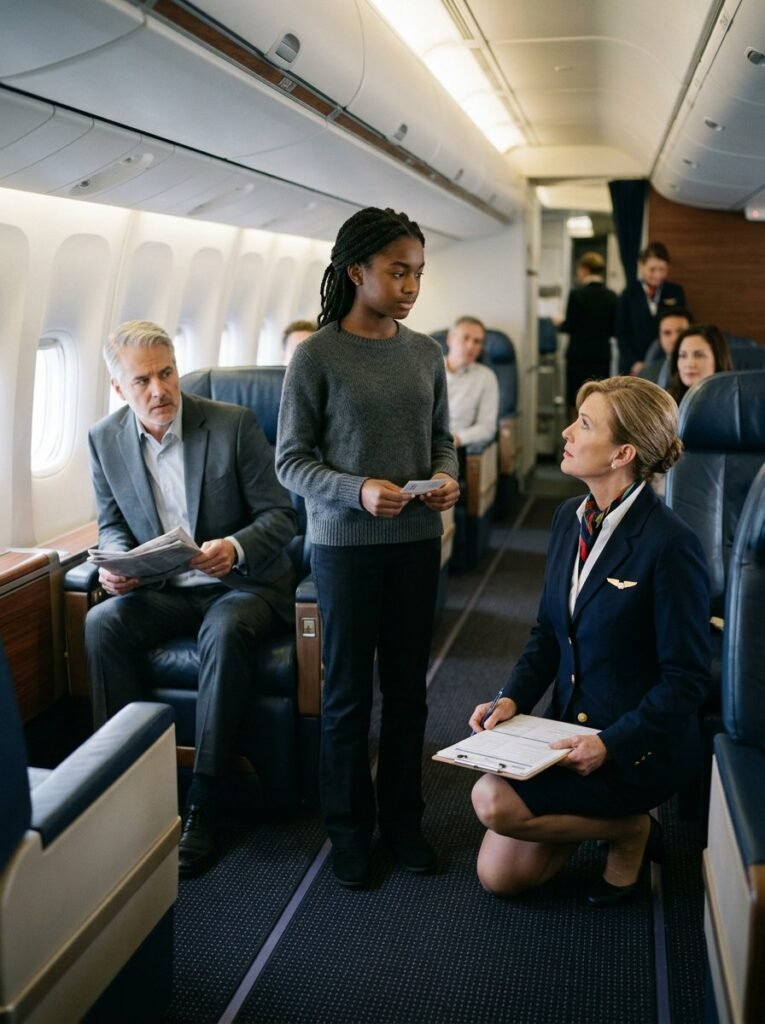
Zara held up her boarding pass and said, “Sir, you’re sitting in my seat.”
Senior flight attendant Elizabeth Hart stepped closer and took the ticket from her hand.
One number was printed beside Zara Coleman’s name.
2A.
Elizabeth looked at the surname again.
Something was wrong.
“Economy starts about thirty rows back.”
Richard Bennett said it without lowering his newspaper.
For a second, Zara Coleman wondered whether she had misunderstood him.
She was fourteen years old. She had traveled alone before. She knew airports, boarding groups, passport checks, security lines, and the particular way adults sometimes spoke more loudly to teenagers when they assumed confusion was the only explanation for disagreement.
But there was nothing confusing about the boarding pass in Zara’s hand.
NEW YORK — LONDON.
FLIGHT 212.
SEAT 2A.
She looked above the window.
2A.
Then at the man sitting beneath it.
Silver hair. Dark tailored suit. Polished shoes. A folded newspaper spread across his lap. His jacket had already been removed and carefully tucked beside him as though he had lived in that seat for an hour rather than several minutes.
“My ticket says that’s my seat,” Zara said.
Richard finally lowered the newspaper enough to see her.
His gaze moved from her face to the charcoal sweater she wore, then to her dark trousers, black sneakers, and burgundy travel bag.
“Then somebody made a mistake.”
“Could I see your boarding pass?”
That seemed to surprise him.
Richard’s eyebrows lifted.
“You’re asking to see my boarding pass?”
“I’m asking because mine says 2A.”
“I heard you.”
“Then please check yours.”
Several passengers nearby had begun paying attention.
A man across the aisle stopped fastening his seat belt.
A woman in Row 3 glanced over the top of her tablet.
Zara hated that part.
She didn’t like becoming the center of a room.
Her father had taught her something about situations like this.
Never raise your voice simply because someone else wants you to lose control.
People remembered the loudest person.
Evidence remembered the truth.
Zara kept her voice even.
“You may have 2B,” she said. “Could you please check your pass?”
Richard stared at her for another moment.
Then he gave a small, humorless laugh.
“You don’t belong in First Class.”
Heat rose behind Zara’s ears.
She could feel it spreading down her neck.
Not because she doubted herself.
Because she understood exactly what he meant.
She was young.
She wasn’t dressed like the executives around him.
She had no designer coat hanging from her arm.
No assistant.
No visible parent.
No reason, in Richard Bennett’s mind, to occupy the seat he wanted.
“I have a First-Class ticket,” Zara said.
“I heard you.”
“Then please move.”
Instead, Richard folded his newspaper.
He looked almost offended now.
“Do you know who I am?”
Zara paused.
“No.”
The passenger across the aisle coughed into his fist.
Richard’s mouth tightened.
“Richard Bennett. Bennett Strategic Holdings.”
He said it with the confidence of someone accustomed to watching recognition alter people’s posture.
Nothing altered Zara’s.
“That doesn’t change the seat assignment.”
Richard blinked.
Then a voice came from behind Zara.
“Is there a problem?”
Zara turned.
Senior flight attendant Elizabeth Hart had approached from the forward galley.
Elizabeth was in her late thirties, poised, blonde hair secured neatly behind her head, her wine-red neck scarf sitting perfectly against a crisp white blouse.
She recognized Zara.
Not personally.
But enough to remember her.
The girl had flown this route several times over the previous year.
Always polite.
Always alone.
Never demanding.
Elizabeth remembered bringing her hot chocolate once after turbulence and finding her calmly working through a book of engineering puzzles.
She did not, however, know anything about Zara’s family.
Richard answered first.
“This child is confused.”
Zara did not argue.
She simply held out her boarding pass.
Elizabeth took it.
Her eyes moved over the details.
“Seat 2A,” she said.
“Exactly,” Zara replied.
Elizabeth turned to Richard.
“May I see your boarding pass, sir?”
Richard exhaled theatrically.
“This is ridiculous.”
“Your boarding pass, please.”
He pulled it from the inside pocket of his jacket.
Elizabeth compared the two.
Her expression remained professional.
“Mr. Bennett, you are assigned to 2B.”
Richard pointed at the aisle seat beside him.
“We’re sitting together either way.”
“Yes, sir.”
“So what difference does it make?”
“It matters because 2A is Miss Coleman’s assigned seat.”
Richard leaned back.
“I paid full fare.”
Elizabeth looked down on Zara’s pass.
“So did Miss Coleman.”
Something changed in Elizabeth’s expression.
Not much.
Just a pause.
COLEMAN.
Her gaze lingered on the surname.
It meant something.
Or almost meant something.
She looked at Zara.
Zara noticed.
Richard did not.
“I need you to move to Seat 2B, sir,” Elizabeth said.
“No.”
The answer came instantly.
A quiet ripple moved through the passengers listening nearby.
Elizabeth remained still.
“Mr. Bennett, the seating assignment is not optional.”
“I’m already settled.”
“The aircraft has not departed.”
“And I’m not rearranging myself because some kid suddenly wants the window.”
“It isn’t sudden,” Zara said. “It’s printed on my boarding pass.”
Richard ignored her.
He looked at Elizabeth instead.
“Was she upgraded?”
Elizabeth’s expression cooled.
“Excuse me?”
“Was she upgraded at the gate? Is somebody doing her a favor?”
A man in Row 3 muttered, “Come on.”
Richard heard him but didn’t turn.
Elizabeth’s tone sharpened.
“Miss Coleman holds a valid First-Class ticket for Seat 2A.”
Richard glanced at Zara again.
“You don’t belong here.”
This time the words landed differently.
Zara stopped trying to convince him.
She looked at the seat number.
At Elizabeth.
Then at Richard.
“Keep it.”
Elizabeth frowned.
“Miss Coleman, you don’t have to do that.”
“I know.”
Richard smiled.
It was small.
Satisfied.
“Good choice.”
Zara met his eyes.
“You may feel differently in a few seconds.”
The smile weakened.
“What is that supposed to mean?”
Zara turned away.
She walked toward the forward galley.
Elizabeth followed.
“Miss Coleman?”
Zara reached into her bag and took out her phone.
Her father had programmed a small folder into it before her first solo international trip.
Not because he feared flying.
Because he understood operations.
Emergencies.
Systems.
And how quickly ordinary problems became dangerous when adults stopped listening to one another.
The folder was protected.
There were only three contacts.
HOME.
SECURITY.
DAD — OPERATIONS.
Zara tapped the last one.
Behind her, Elizabeth looked once more at the boarding pass.
COLEMAN.
Her eyes narrowed.
Then widened.
“Wait,” she whispered.
The call connected after one ring.
“Z?”
Her father’s voice changed instantly when he heard her breathing.
“Dad.”
“What happened?”
Zara looked down the aisle.
Richard had reopened his newspaper.
He was sitting in 2A as though he had won.
“A passenger took my assigned seat.”
“Which seat?”
“2A.”
“Did the crew verify your pass?”
“Yes.”
“Did they verify his?”
“Yes. He has 2B.”
A pause.
“Why isn’t he moving?”
Zara lowered her voice.
“He said I don’t belong in First Class.”
Silence.
Not an angry silence.
Something colder.
“Is the crew involved?”
“Yes. Elizabeth tried.”
Beside Zara, Elizabeth stopped breathing for a second.
Her eyes moved toward the cockpit.
“Did anyone touch you?” Marcus asked.
“No.”
“Are you safe?”
“Yes.”
“Flight number?”
“Two-twelve.”
“Route?”
“New York to London.”
Another pause.
Zara knew what her father was doing.
He was not asking questions because he had forgotten her itinerary.
He was verifying facts.
“Dad,” she said quietly. “They took my seat.”
“I understand.”
Elizabeth stared at Zara.
Then at the phone.
A memory seemed to arrive all at once.
Coleman.
Marcus Coleman.
She had seen the name.
Not on passenger lists.
In company briefings.
Operational memos.
Emergency authorization chains.
Zara drew one slow breath.
“Shut it down.”
There was no drama in her voice.
PART 2
Nothing happened for forty seconds.
That was the part Zara remembered later, and not the shouting. Forty seconds in which the aircraft stayed exactly as it was: the belt sign off, the galley carts unlatched, a child two rows back asking loudly for ginger ale, and Richard Bennett reading the business section in 2A with his jacket folded at his feet.
Then, at Gate C4, a woman named Renee Okfor was in the middle of a sentence to a passenger about a wheelchair, and her handheld went amber, and she stopped talking.
FLT 212 — HOLD — OPS CONTROL. PAX NONCOMPLIANCE. SECURITY TO GATE C4.
Renee had worked that gate for nineteen years. She had seen weather holds and fuel holds and a runway that once had a deer on it. She had never once seen a hold that named a passenger.
She keyed her radio twice before her hand would cooperate.
Inside 212, the aircraft’s own phone rang in the forward galley.
Elizabeth Hart looked at it.
It rang six times.
She picked it up because she had already decided that whatever was about to happen to her, she wanted to have answered the phone.
“In-flight, go ahead.”
The voice on the other end belonged to a duty manager she had never met, a man named Colm, and he was calm in a way that made the hair on her arms stand up.
“Elizabeth, this is Ops Control. We are placing 212 on a documented passenger-conduct hold under Section 14, and I need the crew’s contemporaneous note now, in your own words: who is in the seat, what did the passenger say, and what did he do when he was instructed to move.”
“His name is Bennett,” she said. “Richard Bennett. He is in 2A. He has 2B. He refused a lawful instruction at seven-thirty-five.”
“Is he intoxicated?”
“No. He is not.”
A pause.
“Is he frightening anyone?”
Elizabeth looked up the cabin.
Richard was folding his newspaper into quarters now, neatly, the way a man folds a thing when he has decided he is the only adult present.
“He’s not frightening anybody,” she said. “He’s just refusing. And everyone is watching.”
“Ma’am, that is the definition.”
Then the jet bridge filled.
The fourth door opened and Yolanda Reyes came down the aisle in a navy blazer with the airline’s logo on her lapel, no coat and no scarf, which everyone in that cabin knew meant she had left somewhere warm in a hurry.
Yolanda Reyes was fifty-eight, thirty-one years in the air, seven of them running In-Flight Operations. She did not raise her voice in rooms, ever, because she had learned long ago that a cabin follows whoever is calm.
She did not look at Richard Bennett first.
She walked to the girl by the jump seat and she stopped and she said, “Miss Coleman.”
Zara looked up.
“I need to ask you one question, and I am going to ask it out loud where everybody can hear me, and I need you to answer it the way you have answered everything else today.”
Richard straightened in the window seat.
“Did anybody put you in a seat, or did you take one?”
“He took mine,” Zara said.
Yolanda nodded once.
Then she turned to 2A, and her voice did not change at all.
“Mr. Bennett. Your boarding pass was reissued in error at 6:58 this morning by a ground agent working a double shift. That reissue was voided at 7:12, and the void is in the system with your name on it, and I have a printout coming down the bridge behind me. You were seated in a first-class window you did not hold, and when the crew told you to move, you refused.”
Richard’s face did something complicated.
“I paid full fare.”
“I don’t care, sir.”
“Do you know who I am?”
Yolanda said, “Yes.”
That was all she said, and it took the floor out from under him in a way the shouting never would have.
He stood up.
That was the mistake, because he stood up in front of two hundred and fourteen people and he pointed at a child.
“This is extortion. Whoever that girl called, whatever she pulled, I am going to have her and her father and this airline on the record, and you are going to spend the rest of your career explaining a three-hour hold to an insurer over a seat.”
And that is when Richard Bennett finally looked at his watch, because he had somewhere to be, and that was the reason the whole thing got worse for him and better for everybody else in the cabin.
He was due in London at four. It was the only flight he had before a signing.
PART 3
Here is what the airline’s own rulebook says, and Zara learned it that day because Yolanda Reyes did something almost nobody in an airport does, which was to explain the rules out loud to a child.
Passenger-conduct holds are not about comfort.
They exist because in a metal tube, a person who can refuse a crew member and lose nothing is a person who will do it again at thirty thousand feet, and the last airline that decided this was a seat problem spent nine years in court.
Section 14 says a crew instruction is a lawful order, a refusal is an incident, and an incident is documented before the door is closed.
Yolanda walked to the front jump seat and sat down with a clipboard, and she took statements.
Not from Richard.
From everybody, one at a time, in order, in the aisle, in front of whoever cared to listen, which was almost everybody, because two hundred and fourteen people had nothing to do at eight o’clock in the morning but hear the truth.
Elizabeth Hart gave hers first.
She said the seat number. She said the newspaper. She said “you don’t belong here,” twice, and both times she said it in the words she had heard, and she wrote them down in her own handwriting and signed the page.
The man in 3B, whose name was Alvin, said he had seen the man sit down before the girl ever reached the row and he said he was “sorry, miss, I don’t get involved,” and then he got involved anyway, in the same handwriting, in ink.
The woman in 3A, a magistrate from Leeds, gave a statement of four sentences.
Zara gave hers last, and Yolanda asked her only two questions.
“What did you say to him when you gave him the seat?”
“I told him he could keep it.”
“And then what did you do?”
“I went and called my father.”
Yolanda put her pen down.
“Miss Coleman. I want to ask you a thing that I am not going to put on the record, and I want the answer anyway.”
“All right.”
“When you stood in that aisle with a piece of paper that said your name, and a man looked at your shoes and told you that you did not belong in a room you had paid for. What did you want to do?”
Zara thought about it.
“I wanted to be loud,” she said.
“And?”
“And then I thought about what it looks like when a fourteen-year-old girl gets loud, and it doesn’t matter what she’s right about.”
Yolanda Reyes was fifty-eight years old and she had been in aviation for thirty-one, and she looked at that child for a moment and said the thing she said to nobody else that day.
“That is a better answer than the one my daughter gave the police officer who pulled her over in 2019.”
Two things happened next, and they happened in the same twenty minutes.
The first was that the port authority officers came aboard with a handheld camera and they took Richard Bennett’s statement in the galley standing up, with his jacket over his arm, and they asked him three times whether he understood that a crew instruction on an aircraft is a lawful order, and he said yes three times, and the last time he said it he was looking at the number of seats behind him.
They asked him to step off the aircraft.
He asked, in the doorway, whether he was being removed because of a child’s phone call.
Yolanda told him, in front of Renee Okfor and two officers and the whole jet bridge, that he was being removed because he had refused her crew.
“Your father,” he said, when he saw Zara at the galley curtain, “whatever he does for a living, this is not the way people behave.”
Zara said, “He doesn’t work for anybody here.”
And that was true, and it was the sentence nobody in that terminal understood until much later that day.
The second thing was the money.
Bennett Strategic Holdings was thirty-six hours from closing a deal to buy a forty-two percent stake in a chain of cargo terminals, and its own agreement had a clause in it that its own lawyers had written and had refused to change in two years of negotiation, because a clause you refuse to change is a clause you intend to use on somebody else.
It said the buyer could walk, without penalty, on written notice of a material adverse event, and it gave, as its only example, “any governmental, regulatory, or aviation-authority proceeding involving a named principal.”
Richard had an aviation-authority proceeding involving a named principal at nine-fifteen that morning, and the record of it was two hundred and fourteen people in a tube at JFK with a clipboard.
He called four people from the jet bridge.
The fourth one was a lawyer, and the lawyer told him, in a sentence he would remember for the rest of his life, that a civil claim against a fourteen-year-old would make every one of those statements a public exhibit.
PART 4
Zara’s father did not come to the airport.
That is the part the terminal got wrong, and it is the part the story is actually about.
Here is how he knew at all. The hold notice Elizabeth Hart filled in had one free-text field that the system requires on any Section 14 event: the name of the aggrieved party. When a carrier’s own software sees a Coleman in that field, the ticket does not sit in a queue. It escalates in ninety seconds, because the same software that runs the airline’s control center is the software Marcus Coleman’s company wrote, and it was built by a man who had spent twenty-two years being told that a conflict of interest is only dangerous when nobody can see it.
He was in his own office in Jersey by 8:40 with a coffee he did not drink and a chair he rolled to the wall so he could stand in front of a window, and what he did in the next four hours is not a magic thing.
It is worse than that.
Coleman Aerial Systems, which he started in a rented room in 2002 with two engineers and a broken weather radar, owns no planes and no airlines and has never owned either.
What it sells, to forty-one carriers on three continents, is the thing every one of them is legally required to have and none of them wants to build: the operations control center, the safety-reporting spine, the authorization chain, and the audit.
The airline flying 212 does not answer to Marcus Coleman.
Marcus Coleman answers to the airline’s regulator.
That is the whole of it, and it is not a trick. His contract, page eleven, says that when a carrier’s own system logs a Section 14 event, the oversight flag is automatic, and nobody has to like anybody on either side of it for the flag to fly.
He did not ground a plane because his daughter was upset.
The plane was grounded by a rule he wrote eleven years ago that says a person who refuses a crew instruction is not allowed to be on a moving aircraft until somebody writes down what happened, and the rule does not care whether the person is a fourteen-year-old girl in black sneakers or a man with a company named after himself.
He made one phone call that morning, and it was to the chief operating officer of the carrier, a woman he has known since 2013, and he said four sentences.
He said: “I am not asking you for anything for my daughter.”
He said: “I am calling to tell you that I am on the other end of that phone, and that you are going to want your lawyers in the room before you decide what to do with that, and I am sorry to put you there.”
He said: “Your crew did the right thing and your crew is going to need support on Monday.”
And then he said, “I am going to log the conflict, and I am going to log my own daughter as a party, and if any part of what happens today touches my contract, your general counsel should come at me directly, not at a child in a terminal.”
That last sentence cost him something, and he did not find out how much for nine days.
Because a man with a lawyer and a grudge and nothing left to lose does not sue an airline.
He sues the vendor.
The complaint was filed nine days later in the Superior Court of New Jersey, and it named three defendants.
Marcus Coleman.
Coleman Aerial Systems.
And Zara Coleman, a fourteen-year-old, listed in the caption by her full legal name, in a paragraph that said she had “by her father’s office, with malice, caused the total loss of a business opportunity of a value in excess of one billion dollars.”
The airline’s general counsel called Marcus at 6:12 in the evening.
“Mr. Coleman. Two things.”
“Go ahead.”
“The first is that the carrier is going to stand behind its crew and behind the hold, and we’re going to say so in writing, and we’d like your company to be named with us.”
“All right.”
“The second is a copy of the incident report from this morning, and there is something in it that matters more to you than anything Mr. Bennett filed, so I want you to read page two before you speak to your own board tonight.”
Page two was Yolanda Reyes’s own handwriting.
At 7:36, before the jet bridge, before the officers, before a single thing happened to Richard Bennett, Yolanda had written one line at the bottom of the hold notice that said what she believed had caused the event.
She could have written a passenger’s refusal.
She had written: ground reissue error, 6:58, agent unverified; passenger refusal second, not first.
Meaning that the airline had made the mistake.
Meaning the carrier had handed a man a seat that belonged to a child, and had done it at a counter, at 6:58 in the morning, by a woman working a double shift who had already been suspended, and that a fourteen-year-old girl had been correct about her own piece of paper from the first second in that aisle.
Marcus Coleman read that line twice in his office with the light on and the city outside, and then he called his own board at 6:52 that evening, because there was a clause in his contract he had to say out loud before the airline’s lawyers found it for him.
He had written it himself in 2011. If a principal of the firm uses operational authority for a personal purpose, the carrier may terminate without cause, and the penalty is the whole contract, and the whole contract was four hundred and twelve million dollars across nine years and forty-one airlines.
He had used a system to fix a personal wrong, and there is no version of that rulebook in which he gets to be the exception.
The chairman let him finish.
Then the chairman said, “Marcus. We can make that go away. Nobody at that carrier is going to open that file on a girl’s behalf, and if you want, I will get the report reworded before nine.”
And Marcus Coleman said, “If you touch that report, I will resign tonight and take the audit with me.”
PART 5
The arbitration panel took four months.
Marcus filed his own disclosure the next morning, unsolicited, in seven pages, and one sentence in it got quoted back at him by a reporter in March, which he hated, because he had written it for a lawyer and not a newspaper.
It said: a rule that is only applied to people I do not know is not a rule, it is a preference, and I have been paid for twenty-two years to be the one person in this industry who cannot have preferences.
The panel found three things.
The hold had been properly executed by the carrier under its own Section 14, and Marcus Coleman had no part in causing it.
His daughter had been right about the seat at every second of the morning.
And the ground agent who reissued 2A at 6:58 had been working a twenty-hour week on a scheduling template that Coleman Aerial Systems itself had written in 2019, and had never been audited for hours, because nobody audits the thing they built.
That last finding cost Marcus the safety-committee chair he had held for eleven years. He gave it up in a letter of two paragraphs, fixed the template inside a week, and the fix is in thirty-one countries now because the whole industry adopted it and never credited him, which was the deal.
The airline paid the delay loss out of its own insurance and never once came after the family, and it did one other thing that nobody expected.
It changed Section 14.
Not the hold rule. The form.
Under a revision that Yolanda Reyes wrote herself in December, a crew now has to record the seat number, the original assignment, and the reissue source before the words passenger conduct are allowed on the page. Because most of what happened on that aircraft happened at a counter, at 6:58, to a child who was right, and the paperwork had been built to blame the last person who spoke.
Richard Bennett was fined eleven thousand dollars by the F.A.A. in September for interference with a crewmember’s duties. He paid it. The carrier barred him for two years. The cargo terminal deal did not close, and the acquirer’s own filing used, word for word, the clause Bennett’s lawyers had refused to soften for two years.
The lawsuit did not survive a deposition in which a court reporter asked him to repeat “you don’t belong here” eleven times and he could not get past the third. He dropped it in February, with prejudice, and the settlement said nothing at all about a fourteen-year-old girl, which was the only outcome Zara wanted and did not know she had asked for.
Zara read the complaint herself. Her mother let her.
She cried once, in the kitchen, and it was about the words by her full legal name, and nothing else, and her father sat down across from her and said nothing until she was finished.
“Dad,” she said. “You didn’t make him do anything. You made one phone call.”
“I did.”
“I thought you grounded the plane.”
He said, “Z. I have never in my life grounded an airplane for anybody. There is a rule that says a man who tells a crew to go to hell doesn’t get to be on a moving aircraft, and the rule has arms and legs and paperwork and a night shift, and it went and did its job without ever once hearing from me.”
“And if it hadn’t?”
“Then I’d have been angry at a rule instead of a man, and that’s a better place to be angry, because a rule can be fixed by anybody.”
The last thing that matters happened in June, at Gate C4, on the same aircraft type, and Renee Okfor saw her coming and did something that made a supervisor nervous.
She held out a printed boarding pass herself, before the child reached the scanner.
“2A,” Renee said. “Window. I checked it twice. Sit down in it.”
Zara looked at the paper.
She looked at the aisle.
There was a family in the queue with one seat together and one seat not, and a boy about her own age holding a paperback with a cracked spine and looking at the ceiling the way she used to.
She sat in 2A for exactly as long as it took to open her bag, and then she got up and walked one seat over, and she said, “You want the window?”
The boy said, “Is that all right?”
And that is the part that made Marcus Coleman laugh.
His daughter did not have to give it up. She had already won that seat twice, once on paper and once on the record, and she moved anyway, and nobody who has ever been in a room with her has been able to say a thing about it but good.
Zara Coleman is fifteen now.
She has a folder on her own phone, and there are four names in it, and the fourth one is a woman in navy with a clipboard who teaches a class once a year at the academy on conflict in a cabin, and Zara is in the front row, and she is not the loudest person in that room.
She never was.