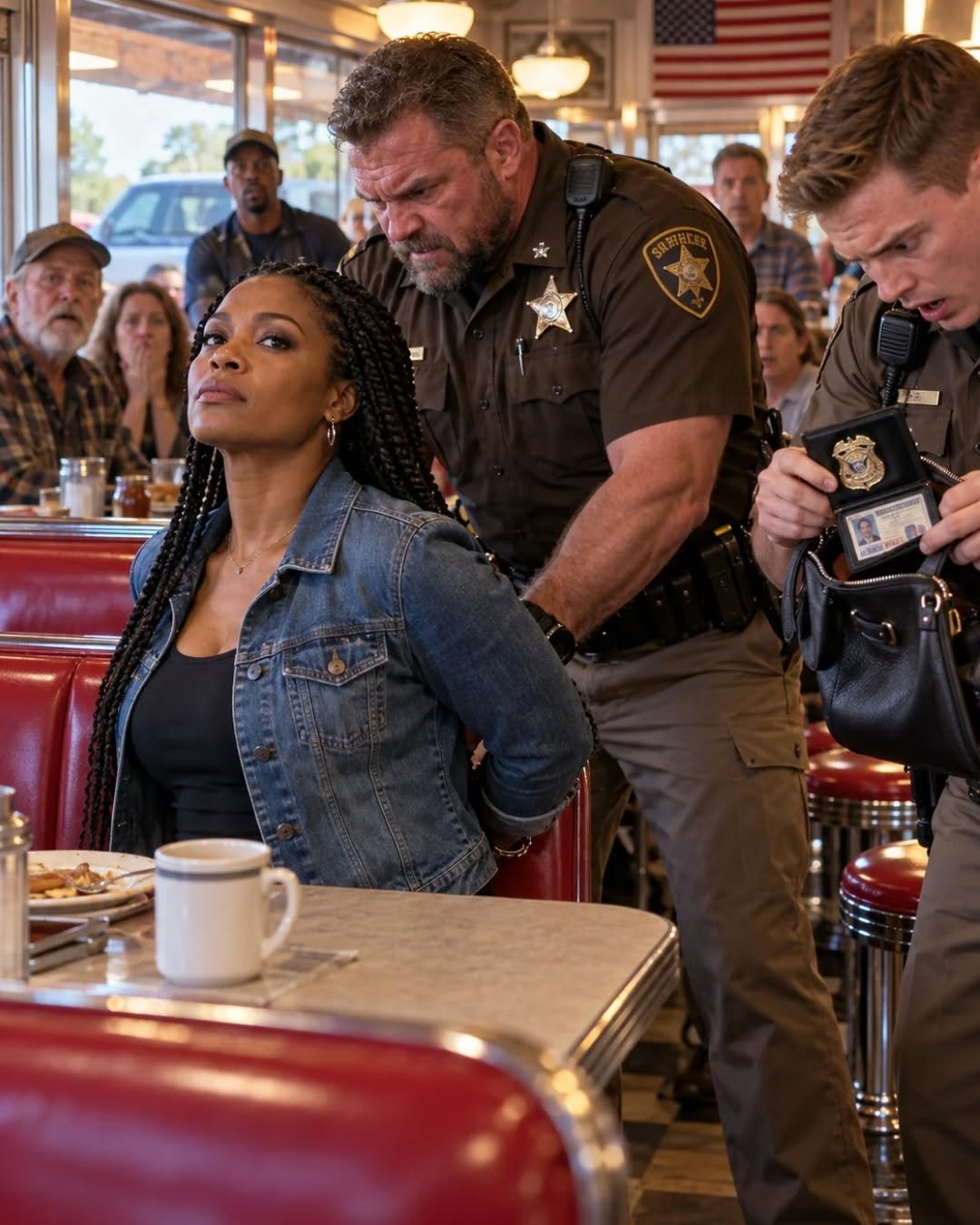
The heavy metal cuffs slammed onto my left wrist before I even had time to lower my fork.
“Hands behind your back, right now!” Sheriff Dalton Voss growled, his deep voice booming across the small-town diner like sudden thunder.
The entire restaurant went dead silent. Utensils clattered onto ceramic plates. Local diners froze in mid-bite, staring in utter shock as this burly, thick-necked lawman pinned my shoulder against the vinyl booth. I didn’t flinch. I didn’t scream. I sat perfectly still, feeling the ice-cold steel bite into my skin as I calmly finished chewing my lunch.
My name is Amara Whitlock. I am forty-four years old, born and raised in Georgia, and for the past six years, I have served as an appointed United States District Judge for the Federal Court. But looking at me today in my faded denim jacket, soft braided hair, and scuffed sneakers, Sheriff Voss saw only what he wanted to see.
He saw a Black woman alone. He saw someone he believed was powerless, isolated, and completely at his mercy. He saw an easy target.
He didn’t know I had deliberately left my judicial badge concealed deep inside my purse, choosing to enter his county incognito after receiving dozens of anonymous corruption complaints against his department. For months, letters had come to my chambers. Handwritten accounts from mothers, from truck drivers, from teenagers — all describing the same thing: a sheriff who ruled through intimidation, who invented charges, who made people disappear into his jail for days without a proper booking. The Judicial Conduct Board had flagged it, but they wanted proof. So I came to see it for myself.
I wanted to witness firsthand how Sheriff Voss treated ordinary citizens when he thought nobody was watching. Now I was getting my answer.
“You’re making a grave mistake, Sheriff,” I said softly, keeping my voice steady, unbothered, and completely measured. I didn’t raise it. I didn’t need to. Authority doesn’t need to shout.
Voss sneered, leaning down so close I could smell the stale coffee and cigar smoke on his breath. His belly pressed against the edge of the table, his badge glinting under the fluorescent diner lights.
“I don’t make mistakes in my county, lady,” he spat. “You match the description of a suspect in an armed theft, and right now, you’re actively resisting arrest.”
I hadn’t moved an inch. I hadn’t raised my voice. My hands had been folded neatly around my water glass. Yet he twisted my right arm behind my back with a practiced cruelty and slapped the second cuff shut with a vicious, metallic click that echoed through the quiet room.
A few diners looked away quickly, their eyes on their plates, pretending they hadn’t seen anything. That was the fear he cultivated. This wasn’t law enforcement. This was theater, and everyone in town knew their role was to stay silent.
He yanked me out of the booth so violently that my table shook and my water glass tipped over, spilling across the Formica. The crowd gasped, but nobody dared to speak up against the man who had ruled this town through raw fear for over a decade. An older waitress pressed her hand to her mouth. A young father pulled his child closer.
Voss leaned down to my ear, his tone dripping with cruel satisfaction, his voice low enough that only I could hear it.
“You think you’re clever? In my town, nobody hears you scream, and nobody is coming to save you.”
He said it like a promise. Like he had said it before to others who couldn’t fight back.
In that moment I understood exactly why the letters to my chambers had all ended the same way: please don’t use my name. For years, Voss had counted on anonymity and silence to keep his county sealed off from oversight. He believed the federal courthouse was far away and federal judges were abstract names on orders he could ignore. He believed no one inside that diner would ever testify, no camera would ever stay on, and no record would ever leave the county line.
As he violently shoved me through the glass front doors toward his idling police cruiser, the bell above the door jingling wildly, my purse was left behind — dangling from his young deputy’s shoulder. And inside it, my encrypted phone suddenly began to vibrate frantically with an urgent, high-priority alert directly from the Chief Judge of the Federal District Court.
The screen lit up through the leather. One name flashing over and over.
Sheriff Voss thought he had just humiliated another powerless outsider in his small county. He had no idea he was locking up the very federal judge who held his entire future in her hands.
And the nightmare at the precinct was only just beginning.
PART 2
The ride to the precinct was short, but Sheriff Voss made it feel long. He drove deliberately slow through Main Street, lights flashing, sirens off, making sure everyone saw who was in the back of his cruiser. I sat with my hands cuffed behind my back, my shoulders aching, watching the town blur past the reinforced glass.
This was not my first time being underestimated. As a young Black prosecutor in Atlanta, I had been mistaken for the court reporter, the defendant, the intern. As a federal judge, I had watched attorneys do a double-take when I took the bench. But this was different. This was not bias born of ignorance. This was cruelty wielded as policy.
When we pulled into the cracked lot behind the county precinct, the building looked exactly like the complaints had described: faded brick, blinds drawn, a faded American flag snapping in the wind above a security camera that pointed directly at the holding cells, not the entrance.
Voss hauled me out by the elbow and marched me inside. The air smelled of bleach and old coffee, the fluorescent lights humming overhead. Two deputies at the intake desk stood up straighter when he entered, and a dispatcher went silent mid-call.
The young deputy who had carried my purse — he couldn’t have been more than twenty-four, with a close crop and nervous eyes — followed us in and set my purse gently on the steel intake counter, as if he already knew it didn’t belong there.
“Log it,” Voss barked at him. “Search it. We need to find what she stole.”
I said nothing. Federal judges learn the power of silence. I let him build his own case, word by word, violation by violation.
The deputy hesitated. He unzipped the main compartment slowly. First he pulled out my car keys, my reading glasses, a small notebook. Then he found the wallet. It was a simple black leather bifold, worn at the edges.
He flipped it open to the clear ID window, expecting a driver’s license.
What he saw instead made his hands freeze in mid-air.
Behind the plastic sleeve was not a Georgia driver’s license. It was a United States District Court credential. Heavy cream stock. Embossed gold seal of the United States Courts. My official judicial portrait. And in bold, raised letters: THE HONORABLE AMARA M. WHITLOCK — UNITED STATES DISTRICT JUDGE — NORTHERN DISTRICT OF GEORGIA.
The blood drained from his face.
“Sir…” his voice cracked. It was barely a whisper. “Sheriff… sir, you need to see this. Right now.”
Voss, who had been leaning against the wall with his arms crossed, smirking at the other deputies, pushed off and swaggered over. He snatched the wallet from the deputy’s trembling hands, ready to mock whatever he found.
He stared at it for a full three seconds. His smirk vanished.
He turned the badge over, as if checking if it was fake. He read the name again, slowly, moving his lips. Amara Whitlock. Then his eyes flicked to the seal, to the federal signature at the bottom, to the security hologram that no one could counterfeit.
The room went absolutely still. The other deputies had leaned in, and now they leaned back, as if the wallet itself might detonate.
On the steel counter, my encrypted phone began to vibrate again — louder this time, insistent, buzzing against the metal like an alarm. Then it began to ring. A sharp, federal trill that every law enforcement officer in that building recognized.
The caller ID glowed bright on the lock screen for everyone to see: CHAMBERS OF THE CHIEF JUDGE — U.S. DISTRICT COURT — URGENT.
The young deputy looked at Voss. Voss looked at the cuffs still locked on my wrists. And for the first time since he had slammed steel on me in that diner, Sheriff Dalton Voss looked terrified.
At that moment, the precinct’s front doors burst open, and a woman in a dark federal windbreaker stepped inside, holding up her own badge.
PART 3
The woman in the windbreaker didn’t raise her voice. She didn’t need to. The yellow letters on her back said it all: U.S. MARSHAL.
“Everyone hands where I can see them,” she said calmly, her eyes sweeping the room. She was in her early thirties, composed, her hand resting near her service weapon but not drawing it. Behind her, two more marshals entered, moving with the quiet efficiency that comes from doing this for real, not for show.
Voss recovered first, but his recovery was ugly. He shoved my wallet back onto the counter like it had burned him.
“This is my county, Marshal,” he snapped, trying to summon the thunder he had used in the diner. “This woman is a suspect in a felony theft. I don’t care what piece of plastic she’s carrying. You can wait outside while we process her.”
The lead marshal looked at me, cuffed to the bench, my blazer half off my shoulder, my wrists red from the steel. Then she looked at the badge still lying open on the intake desk.
“That piece of plastic,” she said evenly, “is a federal judicial commission signed by the President of the United States. This woman is Judge Amara Whitlock. And you just broadcast her false arrest on your own bodycam.”
The words landed like a gavel. One of the older deputies took a step back and lowered his head. The dispatcher quietly reached over and stopped the intake recording, her hand shaking.
I finally spoke. My voice was quiet, but it cut through the cinderblock room.
“Sheriff Voss, my name is Judge Amara Whitlock. Six months ago, my chambers began receiving sworn complaints about this department. Unlawful stops. Coerced confessions. A sixteen-year-old boy held for thirty hours without a parent or a phone call. I am the judge assigned to the federal civil rights review of this county. I came here to observe. You have now given me direct, personal evidence of every allegation.”
Voss’s face twisted. For a second I thought he might double down and drag me to a cell. He had ruled by never admitting fault, and men like him would rather destroy evidence than admit terror.
“You’re lying,” he hissed, pointing at me, his finger trembling just enough to betray him. “You can’t prove anything. This is entrapment.”
The lead marshal stepped forward and placed a sealed envelope on the counter next to my phone, which was still ringing.
“That’s a federal order,” she said. “Signed by Chief Judge Harland Mercer this morning. It authorizes the immediate preservation of all records, bodycam footage, booking logs, and holding cell video for this precinct. It also authorizes the U.S. Marshal Service to take protective custody of Judge Whitlock.”
She looked directly at Voss.
“And Sheriff, that phone call you’ve been ignoring? That’s Chief Judge Mercer. He has been on the line with the Governor for twenty minutes. He has watched your bodycam feed live since you put cuffs on her in the diner.”
Voss went pale. The deputy who had searched my purse finally found his courage and spoke.
“Sir, we never read her Miranda rights,” he whispered. “We never booked her. There’s no victim, no report…”
The marshal nodded to her partner, who knelt beside me with a cuff key.
“Judge Whitlock,” she said softly, with genuine respect, “I’m Deputy Marshal Reyes. On behalf of the United States, I am so sorry this happened to you. May we remove these?”
I nodded. The cuffs clicked open. Circulation rushed back into my hands, stinging and hot. I rubbed my wrists slowly, deliberately, looking straight at Voss as the steel fell away.
“No,” I said to Reyes, my voice steady. “Leave the cameras on. I want every second preserved. We’re not done here.”
Voss lunged for the intake computer, his hand reaching for the power strip, and Reyes moved faster than anyone expected.
PART 4
He didn’t get to the plug.
Marshal Reyes caught his wrist in mid-air, twisted it just enough to force his hand flat against the desk, and held it there with professional restraint. It wasn’t violent. It was final. The other two marshals stepped between Voss and the row of computers that held a decade of his power.
“Don’t touch anything, Sheriff,” Reyes said quietly. “That would be obstruction of a federal order and tampering with evidence. That’s a felony.”
Voss wrenched his hand free, breathing hard, his face red with humiliation. He was a man who had never been told no inside these walls, and now his entire staff was watching him get cornered in his own precinct.
“You think this changes anything?” he snarled at me, his voice cracking. “I know every family in this county. I know every back road. You can write all the orders you want from Atlanta, Judge, but out here, I’m still the law. You walked into my house. You don’t walk out and tell me how to run it.”
It was a threat. Barely veiled, but a threat nonetheless. And it was being recorded from four different angles — my phone, still on speaker after Reyes had answered it, the marshals’ bodycams, and the precinct’s own ceiling camera that Voss had forgotten was still rolling.
On speaker, a calm, older man’s voice filled the room. It was Chief Judge Mercer, whose voice I had known for twelve years as a mentor and a friend.
“Amara? Are you safe? Can you hear me?”
“I’m safe, Chief,” I said, my eyes never leaving Voss. “I am at the county precinct. Sheriff Voss arrested me without cause, without reading me my rights, and while on camera stated that no one would hear me scream. I have observed sufficient cause for an immediate federal intervention.”
“Thank God,” Mercer exhaled, audible relief breaking his judicial composure. “Amara, I’m looking at your location. The FBI field office is seven minutes out. The Governor’s counsel is on the other line. Do not let that man touch you again.”
Voss heard the word FBI and laughed — a sharp, desperate laugh.
“FBI? For what? For doing my job? You have no jurisdiction here. This is a local matter. This is county business.”
Reyes answered without looking at him. “Sheriff, at 11:42 a.m. you used excessive force during a warrantless arrest of a federal officer. At 11:47 you transported a federal judge against her will across a county line. That’s kidnapping under federal statute if intent is shown. And at 11:53 you attempted to destroy evidence under federal preservation order. That’s three felonies before lunch.”
The color drained from Voss completely. The older deputy quietly slid his utility belt off and placed it on the counter, stepping away from the sheriff, a silent resignation. The young deputy who had found my badge stood frozen, tears in his eyes, mouthing “I’m sorry” to me over and over.
Voss saw it — the loyalty evaporating, the empire crumbling in real time. And like all bullies when the audience turns, he reached for the last weapon he had left.
He turned and stormed toward the locked interrogation room at the back of the precinct, grabbing my purse from the counter as he went.
“If you want your precious federal property, Judge, come and get it,” he spat, unlocking the heavy steel door and disappearing inside with it, slamming the door shut and throwing the deadbolt with a loud, echoing clang.
Inside that purse was not just my badge. It was my encrypted federal docket drive — containing sealed testimony from twenty-seven residents of this county who had risked everything to report him, their names, their addresses, their children’s schools.
Reyes tried the handle. Locked. Solid steel. No windows.
From inside, we heard the sound of a metal zipper, then papers rustling.
He was going to shred them. Or worse, photograph every name.
Outside, sirens began to wail — closer and closer, not the county’s familiar whoop, but the sharp federal yelp. The FBI had arrived. But the steel door stood between us and the only copy of the evidence that could protect those families.
And Voss was on the other side, with everything to lose.
PART 5
No one moved for a half-second that felt like a lifetime. Then training took over.
“Breaching tools, now!” Reyes snapped, and one of her marshals was already running to their SUV outside, where the FBI vehicles were screeching to a halt, doors flying open.
I pressed my hand against the cold steel door, my heart pounding, but my voice remained absolute calm. This was my courtroom now.
“Sheriff Dalton Voss,” I said loudly, clearly, so the cameras and the phone and the twelve officers now crowding the hallway could hear every word. “This is United States District Judge Amara Whitlock. Inside that purse is sealed federal evidence under my direct judicial custody. Destroying it is obstruction of justice, retaliation against witnesses, and contempt of federal court. If you do this, I will personally ensure you are prosecuted to the fullest extent of federal law. Open the door.”
Silence. Then a shuffle. Then his voice, muffled and shaking.
“You don’t know what it’s like to hold this place together,” he shouted through the door. “These people need a strong hand. You soft judges in your towers—”
The deadbolt clicked. The door creaked open an inch.
Voss stood there, my purse hanging limply from his hand, his face streaked with sweat and something that looked like shame finally breaking through years of armor. He did not hand it to me. He dropped it. It thudded at my feet.
“I didn’t look,” he whispered. “I didn’t look at the names. Please. Please don’t destroy my family over this.”
Reyes secured him immediately — not with cruelty, not with the violent yanking he had given me, but with firm, professional hands behind his back, reading him his Miranda rights word for word, the words echoing off the cinderblock walls he had once controlled.
The FBI evidence team took custody of my purse, my phone, and most importantly, the intake desk’s bodycam server, which Reyes had protected with her body. Outside, residents who had heard the sirens were gathering on the sidewalk, phones out, watching as the man who had made them whisper for years was walked out in his own cuffs.
He didn’t look at them. He couldn’t.
Three weeks later, in a federal courtroom in Atlanta, I took the bench as scheduled. Sheriff Dalton Voss sat at the defense table in a plain suit, no badge, no gun, his hands folded, his eyes down. The Department of Justice presented the bodycam footage — eleven minutes that needed no explanation. The jury deliberated for ninety minutes.
Guilty on all counts: deprivation of rights under color of law, obstruction, and attempted destruction of federal evidence.
As he was led away to begin his federal sentence, the young deputy who had found my badge — Deputy Ellis, who had testified truthfully and was now under federal protection for his family — stopped in the hallway and shook my hand with both of his.
“Thank you for not screaming back,” he said quietly. “Thank you for showing us what real power looks like.”
I adjusted my robe, felt the familiar weight of the gavel in my hand, and looked out at the packed gallery of families from that small county who had finally been heard.
I had not come for revenge. I had come for justice. And justice, at last, had been served.