Morning light had just reached the old stones beneath the trees when I saw the newborn macaque. He lay on a broad, flat surface near the edge of the Angkor Wat forest, where roots had lifted sections of the ground and dry leaves collected in narrow seams. His mother was visible several steps away.
The distance was not great, but it felt large beside an animal so young. The infant opened one hand, rested it, then raised his arm toward her. His legs shifted against the stone without carrying him forward. From the path, I could hear insects in the canopy and the faint movement of the troop farther uphill.
The mother looked older than the other females nearby. She sat with her shoulders rounded and her hands on the ground. Twice she turned her head toward the infant. Each time, she remained where she was.
It would have been easy to read refusal into that pause. Human eyes search quickly for a reason when a newborn appears alone. Yet the full scene suggested something more uncertain. The mother had not left the area. She watched him, rested, and kept the other macaques within view.
I stayed back. Approaching could have driven her farther away or placed another source of stress between the pair.
From where I stood, the stone was fully exposed on one side but sheltered by roots on the other. No food or crowd surrounded the pair. The absence of immediate pressure made waiting feel safer than acting on the first interpretation that entered my mind there.
The infant rolled slightly onto his side. His fingers closed around a small piece of bark, then released it. When he called, the sound was short and light, almost lost beneath a bird in the branches above.
The mother responded by standing. She moved only halfway toward him before sitting again. For a moment, both were still. Then the newborn raised his arm once more.
This time she crossed the remaining space.
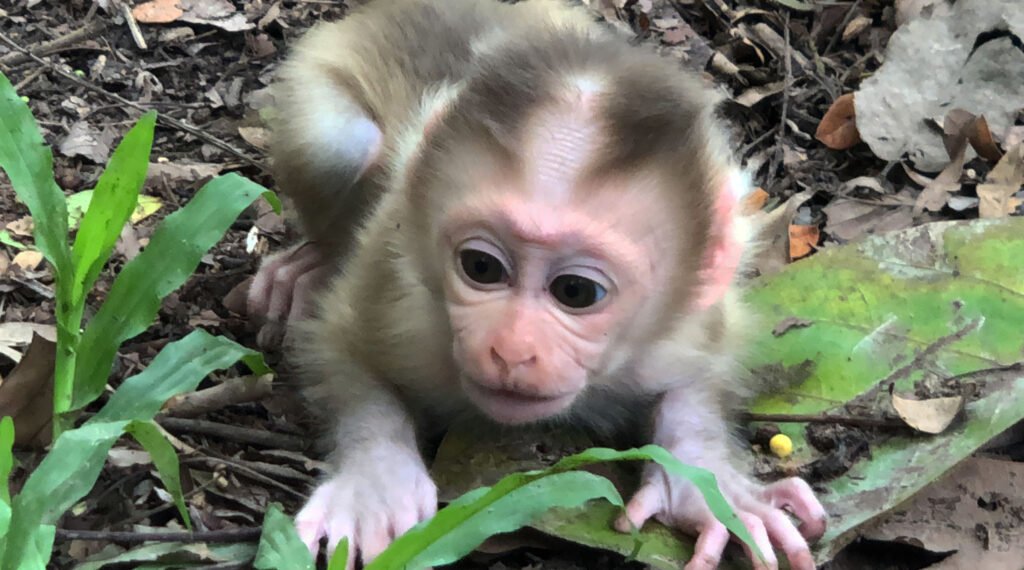
She stopped beside his feet, looked around the clearing, and lowered one hand near his shoulder. The infant turned toward her immediately. His fingers caught the fur at her wrist. The grip did not appear strong, but she waited until he had secured it before shifting closer.
The mother did not lift him at once. She sat with one leg beside his body and allowed him to pull toward the warmth of her side. When his head reached her stomach, she placed her palm lightly across his back.
Nothing about the return was hurried. That was what made it feel so honest. The mother still looked tired. The infant still needed more coordination than he had. Their connection came through a series of small adjustments rather than one dramatic gesture.
I thought of the quiet negotiations familiar to many American parents: a baby stirring before dawn, an exhausted adult sitting at the edge of the crib for one extra breath, then reaching in. Care does not always arrive with visible energy. Sometimes it is measured in the decision to move closer despite fatigue.
After several minutes, the mother rose with the newborn holding beneath her. She took a few careful steps toward deeper shade and stopped near a large root. The troop continued calling above them.
By the time they disappeared behind the trees, the stone where the infant had waited was empty again. What remained was not proof of rejection or a simple story of abandonment. It was a quieter observation: an older mother needed time, a newborn kept reaching, and the space between them eventually closed.

The mother stepped away three times before she finally settled beside her newborn.
I watched from a quiet section of the Angkor Wat forest where a low sandstone border divided the visitor path from the trees. The afternoon was warm, and most of the macaque troop had moved into the shade. The newborn remained on the stone, turning his face from side to side as if searching for a familiar shape.
His mother sat nearby. She looked older, with pale fur around her cheeks and a slow, careful way of changing position. When the infant moved toward her, she stood and walked several feet to a root. She rested there, glancing back.
The newborn pushed with his hind legs. His hands slid against the flat surface, and he made only a little progress. The mother watched, then returned. She lowered her head toward him, touched his shoulder, and moved away again.
From a human perspective, the pattern could look like rejection. But observation is not the same as diagnosis. The mother may have been uncomfortable, exhausted, alert to the troop, or simply repositioning. Without a veterinary assessment or a continuous record, I could not know.
The area changed with every passing cloud. When the sun brightened, the mother shifted toward shade; when it faded, she moved closer to the infant. Her path may have followed temperature and comfort as much as emotion, another reminder that behavior needs context before it receives a label.
On her second return, the infant reached beneath her chest. He appeared to search for a place to nurse, but the mother shifted before he settled. She sat with her back against a root and looked toward the canopy. A larger macaque crossed above them, shaking loose a handful of dry leaves.
The newborn called. His mother turned immediately.
This time she did not walk all the way back. She moved halfway, stopped, and extended one arm. The infant’s fingers found her hand. For several seconds they remained connected across the edge of the stone, the mother seated and the newborn lying on his side.
The contact seemed to change her decision. She moved beside him and used one hand to guide his body toward her lap. He pressed his face into her fur. She groomed the top of his head, paused, and groomed him again.
I was struck by how often care appeared as reconsideration. The mother stepped away, assessed the surroundings or her own comfort, and turned back. Her behavior did not fit a simple label. It was uneven and attentive at the same time.
Many U.S. families understand that tension. A caregiver can feel depleted and still notice the smallest sound from the next room. Needing a moment of distance does not erase attachment. In the forest, the mother’s repeated glances told as much of the story as her movements.
The troop began traveling toward a cluster of taller trees. Juveniles moved first, followed by two adult females. The older mother waited until the infant had secured both hands in her fur. Then she stood.
She took the easier route around the sandstone instead of climbing directly over it. At the first broad root, she stopped so the infant could adjust his feet. When his grip was steady, she continued into the shade.
The scene left me cautious about words such as “refused” and “abandoned.” They describe conclusions, not the uncertain minutes I had witnessed. What I saw was a tired mother stepping away, listening, and returning. Her care was not smooth, but it remained present in every turn back toward her newborn.