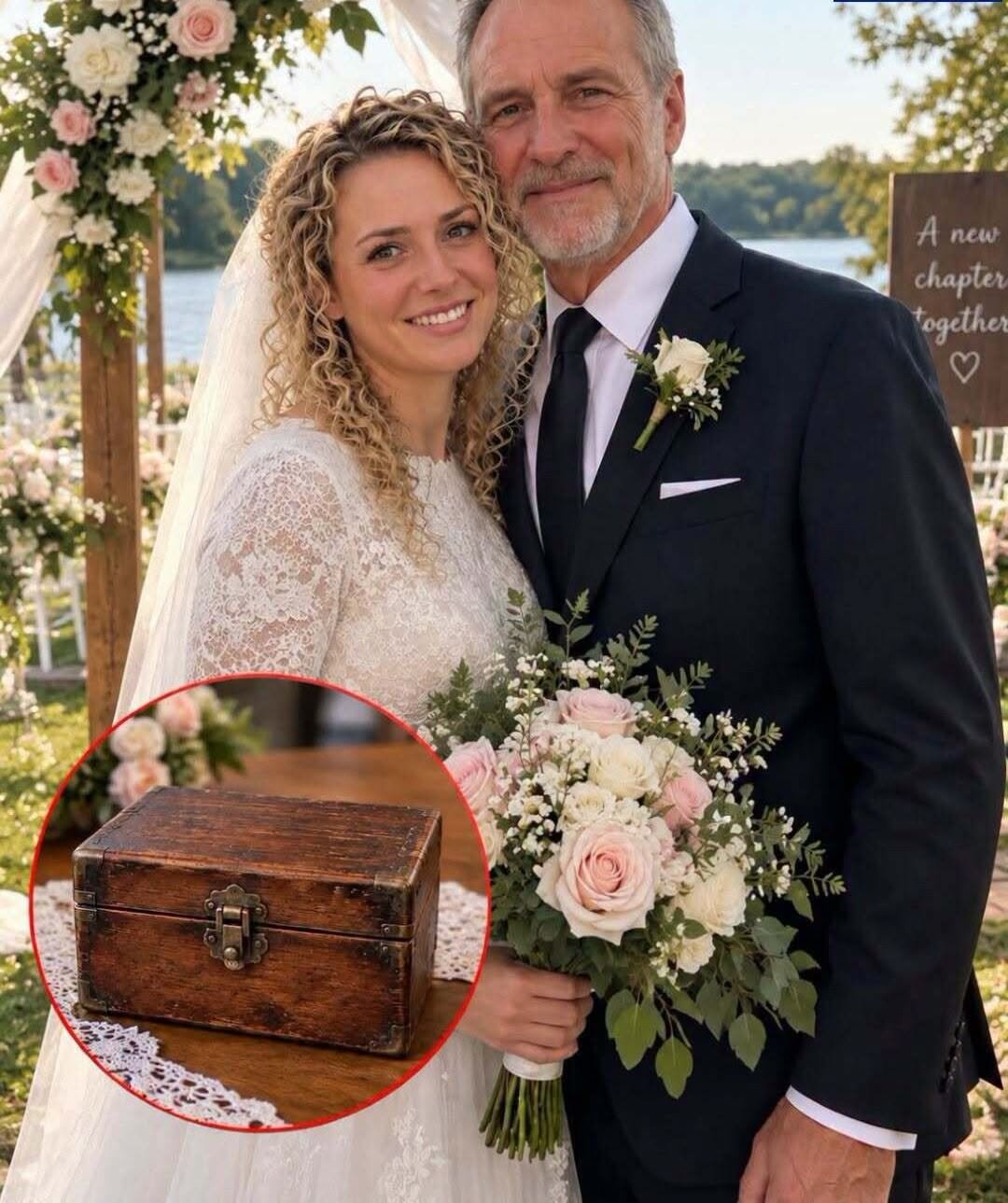
I married a man 30 years older for his fortune — after his funeral, his lawyer gave me a box and said, “He made sure you got exactly what you deserved.”
Everyone thought they understood why I married Russell.
And honestly, they weren’t entirely wrong.
I was 32, buried in debt, and constantly terrified that one missed paycheck could leave me without an apartment.
Russell was 62.
He was wealthy and widowed, with a beautiful house, expensive watches, and more money than he could ever spend.
But he was also painfully lonely.
We met at a charity dinner where I was serving champagne.
Russell asked my name.
Then he glanced at my shoes and quietly asked if my feet hurt.
It was such a small thing.
But no one had shown that kind of concern for me in years.
Three months later, he proposed.
My friends thought I was making a terrible mistake.
Russell’s children were convinced I was after his money.
“You think you’re getting the house?” his daughter hissed at me after the wedding. “You’ll get nothing!”
Russell heard her.
He didn’t argue.
He simply smiled.
“She’ll get exactly what she deserves.”
I pretended their opinions didn’t bother me.
And yes, I loved the security Russell’s money gave me.
I loved waking up in a warm house, buying groceries without checking my bank balance, and no longer panicking over every bill.
But what I hadn’t expected was Russell himself.
He was gentle, patient, and kinder than I ever imagined.
At some point, the marriage stopped feeling like something I’d entered just to survive.
I genuinely began to care about him.
Then Russell got sick.
Everything happened unbelievably fast.
Only six weeks passed between his diagnosis and his funeral.
His children barely looked at me during the service.
The hatred in their eyes made it seem as though they blamed me for their father’s death.
I cried anyway.
Afterward, Russell’s lawyer asked me to come to his office.
When I arrived, his children were already there.
I expected to see a will or stacks of documents.
There was nothing like that.
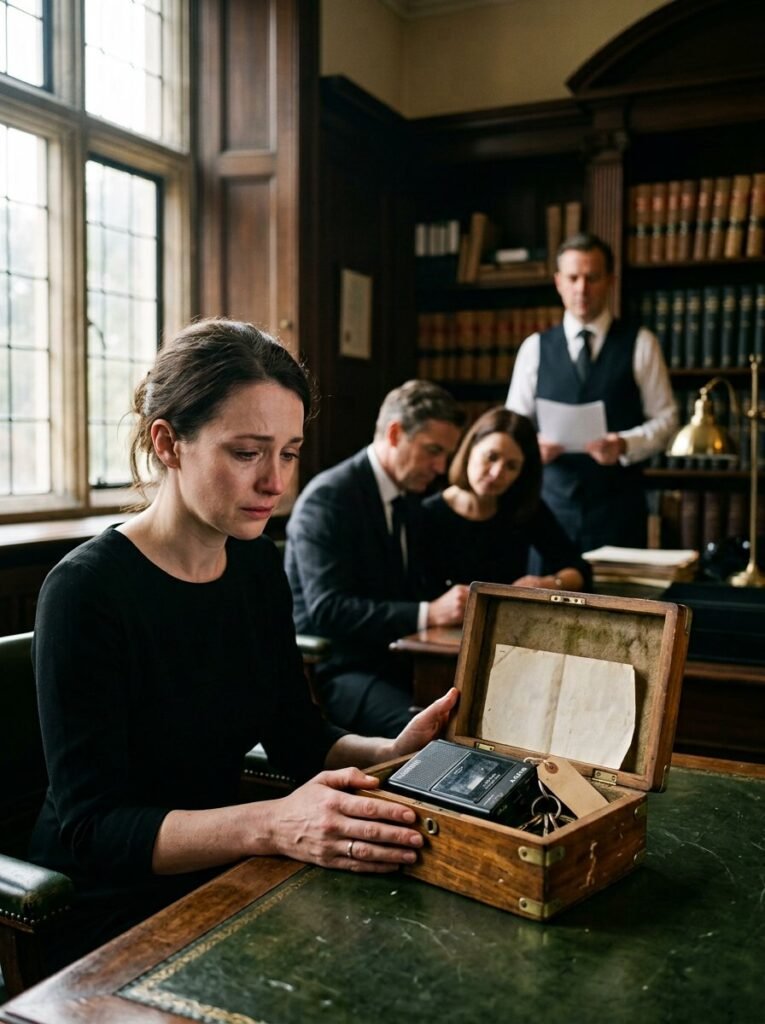
Only a small wooden box sitting in the middle of the desk.
The lawyer looked at me, then at Russell’s children.
“Russell left instructions,” he said.
His daughter gave a quiet laugh.
Then the lawyer slid the box toward me.
PART 2
It was not heavy. I want to say that first, because what I had braced myself for was a folder with numbers in it, and what I got was a shoebox of varnished wood with brass corners and a smell I knew before I looked inside it. Pipe tobacco, and the lemon thing Russell used on the desk in the room at the end of the hall, where he sat every morning from six until nine with the door open and never once told me what he was doing.
There were four things in it: a tape recorder, the old kind, with a cassette in the well and the counter reading 000; a ring of keys with a paper tag that said 118 B; a bank receipt with a paid stamp on it for $141,200, dated four months before I ever put a ring on; and a note in Russell’s hand, on the back of an envelope, in the crooked printing he used when his fingers were stiff.
Play it in front of them. Do not let them make you listen to this alone.
The lawyer’s name was Gil Waddell. He had drawn Russell’s will in 1988, and he read it out loud the way a man says the same eleven sentences every year and has never once gotten bored with them.
The house on Ellsworth went to Corinne. The shares in Kestrel went to Adam. The accounts, the watches, the boats, the furniture, the money in the two banks and the ones in Jersey: divided equally between them. Nothing else.
When he finished, Corinne said, “That’s it?”
“That is the estate, yes.”
“And her?”
Gil Waddell looked at me for the first time since I sat down.
“Russell left his wife nothing of the estate. He left her a letter, which is the recorder, and he left her the Kestrel Memorial Fund.”
And then he said the number, and I heard Adam’s chair go back on the floor.
Four million, one hundred and ten thousand dollars, sitting in a certificate of deposit at First Commercial, and it was not part of the estate. It had never been part of the estate, because Russell had moved it into a charitable trust in 1979 and had been paying into it, every single March, for forty-four years.
“What does she get out of that?” Corinne said. “She can’t spend a dollar of it.”
“No, ma’am,” Waddell said. “She is the only person in this state who can send it.”
Nine names were on that fund’s list. There had been two hundred and forty-one. The Kestrel plant on Delaware Avenue lost a solvent tank on the twelfth of November, 1978, and the fire that followed killed seven men in a room with two exits, one of which had been chained shut for a delivery that week, and a hundred and nine people went to the hospital with burns and lungs that never healed. Forty-four years later there were nine of them left, and the newest name on the list was a woman called Lorraine Fisk, whose husband never came home, and who had been waiting on a number since 1982.
“Before you ask,” Waddell said, looking at me for the first time since I came in, “the keys are not a gift from the estate. Unit 118 B on Harrow Street was deeded into your name, free and clear, eleven days before the wedding, paid for by a man who is not in this room. It cannot be contested by anybody in this family, because it stopped being his the day it became hers.”
Corinne said, “That is a one-bedroom over a garage.”
“That is a deed,” Waddell said.
The Fund’s closing order had a date in it. Friday, at four in the afternoon, and the trust instrument said that on that date, whatever had not been paid out, the Fund dissolves and the residue goes back to the family of the settlor.
To Corinne and Adam.
Russell had set it up himself in a way that meant the only person on this earth who could stop it was the trustee, and until nine days ago the trustee had been him, and now it was the woman who poured his champagne.
That is what he thought I deserved. Not the money. The decision.
Gil Waddell put his pen down and said, “There’s a tape. He wanted it played in front of everybody.”
Corinne said, “I’m not listening to a dead man’s message.”
But she sat down.
And Adam sat back down too, and I put the cassette in and pressed the two buttons together the way you do when your hands don’t work, and his voice came out of that little speaker in a lawyer’s office on the fourth floor of a building with bad carpet, and he said the first thing he said to me on a recording, and it was not to me.
“This is Russell Ashby, the ninth of this month, and I would like it noted that I am of sound mind and that I have made the decision I have made about my money in the presence of two people who do not know it, which is the only way I could make it.”
PART 3
There were eleven minutes on the first side.
He talked about the plant. He had been twenty-nine in 1978 and he had been the man who signed the maintenance order that kept the Kestrel line running through a weekend, and the chain on the east door had been his decision, and he had not thought about it as a door, he had said. He had thought about it as a way to keep a truck off the loading dock.
He said that seven men were killed and that the company had paid a settlement in eleven months, and that the average had been thirty-one thousand dollars, which was the price of a house that year, and that he had known because he had signed the checks, and that in 1979 he started a fund with the one thing he could not have back.
He said: “I have been paying this money into that fund for forty-four years, and my children have asked me nine times to close it. Both of them. Nine times, and I have said no, and they have been polite about it for the last four years, which is worse.”
Corinne said, “Dad was ill.”
“That is the fourth year, Corinne, and I know, because I was watching.”
And then he said the sentence that took the floor out from under both of them.
“In 2021 I made a loan against my portfolio to Adam, for a marina in Long Beach, of six hundred and ten thousand dollars, unsecured, with no note, because you are my son and you asked me at my wife’s grave, and I want to read the letter I wrote myself and put in this box.”
Adam said, “Don’t.”
But the tape went on, and he read his own letter, out loud, and the letter said the loan was due on the day of his death and that the Fund would be short that amount if the note was not called, and that he had decided to call it, and that he had put the file in the box so that whoever was left holding it would know whose money it had ever been.
“I have not given you my money,” he said into the tape, “because I have not owned my money since 1978. I have been holding it.”
Then he said the part I did not expect, and the room changed.
“To the woman who came to my door with nine hundred dollars and a shoe that did not fit, I want to say one thing in front of my children, because I have waited four years to be able to say it where they could hear me.”
“You think you sold yourself to me, and I have spent four years trying to find a way to tell you that you did not, and every way I tried I could not, because you would not believe me. So here it is, in writing, in front of them.”
“Four months before we stood up in that room I paid your debt. One hundred and forty-one thousand and two hundred dollars, at a bank on Sixth, on a Tuesday, and I did not tell you, and I want you to understand why, because it is not because I was generous. It is because I wanted to know whether you would stay anyway.”
“That is the ugliest thing I ever did in a marriage, and I have lived with it, and I put the receipt in the box so that nobody, ever, including you, can take that from you. I checked. A woman who is paid a debt is not a woman who was bought.”
I put my hand on the desk, and the receipt with the stamp on it was under my palm, and I want to be honest: I was not angry at him. I have thought about it a great deal, and I was not angry at him, because the second part of it was true, and the second part of it was that I had stayed, and I had stayed because he asked me whether my feet hurt.
Corinne stood up.
“Fine,” she said. “I’ll make this easy for her.” She took out her phone and she read me a number off it, and it was the number of her lawyer, and she said, “Two point four million, and she signs the deed of resignation and closes the Fund on Friday like a normal person, and Lorraine Fisk gets the number she’s already been offered, which is not two point four million, and nobody has to sit in a room for another hour.”
I said, “You want me to sell a dead man’s list.”
“I want you to sign a piece of paper,” she said.
“Those are the same thing in this family,” I said. “He just told you so, on tape, in your father’s voice.”
And then Adam said the thing I have been afraid of since I opened the box.
“Nobody’s signing anything,” he said. “Because she can’t.”
PART 4
He took out a folded paper and put it on the desk with his thumb on it, and it had a case number on top and a clerk’s stamp in the corner from nine-forty that morning, which was twenty minutes before we got there.
It was an emergency petition for removal of a trustee, and it said that the trustee was a person of “unsound interest” who had exercised undue influence over the settlor in the final year of his life, and it said that in the meantime, the Court had granted an interim order staying all distributions from the Kestrel Memorial Fund.
Signed. Sealed. Filed by a man whose wife had never been in a courtroom in her life.
“They got the judge on duty at ten,” Waddell said, and his voice had gone flat and cold, and I could see him being furious in a way a lawyer is never allowed to show. “Adam, when did you file this?”
“It’s not a crime.”
“I did not ask you when it was a crime.”
Corinne sat down. She put her hands in her lap and she said, very reasonably, “Sign the resignation. Then you get two point four. You can’t fight us, and you can’t fight a stay, and you don’t even have a lawyer, which tells me everything about how serious you were about any of this.”
I said, “I have one.”
“You have a box,” she said. “You have a tape and a box and a dead man who used you to make a point.”
That last part is the one that got me, and I want to say exactly why, because it is the only thing in that office that was true.
Russell had paid my debt four months before I ever said yes to him, and he had said nothing about it through four years of marriage, and then he had put the proof in a box to be opened after he was dead. He had made me into a lesson. He had left me the only thing in his whole life that had ever mattered to him, so that I would have to decide in front of everybody whether I was the woman in that tape or the woman in that courtroom.
I asked him, “Can a stay stop me from writing nine checks?”
He looked at his hands for a long moment, and then he checked his watch, and I have never in my life been so grateful for a clock.
“A stay stops the Fund from paying, ma’am. It does not stop a trustee from filing. If a real name goes onto a claim list, the money is not discretionary any more, a court can lift the stay in a week, and on Friday the residue only goes back to the family if there is nothing owed.”
I said, “How many names are missing?”
He did not answer me for a second. He went to his shelf and he took down a binder that had a rubber band around it and he put it on the desk, and the tab on it had Russell’s handwriting on it, which means he had taken it home and read it and brought it back, and the tab said NAMES LEFT OFF.
“I know of one,” Waddell said.
And then the door opened behind him, and it was not his clerk.
She was eighty-one years old and she had come on a bus in a good coat with a bag of groceries at her feet, and she said to the room, “Somebody came to my door this morning and told me the family I have been waiting on since 1982 is closing the account.”
“Ma’am,” Adam said, “this is a legal proceeding—”
“I know what a proceeding is,” she said. “I sat in one for nine years while they told me my husband was worth thirty-one thousand dollars.”
Nobody in that room said anything at all, and then Waddell stood up and went around the desk and pulled out a chair for her, and that is when we saw there was somebody in the corridor behind her, and Adam looked past all of us at the door, and the color went out of his face for the second time that day.
Because on the floor of the corridor, in a wheelchair, with a woman in a nurse’s uniform standing behind him and a manila folder across his knees, was a man of sixty-eight with no fingerprints on either hand, and he said, “Which one of you is Mrs. Ashby? I’ve got a letter from your husband and I’ve been looking for this office for forty-four years.”
PART 5
His name was Dale Prentiss. He was twenty-two in 1978 and he was in the room with the chained door, and he spent four months in a burn unit and eleven weeks of that with no idea what his own name was, and he was not on the list of nine, because he had never been taken off it. He had never been put on.
In 1980 a man from Kestrel came to his mother’s kitchen with a form and told her that her son had died in the fire, and the fund was closed to him, and she signed a page so that nobody would come to her door again, and the page was still in the company’s own file. Forty-four years, and the page was still in the file.
Waddell’s clerk had found the page in a box of Russell’s own records in 2019, and Russell had spent three years trying to find the son, and the folder in Dale Prentiss’s lap was the letter he had written to him on the twenty-sixth of March, which is nine days before he died, and which nobody in the room had opened yet, because it had Russell’s name on the front and a stamp of a facility in New Jersey on the back, and it had come back to him.
Dale said, “I don’t want money from anybody who’s dead. I want the county to look at a page from 1980 with my mother’s name on it and a company logo I can still smell.”
That is what ended the room. Corinne said they could make it right. Adam said there was a process. And the nurse who had pushed a wheelchair into a lawyer’s office on the fourth floor of a building with bad carpet said, “Sit down, sir, you are not going anywhere today.”
We did not close on Friday. The stay was dissolved four days later after a judge read eleven minutes of a tape and one letter dated March twenty-sixth, and the court named a receiver for one week, and then it named me again, and it told me in writing that any payment made outside the claim list would be a fraud on the trust, which is what I wanted and did not know how to ask for.
Ten checks went out on the eleventh of a Monday morning in a bank on Sixth, because by then there were ten names, and I sat in the room for every one of them. The last two were paid at a kitchen table in a house with a chain-link fence, and somebody took a photograph of Lorraine Fisk holding hers in both hands like it was a cat, and I have that photograph.
The Fund had four million one hundred and ten thousand dollars in it, which is what forty-four years of one man’s Tuesdays adds up to, and it went out in nine days, and then there was nothing left in it, which is the only thing a fund is ever for.
The children got the house and the shares and the watches and the boats. Adam’s marina was foreclosed in the spring. Corinne kept the lawyers and lost the appeal on both counts, and the second opinion said the loan of six hundred and ten thousand dollars was a debt of the estate, and the estate had to pay it back out of the money he had already spent, which took them nineteen months and a piece of the property on Ellsworth.
They have never spoken to me, and I have asked nobody to.
I live in unit 118 B over a garage, and I pay the taxes on it out of a job I have, and I have never rented from anybody in my life. I went back to catering on a Saturday in July, not because I had to, but because there is a room in that county I had not stood in for four years and I wanted to know whether I could be in it.
I could. I was fine in it. My feet did not hurt.
Gil Waddell sent me one thing in October, in an envelope with no return address. It was a copy of a page from a bank on Sixth, stamped four months before our wedding, that says PAID IN FULL, with my name typed on the front and nobody else’s name on it at all, and a note in his own writing.
He asked me not to tell you for four years, and I have not told you for four years. He asked me also, when I could, to tell you one thing, and here it is, and then I am done with the both of you. He said, “Tell her I never once checked those years. I only checked that she stayed.”
Then, in January, he drove out to the garage on Harrow Street and stood in my kitchen in his coat and gave me the last thing in the box, which he had kept in his own desk since before the funeral, because Russell had told him not to hand it over in front of anybody, and he had been waiting for a day when there was nobody in the room.
It was a napkin, folded into a square, gone soft as cloth from being handled.
My name is on the top of it, and my phone number, in a shorthand I used at twenty-nine when I worked tables and had no hands free, with the word ask in front of it, because I could not make myself write call me, and I had written ask at the bar and left it on the high top and gone back to the champagne.
Under mine, in block capitals, in the crooked printing of a man with stiff fingers, is his.
He never asked me to dinner that night. He picked up the napkin, and he added his own number to it, and he handed it back across a room full of people who had come to give money to the families of the men my husband had killed, and that is the whole of what happened, and I have spent four years telling everybody it was a transaction.
I was thirty-two years old and I had eleven dollars and a shoe that did not fit, and a man asked me whether my feet hurt.
I have kept it on the shelf above my bed since January, and every night I look at it, and what I see is not a rich man’s charity. It is two phone numbers on a square of paper that two people wrote down on purpose.
Russell said he made sure I got exactly what I deserved.
He was right, and he was kind about it, and I have a house over a garage, and eleven dollars in the drawer, and nobody in the world left to ask.