My mother blocked the entrance to my father’s memorial service and ordered me to take off my Navy uniform. She said I had already disgraced our family by missing his funeral, and she wasn’t going to let me embarrass her again in front of the entire church. But what she didn’t know was that a decorated Army veteran sitting in the front row had been given a letter by my father before he died.
And that letter was about me.
My name is Sarah Mitchell. For twelve years, the people in Cedar Creek, Tennessee, believed I had turned my back on my family, and my mother, Elaine Mitchell, had done nothing to correct them. By the time I stood in that church doorway, I had become the daughter everyone whispered about, the selfish one who cared more about her military career than the father who raised her. What none of those people knew was that I had spent the days surrounding his funeral unconscious or recovering in a military hospital in Germany.
Six weeks earlier, an explosion during an overseas assignment had left me seriously wounded. Shrapnel had entered my side, and emergency surgery had saved my life, but I lost several days before I was fully aware of what had happened. When I finally woke up, one of the first things I asked about was my father. That was when I learned that Colonel James Mitchell, the man who had taught me how to change a tire and never let me quit when things became difficult, was already gone.
I hadn’t chosen to miss his funeral. I couldn’t even get out of a hospital bed, much less travel halfway around the world. My younger sister, Emily, knew I was hospitalized, and so did our mother. Yet somehow, the story being repeated around Cedar Creek was that I simply hadn’t cared enough to come home.
I received messages from neighbors and people I hadn’t spoken to in years. Some said my father deserved better, while others accused me of forgetting the family that raised me. I could have defended myself, but I was exhausted, injured, and grieving a man I hadn’t been able to say goodbye to. And after twelve years of fighting to be understood by my mother, silence had become an old habit.
Then Emily told me the church was holding a memorial service for Dad. Unlike the private funeral I’d missed, this gathering would bring together his fellow veterans, church friends, and neighbors from the surrounding counties. I promised her I would be there, although I knew my mother wouldn’t welcome me. What I hadn’t decided was whether I had the strength to face the people who believed her version of my life.
The night before the service, I sat alone in a hotel room outside Cedar Creek. My Navy dress uniform lay across the bed, freshly pressed, with every ribbon carefully aligned. Beneath my jacket, my healing wound still pulled whenever I moved too quickly, but I was determined to look as Dad would have wanted. Beside the uniform lay one of the last letters he had ever written to me.
Near the bottom, he had written, “Sarah, when they honor me, wear what you earned. Don’t put it on for them. Wear it for me.”
I read those words until I could almost hear his voice. Dad had been a career Army officer, but he’d never treated my decision to join the Navy as a betrayal. When I told him I wanted to serve, he’d laughed, hugged me, and told me to become the kind of sailor who made everyone proud. My mother had reacted as though I had announced I was leaving the family forever.
That difference between them had followed me throughout my adult life. Dad wrote letters, asked about my assignments when he could, and never complained when I couldn’t tell him where I was stationed. Mom counted every missed holiday and every visit that ended too soon. I kept hoping time would soften her anger, but it seemed to make her accusations sharper.
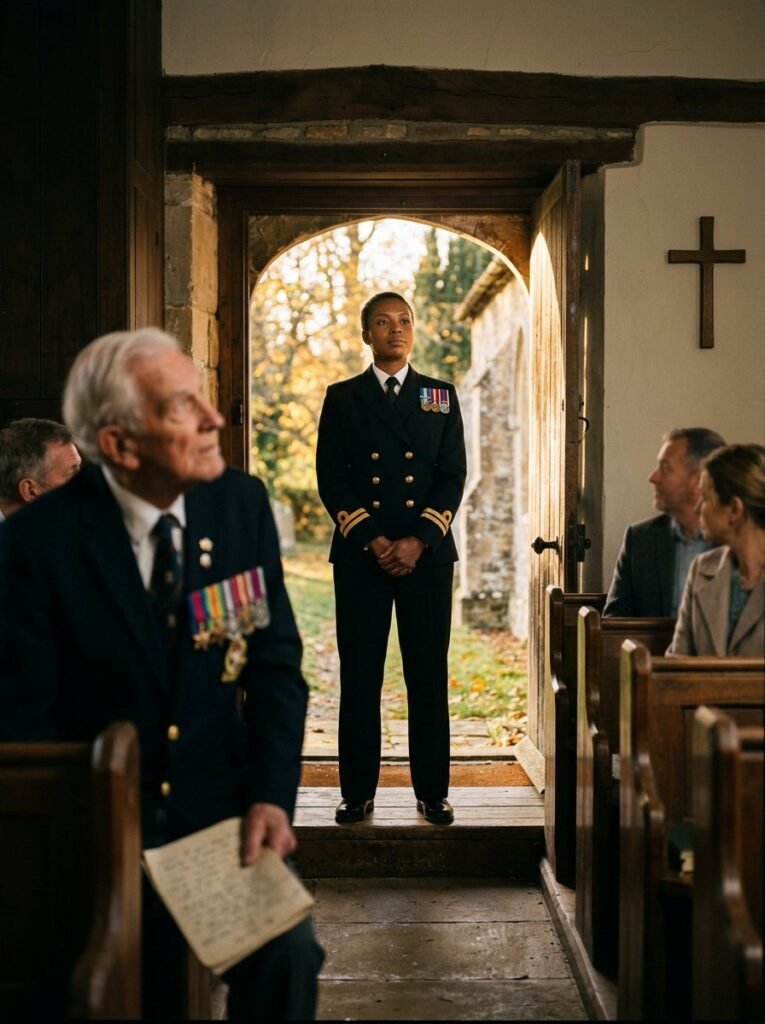
On the morning of the memorial, I fastened my uniform jacket and drove toward the church. The parking lot was already crowded when I arrived, and several men wearing veterans’ caps stood near the entrance. Conversations slowed when I stepped out of my rental car. One woman covered her mouth, and I heard someone whisper, “Is that Sarah Mitchell?”
I walked inside without answering. Near the sanctuary, Emily saw me and immediately began crying. She rushed forward, hugged me carefully, and whispered that Dad would have loved seeing me in uniform. For a few precious seconds, I felt as though I had finally come home.
Then my mother’s voice cut through the lobby.
“No. Absolutely not.”
She stood beside the sanctuary doors in a black dress, her silver hair perfectly arranged. She looked at my uniform, then at the people gathering behind me, and told me I wasn’t going inside dressed that way. I tried to explain that Dad had specifically requested it, but she dismissed the letter before I could finish. According to her, the uniform was nothing more than an attempt to make his memorial about myself.
Everyone could hear us now. People in the sanctuary were turning in their seats, and several veterans near the front stopped talking. My mother told me to return to my car, change into something appropriate, and come back quietly. When I refused, her face hardened.
“After everything you’ve done to this family,” she said, “you still think you have the right to make demands?”
Those words nearly sent me back through the entrance. I was still weak from my injuries, and the thought of defending myself before an entire church was unbearable. But then I remembered Dad’s handwriting, the letter tucked safely inside my jacket, and the promise I’d made to him. I lifted my chin and told her I wasn’t taking off my uniform.
A wooden cane struck the church floor.
The sound came from the front row, where an elderly veteran had slowly risen to his feet. His dark suit carried rows of military decorations, and every older soldier in the room seemed to recognize him. My mother turned toward him, apparently expecting another person to support her. Instead, he looked straight at her and spoke with the authority of a man who had spent his life giving orders.
“Elaine, let that young woman through.”
My mother stiffened, but the veteran wasn’t finished. He said he had known my father for more than thirty years and had made him a promise before he died. Then he reached into his jacket and removed a folded sheet of paper covered in handwriting I recognized instantly. It was my father’s handwriting.
The veteran looked from my mother to the crowded sanctuary.
“James told me what he wanted done if Sarah came home and found herself unwelcome,” he said.
My mother’s face went pale.
And when the old colonel unfolded that letter, she whispered two words I had never expected to hear from her.
“Robert, don’t.”
PART 2
Robert did not answer her.
He unfolded the page the way a man unfolds a map — slow, with both hands, corner to corner — and he held it up so the light from the transom fell across it, and he said, “Elaine, I have known your husband since 1991. He asked me for one thing in thirty-three years. This is it.”
Then he read.
I am James Mitchell, colonel, United States Army, retired. I am of sound mind and I have written this out in my own hand because I do not trust a lawyer to say it the way I want it said.
If you are hearing this in a church, then my wife has done the thing I asked her not to do, and my daughter came home anyway.
The sanctuary made a sound. Not words. Two hundred people breathing at once.
I want to be clear about something before anything else gets said in this room. Sarah did not miss my funeral. She was not in Ohio. She was not at a conference. She was in a hospital bed at Landstuhl with a hole in her right side and a tube in her chest, and on the day they put me in the ground she had been unconscious for eight days, and would not wake for another four.
My knees went. I put my hand on the back of a pew and Emily’s arm came around me, and I heard someone behind me say, “Oh, Lord.”
I knew about it on the twenty-eighth of February. The Navy called this house at 6:20 in the morning and I took the call in the kitchen, and the young man on the other end said the words “seriously wounded” and then asked whether to request humanitarian leave, and I said yes before he finished the sentence.
My wife was standing in the doorway in her nightgown. She heard the whole of it.
I turned and looked at my mother, and she was not looking at me. She was looking at the floor between her shoes with her chin up like a woman in a dentist’s chair.
Here is what I have to confess in front of my neighbors, and I want it said out loud, because a man should not die leaving a thing unsaid.
Twelve years ago my daughter told me she was joining the Navy. I laughed and hugged her and told her to make me proud, and then I went into the kitchen and I did not say a word to my wife about the argument she had already lost. I let Elaine be the villain of that story. It was easier. It has been easier for twelve years.
I let her tell this town that Sarah chose the Navy over her family, and I did not correct it, because every time I corrected it I slept on the porch for a week. Do you understand what I am telling you? The story you have all been repeating about my daughter was not built by my wife alone. It was built by my silence, and I have had a lot of years to sit with that and I am not going to die with it.
Somebody in the third row was crying openly. Helen Boyd, who taught me Sunday school and who once told my mother, in the grocery store line, that a daughter who doesn’t come home for Christmas has made her choice.
And here is the rest of it.
On the seventh of March I went into the hospital in Nashville for the last time, and I told Elaine that when the Navy called again she was to tell them Sarah’s father was not expected to live, and that they were to get her on a plane the moment the surgeons would allow it. And she said she would.
She did not.
She called Landstuhl herself on the ninth of March and told a duty nurse that the family was handling it. She told Emily not to say anything to her sister until it was over. And when Sarah woke on the fourteenth of March and asked for me, I had been two days in the ground, and the first thing that girl heard in a hospital bed eight thousand miles from home was a chaplain telling her that her father’s service had already been held and that her mother had asked that it be kept small.
I have read the letter my father wrote in March, and he wrote that line, and I want to tell you that when Robert read it in that church, I did not cry. I stood there in a uniform I had put on in a hotel room with my hands shaking, and I thought: that is exactly right. Two days. It was two days.
I do not know what my wife will say when this is read. I have thought about it for a month. I have decided I am not going to be the man who goes to his grave protecting a lie because the liar is someone he loves.
Elaine. I loved you from the spring of 1983 and I have loved you every day since and I am not going to stop, and I am also not going to let you do this to her.
Robert stopped.
The page in his hand was shaking, and he lowered it, and he said, “There is one more paragraph, and it is not for the room. It is for Sarah.” He looked at me over the top of it. “I am going to read it anyway, because he told me to read the whole thing, and because I am eighty-four years old and this is the last errand I have.”
Then he read the last paragraph.
Sarah. I know what it costs to stand at attention in a room full of people who think they have your number. I have done it. Your grandfather did it.
You are going to want to explain yourself. Do not. You do not owe this town an explanation, and you have never in your life owed your mother one, whatever she believes.
What you owe me is this. Wear what you earned, stand up straight when they say my name, and then, when this is over, go and ask your mother about Michael.
Robert folded the letter.
“Michael,” he said, into the silence, and he looked at my mother. “You want to tell her, Elaine? Or shall I?”
My mother lifted her head.
“Robert,” she said, “I will burn every letter he ever wrote to you.”
“Then burn them,” Robert said. “I’ve got it memorized.”
And she walked out.
She did not walk out through the back. She came down the center aisle, past two hundred people, past the veterans with their caps in their hands, past her own daughter standing in a Navy uniform in the doorway, and she did not look at me once, and she went out through the narthex into the parking lot.
The sanctuary doors swung shut.
Emily said, “Sarah, don’t.”
I was already moving.
PART 3
I found her in the parking lot behind the fellowship hall, sitting in the front seat of my father’s Buick with the door open and her hands in her lap.
I want to tell you what I did, because I have had three weeks to think about it and I still do not know whether it was the right thing.
I did not shout. I walked over and I stood in the door of that car in my dress uniform with my ribbons on and I said, “Mom. Who is Michael?”
She did not look at me.
“Mom.”
“My brother,” she said.
The wind came across the parking lot and moved the leaves around the tires.
“His name was Michael Rafferty. He was a year and a half older than me and he was a Marine, and he was twenty-four years old when he died in Beirut on the twenty-third of October, 1983. You were not born. I was twenty-three years old, and I was engaged to a man who was not your father.” She said it all in one breath, flat, like a woman reciting a list she has recited to herself in the dark for forty years. “The barracks came down at 6:20 in the morning. My mother heard about it on the radio before the Marines came to the door.”
I sat down on the running board, and then I had to shift my weight, because the place where they had cut me had begun to pull the way it does when I stand up too fast, and I did not want her to see me wince in a uniform I had put on to keep from folding.
She saw it. My mother has never once in her life missed a thing like that and has always pretended she did not.
“Lean on the door,” she said.
“I’m all right.”
“Lean on the door, Sarah.”
So I leaned on the door of my father’s car, and we talked.
“I met your father at my brother’s funeral,” my mother said. “He was in the honor detail. Twenty-six years old, in his dress greens, holding a flag at the back of the church, and after the burial he walked my mother to the car and he said one sentence, and it was, ‘Ma’am, he was a good Marine.’ And I married him two years later and I have been sitting in the front row of funerals in that uniform my entire life.”
“Mom—”
“Eighteen years ago I stood at my mother’s funeral in the same church you just walked into, and half the men in that room had his flag folded in a case in their living room.” She looked at me then. “I have been to forty-one of them, Sarah. Forty-one. I know the sound of the folding. I know the sound a bugle makes when the man playing it cannot get to the end.”
“Then you know why I do it.”
“No,” my mother said. “You do not get to sit there in that coat and tell me you know what I know. You were twenty-nine years old and you came home at Christmas and you told me at the table, with your father grinning at you, that you had signed the papers. And all I could see was my mother in the doorway of our house with the radio on.”
“That was twelve years ago.”
“And you have been gone for all twelve of them.”
“I have been deployed for nine of them,” I said. “I have been home for four Christmases and I was in Virginia for one of them and you knew it and you did not come.”
My mother’s jaw moved.
“You kept a calendar,” I said. “You used to tell people it was 340 days since I called.”
“It was 340 days.”
“It was eleven weeks! I was on a submarine, Mom. I could not call. What was I supposed to do?”
“Be somewhere I could reach you,” my mother said. “That is what a family is. That is all a family has ever been. Somebody you can reach.”
We sat there. Somewhere inside the church, somebody had started the organ, and I could hear the low pedal note coming across the asphalt.
“Dad wrote me thirty-one letters,” I said. “Did you know that? Thirty-one. And in the one before he died he told me to wear this uniform, and he told me to come and ask you about Michael, and he knew exactly what that would do, because he knew you, and he knew me, and he loved us both and he was smarter than the pair of us put together.” I put my hands on my knees. “So I am asking. Michael. The other Michael. Why did the letter have to say it?”
My mother looked out the windshield at the river of cars.
“Because he is the reason,” she said. “And because your father and I agreed in 1983 that we would never speak his name in front of our children, and I have kept that promise for forty-two years, and he is the only man alive who could break it and he did it from a coffin.”
“Mom. Why the other Michael?”
And she turned and looked at me with her eyes full and said, “Because it is on your birth certificate.”
PART 4
I am going to give you the next four minutes the way they happened, because they are the four minutes of my life I have replayed the most.
My mother took a folded document out of her purse. It had been folded so long it had gone soft at the creases, and it was a photocopy of a birth certificate from the state of Tennessee, and she put it in my hand.
Father: Michael Rafferty.
Mother: Elaine Mitchell Rafferty.
Child: Sarah Elizabeth Rafferty.
I read it four times.
“That is not my name,” I said.
“That is the name you had for eleven days,” my mother said. “You were born in March of 1984. I was twenty-three years old and my brother had been dead for five months, and the man I was engaged to before I met your father walked out when I told him, and I am not going to cry in a parking lot, so do not ask me the rest of it.” She wiped her face with the back of her wrist. “James adopted you in 1987. He signed the papers and he paid the fee and he carried you around a courthouse for an afternoon and he told the clerk he had been your father since the day you were born, and that was true, and it has been true for thirty-eight years.”
Something in my chest moved that had nothing to do with the shrapnel.
“You gave his name to your brother,” I said.
“I gave my brother’s name to my daughter,” my mother said. “Michael James Mitchell. That is what is on your adoption decree. And then at the age of two you started calling yourself Sarah, and the name stuck, and your father never once called you anything but Sarah and I have called you Sarah since you were two years old, and the only person who ever called you Michael was me, in a hospital in Nashville, in March of 1984, when nobody was in the room.”
She looked down at her hands.
“Every time you put that uniform on,” she said, “I am twenty-three years old and it is a Tuesday morning and a man in dress blues is standing in our front yard with his hat in his hands.”
We sat there on the running board of my father’s car for a long time. The organ went quiet inside the church.
“Mom,” I said. “Why did you tell them I didn’t come home?”
She flinched.
“Why did you let Helen Boyd tell you at the grocery store that a daughter who doesn’t come home for Christmas has made her choice, and you just stood there with your cart?”
“Because it was easier than the other thing,” my mother said.
“The other thing being that you told Landstuhl not to call me.”
“The other thing being that I did not tell you he was dying, and I had nine days to do it, and I did not do it.” She said it in a rush and put her hand over her mouth. “Nine days. I sat in that kitchen with a calendar on the wall and I knew the telephone call was coming and I did not make it. And when the Navy called again on the twelfth I said the family would handle it. And then he was gone, and the only story I had left was that you did not come.”
I stood up off the running board. I had to. My leg had gone numb from the cold of it.
“You have let me believe that for three weeks,” I said.
“I have let you believe that for twelve years,” my mother said. “The last three weeks of them were just the part where it was true.”
And that is when Emily came around the corner of the fellowship hall with her coat over her arm and Robert behind her with his cane, and Emily said, “The pastor wants to know whether the service is going to happen.”
The four of us stood in a parking lot in Tennessee.
“Go inside,” my mother said. “Both of you. I am not going to be the reason that service doesn’t happen.”
“Mom—”
“Sarah.” She put both hands on my shoulders, and they were cold, and she held me at arm’s length and looked at me in that uniform. “You walk down that aisle in that coat and you sit in the front row and you let that man read your father’s name, and you do not do one single thing for me in this building. Not one. You do it for him. Do you understand me?”
“Yes, ma’am,” I said, because I have said yes ma’am to my mother my whole life and it did not cost me anything to say it then.
“Then get in there.”
She did not come. She stood in the parking lot beside the Buick with her purse against her chest and watched us go, and Robert turned at the door and said, “Elaine. Door’s open, girl. Always has been.”
And my mother, who has not been in a church for six years, put her chin up and came.
The service was forty-one minutes long. Eleven veterans in the front row and a Navy honor guard from the recruiting station in Cookeville and a bugler from the post, and when they played Taps, I stood at attention in a uniform with a ribbon I had earned the hard way, and beside me, in a black dress with her hands folded, my mother stood at attention too, at sixty-five years old, because nobody had ever taught her a different way to stand at a funeral.
And when it was over, and I had nodded to the eleven men, and a woman from the church had squeezed my arm and said, “We didn’t know,” and I had said, “You do now,” Robert came and stood in front of me and put his hand in his jacket a second time.
“There is one more thing in it,” he said. “He told me not to give it to you unless you asked about Michael, and you did, in a parking lot, and I heard you through the window.”
He put a small envelope in my hand with my name on it in my father’s handwriting, and I have never in my life wanted to open a thing less.
PART 5
I opened it in the car.
It is four lines. My father was not a man who wasted a page.
Sarah —
A man gets one chance to be somebody’s father and I got mine in a courthouse on a Thursday in 1987 with a bad pen.
I have never once told you the whole of the other thing because it was your mother’s to tell, and she has not been able to say it out loud since 1983, and I have watched her carry it and I am telling you she has carried it well from the outside and badly from the inside.
Go to the cemetery. Not to my grave. Hers. He is under a flat stone at the back of Cedar Grove with a flag in it that I have replaced eleven times.
I went that afternoon.
The stone is at the back, past the Murphys and the Coulters, and it is flat and low and it says MICHAEL LEE RAFFERTY, PFC, USMC, OCT 23 1983, and there is a small bronze vase in the ground beside it with three flags in it, and every one of those flags is new.
There was a woman kneeling in front of it in a black dress with a hand trowel, pulling weeds out of the seam between the stone and the grass.
My mother is sixty-five years old and she has been kneeling in that grass every third Sunday of her life.
I stood behind her for a while and did not say anything.
“Your father brought me here the day after the funeral in November,” she said, without turning around. “I told him I would not marry a soldier. He said he would not ask me to stop coming here.” She set the trowel down. “Forty-two years of Sundays and he never once complained and he never once made me pick.”
“Mom.”
“Your father carried a flag at my brother’s funeral and then he carried a flag at his own daughter’s birth and then he stood in a church and carried the whole of this family up a hill on his back while I made him sleep on the porch for correcting me.” She sat back on her heels. “He was a better man than all of us.”
“Mama.”
“The word is mother,” she said, and her voice broke on it, and it is the first time in my life I have heard my mother’s voice break.
We stayed there until the light went.
Here is what has happened since.
My mother told the town. Not in a letter, not in a Facebook post; she stood up at the Cedar Creek church on a Wednesday night with a microphone she asked for and she told the whole thing — the ambulance in Beirut, the radio, the birth certificate, the ninth of March, and the six weeks in which she stood in a crowd and let people say that her daughter had abandoned her father. It took eleven minutes and she started nine sentences and finished all of them and she ended with the words “and I am not going to be that woman anymore,” and then she sat down and nobody said anything for a long time, and Helen Boyd stood up and said, “Well, Elaine. About the grocery store.”
They are not best friends. I want to be careful with this part, because there is a version of this story where everybody hugs. The town forgave her faster than I did. I was still angry in June.
But in May she came up to Virginia on a Tuesday without telling me, and my commanding officer put himself in front of her at the quarterdeck with an expression of profound alarm, and my mother stood there with a Tupperware container of chicken and dumplings and said, “I have brought this from Tennessee and it is still warm, and I do not know what the rules are in this building, but I am her mother and I am here.”
She stayed nine days. She did not once mention the uniform.
My father’s flag is in a case in my apartment with a photograph and the little envelope on top of it, and on Memorial Day I take it down and dust it and put it back, and I have started doing that in the morning, before the parade, because the parade is for the living.
In October of that year, Cedar Creek buried the last man from that battalion who had ever lived in this county. He was seventy-eight, and there was no Marine left in Cedar Creek to hold the flag, and my mother called me on a Thursday and asked whether I would come and stand in a uniform, and I said yes.
After it was over I walked her back to the flat stone at the back of Cedar Grove, past the Murphys and the Coulters, and we stood there together in the wind while she straightened the flag in the bronze vase with both hands, the way she has straightened it a thousand times.
“Say it,” my mother said.
“Michael Lee Rafferty. Private first class. United States Marine Corps.”
“Again.”
“Michael Lee Rafferty.”
She put her hand on my arm and left it there.
Nobody in that cemetery knew the man under the stone. There is no photograph of him in my apartment and no letter in my drawer in his handwriting, and the only person alive who remembers his voice is a sixty-five-year-old woman who has been kneeling in that grass every third Sunday for forty-two years, in the wrong color, in a family that had to be rebuilt around a hole.
That is the thing nobody tells you about a funeral. You do not bury a man. You bury the version of him everybody agreed to keep.
My father spent forty years married to a woman who could not hear the word Marine without seeing a radio on a kitchen table and a hat in a man’s hands, and he never once asked her to pick, and he never once told me the truth. Then he did the arithmetic at the end, in a hospital bed in Nashville with nine days left, and he decided the truth was worth more than the peace. I have thought about that every day since April, and this is what I have come to.
That was his bravery. Not standing in a church in 1983 holding a folded flag for a stranger. Four pages, by hand, in a house that had been quiet for forty years, for an old friend to read out loud if his wife did what he was afraid she would do.
I wore the uniform home. I still do.
And on the third Sunday of every month, when my mother kneels in that grass with a trowel and a bag of new flags, I stand behind her in whatever I happen to be wearing, and I say the name, and she says it back.