My son’s best friend arrived at his funeral wearing a bright red dress. My husband was already standing up to ask him to leave, and I was desperately trying to stop him. But when the young man finally stepped behind the microphone, he revealed a conversation he’d had with our son that neither of us knew about. What he said next left the entire chapel in tears.
Theo had been part of our family since he was seven years old.
He lived just four houses away, but he spent so much time at our home that we eventually stopped referring to the guest bedroom as the spare room.
It became Theo’s room.
His family life had never been easy. When his parents were struggling through their separation, he often stayed with us. Three Christmases in a row, he sat at our dinner table, laughing and exchanging presents with Jack as though they were brothers.
My son never questioned whether Theo belonged there.
To Jack, he always had.
And when Jack became seriously ill, Theo showed us what true friendship looked like.
The diagnosis came far too late. Despite every treatment the doctors tried, we eventually learned there was little more they could do.
Fourteen months.
That was how long we had between the diagnosis and the day we lost our beautiful boy.
Throughout those months, Theo barely left Jack’s side.
He completed his homework on Jack’s bedroom floor, brought him snacks, watched ridiculous movies with him, and sometimes fell asleep beside his bed.
There were entire weeks when Theo spent more time with my son than I did.
He saw Jack at his weakest.
He stayed when conversations became difficult.
And he never once complained.
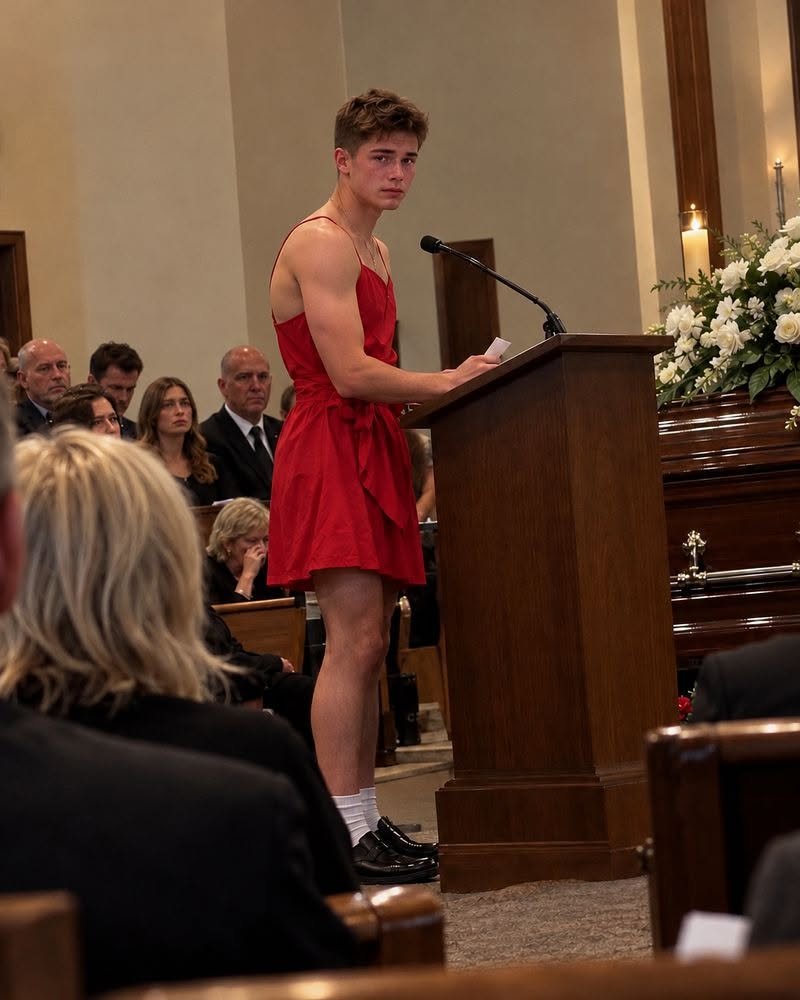
That’s why I couldn’t understand what I was seeing when Theo walked into the funeral chapel wearing a red dress.
It was impossible to miss.
Bright red, knee-length, and completely different from the black and dark-colored clothing everyone else had chosen.
People immediately began whispering.
Several relatives stared openly.
I felt my face grow hot.
Had something happened between the boys before Jack passed away?
Had they argued?
Was Theo trying to make some kind of statement?
I leaned toward a few of Jack’s classmates.
“Did something happen between Theo and Jack? Was there a disagreement?”
They shook their heads.
“No, Mrs. Harris. They were fine.”
But nobody could explain the dress.
And I hate admitting this now, but part of me wondered whether Theo wanted attention.
At my son’s funeral.
On the worst day of our lives.
My husband, Daniel, noticed him sitting near the aisle.
His expression hardened.
Then, without saying a word, he stood.
I immediately caught his sleeve.
“Daniel, please. Not now.”
He looked toward Theo.
“Why would he wear that here?”
“I don’t know,” I whispered.
We were both exhausted from grief. Neither of us had the strength to understand one more unexpected thing.
Then the officiant announced Theo’s name.
He was going to deliver the eulogy.
The chapel grew quieter as he walked slowly toward the podium.
I watched him adjust the microphone, his hands visibly trembling.
For several seconds, he couldn’t speak.
Then he looked at the mourners.
“I know some of you probably wish I wasn’t standing here dressed like this.”
His voice cracked.
He paused, fighting back tears.
Then he glanced down at the red dress.
“I know it looks strange. Honestly, it doesn’t even belong to me. I borrowed it from my sister.”
A few guests shifted awkwardly in their seats.
Theo took a shaky breath.
“But there’s a reason I’m wearing it today.”
He turned toward Jack’s coffin.
“And I wish more than anything that I didn’t have to explain it.”
My husband’s hand slowly relaxed beneath mine.
Theo pulled the microphone closer.
“Six months ago, Jack asked me to promise him something.”
He swallowed hard.
“Something he never told his parents.”
The entire chapel fell silent.
I leaned forward, my heart pounding.
Because whatever Theo was about to reveal, I suddenly understood that the red dress wasn’t meant to disrespect my son.
It was connected to a promise Jack had made him keep.
And as Theo began repeating their final private conversation, I realized my son had been preparing for a goodbye long before Daniel and I were ready to imagine one.
PART 2
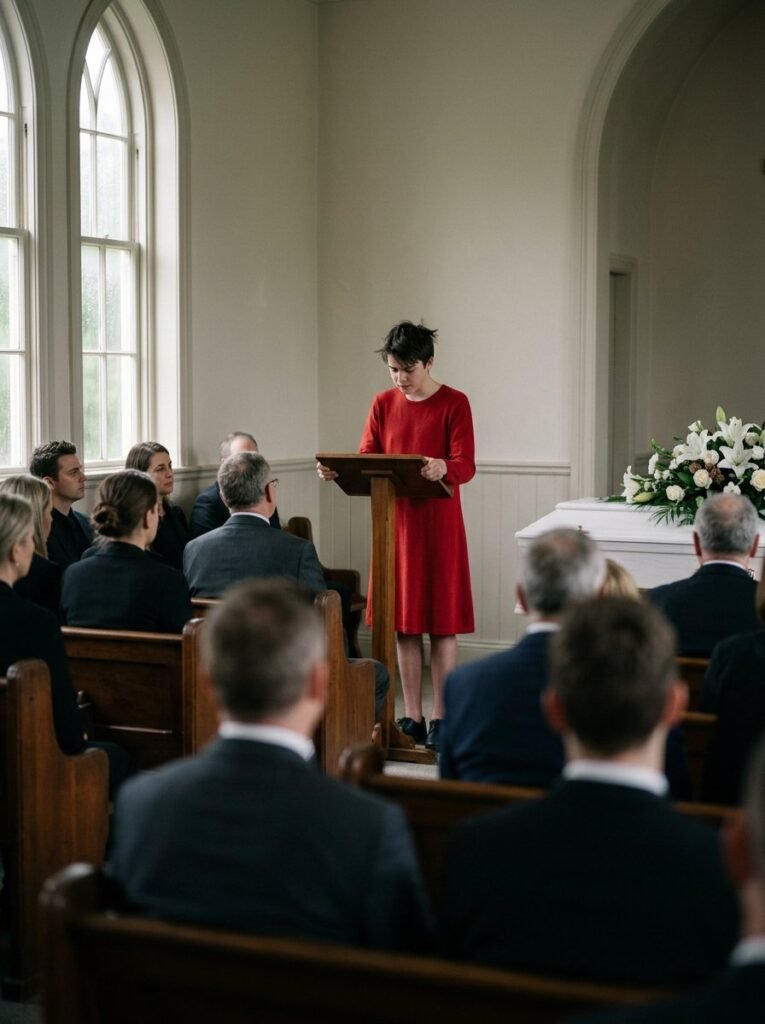
“He asked me for three things,” Theo said, “and I’m going to tell you the whole of it, because he made me promise not to until I was standing up.”
He took a folded slip of paper out of the pocket of the dress, and his hands shook so badly that he had to hold it with both of them.
“October ninth. A Thursday, raining, and he’d been home from the hospital eleven days.” He looked down at the paper. “He had it all worked out. A list, on a yellow pad, in his handwriting, with numbers, because Jack liked numbers.”
Somebody behind me made a sound. It was my sister-in-law, and she had started to cry already.
“He said, ‘Theo, I need three things, and you can’t ask me why until after.’ I said, ‘Anything.’ And he said, ‘Don’t say anything until you hear all three.'”
He unfolded the slip. “This is the first one. He wrote it out so I wouldn’t get it wrong.” He held it up, and I could not see it from the third row, but I have it now, in a frame, and it says exactly this:
For Theo — REASON INSIDE. Don’t read it until you’re standing up.
“He gave me the dress the same afternoon,” Theo said. “A bag from the mall. He bought it in October, in a wheelchair, in the store next to the pretzel place on Route 9, with thirty-four dollars and ninety-nine cents out of a jar in his closet.”
I put my hand over my mouth.
“The tag’s still in the seam. Size six, because my sister’s a size six, and he made me ask her. He never told me why.” He looked up. “I’ve had this dress in my closet for six months. Not one day went by that I didn’t think about taking it back to the store.”
Daniel had not sat down.
“Mr. Harris,” Theo said. “Sir. I know what you’re thinking, because I’d be thinking it too if I was you. You’re thinking, why would this kid do this to us. And the answer is the worst part, and I have to say it, and then you can throw me out.”
He looked at my husband and said it.
“He knew before you told him.”
Nobody moved.
“He knew in August,” Theo said. “He heard Dr. Patel in the hallway outside his room saying ‘palliative’ and ‘months, not years,’ and he heard your voice, sir, and he knew what he was hearing. Then he lay back down and put his headphones on so you wouldn’t know, because — I’m quoting him — ‘My dad has to be able to look at me tomorrow.'”
Daniel made a noise I have only heard once in my life, and it came out of him in that chapel, standing up, with his fists at his sides.
Theo turned the paper over.
“Then he said, ‘My mom is going to hold everybody up. She’s going to answer the door and make the coffee and say the right thing to a hundred people, all of it in black, and she’ll be so busy being brave that she won’t feel anything until June. And my dad is going to want to hit somebody, and there won’t be anybody to hit.'”
I could not breathe.
“He said, ‘So I need you to give them something to be angry at. Give them one thing that’s wrong, so the wrong thing can be me.'”
Theo stopped and looked at the paper, and then out at the room full of people in dark clothes.
“And he said, ‘When they can’t be angry anymore, read them what I wrote.'”
He folded the slip away. “That’s the third thing. There’s a letter in my jacket. Eleven pages. He wrote it in November, over four days, and his hand hurt so badly by the end that he had to stop every page and a half.”
I was on my feet before I knew it. Daniel’s hand closed on my arm.
“And the second thing is why I have to do this here,” Theo said, “and not next week, and not at home where it would be easier. The second thing was, ‘Don’t let them bury me on Saturday and go home and sit in the dark. Somebody has to make them do the thing.'”
He looked at his shoes.
“So I have to ask you something,” he said, “and I have to ask it in front of everybody in this room, because he said that was the only way it would count.”
The chapel was so quiet that I could hear the rain on the roof.
“Six months ago, on that Thursday, in his bedroom, we were talking about what happens after. And he said, ‘I want to know what people say about me.’ And I said, ‘You’ll be there.’ And he said, ‘No, I won’t. So you’re going to have to tell me.'”
Theo lifted his head.
“And then he asked me a question I couldn’t answer,” he said. “And I promised him I would ask you.”
PART 3
“Wait,” Daniel said.
He said it out loud, into the silence, and every head in the chapel turned.
Theo stopped with his mouth open.
“Say that again,” Daniel said. “The part about August.”
“He heard Dr. Patel,” Theo said.
“August twenty-second,” my husband said. “That was the appointment. We came home and we sat in the driveway for forty minutes and agreed we would not tell him until after the holidays. After Christmas.” His voice was doing something terrible. “We agreed on Christmas.”
“I know, sir.”
“He was seventeen.”
“I know.”
Daniel took a step toward the podium.
“Then what did he do in September?” he said. “Because I want to know what my son did in September, if he already knew, and he sat at that table with us every night, and he ate, and he asked me about the game, and he—”
He stopped, because he had reached the part of his own sentence he could not finish.
“He made a list,” he said. “There were thirty-one things on it. I have it. He gave it to me with the dress.”
“Thirty-one,” Daniel said.
“He got through twenty-nine.” Theo’s chin went up. “He did the two halves of the two he couldn’t do.”
I heard myself say, “What were they?”
“Number four was to see the ocean one more time. We did that in September. You drove us, ma’am, and you told us not to get sand in the car, and he laughed so hard he had to hold his side.” He swallowed. “Number nineteen was to eat a whole sleeve of Oreos without telling the doctor. Number twenty-two was to have a fight with me about something stupid so it wouldn’t be a big deal. We fought about a video game. Four minutes. We both lost it completely.”
Somebody laughed. It was one small, wet, awful laugh from the back row of teenagers, and it was the first sound other than Theo’s voice that had been made in that room in ten minutes.
“The last two he couldn’t do,” Theo said. “So he gave them to other people. Number thirty was to see his sister graduate.”
I stopped breathing.
“He doesn’t have a sister,” somebody whispered.
“He has a cousin in Oregon. Megan, six years old. He said it would be eleven years until she graduated and he wouldn’t be there, so he wrote her a card and gave it to his aunt to keep. It says, ‘Megan — congratulations. I always knew you would.'”
The woman from Oregon was in the fourth row and had to be helped out to the vestibule.
“Number thirty-one,” Theo said, “was the one he couldn’t do at all. It’s the one I’m supposed to ask you about. It’s the one I need you to promise, and he made me promise that I would ask for it in front of everybody, and not one minute before the day, and not after.”
He put both hands on the podium and looked at my husband, and then at me.
“He said, ‘I want to know what people say about me.'”
“Yes,” Daniel said. “You said that.”
“And I said, ‘You’ll be there.'”
“You said that.”
“And he said, no, I won’t. And then he said—” Theo’s voice went out, and he had to take three breaths. “He said, ‘When they open the door and everybody comes in and they see that red dress and they get angry at you, and my dad stands up, and my mom stops him — stop the whole thing. Stop the funeral. Because I’ve been to funerals, and everybody talks about the person they knew, and nobody ever says the thing they actually want to say. So ask them. Out loud. Every one of them. And write it down, because I won’t be there to hear it, and I want to read it.'”
The rain had stopped. I remember that, because the room got quieter in a way that had nothing to do with people.
“He knows he won’t read it,” Daniel said.
“He asked me to bring it to the grave,” Theo said.
My husband walked to the front of the chapel in front of two hundred people, stood next to Theo, put his hand flat on the podium, looked out at the room, and could not speak at all.
So I spoke.
I stood up in the third row, in a black suit I had bought on Thursday, and I said, “Did he write down what he wanted said about himself?”
And Theo smiled — the first time he smiled all morning — and it was so much like my son’s smile that I had to look at the floor.
“He wrote a paragraph,” Theo said. “He said if nobody thinks of anything, I’m allowed to read it. But he said it doesn’t count, because you’re supposed to do it yourself.”
“Read it,” Daniel said, with his hand on the podium next to a seventeen-year-old boy in a red dress. “Read the paragraph. And then we will do the thing.”
Theo took a folded page out of his jacket.
He opened it, and he read my son’s words about himself, and this is what my son wrote about himself, in November, in a four-day-long letter, on the fourth page:
I was not the best at anything I did. Pretty good at math, terrible at the trumpet, never learned to drive. I had a good dog for nine years. I made my mother laugh so hard once in the car that she had to pull over. Dad — I knew about the money the whole time, and I never once thought it was my fault, and neither should you.
I want to be remembered as somebody who showed up. That’s it. That’s the whole thing. Somebody who showed up. If you’re sitting in a chair right now and you’re thinking, I should have come to the hospital more, I want you to do something for me instead of feeling bad: go and see somebody in July. Not at Christmas. In July. When nobody’s coming.
And Dad — you’re going to be the one who does the hard part. Mom will do the cards and the food and the thank-yous and everyone will tell her she’s so strong. Somebody has to make sure she takes her medicine. Somebody has to make sure she eats. That’s your job now, and I’m sorry, and you’re the only one I trust with it.
Okay. That’s it. That’s my paragraph. Nobody cry. I’m kidding. Cry, it’s fine. I won’t tell anybody.
Theo stopped.
Then he wiped his face with the back of his wrist and looked down at the coffin, and the whole chapel looked with him.
“Okay, Jack,” he said, in a normal voice, the voice of a boy talking to his best friend across a bedroom floor. “Here’s the thing you asked me to ask.”
PART 4
Theo came down the three carpeted steps and stood at the head of the center aisle in the red dress with a yellow notepad in his hand — my son’s notepad, the one from the bedroom, numbers down the left margin.
“Mr. Winslow is going to write it all down. Jack said a teacher has to do it, because a teacher will make you finish.”
Our assistant principal raised a hand from the back like a man in class. He had no notepad. He had his phone, and he recorded every word of it — forty-one minutes — so that there would be a copy.
“The question is this,” Theo said. “He wrote it down for me, so it’s not my words, it’s his. ‘What’s the one thing you’d want to say to me, if you could only say one thing, and you couldn’t say the sad part?'”
Nobody spoke.
“I’ll go first,” Theo said. “That’s what he’d do.”
He looked at the coffin.
“You told me I could have your room. Not your things. Your room. And when I said that’s stupid, you said, ‘It’s not stupid, it’s a room, and if it’s empty then it’s just a room, and if it’s not empty then it’s still mine.'” He nodded slowly. “You’re the only person who ever gave me somewhere to be that I didn’t have to earn.”
Then he stood to one side of the aisle and looked at the first row.
And they went. One at a time. In a chapel of two hundred people, in an order nobody planned, people got up out of their seats and stood in that aisle and said the thing.
His chemistry teacher said, “You got a B in my class and you should have had an A, and I gave you the B because you were sick and I didn’t know yet, and that is mine to carry.”
His uncle said, “You fixed my dock in one summer and I never paid you, and I’m going to pay it to the rowing club in your name, because you loved that stupid dock more than I ever did.”
A girl in a green sweater, one of the eleven teenagers in the back, said, “You got lunch put at my table every single day for a year when nobody would sit with me. You never told anybody. And I’m not going to tell anybody either. But I know.”
A man in the last row, in a work shirt, someone I did not know at all, said, “I’m from the garage on Route 9. Your son sat in my waiting room for four hours in May and asked me about my boy, who was in Fallujah. And he listened to me for forty minutes. He was seventeen. Nobody listens to a mechanic for forty minutes.”
Our neighbor, Mrs. Delgado, said, “He shoveled my walk for three winters and would not take a dollar, and after the diagnosis he did not stop shoveling it, and in February I came out and caught him in a chair resting halfway. And the walk was done. And he said he’d done it all.”
A girl at the end of the row stood up with her mother’s hand on her back and said, “You helped me with my math because you said you’d be dead before the test and you’d never have to find out whether it worked.” Then she sat down and put her face in her hands, and her mother said into the silence, “He was right. She got a ninety-four.”
Then it was my husband.
Daniel stood up at the front, with his hand on the casket, and turned around, and I saw him decide.
“Jack,” he said. “I was going to say that I’m sorry. And I am. But that’s the sad part, and you don’t get to make the rules and then change them.” He wiped his face with his sleeve. “So here’s mine. You were the only person in this house who ever laughed at my jokes.”
Two hundred people burst out laughing and crying at the same time.
I want to say what I said, and I want to say it exactly, because I said it in front of two hundred people and I have said it a thousand times since.
I stood up in my black suit and looked at the coffin and I said, “Jack. You asked us to say the thing we’d say if we couldn’t say the sad part. But I’m not going to do what you told me, because you’re gone, and you don’t get to run my grief. You’re not in the ground yet.”
The room went absolutely still.
“The thing I would have said,” I said, “is the thing I would have said if I’d been brave enough to sit on the edge of your bed in November instead of telling you the doctors were optimistic. I would have said, ‘You are my favorite person, you have been since the morning you were born, and I would have raised you in a house with no roof. If I had it to do again I would not make you take the chemo the second time. You told me you were tired, and I made you do it anyway, because I was not ready.'”
Daniel’s head had gone down.
“And you are not going to tell me I was wrong to,” I said. “You are going to stand there in the ground and be my son and let me have been wrong, and I am going to bring you red every Sunday.”
At the back of the chapel, the doors opened.
It was my mother-in-law, who is ninety-one and in a wheelchair, and she had been parked in the vestibule all morning because there was no room, and she was being brought in now by two of my cousins.
“I’ve got one,” she said, in a voice that has never in her life needed a microphone. “I want to say my one.”
“Ruth,” I said.
“Get me a microphone,” she said.
And that is the exact moment the alarm on my phone went off, because it was eleven o’clock, and the cemetery had called me at eight that morning to say that the rain had flooded the east section, that the plot next to my father was standing in six inches of water, and that they either needed to move the interment to the west lawn at two o’clock or delay until Monday.
I looked at my phone in my hand. Then at my son’s coffin. Then at Theo, who was watching me from the aisle.
“We can’t bury him at eleven,” I said.
The chapel turned around.
“He wanted the shade,” Theo said quietly.
Theo and I looked at each other, and I understood that he was telling me something that Jack had told him, and that it was not on the list.
PART 5
There were two hundred people in the chapel, eleven of them children, one of them ninety-one, and the funeral home had another service at two. So Daniel and I stood in the vestibule with the director and made the decision in four minutes.
“The west lawn is on a hill,” the director said. “There’s a maple and a bench. It’s a good place. It’s just not the place you chose.”
“Was the east section chosen because of my father?” I said.
“It was chosen because it was available in March of nineteen eighty-four, when your father died,” the director said. “You were four years old. There was six inches of snow and the section was new.”
Daniel said, “What did Jack tell you?”
I looked at Theo, who had followed us out and was standing in a red dress in a vestibule holding a yellow notepad.
“He said he didn’t want the east side,” Theo said. “It’s in the letter. Page nine. He said, ‘Don’t put me next to Grandpa if it’s a bad year. The east side floods in April, it always has, and I’m not going to spend the rest of forever in six inches of water. Put me on the hill where you can see the maple.'”
“Page nine,” my husband said.
“He was fifteen when he figured that out,” Theo said. “He looked it up. He looked up the drainage for the whole cemetery in the town records, because he had to do a project on water tables.” He held up the notepad. “It’s number twenty-six. ‘Tell them not to bury me in the wet part.'”
I started laughing. I could not stop it, and it echoed in that vestibule like something broken, and then I was crying and my husband had both arms around me and Theo — seventeen, in a red dress, in the vestibule of a funeral home — stood there and cried with us.
We buried him on the west lawn at two o’clock, in the shade of the maple, with two hundred people standing on a hill in wet shoes.
Theo read the letter at the grave, all eleven pages, out loud, in the wind, and never once stumbled.
Ruth got her one thing, in the end, on the hill, into a microphone someone held for her. She said, “You came to see me every Tuesday in the winter when it was dark by four and nobody else came, and you never once said it was a chore. It was a chore. You did it anyway.” Then she handed the microphone back and said, “That’s all I had.”
I wore red to the one-year anniversary. So did Daniel, which he did badly and with great commitment, and so did eleven teenagers and a girl in a green sweater and my mother-in-law in her wheelchair with a red blanket over her knees.
Theo went to Boston for school in September. He comes at Christmas and he called me in July, on the fifteenth of July, and said, “It’s July. Number twenty-nine says see somebody in July. I’m coming home this weekend.” I cooked the meal that Jack liked, the one with the potatoes, and we ate in the yard, and Theo sat in the chair Jack always sat in and did not apologize for it once.
They gave him the dress back. He tried to return it to his sister and she told him to put it in a box.
It is in my closet now, in a garment bag, and I want to tell you what is genuinely on the label, because I have looked at it more than a hundred times in two years: size six, thirty-four ninety-nine, the tag still folded into the seam, where a dying seventeen-year-old boy left it because he was seventeen and did not know that you take the tag out.
There is a red thread in my coat pocket, and I have never sewn anything in my life.
My son did not want a funeral. He wanted a room where two hundred people had to say the thing out loud before they went home and forgot how. He knew exactly what would happen in a chapel with a red dress in it, because he had watched us for seventeen years: his father would stand up angry, his mother would put a hand on his arm, and if we were angry for eleven minutes we would be able to feel the rest of it for the rest of our lives.
He did not plan a funeral. He built a door, out of a borrowed dress and a yellow notepad and a friend who kept his promise, and he made us walk through it.
Theo keeps the notepad. I keep the dress. Daniel got the job that Jack gave him, and he has been doing it every day for two years: the medicine, the meals, the part where somebody has to make sure I eat.
And the truth is that on the worst morning of my life, the color came back into the world before the tears did, and it came in at the door of a chapel on a boy in a red dress, because my son picked it out himself.