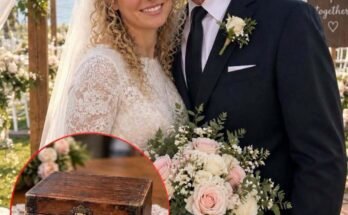
The cruelest thing anyone ever said about me was printed on a wedding name card. And the person who put it there had no idea my little brother was about to destroy a multimillion-dollar deal to defend me.
I was thirty-five years old, standing in a beautiful ballroom surrounded by two hundred guests, when I realized the people my brother was marrying into thought my entire life was a joke.
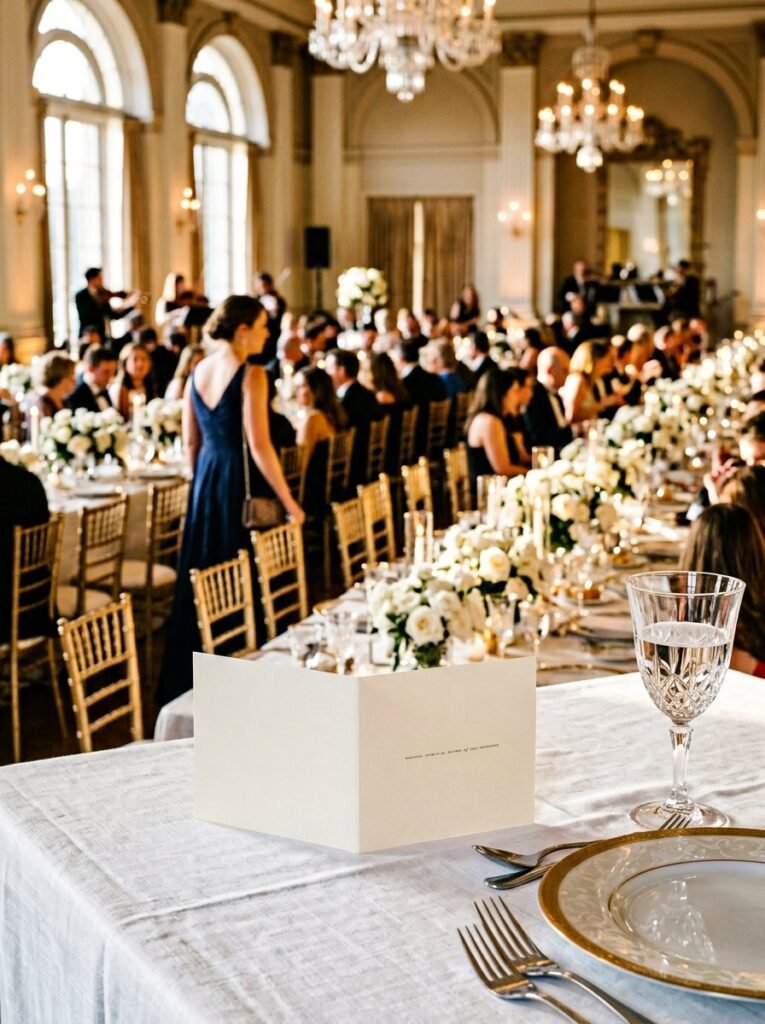
The card sat in front of my plate.
Poor, uneducated sister—living off her brother.
I read those seven words three times, hoping they would somehow change.
They didn’t.
Morning sunlight streamed through the enormous windows of Rosewood Hall, illuminating white roses, gold chairs, and crystal champagne glasses. A string quartet played near the entrance. Waiters moved between tables carrying silver trays.
Everything looked expensive.
Everything looked perfect.
Except me.
I was wearing the only navy dress I owned, a simple knee-length dress I’d carefully ironed the night before. My shoes were old, but I’d polished them until they shone.
I’d even gotten my hair done at the little salon near my apartment.
I wanted to look nice for Ethan.
My little brother was getting married, and nothing—not even the fact that his bride’s family had more money than anyone I’d ever known—could have kept me away.
Then Claire Whitaker’s cousin leaned over my shoulder.
“Oh my God,” she said, reading the card.
She laughed.
Not a nervous little chuckle.
A loud, delighted laugh that made three people at the table turn around.
“Did you see what they put for Ethan’s sister?”
Another cousin leaned closer.
Then another.
Within seconds, several people were laughing.
I felt my face burning.
Across the table, Claire’s mother lifted one manicured hand to her mouth. For one foolish moment, I thought she was embarrassed.
Then I saw her eyes.
She was smiling behind her fingers.
At the head table, Claire’s father, Richard Whitaker, watched me over the rim of his champagne glass.
He wore a perfectly tailored gray suit and the small, satisfied smile of a man who had been waiting for something.
Something told me this wasn’t an accident.
I carefully turned the card facedown.
But the laughter continued.
“Well,” one of the cousins whispered, not quite quietly enough, “at least somebody finally told the truth.”
I stared at the white tablecloth.
I had spent sixteen years learning how not to cry in front of strangers.
I wasn’t going to forget that lesson today.
When our mother died, I was nineteen and Ethan was twelve.
Our father had already started disappearing into bottles of cheap whiskey and mountains of unpaid bills. After Mom’s funeral, he disappeared from our lives completely.
One morning I was a community college student with dreams of becoming a teacher.
The next, I was responsible for a frightened little boy who kept sleeping with the hallway light on.
I withdrew from school.
I took a morning job at a grocery store and an evening cleaning job at a medical office.
I learned how to make twenty dollars feed two people for almost a week.
I learned which bills could wait and which ones couldn’t.
And I learned to smile while telling Ethan I’d already eaten dinner.
When his shoes split open during basketball season, I bought him new ones and wore my own sneakers with holes in the soles.
When he needed cleats, I sold the little gold necklace Mom had given me for my sixteenth birthday.
When he got his heart broken at fifteen, I sat on the edge of his bed until two in the morning, listening while he told me he’d never love anybody again.
And when he graduated from high school, I stood in the bleachers cheering so loudly that he laughed through his tears.
He once told me I was his sister, his mother, and his best friend.
I told him I was just Nora.
Just his big sister.
That was enough for me.
Years later, Ethan built a successful technology company called Northline, which developed water-leak detection systems for apartment buildings.
He used to say the idea came from the years we spent setting pots beneath our leaking ceiling.
I used to tease him that all those miserable nights had finally been useful.
I never asked him for a share of his success.
When he offered to buy me a house, I refused.
When he tried to replace my old car, I told him it still ran perfectly well.
I worked in administration at a neighborhood health clinic, paid my own bills, and lived quietly.
Ethan knew I was proud of what he’d become.
What he didn’t know was how much I still worried about being an embarrassment to him.
Especially around Claire’s family.
The Whitakers owned apartment complexes, commercial properties, and several luxury hotels across three states.
Mr. Whitaker had spent the rehearsal dinner discussing a major Northline business agreement that was supposed to be finalized the morning after the wedding.
He kept calling Ethan “the future of our family.”
But when he spoke to me, his voice changed.
“So, Nora,” he’d asked, “did you ever finish college?”
“No, sir.”
“That’s unfortunate. Education makes all the difference.”
I’d smiled politely.
He hadn’t asked why I’d left.
Neither had Claire’s mother, who spent most of the evening correcting the way I pronounced the names of expensive wines.
Claire herself had always been kind to me, although she’d seemed strangely distracted during the wedding preparations.
I told myself she was simply nervous.
Now, sitting in that ballroom, I wondered how long her family had been laughing about me behind closed doors.
I folded the name card in half.
Then I stood.
My chair scraped softly against the floor.
I would leave quietly.
Ethan deserved one perfect wedding day.
He deserved happiness without me turning his celebration into an argument.
I picked up my little handbag and started toward the exit.
“Nora?”
I froze.
Ethan was standing near the dance floor with the pastor.
Even from across the room, I could see his expression change.
He excused himself and walked toward me.
“Hey,” he said gently. “Where are you going?”
“Just getting some air, sweetheart.”
He studied my face.
“You’ve been crying.”
“No, honey. It’s just warm in here.”
Then his gaze moved to my empty place setting.
To the folded card beside my plate.
He reached for it.
“Ethan, please.”
He unfolded the card.
Read it.
And went perfectly still.
I’d seen my brother angry before.
I’d seen him furious when someone bullied a classmate, heartbroken when Mom died, and frightened when we almost lost our apartment.
But I’d never seen that look.
His jaw tightened.
His face lost every trace of color.
“Who did this?”
The people at the table stopped laughing.
Nobody answered.
Ethan raised the card slightly.
“I’m asking a question. Who thought this was funny?”
One of Claire’s cousins stared at her lap.
Her mother shifted uncomfortably.
Mr. Whitaker slowly set down his champagne glass.
“Now, Ethan,” he said, sounding amused, “don’t make a scene.”
Ethan didn’t move.
“Answer me.”
Mr. Whitaker gave a dismissive wave.
“It was a joke, son. A little family humor. Your sister shouldn’t be so sensitive.”
I felt Ethan’s hand close around mine.
Not tightly.
Just firmly enough to remind me of the little boy who used to hold my hand when thunderstorms frightened him.
“Please,” I whispered. “It’s your wedding.”
He looked at me.
For a moment, I saw that twelve-year-old boy again.
Then he turned toward Mr. Whitaker.
“Say that again.”
The older man’s smile faded.
“Excuse me?”
“Tell me again how humiliating the woman who raised me is funny.”
The quartet stopped playing.
Someone lowered a champagne glass.
Claire appeared at the ballroom entrance, her white wedding dress trailing behind her.
“Ethan?” she called.
He didn’t look away from her father.
Mr. Whitaker stood, straightening his jacket.
“I suggest you remember who you’re speaking to. There are millions of dollars involved in our arrangement.”
Ethan glanced at the card one last time.
Then he took my trembling hand in both of his.
The whole ballroom seemed to hold its breath.
And my brother spoke six words that changed everything.
“You just made the most expensive mistake of your life.”
PART 2
The ballroom made a sound I have never heard before or since: two hundred people trying not to react at the same time.
Ethan did not raise his voice. He held my hand and walked me past the head table, past a waiter carrying a tray of champagne who stepped back against the wall to let us by. Halfway to the doors, Claire caught up with us in her white dress, holding the train in one hand.
“Ethan. Wait.”
“Don’t.”
“My father did that.” She was out of breath. “The place cards. He had the stationer reprint them on Thursday. I saw the invoice in his study, and I told myself it was seating.” She stopped, and her face did something I had seen in my own mirror. “I should have opened it. I’m sorry, Nora.”
“Claire—”
“Go,” she said. “I’ll handle him.”
Outside, the parking lot smelled like cut grass and rain. Ethan stood by my old car for a moment with his hands on his hips. Then he took out his phone. 7:38 p.m.
He called Harriet Cho, his general counsel, at home, on a Saturday, and he said four words.
“Kill the Whitaker deal.”
I could hear her through the phone.
“Ethan. Six weeks of work.”
“Kill it.”
“It’s a hundred and eighty million dollars.”
“Then it’s an expensive mistake,” he said. “Apparently that’s what we do now.”
He hung up and called her back fourteen seconds later and told her to pull every document in the file relating to the sensor patent, and to bring the originals, not the copies, to his apartment at eleven o’clock that night.
I sat on the passenger side of my own car and put my handbag in my lap, and I want to be honest about what I felt, because it was not gratitude. It was that specific shame of a person who has been a burden all her life and has just watched a scene about it in a ballroom.
“Ethan,” I said. “Go back inside.”
“And then what?”
“Then you get married and you don’t blow up your company over a piece of cardboard.”
“It’s not cardboard.” He got in the driver’s seat and started the engine. “It’s a signature. He put his name on it. That’s a document, Nora. That’s the whole reason I’m still calm.”
He drove me home and waited on the sidewalk while I went inside, and I stood in my kitchen in the dark with the folded card still in my bag, and then I came back out and got in the car and let him take me to his apartment.
At 11:52 that night I sat at his kitchen table with a mug of tea I did not drink while a lawyer spread documents across the wood.
Harriet Cho is fifty-one years old and she does not waste words. She put three things in front of me, in this order.
A certificate. United States Patent 9,486,732. Moisture Detection Array for Multi-Unit Structures. Filed October 4, 2016. Issued May 7, 2019. Inventor: Nora Alice Vance. Assignee: none.
An assignment. One page. Recorded in the United States Patent Office in 2018. My name at the bottom, and Ethan’s name beside it, assigning “the invention described in U.S. Provisional Application 62/298,114, and all improvements thereto” to Northline Technologies, LLC.
And a copy of a license agreement, two hundred and nine pages, with a tab on Section 12.
“The card,” I said.
“Forget the card for a minute,” Harriet said. “Do you remember signing this?”
I remembered.
In 2016 I was twenty-seven and my brother was twenty, and he had an idea and no money at all. I paid for the filing out of a paycheck from the clinic — twelve hundred dollars, which was one month’s rent — and I sat at his kitchen table and signed a stack of papers he put in front of me while he talked about pots under a leaking ceiling.
“You told me it was the paperwork,” I said.
“It was.”
“You told me you were putting my name on it because you couldn’t afford a lawyer and you needed an inventor.”
“I did.”
“Then why did nobody tell me that Northline’s entire product runs on it?”
Harriet and Ethan looked at each other, and that is when I understood that something had been left out of my brother’s kitchen table that night. And that this was not me being stupid. That is the difference between an uneducated woman and a stupid one, and I have lived in it my whole life.
“Because it was a paperwork problem,” Ethan said, “and I was twenty years old and embarrassed, and then we got big and I told myself it didn’t matter who was named on a certificate.” He looked at me. “It’s your patent, Nora. Legally, the product we sell is licensed from you, and there is a page in that agreement with your name at the bottom that says so.”
I did not say anything for a while.
Then Harriet took a second envelope out of her bag and put it on the table, and this is the moment I have gone over more times than any other in my life.
Courier envelope. Whitaker, Styles and Doane, LLP, printed on the corner. Addressed to Ms. Nora A. Vance, 1140 Fayette Street, Apartment 4B. Delivered July 12th.
“Did you open this?” she asked.
“No. I get four envelopes a week from insurance companies and lawyers.” I looked at it. “I thought it was a warranty.”
Ethan opened it with a knife from the drawer.
Eight pages. A consent and waiver of the licensor’s rights under the Northline license agreement. A signature page. And on the top, clipped to the first page, a single sheet of legal pad with a note in black ink, in a hand I did not know then and would come to know very well.
Bennett — she won’t understand it. Get it signed at the wedding if you have to. R.W.
The kitchen clock clicked.
“July twelfth,” Ethan said quietly. “This has been a plan since July.”
I looked at the note, and at the seven words printed on the card in my bag, and the two of them fit together like a key in a lock.
At twenty past midnight his phone rang on the table, and Harriet picked it up and listened and said yes four times and hung up.
“That was Bennett Styles,” she said. “The signing is at nine o’clock tomorrow morning. At the Whitaker Building.” She put the phone down. “He said to bring your sister.”
PART 3
The fourteenth floor of the Whitaker Building smelled like new carpet.
They had set a long table with eight chairs and eight bottles of water and one flag, and they had put the closing documents in black binders with gold lettering. It looked like a place where large things happened quietly.
Richard Whitaker sat at the head with his cuff links and his reading glasses. Priscilla sat to his right in a pale pink suit. Bennett Styles, the lawyer, sat with a laptop. There was a banker on speakerphone from Charlotte. Claire came in last, in jeans and no makeup, and sat at the far end and did not say anything to her father.
“Nine o’clock,” Whitaker said. “Nora. I’m glad you came. This will take ten minutes.”
“It won’t,” Ethan said.
“You’ve had a night to be angry. I understand that.” Whitaker opened a binder and turned it around. “The card was in poor taste. I apologize for the method and not the sentiment.”
I had spent twelve hours thinking of things to say to that man, and every one of them died in my mouth.
“Let’s be practical,” he said. “We have eleven pages to sign, and one of them is yours.”
He slid a single page across the table. It was the consent I had been mailed in July, printed fresh, with the date filled in.
“Two hundred and fifty thousand dollars,” he said. “I’ve already written the check. Sign your consent and take it. You’ll never have to work again, and everybody can get on with the wedding.”
Nobody at that table moved.
Then Ethan put both hands flat on the table and said, very quietly, “The deal is off.”
Whitaker did not look up from his binder. “No, son. It isn’t.”
“I’m the chief executive officer of Northline and I’m telling you there is no deal.”
“Then I’ll tell you what you’ll be telling your board at four o’clock this afternoon,” Whitaker said. He took his glasses off. “I’ve known about the patent since May. My lawyers did what your lawyers didn’t bother to do, and they found a copy in the record office with your sister’s name on it, and for months I have been waiting to see whether you would tell me yourself.” He looked at me. “I put that card at your place because I wanted you to understand what you were before you got difficult about it.”
The banker’s line was buzzing.
I looked at that page. One signature line. Two hundred and fifty thousand dollars. Seven words on a card in my handbag.
“May I see the license?” I said.
Bennett Styles looked at Whitaker, who shrugged.
They put the binder in front of me. Two hundred and nine pages, tabbed, annotated in a careful hand. I turned to Section 12 and read the page twice to be sure, and then I read it a third time out loud to the table.
“‘Any assignment of this Agreement, or any change in the ownership or control of Licensor, or any transfer of the Licensed Patents, shall require the prior written consent of the Licensor, and any attempt to do so without such consent shall be void.'”
I looked up.
“Who wrote this?”
“Your brother’s counsel,” Whitaker said.
“Then my brother’s counsel did a better job than my brother,” I said. “This agreement is between Northline and Whitaker Properties. Northline licenses the patent from the licensor. The licensor is me.” I turned the page around. “Section 12 requires my written consent to any change in control. That is what you mailed me on July twelfth and that is what this page is. So the deal does need my signature. You were correct when you put the card at my place.”
Priscilla Whitaker said, “Well, isn’t that convenient,” and Bennett Styles said, “Mr. Whitaker, I need a word,” and the banker on the speakerphone said, “Can someone tell me what’s happening,” and nobody answered him.
“Five o’clock,” Whitaker said.
“Excuse me?”
“We’ll meet at five. My counsel and yours, and you can think about the number.” He stood and buttoned his jacket. “Ms. Vance, I’ve bought and sold more in a bad afternoon than your brother will do in a decade. A woman who cleans offices and files papers at a clinic does not negotiate with me. You sign, or you don’t, and if you don’t, my complaint for fraud and negligent misrepresentation goes to the courthouse on Monday and the first thing that happens is your brother’s company freezes to death waiting for a hearing.”
Ethan started to stand up.
“Ethan,” I said. “Sit down.”
He sat down.
I put both hands on the table and looked at Richard Whitaker for a long moment.
“There is one thing I want you to understand,” I said. “I have read four hundred contracts in nine years at that clinic. Grant agreements, vendor agreements, leases, and one settlement that kept our doors open in 2020. I read them because nobody was doing it for me. I know what a signature is worth, Mr. Whitaker, and I am the only person in this room who has never once signed something I had not read.” I folded the consent page in half and put it in my bag. “Five o’clock.”
In the elevator, Ethan said, “Nora. I’m sorry. I didn’t know they’d—”
“I know you didn’t.”
“Say the thing,” he said. “Whatever it is.”
“I don’t have it yet,” I said. “Ask me at five.”
PART 4
At 2:40 that afternoon Harriet Cho sat at my kitchen table with a cardboard box.
She had the file from the 2019 application, pulled out of a storage unit in Norcross, and she took a document out of it and slid it across the table to me.
A second patent. U.S. Patent 11,204,318. Filed July 11, 2019. Issued December 21, 2021. Same title. Same inventorship.
“Your brother’s entire product line,” Harriet said, “runs on this one. The first patent covers the sensor. This one covers the thing that made the company worth a hundred and eighty million dollars, which is the pressure differential across a wet trap. If Whitaker gets an injunction on the first one, we’re hurt. If anyone gets an injunction on this one, we’re dead.”
“And who owns this one?”
She turned the front page around.
“Who filed it?” I asked.
“You did,” she said. “July 2019. Ethan brought you lunch and a stack of papers, and you signed the inventor’s declaration. That is a declaration, Nora. It is not an assignment. It says, in about four hundred words of patent English, that the invention is yours — sworn under penalty of perjury, in front of a notary, by the woman who came up with it.”
I sat down slowly.
“The 2016 assignment covered the invention as it existed in 2016,” Harriet said. “The 2019 application claims something that did not exist in 2016. There is no assignment for it in the file. I have looked. There is a declaration with your signature on it, and nothing else.”
Then she said the thing that made the room go cold.
“And that is why he sent you that consent, and why he sent it in July, and why he wanted it signed at the wedding. He doesn’t need your consent for his own protection. He needs your signature on a document that any court will read as an assignment of ‘all rights, title, and interest in and to any patent or patent application relating to the moisture array.’ If you’d signed it at two hundred and fifty thousand dollars, he would have owned the company’s whole future. And he’d have gotten it in a white envelope, at a wedding, in front of two hundred people.”
At 4:50 I walked into the Whitaker Building with my little handbag, and this time I did not sit at the far end.
Two hundred and nine pages had been replaced by eleven. Bennett Styles had drafts of a fraud complaint, a press statement that said Northline’s product line was “built on documentation irregularities,” and a letter to the venture lender.
Ethan sat beside me. Harriet sat on my other side with a notepad and no pen, which I noticed.
“My offer stands,” Whitaker said. “The check is still in my pocket. In fact, it’s better. Four hundred thousand, because you’ve cost me a day.”
“Richard,” Harriet said, “before we discuss anything, my client is entitled to ask how your client intends to explain the July twelfth letter.”
“I don’t intend to explain anything,” Whitaker said. “I intend to sign a closing.”
The banker was on the speaker again, and this time he was not polite. He said the words “material misrepresentation” and “the two blue loans” and “if this isn’t closed by Thursday, we call.” It meant two loans against the license revenue and a refinancing that would fail if the bank did not see Whitaker Properties owning the exclusivity.
“Sign it,” Whitaker said, and put the page in front of me, and then the check, and then a pen.
Two hundred and eleven people work at Northline. I had asked Ethan at noon how many, and he had told me, and then he had told me again because I made him say the number slowly: two hundred and eleven, plus the delivery drivers in four states, plus the four hundred and sixty apartment buildings that had the little white sensors screwed to their basement walls, including a hundred and forty units at Fayette Commons where three of my own patients lived, where a faulty valve had flooded eleven apartments in 2022 and a woman named Ruth Okafor had lost everything she owned.
“Sign it,” Whitaker said again. “Or I will spend the next six months making sure that your brother’s company dies with your name in the newspaper.”
The room was very quiet.
I picked up the pen.
“Nora,” Harriet said quietly. “You don’t have to do this today.”
“No,” I said. “It’s all right.”
I put the page flat on the table and smoothed it with the side of my hand, and I read all eleven pages in front of them, slowly, in a silence that got heavier with every page.
Then I picked up the pen and wrote three things on that consent.
And then I signed my name.
PART 5
The signature page says:
Signed: Nora A. Vance (Licensor)
And above it, in my handwriting, in blue pen, with my initials in the margin beside each line:
Conditioned on all three of the following. NV
1. “Exclusive” struck in Section 4.2 and in Exhibit C. Non-exclusive. The licensor may license the moisture array to any other person or entity at any time. NV
2. Two percent of all licensing revenue paid, perpetually, to the Delia Vance Fund at the Fayette Street Community Health Center, for students who left school to raise a family member. NV
3. Richard T. Whitaker to read the place card from Rosewood Hall, table nine, aloud to the guests of the Sunday brunch, in full, twice, at 12:00 p.m. today. If terms 1-3 are not accepted in writing before 9:00 a.m. Monday, this consent is withdrawn in its entirety. NV
Bennett Styles read it to himself first. I watched him go back to the top and read it again, and then I watched him take his glasses off and press his thumb and forefinger into his eyes, and I want to tell you I felt something like Christian mercy in that moment, but what I felt was that I had finally done my homework and the boy who copied it off me was getting an F.
“Richard,” he said.
“Sign it and let’s go.”
“Richard,” Styles said again. “She wrote on it.”
“Then she can unwrite it.”
“No.” Styles handed him the page. “She initialed it. She has made a conditional offer in writing, and she’s given you until nine Monday to accept, and I am telling you as your lawyer that a court will hold us to it. The interlineations are in her hand, they are initialed, and they are dispositive. She has struck the exclusivity.”
Priscilla said, “That’s absurd. She can’t just write on a contract.”
“She just did,” Harriet said. “And my client has signed it, which she was not obliged to do. On behalf of Northline, Mr. Whitaker, I accept terms one and two, and term three is between your client and the two hundred people at his daughter’s brunch.”
The banker on the phone said, “Is the license non-exclusive?” and nobody answered him, and then he said, “Richard, I need to know right now whether the refinancing still works,” and Richard Whitaker did not answer him either.
I have kept the memo that went out from Whitaker Properties’ counsel to its lender on Monday afternoon, because there is a copy in a court file in Fulton County and because I am a person who keeps records.
The exclusivity condition has been removed from the transaction by the licensor’s interlineation. Whitaker Properties may proceed with the purchase of Northline’s distribution rights on a non-exclusive basis and at a materially higher cost per unit, or may decline. The refinancing contemplated in the July term sheet does not close without exclusivity. Please advise.
They proceeded. The transaction came in at a hundred and eleven million dollars instead of a hundred and eighty — seventy-four million in cash at closing and the rest against unit sales — for the right to buy sensors that any other landlord in three states could also buy. Richard Whitaker’s own board minutes in September contain the words “adverse outcome.”
Ethan called me when the wire hit his account. He did not gloat. He said the deal he had been ready to blow up on Saturday night was worth nothing, and this one was worth a hundred and eleven million dollars, and his sister did that. Then he said, “Cheapest thing I ever bought,” and I could hear him grinning through the phone, and I told him to go home to his wife.
Ethan sent me the wire confirmation for the first royalty payment on the second of January. It was $184,000, and I sat at my kitchen table and looked at it for a long time, and then I called the clinic’s finance director and told her we were going to need a bigger office.
The Delia Vance Fund gave out its first four scholarships in August: a girl at Georgia State who is raising her two brothers, a man at Atlanta Tech who left school in 2019 to care for his mother, a woman at the clinic who is a nursing aide and wants to be a nurse, and a young man who wrote in his essay that he had spent four years sleeping with the hallway light on, and who did not need to explain it to anybody.
I never finished college. I want to say that plainly, because it is the one line in this story that Richard Whitaker got right, and because I have come to think of it differently than he does. I left school at nineteen because a twelve-year-old boy needed somebody to come home to. I got an education anyway. It just didn’t come with a certificate, and it cost a great deal more.
They had the brunch on Sunday at noon in the same ballroom, and I want you to know that I went, and that I wore the navy dress again, and that I walked in through the front doors this time with my head up.
Two hundred people were there. The roses were a day older. Claire had changed out of the dress into a white pantsuit and had not spoken to her father since Saturday night, and she came and stood beside me at the back, and took my arm, and did not let go.
At twelve o’clock exactly, Richard Whitaker stood up at the head table with a card in his hand.
He had been given it by his wife, who had read my terms in the elevator and had said one word, which was “no.” He read it anyway, because his general counsel had gone home for the weekend and left a memo on his desk that said, in effect, that the consent was conditional and that nothing was going to close on Monday if he did not.
He read it into the microphone in a voice I had never heard him use.
“Poor, uneducated sister—living off her brother.”
The room did not laugh. Two hundred people sat in a silence where you could hear the ice settle in the glasses.
He looked up, and I held up two fingers from the back of the ballroom, and I did not put my hand down.
And Richard Whitaker read my name card out loud a second time, because I asked him to.