A man behind me put his smelly bare foot on my airplane armrest and refused to move them—I didn’t yell, but my little lesson made him turn bright red.
I was four hours into a packed flight when something warm brushed my elbow.
I looked down.
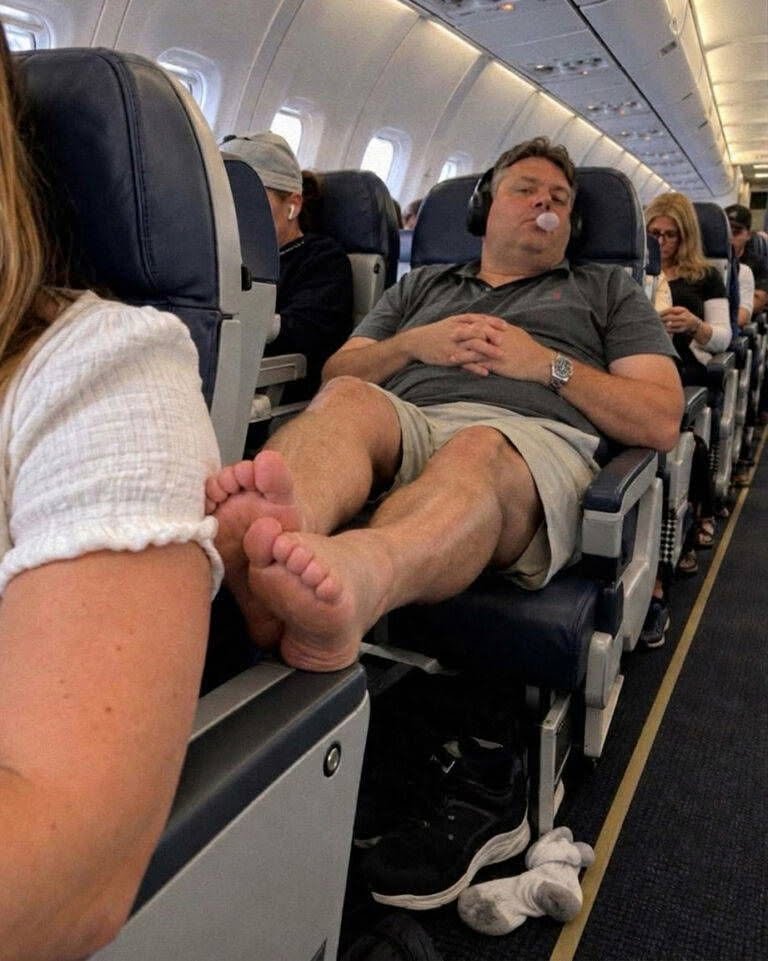
Five bare toes were resting on my armrest.
For a second, I honestly thought I was imagining it.
Then the smell hit me.
I turned around. The man behind me looked about forty-five, wearing an expensive watch and headphones, with his shoes kicked under the seat.
“Excuse me. Could you move your foot?”
He pulled one headphone aside.
“It’s not touching you.”
“It’s on my armrest.”
“My feet need to breathe.”
“Then let them breathe in your own seat.”
He smirked. “It’s an airplane. We’re all sharing space.”
He glanced at my other arm.
“So use your other armrest and don’t bother me.”
I stared at him.
He smiled, put his headphones back on, and wiggled his toes.
I moved my elbow away.
Ten minutes later, his foot was still there.
When the plane hit turbulence, his toes actually brushed my sleeve.
I turned around again.
“Seriously. Move your foot.”
He sighed like I was exhausting him.
“Lady, it’s just a foot. You’re acting like I put it on your dinner plate.”
The woman beside me made a face.
“That’s disgusting.”
He laughed.
“You two need to relax.”
That was when I stopped arguing.
“Okay,” I said.
He smirked, clearly convinced he’d won.
Twenty minutes later, he fell asleep.
His bare foot was still inches from my elbow.
I stared at it for a moment.
Then an idea came to me.
I glanced at the woman beside me.
“Would you mind blocking his view if he wakes up?”
Her eyebrows rose.
“Why?”
I leaned closer and whispered my plan.
Her eyes widened. Then she covered her mouth to keep from laughing.
“Oh, you’re actually doing that? You’re my queen,” she whispered, winking at me.
I smiled.
For less than a minute, I quietly put everything in place while he slept.
Then I sat back and waited.
About forty minutes later, the man woke up, stretched, and stood to head toward the restroom.
He made it only a few steps.
A passenger across the aisle looked at him, did a double take, and burst out laughing.
Someone else turned around.
Then another.
Even the flight attendant stopped.
The man frowned.
“What?”
Nobody answered.
He looked down.
His face turned bright red.
Then he spun toward me.
“What the hell did you do?!”
PART 2
“I thought your feet wanted attention,” I said.
Five toenails gleamed beneath the cabin lights in five shades of pink. Two plastic rings—one shaped like a purple heart, the other topped with an enormous fake diamond—sparkled on his second and third toes.
The woman beside me folded her lips inward, but her shoulders shook.
The decorations had come from a beauty set I had bought for my nine-year-old granddaughter, Lily. I had intended to give it to her unopened. Instead, the brightest bottle had helped a stranger discover the inconvenience of unwanted contact.
“You touched me while I was asleep!” he shouted.
“And your bare foot touched me while I was awake.”
A flight attendant stepped between our rows. The man thrust one decorated foot toward her as if presenting evidence at trial.
“She did this without permission.”
The attendant looked at the armrest, then at the shoes still shoved beneath his seat. “Sir, please put your shoes on and keep your feet within your own seating area.”
“That is not the point!”
“It became the point after three requests,” the woman beside me said. “I heard every one.”
The man’s name, I soon learned, was Bradley. He pulled the rings off, jammed his feet into his loafers, and demanded my full name. I gave it to the flight attendant instead.
“I understand that painting him was inappropriate,” I said. “I’ll answer for it. Please also document why it happened.”
Bradley leaned close as the attendant wrote her report.
“You’re going to regret humiliating me.”
The humor left the moment.
The flight attendant heard him. So did my seatmate, who introduced herself as Diane Foster and quietly revealed that she had recorded our second exchange after Bradley refused to move his foot.
Bradley returned to his row, but not before telling me that people who “made scenes” often discovered how little influence they actually had.
I did not respond.
During landing, he pulled a leather portfolio from the overhead bin. A luggage tag swung from its handle.
BRADLEY KENT.
MERIDIAN FREIGHT SYSTEMS.
The name was familiar.
For twenty-eight years, I had worked in transportation operations, beginning as a dispatch clerk and eventually overseeing three distribution centers. Meridian’s board had recently hired me as its new regional director after a string of complaints about turnover, safety, and management culture.
My appointment had not yet been announced.
The board packet in my carry-on contained profiles of four executives being considered for senior vice president. Bradley Kent, director of field operations, was the leading internal candidate.
His photograph in the packet had been formal and flattering. Until I read his luggage tag, I had not connected it to the man behind me.
Diane noticed my expression. “You know him?”
“I know who he is now.”
Bradley pushed past us after the doors opened without looking back. He had no idea that the woman he ordered to use less space was scheduled to chair his promotion interview at ten the next morning.
At home, Lily laughed until she fell sideways on my sofa when I explained why two rings were no longer sealed in the package.
“Did the mean man learn his lesson?” she asked.
“I think he learned to wear shoes.”
The deeper lesson would depend on what he did next.
At 9:55 the following morning, I approached Meridian’s executive conference room and heard Bradley’s voice through the half-open door.
He was telling six coworkers about the “unstable woman” who had attacked him on a plane.
Then he added, “Some people don’t understand their place until you show them.”
My assistant reached for the door.
I stopped her.
Bradley had just turned an embarrassing airplane dispute into the first honest answer of his promotion interview.
PART 3
I listened for another minute.
Bradley left out the bare foot, the repeated requests, and the threat the flight attendant had documented. In his version, he had been sleeping peacefully when a bitter woman decided to punish a successful man.
A few people laughed uncertainly. A younger woman near the door did not.
My assistant, Sophie, opened the conference room.
“Everyone, our new regional director has arrived.”
I entered carrying the same leather folder Bradley had seen on the plane.
His confident smile disappeared.
“Good morning,” I said. “I’m Rebecca Hale.”
Bradley stared. “You?”
“Yes. We have met.”
Someone at the table asked if I was the woman from his story.
“I am,” I said. “And since Mr. Kent discussed it before a room of colleagues, I’ll add the detail he omitted: his bare foot was on my armrest after I asked him three times to move it.”
Bradley turned crimson.
I did not mention the nail polish again. I began the meeting.
The interview was supposed to focus on budgets, expansion, and staff retention. Bradley gave polished answers until Janelle Ortiz, the younger manager near the door, asked why turnover in his division was twice the company average.
He interrupted her before she finished.
“Janelle is new to senior-level numbers.”
“She asked a clear question,” I said. “Please answer it.”
His smile tightened.
He blamed the employees. They lacked resilience. They expected accommodation. They treated ordinary standards as personal attacks.
I had heard the same argument at thirty thousand feet.
After the meeting, Bradley asked to speak privately. He closed my office door and apologized, but only for failing to recognize me.
“If I’d known who you were, none of that would have happened.”
“That is the problem,” I said. “Respect that depends on a title is not respect.”
His expression hardened. “You can’t use a personal incident to block my career.”
“I won’t. The board will use your record, and I will disclose our encounter.”
By lunchtime, Bradley had filed an ethics complaint against me for touching him while he slept. I recused myself from his promotion decision and submitted the flight attendant’s report. I also accepted that the prank had crossed a boundary, even if his behavior provoked it.
Bradley mistook accountability for surrender.
He told employees I would be gone within a week.
That afternoon, Janelle came to my office with a list of nine former supervisors who had resigned from Bradley’s division. Three had reported him for retaliation. Two had raised safety concerns. None of the complaints remained in the human-resources system.
“I filed one myself,” she said. “It vanished.”
She had kept the confirmation email. Its case number belonged to a complaint the system now claimed had never existed.
Independent counsel expanded the review. Digital auditors recovered deletion logs tied to an administrator account used by Bradley’s office. They also found altered inspection dates after an employee was injured at a loading dock six months earlier.
Bradley denied everything. He said assistants shared his credentials and accused Janelle of manufacturing records to help me retaliate over the flight.
Then Diane called.
She was not only my former seatmate. She was a retired labor attorney who had spent thirty-five years teaching companies how to preserve workplace evidence. Her recording captured Bradley’s refusals, his threat, and the flight attendant’s warning.
“I thought you might need the full version before he edits the story again,” she said.
Her video did not excuse what I had done. It proved Bradley had lied about what he had done.
The board postponed his promotion and placed the decision with an outside panel.
That evening, Bradley passed me near the elevators.
“You think one stupid foot is going to end my career?”
“No,” I said. “Your record may do that without any help from me.”
For the first time, he looked afraid.
His complaint had been designed to remove me. Instead, it had opened every locked file he believed his title would keep hidden.
PART 4
Bradley fought the investigation by turning it into entertainment.
A cropped video appeared online showing me leaning toward his sleeping foot with a bottle of pink polish. The clip began after his refusals and ended before his threat. Its caption called me “Meridian’s unhinged new boss.”
By morning, reporters were outside company headquarters.
The board placed me on administrative leave. Bradley returned to work and told his division that the promotion announcement had merely been delayed.
I did not argue with the suspension. I had painted a sleeping passenger’s toenails, and a responsible company had to examine that choice. But I refused to let Bradley use my mistake to erase everyone else’s evidence.
Janelle delivered the original loading-dock inspection sheets to independent counsel. They showed that a damaged restraint had been reported eleven days before an employee named Marcus Bell was seriously injured. The electronic copies had been changed after the accident to make the warning appear late.
Bradley’s approval appeared on both versions.
He claimed the signature had been copied.
The executive assistant who managed his administrator account suddenly resigned and stopped answering calls. Without her testimony, auditors could prove the files were deleted from Bradley’s office but not who pressed the keys.
At the emergency board hearing, Bradley arrived in a dark suit and a carefully wounded expression. He said the entire inquiry was revenge by a superior who had humiliated him in public.
His attorney played the cropped airplane video three times.
My counsel played Diane’s complete recording. It established context, but the directors remained divided. One board member said Bradley’s rudeness did not justify my contact. I agreed.
“I am not asking you to declare my choice wise,” I said. “I am asking you not to confuse my accountability with his innocence.”
The panel then reviewed the missing complaints and altered safety inspection. Bradley said Janelle resented him because he had denied her a raise. He said Marcus had caused his own injury. He said every former employee criticizing him was weak, angry, or opportunistic.
Everyone was at fault except Bradley.
The board chair asked whether anyone could directly authenticate the deleted records.
No one answered.
Bradley’s missing assistant had been the only other person with access.
At 4:40 p.m., the panel recessed. The chair returned twenty minutes later with a sealed decision.
The finding against Bradley was inconclusive.
My conduct, however, was visible on video and undisputed. The board terminated my appointment for violating its leadership standards. Bradley’s promotion review would resume the next morning.
He looked at me across the table, unable to hide his smile.
As I gathered my papers, my phone vibrated with a message from Janelle.
Marcus found the original camera archive. It was never destroyed.
A second message appeared.
It shows who entered the loading dock office after the accident.
Before I could open the attached file, Meridian’s security chief took my company phone and access badge.
Bradley rose behind me and adjusted his expensive watch.
“At least now,” he murmured, “you finally know your place.”
The conference-room door closed, and the evidence that could expose him remained locked inside the company that had just removed me.
PART 5
Being terminated did not cancel the independent investigation.
The next morning, I met Marcus, Janelle, Diane, and my attorney at the offices of the state workplace-safety regulator. Marcus had kept the loading-dock archive because he never believed his injury was his fault. The camera system stored a hidden backup on a local drive that Bradley’s office had overlooked.
The recording showed Bradley entering the dock supervisor’s office two hours after the accident. He remained inside for seventeen minutes. The next person to enter was his executive assistant, carrying the inspection sheets that later disappeared.
Her resignation had not been voluntary.
Independent counsel located her at her sister’s home. Bradley had threatened to blame every deletion on her unless she left before the hearing. Once she learned the camera archive existed, she agreed to testify and surrendered text messages in which Bradley ordered her to “clean the complaint queue” and change the inspection date.
At 9:15, while Bradley waited for his promotion announcement, state investigators entered Meridian’s boardroom.
The board chair halted the meeting.
Bradley denied the messages until counsel displayed them beside records from his personal phone. He blamed his assistant, then Janelle, then Marcus. Finally, he accused the board of surrendering to public pressure.
The chair looked at him. “This is not about nail polish. It is about dishonesty, retaliation, and an employee who was injured after you concealed a safety warning.”
Bradley was dismissed for cause. Regulators referred the altered records for criminal review, and Meridian settled with Marcus. The company restored the deleted complaints, compensated employees who had faced retaliation, and hired an outside firm to rebuild its reporting system.
My outcome was less simple.
The board offered to reinstate me immediately and erase the termination from my file. I declined that version of the offer.
“If the company expects employees to accept consequences,” I said, “its director should do the same.”
I agreed to return only after the board replaced the termination with a formal reprimand, required me to complete the same conduct training any employee would receive, and adopted a policy preventing senior leaders from deleting complaints.
Accountability was not humiliation. It was the part Bradley had never understood.
Three months later, I resumed the regional-director role. Janelle became head of operations compliance. Marcus returned in a training position after his recovery and helped redesign the loading-dock inspection process. Bradley’s former assistant received legal protection as a cooperating witness.
Diane and I remained friends. Whenever we met for lunch, she insisted on choosing a restaurant with a strict shoes-required policy.
Lily turned the airplane story into family legend. She told anyone who would listen that her grandmother had defeated a corporate bully with pink nail polish. I always corrected her.
“The polish embarrassed him,” I said. “The truth defeated him.”
A year later, I boarded another crowded flight for a Meridian meeting. A tired mother sat beside me with a sleeping toddler across her lap. She apologized every time the child’s blanket brushed my sleeve.
“You’re fine,” I told her. “You’re allowed to take up the room you need.”
Halfway through the flight, a man in the aisle seat leaned across both of us to claim the window shade. The mother quietly asked him to move back. He sighed as though she had inconvenienced him.
I turned toward him.
“She asked politely.”
He looked at me, reconsidered, and returned to his own space.
No argument. No nail polish. No spectacle.
Just a boundary spoken clearly and supported by someone who heard it.
When I reached home, Lily had left a drawing on my kitchen table. It showed an airplane, a bright pink row of toes, and a woman wearing a crown. Beneath it, in purple marker, she had written: Grandma Rebecca teaches people manners.
I laughed and placed the picture on my refrigerator.
I did not feel like a queen. I felt like a woman who had finally learned the difference between revenge and power.
Revenge had colored Bradley’s toes for a day.
Power had made sure he could never again erase someone else’s voice.
From then on, whenever anyone told me to use less space, I remembered that armrest—and kept exactly the space that was mine.