My husband’s best friend offered to drive our sixteen-year-old daughter to ballet lessons three times a week. We’d trusted him for nearly thirty years, so when Audrey suddenly became withdrawn and stopped talking about dancing, I never imagined he could be involved.
Then one afternoon, I went to her studio without warning.
Through the classroom window, I watched the other girls rehearsing.
But Audrey wasn’t there.
When I approached her instructor and asked where my daughter was, the woman’s expression changed immediately.
“Mrs. Bennett, your daughter hasn’t told you what’s been happening, has she?”
My stomach tightened.
“What do you mean?”
She glanced toward the empty hallway and quietly closed the classroom door.
Then she said something that made me realize my daughter had been keeping a secret for weeks.
And the person we’d trusted to help her pursue her dream might know exactly why.
• • •
Audrey had loved ballet since she was little.
Our kitchen was hardly big enough for two people to pass each other comfortably, but somehow, she always found room to practice another turn.
Sometimes I’d be making breakfast when she’d suddenly stretch one leg behind her and begin practicing her balance.
“Audrey, careful! You’re going to bump into the refrigerator!”
She’d grin.
“Mom, I need to learn how to control my movements!”
Then she’d try again.
I used to laugh at how seriously she took it.
Other children asked for expensive toys or the latest electronics.
Audrey saved her birthday money for ballet shoes.
She watched performances online, borrowed dance books from the library, and practiced combinations until she could remember them without looking at a screen.
We’d enrolled her in beginner classes when she was younger, but regular training was expensive.
My husband, Scott, supervised construction sites, and I worked as a hospital administrator.
We managed our expenses carefully.
Professional ballet lessons weren’t always something we could afford.
Still, Audrey never stopped dreaming.
She practiced whenever she could.
And last fall, all that effort finally paid off.
She was accepted into the advanced teen program at a respected dance studio.
The program even included a scholarship covering most of her tuition.
I still remember the afternoon she received the email.
She burst through the front door holding her phone.
“Mom! Mom, look!”
I was standing beside the kitchen counter.
“What happened?”
“They accepted me!”
She pushed the screen toward me.
I read the message.
Then I read it again.
“Oh, sweetheart!”
I wrapped my arms around her.
Audrey hugged me so tightly I could barely breathe.
“Please, Mom,” she whispered. “I want to go so badly.”
I wanted to say yes immediately.
But when I checked the studio’s address, my excitement faded.
It was almost fifty minutes from our home by car.
Taking public transportation required two bus transfers.
And the lessons ended after eight in the evening.
Scott and I both worked late.
Getting Audrey there three evenings a week would be difficult.
Getting her home safely afterward was an even bigger concern.
I looked at the schedule again.
Audrey noticed my hesitation.
“Mom?”
“We need to figure out transportation.”
Her smile disappeared.
“But I got the scholarship.”
“I know, honey.”
“I worked so hard.”
“I know you did.”
She looked down.
“Please don’t say no.”
I felt terrible.
For two weeks, Scott and I tried to arrange rides.
We asked coworkers.
We checked with neighbors.
We considered rearranging our schedules.
But nobody could reliably drive Audrey both ways on all three evenings.
She even offered to take the bus herself.
“I can leave school early enough to get there before class.”
“Getting there isn’t my biggest worry,” I explained. “It’s getting home late.”
She sighed.
“So I finally get accepted, and I still can’t go?”
I had no answer.
Then, during a Sunday dinner, the solution appeared from someone we’d known for years.
• • •
Derek had been Scott’s best friend since high school.
They’d grown up in the same town, played sports together, and remained close throughout adulthood.
He’d been at our wedding.
He’d visited us when Audrey was born.
He’d attended birthday parties, family barbecues, and holiday dinners.
Audrey had known him practically her entire life.
Derek and his wife, Laura, also had a daughter named Mia, who was Audrey’s age.
The two girls had taken beginner ballet together years earlier.
So Derek already knew how much dancing meant to our daughter.
That Sunday, Audrey brought up the advanced program again.
“Dad, what if I take the earlier bus and wait inside the studio?”
Scott shook his head.
“Sweetheart, the problem is still getting you home afterward.”
I looked at her apologetically.
“I wish we had another option.”
Audrey stared at her plate.
Then Derek spoke from the opposite end of the table.
“Why doesn’t someone ask me?”
Scott looked up.
“Ask you what?”
“To take her.”
I blinked.
“Derek, that’s three evenings every week.”
He shrugged.
“My office is right down the street from the studio.”
Scott raised his eyebrows.
“Really?”
“Yeah. I can pick Audrey up after school, drive her there, and catch up on paperwork while she’s in class. Then I’ll bring her home.”
I hesitated.
“That’s a lot to ask.”
He laughed.
“It’s not a big deal. I’m already working in that area.”
Audrey stared at him.
“You’d really do that?”
“Of course,” Derek said. “Somebody has to help you become a famous dancer.”
She laughed.
Then she ran around the table and threw her arms around him.
“Thank you! Thank you so much!”
Scott smiled.
“Are you absolutely sure?”
Derek waved away the question.
“We’re practically family. Stop making it complicated.”
I thanked him again.
At that moment, I believed he was doing something incredibly generous.
And I felt relieved that Audrey wouldn’t have to give up the opportunity she’d worked so hard to earn.
I had no reason to suspect that anything about the arrangement would go wrong.
• • •
For the first few weeks, everything seemed wonderful.
Derek collected Audrey after school on Mondays, Wednesdays, and Thursdays.
He drove her to the studio and brought her home around nine.
Audrey would burst through the door, hungry and excited.
“Mom! You won’t believe what we learned today!”
I’d smile while warming her dinner.
“Tell me.”
She’d begin describing combinations, movements, and corrections from her instructor.
Sometimes she’d stop talking and demonstrate something right there between the stove and the dining table.
“Audrey, not while I’m holding a hot pot!”
“Then put it down! You have to see this!”
Scott would laugh from the living room.
Occasionally, he recorded her practicing in the hallway.
“Ladies and gentlemen, the future star of the stage!”
“Dad!” she’d protest, laughing. “Delete that!”
The whole house seemed brighter.
For the first time in years, Audrey was receiving the kind of training she’d dreamed about.
And Derek’s help had made it possible.
I couldn’t have been more grateful.
Then something changed.
At first, it was so subtle that I almost missed it.
Audrey stopped demonstrating what she’d learned.
When she returned home, she no longer rushed into the kitchen.
Instead, she carried her ballet bag upstairs.
Some evenings, she took her dinner to her room.
Whenever I asked about class, her answers became shorter.
“How was ballet?”
“Fine.”
“Did you learn anything new?”
“Not really.”
“Was Ms. Alvarez happy with your progress?”
“I guess.”
I assumed she was tired.
The advanced program was demanding, and Audrey still had school assignments to complete.
Maybe she needed time to adjust.
But the changes continued.
Her ballet shoes stayed zipped inside her bag.
She stopped practicing in the kitchen.
And the girl who used to talk about dancing constantly suddenly seemed uncomfortable whenever anyone mentioned it.
One evening, the studio sent an email about upcoming recital auditions.
I was excited.
Audrey had always wanted to perform on a proper stage.
At dinner, I asked her what piece she was planning to audition with.
She put down her fork.
“I’m not auditioning.”
I stared at her.
“Why not?”
“Because I’m not ready.”
“Did your instructor say that?”
She looked away.
“Can we please not talk about it?”
I exchanged a glance with Scott.
He gave me a small shrug.
So I let the subject drop.
But I couldn’t stop worrying.
Audrey had once practiced with such determination that I’d had to remind her to rest.
Now she didn’t even want to discuss the recital.
Something wasn’t right.
• • •
Over the next two weeks, Audrey became increasingly distant.
I tried asking whether she was struggling with the classes.
She insisted everything was fine.
I asked whether she needed different shoes.
She became irritated.
“Mom, can you stop trying to fix everything?”
I stood there, confused.
“I was only offering to help.”
“I know!”
She walked away.
That night, I told Scott I was worried.
He sighed.
“Claire, she’s sixteen. Teenagers have moods.”
“This isn’t like Audrey.”
“She’s growing up.”
“Ballet has always been the thing she loves most.”
“Maybe she’s exhausted.”
I wanted to believe him.
But the distance between Audrey and me seemed to be growing every day.
And I couldn’t understand why.
Then came the evening that convinced me something more serious was happening.
I was taking the trash outside when Derek pulled into our driveway.
Usually, Audrey got out of his car immediately.
That evening, she stayed beside the open driver’s-side window.
She was leaning toward him, holding onto his sleeve.
I was close enough to hear her voice.
“But you promised you’d talk to her.”
Derek answered sharply.
“Audrey, not now.”
“Please, Uncle Derek.”
He glanced toward the house.
That’s when he noticed me.
His expression changed immediately.
Audrey followed his gaze.
The moment she saw me, she let go of his sleeve and hurried toward the front door.
I watched her disappear inside.
Then I walked toward Derek’s car.
“Everything okay?”
He smiled.
“Of course.”
“She looked upset.”
“Oh, she’s just annoyed because we didn’t stop at the drive-through.”
I frowned.
“She has dinner waiting inside.”
“Exactly. I told her she didn’t need anything else.”
He laughed lightly.
“You know teenagers.”
I tried to smile.
But something about his explanation didn’t fit what I’d heard.
Audrey hadn’t been asking him about food.
She’d been asking him to speak to someone.
And I had a feeling that someone was me.
Before I could question Derek further, he drove away.
I went inside.
Audrey wasn’t in the kitchen.
I found her crying behind the downstairs bathroom door.
I knocked gently.
“Sweetheart?”
“Go away.”
My heart sank.
“Audrey, what happened?”
“Nothing.”
“Did you and Derek have an argument?”
“No!”
“Then please tell me why you’re crying.”
She opened the door.
Her cheeks were wet with tears.
For a moment, we just stared at each other.
Then she said something she’d never said to me before.
“It’s none of your business! Just leave me alone!”
I stepped back.
Audrey closed the door again.
And I stood in the hallway, trying to understand how my daughter had gone from hugging me over her ballet acceptance letter to acting as though I was someone she couldn’t trust.
• • •
That night, I asked Scott to speak with Derek.
He looked surprised.
“Why?”
“Because I heard Audrey asking him to talk to someone, and he wouldn’t explain what was happening.”
Scott frowned.
“Derek said she was upset about food.”
“Scott, she was crying.”
“Maybe they had a disagreement.”
“But why won’t she tell us?”
He sighed.
“Claire, I’ve known Derek since we were teenagers.”
“I know.”
“He’s helped us for weeks. He’s practically family.”
“I know that too.”
Scott looked at me.
“Then why are you acting like something terrible happened?”
I took a breath.
“Because our daughter has changed completely, and nobody seems to know why.”
He didn’t answer.
I continued.
“She used to practice ballet every morning. Now she won’t even open her dance bag.”
“Maybe the classes are too difficult.”
“Then why won’t she say that?”
Scott rubbed his forehead.
“I think you’re worrying too much.”
Perhaps I was.
But when I went to bed that night, I couldn’t forget the way Audrey had been gripping Derek’s sleeve.
Or the desperate sound in her voice when she said:
You promised you’d talk to her.
I barely slept.
By morning, I’d made a decision.
I was going to the dance studio myself.
• • •
The following afternoon, I rearranged my work schedule and left early.
I didn’t tell Scott.
I didn’t call Derek.
And I didn’t warn Audrey that I was coming.
I wasn’t trying to catch my daughter doing anything wrong.
I simply wanted to speak with her instructor and find out whether something at ballet was making her unhappy.
I drove the fifty minutes to the studio.
As I entered the building, I could hear music coming from one of the classrooms.
Students were finishing their lessons.
Through the glass, I could see several teenage dancers practicing at the barre.
I searched the room.
One girl had dark hair like Audrey.
Another wore a similar practice outfit.
But neither was my daughter.
I looked toward the far corner.
Still no Audrey.
I waited as the music stopped and the dancers began collecting their belongings.
One by one, they filed out.
Audrey wasn’t among them.
My stomach tightened.
Perhaps she’d been moved to another class.
Maybe she was changing clothes.
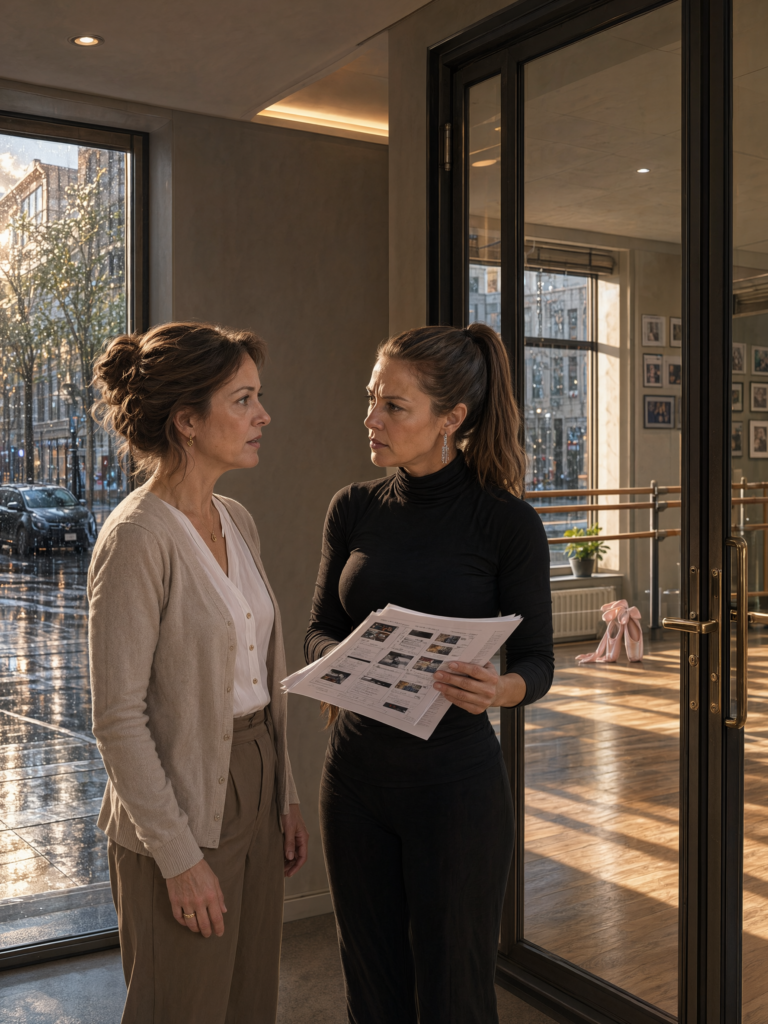
I approached a woman holding a clipboard near the hallway.
“Excuse me. I’m looking for Audrey Bennett.”
The woman looked up.
“Are you her mother?”
“Yes. I’m Claire Bennett.”
She introduced herself as Ms. Alvarez.
Audrey’s ballet instructor.
I smiled.
“I thought I’d surprise Audrey and drive her home today. Is she practicing in another room?”
Ms. Alvarez’s expression changed.
The friendly smile disappeared.
She glanced toward the classroom behind her.
Then she looked back at me.
“Mrs. Bennett, could we speak privately for a moment?”
I felt a sudden chill.
“Of course. Is something wrong?”
She hesitated.
Then she stepped toward the classroom door and closed it.
I watched her carefully.
She looked concerned.
Not annoyed.
Not impatient.
Concerned.
“Please,” I said, “just tell me what’s happening.”
Ms. Alvarez lowered her voice.
“Your daughter hasn’t told you anything, has she?”
For a moment, I couldn’t speak.
“Told me what?”
She glanced down at the clipboard in her hands.
Then toward the empty classroom.
And I realized that whatever had been happening during Audrey’s ballet lessons, her instructor knew something I didn’t.
I thought about all the evenings my daughter had come home silent.
The way she’d hidden her dance shoes.
The tears behind the bathroom door.
The desperate conversation I’d overheard beside Derek’s car.
And suddenly, I was afraid that the story I’d been told about those three weekly rides was not the whole truth.
Because Audrey had been leaving our house for ballet three times a week, but I was about to learn that what happened after Derek dropped her off was very different from what my daughter had led us to believe.
PART 2
“Your daughter hasn’t danced in three weeks,” Ms. Alvarez said.
I stared at her through the music still pulsing faintly from the next classroom.
“That’s impossible. Derek brings her here three evenings a week.”
“He does,” she said. “She changes into her practice clothes, waits until he drives away, and hides behind the costume racks. At the end of class, she comes out so he’ll see her at the entrance.”
My first instinct was to defend Audrey from a punishment no one had suggested. Ms. Alvarez seemed to understand.
“She is not in trouble, Mrs. Bennett. This morning, she finally told me why she has been afraid to go home or enter class.”
The room tilted beneath me.
During the first weeks, Derek had behaved like the uncle Audrey had always known. Then he began changing the route to the studio. He complimented her appearance in ways that made her uncomfortable, told her she was “mature enough to understand adult attention,” and insisted their conversations remain secret.
When she objected, he reminded her that he had helped Scott secure work years earlier. He claimed one phone call could destroy her father’s career. He said her parents would blame her, cancel ballet, and regret ever trusting her alone with him.
Audrey had tried to avoid being alone in the car. That was why she lingered beside his window and begged him to speak to me. Derek had promised he would invent a harmless reason to end the rides. Instead, he denied the conversation and kept returning.
“What did he do?” I asked.
Ms. Alvarez answered carefully. Derek had put his hand on Audrey’s knee after she told him to stop. On another ride, he held her wrist when she reached for the door. He demanded private photographs under the excuse of helping her build an audition portfolio. Audrey refused every time.
There was no graphic detail, nothing I needed to imagine beyond what my daughter had already survived. Her fear was enough.
That afternoon, Derek had followed her through the studio’s employee entrance and cornered her near the costume room. Ms. Alvarez heard Audrey tell him not to touch her. When the instructor stepped between them, Derek smiled and claimed Audrey was being dramatic.
The moment he left, Audrey began shaking.
She showed Ms. Alvarez the messages.
The studio director followed mandatory reporting rules immediately. A detective and a child-advocacy specialist were on their way. Audrey was waiting in the director’s office with another female staff member because she was terrified Derek would return.
I covered my mouth.
“My daughter is here?”
Ms. Alvarez nodded and handed me printed screenshots. Derek’s words filled four pages.
Your parents don’t need every detail.
I can make sure Scott never runs another site.
You owe me for everything I’ve done for you.
The last message had arrived that morning.
If you embarrass me, ballet is the first thing you lose.
I had spent weeks asking Audrey why she no longer loved dancing. Derek had turned the thing she loved most into the weapon that kept her silent.
When I entered the director’s office, Audrey was curled into a chair with her ballet bag pressed against her chest. She looked at me as if she expected anger.
I knelt in front of her.
“You did nothing wrong.”
Her chin trembled. “You believe me?”
“Completely.”
She collapsed against me, and every apology I tried to make tangled in my throat. I had taught her to be polite to adults, grateful for favors, and careful not to cause trouble. Derek had used every one of those lessons against her.
My phone vibrated.
A message from Derek appeared.
You had no right to interfere. Bring Audrey outside.
A second message followed before I could breathe.
I know where you are.
Ms. Alvarez locked the office door. Through the blinds, I saw Derek’s car across the street with its lights off. It pulled away as a police vehicle entered the parking lot.
The child-advocacy specialist arrived moments later. As she helped Audrey set down her bag, something small struck the floor.
A coin-sized tracking device had been sewn inside the shoe compartment.
Derek had never offered those rides simply because his office was nearby.
He had offered them because they gave him access.
PART 3
The detective asked Scott to meet us at the child-advocacy center without explaining why over the phone.
When he arrived and saw Audrey sitting between me and a counselor, his face emptied of color. I told him what she had disclosed. For one terrible second, habit spoke before fatherhood.
“Derek?” he said. “That can’t be right.”
Audrey folded inward.
I stood and faced my husband. “She heard that.”
Scott looked at our daughter, then at the printed messages. “I didn’t mean—”
“You meant you knew him too well to believe her.”
He sat across from Audrey and forced himself not to reach for her until she chose to take his hand.
“I am sorry,” he said. “I believe you. I should have said that first.”
Audrey unlocked her phone. Weeks earlier, after Derek denied grabbing her wrist, she had begun recording every ride. She had been too frightened to play the files for us, but she had kept them.
His voice filled the interview room.
No one will believe a sixteen-year-old over me. Your father has known me for thirty years.
Then came Audrey’s voice, small but steady.
I said no. Take me to class.
Scott lowered his head. The man he called a brother had relied on their friendship as part of the threat.
Police obtained emergency warrants for Derek’s vehicle and office. He surrendered the following morning with an attorney, insisting that his messages were misunderstood encouragement from a family friend. His phone had been reset. His car had been professionally cleaned. The tracking device was registered through an account in Laura’s name.
Derek had prepared for suspicion long before we felt it.
A judge granted Audrey a temporary protection order. Derek’s lawyer argued that there was no proof he had installed the tracker or sent every message attributed to him. The erased phone made Audrey’s recordings even more important, but investigators warned us that a skilled defense attorney would attack every pause and missing minute.
Then Laura called.
She and Mia asked to meet at the advocacy center. Laura looked twenty years older than she had at our last dinner. Mia never lifted her eyes from the floor.
“I should have come sooner,” Laura said.
Years earlier, when Mia still danced, another girl named Tessa stopped attending after Derek volunteered to drive both girls to rehearsals. Tessa’s mother accused him of sending inappropriate messages. Derek said she wanted money. Laura believed him—or chose to.
Soon afterward, Derek made Mia quit ballet and moved the family across town.
Mia began to cry. She said she had seen a folder labeled with Audrey’s initials on Derek’s tablet. It contained schedules, screenshots from Audrey’s social media, photographs taken outside our house, and notes about which parent worked late each night.
“Dad told me it was for her safety,” Mia whispered. “But people don’t need secret folders to keep someone safe.”
Laura had hidden the tablet after Derek returned from the studio furious. When she confronted him, he told her that thirty years of friendship would protect him and that Scott would destroy his own family before admitting he had been fooled.
Scott heard every word.
“That is what I almost did,” he said.
Laura agreed to surrender the tablet. When she opened the compartment in her car where she had hidden it, the device was gone. Derek had found it before turning himself in.
But Mia remembered the cloud account printed on the tablet’s login screen. Detectives preserved the account before Derek could close it. Most files were encrypted, yet the file names remained visible.
There were seven sets of initials.
Audrey’s was the newest.
Tessa’s was the oldest.
The case was no longer one frightened teenager’s word against a trusted family friend. It was a pattern stretching back years.
During the protection-order hearing, Derek looked across the courtroom at Scott as if waiting for their old loyalty to rescue him.
Scott moved his chair beside Audrey instead.
When the judge asked whether she wished to make a statement, Audrey stood. Her hands shook, but her voice did not.
“He kept telling me nobody would believe me because everybody loved him,” she said. “I want the court to know that being trusted does not make someone trustworthy.”
The judge extended the order and prohibited Derek from contacting our family or entering the studio.
For the first time in thirty years, Derek looked at Scott and found no one willing to protect him from the truth.
PART 4
Derek was released on bond while investigators fought to decrypt the cloud files.
He obeyed the protection order with his body and violated it everywhere else. Anonymous accounts posted that Audrey had invented the allegations after losing confidence in ballet. An edited audio clip made it sound as though she had demanded money for private lessons. Scott’s employer placed him on leave after reporters began calling construction sites.
Derek had spent years learning where every weak point in our family was located.
The studio stood beside Audrey. Ms. Alvarez preserved attendance records, security footage, and the moment Derek entered the restricted hallway. But none of those cameras had captured what happened inside his car.
At the preliminary hearing, his attorney described Audrey as ambitious, embarrassed, and coached by an anxious mother. Each word was polished enough to sound reasonable and cruel enough to make my daughter disappear inside herself.
Then the attorney played the altered recording.
A forensic analyst had not yet completed the authentication report. Without it, the judge said the court could not assume the clip was manipulated. The prosecutor requested more time. Derek’s lawyer demanded that the case be dismissed.
Laura was scheduled to testify about the missing tablet, but she arrived alone.
Mia had disappeared before school.
Laura received a message saying her daughter needed space. She believed it for almost an hour. Then she noticed the language sounded like Derek, not Mia.
During a recess, Audrey checked an old ballet account she and Mia had used as children. A new message was waiting.
I found Dad’s tablet backup. He knows. He made me come to his old office. Tell Detective Ross, not Mom. She’ll panic.
A location pin followed.
We gave the phone to the detective. Police units moved toward the office building near the studio while the prosecutor quietly asked the judge to seal the courtroom. Derek’s chair was empty. His attorney claimed he had stepped out because of chest pain.
He had left through a service corridor nine minutes earlier.
Security footage showed him entering a dark SUV. A traffic camera captured Mia in the passenger seat.
Derek had violated his bond, taken a material witness, and driven toward the northern highway. The location pin from Mia’s message moved with him.
I wanted Audrey taken somewhere safe. She refused to leave the detective’s side until he promised to tell her the moment Mia was found. Scott stood behind her, one hand hovering near her shoulder without touching until she leaned back into him.
The red dot stopped at Derek’s former office. Police entered and found the tablet’s shattered case in a trash barrel, but Derek and Mia were gone. A loading-bay camera showed the SUV leaving again three minutes before officers arrived.
Mia sent one more message.
He says Audrey has to withdraw everything or he’ll ruin all of us. I copied the files. They’re still uploading.
The detective told her not to respond. Any sound from the phone could reveal that Mia had contacted us.
The upload reached sixty-two percent.
Then seventy-four.
A highway camera spotted the SUV turning onto the reservoir road, the same isolated route Derek had used during several of Audrey’s rides. Police changed direction. Laura made a sound I will never forget.
At eighty-nine percent, the upload stopped.
The location dot left the road and froze beside an abandoned maintenance building. Detective Ross called the first unit on scene. Over his speaker, I heard an officer shout that the SUV was empty.
Then Audrey’s phone rang from Mia’s account.
I answered before anyone could stop me.
There was rustling, a door slamming, and Mia struggling to breathe.
Derek’s voice came through the line.
“Tell Audrey to take it all back.”
Something crashed.
Mia screamed, and the call went dead.
PART 5
Detective Ross kept Mia’s line open while technicians traced the final signal. The phone was no longer at the abandoned building. It was moving beneath it through an old service tunnel once used by the reservoir authority.
Officers found the entrance behind a rusted maintenance gate. Derek had parked below ground, hidden from the highway cameras, and taken Mia inside to force her to reveal where she had copied the files.
She had hidden the memory card inside the lining of her jacket.
When police entered, Mia ran toward their voices. Derek tried to escape through a second passage and was arrested at the locked gate. Mia was frightened and bruised from being pulled into the car, but she was alive. Laura reached her at the hospital less than an hour later.
The upload had stopped at eighty-nine percent because Derek smashed Mia’s phone. It did not matter. The copied files had already synchronized enough data for investigators to recover the account key.
The encrypted folders opened one by one.
They contained years of messages, tracking records, photographs taken without permission, and notes Derek had kept on girls whose families trusted him. Audrey’s folder included drafts of threats before he sent them and a map of every place he had driven her. The original, unedited recordings proved that the clip released online had been manufactured.
Tessa was located in another state. She was twenty-two now. When detectives contacted her, she still had messages her mother had saved years earlier. Two other young women came forward after Derek’s arrest became public.
The thirty-year friendship that once protected him became evidence of how deliberately he selected access, trust, and silence.
Derek was charged with attempted exploitation of a minor, stalking, unlawful surveillance, witness tampering, evidence destruction, and unlawful restraint. He continued calling Audrey a liar until Mia agreed to testify against him.
His daughter’s testimony ended the performance.
She explained how he used Laura’s account to register tracking devices, how he stored backups, and how he had ordered her to say Audrey was unstable. Laura testified too. She did not ask to be excused for ignoring the warning about Tessa. She told the court that silence had protected her marriage by placing other girls in danger.
Scott took the stand last.
Derek’s attorney asked whether he truly believed a friendship of thirty years had been a lie.
Scott looked at Audrey before answering.
“I believe my daughter. Whatever that costs me is less than what my doubt already cost her.”
Derek accepted a plea only after the recovered files made a trial impossible to control. He received a lengthy prison sentence and permanent restrictions on contact with minors. The civil judgment against him funded counseling for the victims and reimbursed the studio for security improvements.
Scott’s employer reinstated him after the unedited evidence became public. He returned to work, but he never again used the phrase “practically family” as a reason to ignore a boundary.
At home, none of us tried to rush Audrey back into being the girl she had been. We stopped asking when she would dance again. We let her choose which doors stayed open.
For months, her ballet bag remained in the closet.
She met with a trauma counselor. She changed her phone number. Some nights she wanted me beside her until she fell asleep. Other nights she needed the dignity of a closed bedroom door. I learned that protecting her did not mean controlling every step. It meant believing her when she described the ground beneath her feet.
Ms. Alvarez kept the scholarship available without conditions.
One Saturday morning, four months after Derek’s sentencing, Audrey carried her bag into the kitchen. She placed it on the table and opened the zipper.
Her ballet shoes were still inside.
“I want to try one class,” she said. “Not the recital. Not the advanced group. Just one class.”
Scott offered to drive. Audrey looked at me instead.
“Mom?”
“Of course.”
I waited in the studio lobby while she joined a small class with the door open. She left after twenty minutes. The next week, she stayed for thirty. No one applauded or asked for more.
A year later, Audrey chose to audition for the recital she had once been too frightened to discuss. She did not receive the lead, and she did not need it. She accepted a smaller solo because it felt like hers.
On opening night, Scott and I sat beside Laura and Mia. The four of us carried different kinds of regret, but none of us looked away.
The stage darkened. Music rose. Audrey stepped into a pool of light and paused in the position she used to practice beside our refrigerator.
Then she lifted her chin—not for Derek, not for the audience, and not even for us.
This time, every movement belonged to her.