After my wife passed away, I kicked her son out of the house. He was never my biological child. I was certain I would never see him again, but ten years later, I received a very strange phone call and learned something shocking about the boy I had thrown out…. My wife died unexpectedly. That morning, she had been standing in the kitchen, getting ready to go out and reminding me to buy groceries on my way home. By the next day, she was gone. After the funeral, the house felt completely different. Everything remained in its place: her cup, her clothes in the closet, her books beside the bed. But it felt as though the very air had disappeared from the house. And her son was still living there with me. When I first met my wife, she already had a child. She rarely spoke about his biological father. All I knew was that the man had disappeared from their lives long ago. When we married, the boy was six years old. I provided for him, bought him clothes, paid for his schooling, and took him to the doctor whenever he was sick. From the outside, many people considered me a good stepfather.
But deep down, things were different. I never truly saw him as my own child. While my wife was alive, I tried not to show it. She loved her son more than anything in the world, and I understood that hurting him would hurt her most of all. But after my wife’s death, everything changed. I could barely stand to look at him.
The boy was sixteen at the time. He hardly spoke, spent entire days in his room, and sometimes just stared out the window. For some reason, his behavior irritated me more and more. What I failed to understand then was that while I had lost my wife, that poor boy had lost his only remaining parent.
One evening, we had a terrible argument. I don’t even remember what started it. Probably something insignificant. But at one point, I said something I would spend years trying to forget. “Pack your things and get out. You’re nothing to me.” He looked at me so calmly that it only made me angrier. “I don’t care where you go or what happens to you.” I expected him to argue or beg me to let him stay. But the boy said nothing. He simply went upstairs, packed a few belongings into an old backpack, and walked out of the house twenty minutes later. I didn’t even try to stop him.
A few months later, I sold the house. I moved to another neighborhood, focused on my business, and gradually began living a completely different life. Ten years passed. Sometimes I thought about the boy and wondered where he was. But I never tried to find him.
Until one day, an unfamiliar woman called me. “Would you be able to attend an exhibition opening this Saturday? Someone specifically wants you to be there.” I was about to refuse, but then she mentioned the name of a very famous artist. “Why me?” I asked. The woman paused for a moment.
“Do you want to know what happened to the boy you abandoned ten years ago?” My hands went cold. The day I went to that exhibition, I discovered such a horrifying truth about my late wife’s son that I was left completely stunned. You can find the rest of the story in the first comment. 👇👇
PART 2
Ellison.
The woman on the phone had said the artist’s name twice, and both times my hand tightened around the receiver. Ellison was my wife’s name before she married me — the name on her old passport, on the Christmas letters her college roommate still sent, on the brass mailbox plate she refused to let me replace.
It was not her son’s name. Her son had his father’s name, and his father had disappeared when the boy was four.
For six days I told myself it was a coincidence. I have run a business for thirty-one years; I believe in invoices and signatures, not coincidences. But I believed in that one the way a man believes a doctor when he says the word benign — because the alternative is a hallway you are not ready to walk down.
The Renner Gallery on Ninth Street opened its doors at seven on a Saturday in September. There was a line on the sidewalk by six-forty. On the window, two feet high and cut in white vinyl: NOAH ELLISON — THE HOUSE ON ALDER STREET — TEN YEARS.
Alder Street. My street. The house I had sold in the spring of 2017 with the furniture still in it.
A woman met me inside the door before I had taken five steps. Silver braid, reading glasses on a cord, a name tag that said ANA ALVAREZ.
“Thank you for coming,” she said. “He asked me not to give you his name on the phone.”
“You gave me the show’s name anyway.”
“That was as far as I was willing to lie.”
She walked me into the first room, and the room took my legs out from under me.
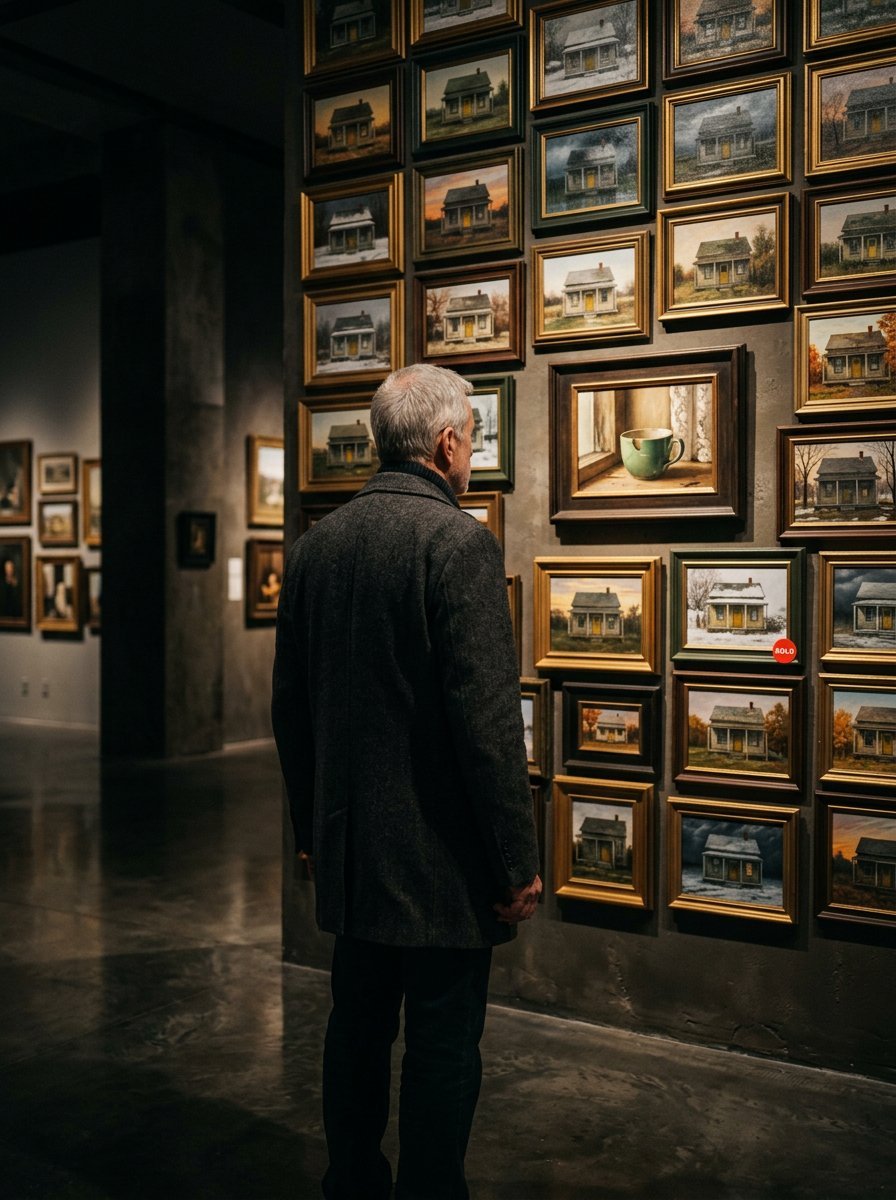
Every painting was the house. The yellow door with the dead bolt that stuck in cold weather unless you lifted the handle while you turned the key. The porch step my wife sat on to pull her boots off. The kitchen window over the sink, with the curtain she sewed herself and never once ironed. The maple that dropped a branch through my truck windshield in 2012. The same house, thirty-one times, in different weather and different light, every one of them painted from the sidewalk, from the driveway, from the street — from outside.
I was looking at my own life through the window of a house I had sold.
One small canvas hung apart, at eye level, where the light fell straight on it. Her green cup on the windowsill, the chip on the handle turned toward the room the way she always left it. The card beside it said, “Her Cup, 2019. Oil on linen. Painted from memory. The artist has said it is the only thing from that house he still thinks about.”
I stood there long enough that a woman behind me said, “Are you all right?” and I heard myself say yes.
The placard at the entrance was typed on cream paper and set in steel.
“Noah Ellison (b. 2000) is a painter based in Chicago. He was born in this county and left it at sixteen. Following the death of his mother in 2016, he spent the winter of his junior year unhoused while finishing high school. He credits his art teacher, Ana Alvarez, with keeping the art room open after hours. This is his largest exhibition to date.”
Unhoused. They had put it on a wall in a nice frame. Two women stood beside me reading the same card, and one of them said, “Can you imagine?” — and I had to put my hand flat against the wall, because I could. Because I had done it. Because the word unhoused on that cream paper was my signature.
Most of the paintings were sold. There was a red dot beside almost every name on the wall.
Then I walked around a partition, and my wife was there.
“Hers, 2017,” the card said. “Oil on linen. Painted from memory.”
It was Claire. Her head turned three-quarters, her mouth on the way to a laugh but not there yet, one hand on the edge of the table the way she stood when she was about to argue with me about something small. I had three photographs of her in a drawer at home. Three. And this boy I had put out of my house at sixteen had painted her face as if he were looking at her.
There was a red dot beside her name too.
“The buyer is a museum in Kansas City,” Ana said behind me. “He did not want to sell it. He did it anyway. He said she would have liked a room with a guard in it.”
“I can’t see her eyes anymore,” I said, and my voice came out wrong. “When I try, I see the photograph from the funeral.”
“He painted it at seventeen. Six times. He scraped the last one down to the linen in the corner — you can see it, right there. He got them right on the seventh.”
I stood in front of my dead wife and let a stranger tell me that an abandoned boy had painted her eyes back into the world.
Ana touched my elbow. “There are thirty-one paintings in this room,” she said. “He sent thirty-two. The last one is in the back. It has never been shown, and it is not for sale.” She looked at me, and her eyes were not kind anymore. “Before I take you to it, you need to know what that winter cost him. And I need to know whether you’re the kind of man who can hear it without making it about himself.”
I looked at my wife’s face on the wall, sold, with a red dot beside it.
“I don’t know,” I said.
“Neither do I,” said Ana Alvarez, and she opened the door to the back.
PART 3
The back room was an office with a radiator that knocked and a desk covered in invoices for canvas and freight. Ana sat behind the desk and did not offer me the other chair, so I stood.
“You know what you did,” she said. “You don’t know what he did with it.”
She told it the way a teacher tells a story she has told before — flat, exact, no drama in the details and no mercy either.
The night he left, he walked two miles to Roosevelt High in the rain. It was the middle of October. The building was locked, but the kiln-room window had never latched, and he knew it because she had shown him herself in the spring, when they were firing late and the room got too hot. He climbed in and slept behind the kiln, on the floor, under a canvas drop cloth.
He was sixteen. He had forty dollars, a phone charger, and a mother who had been dead five weeks.
“He called you,” Ana said.
The radiator knocked.
“It rang four times. He counted. He was out on the football field where the signal was better, and a man answered, and he hung up before you could hear him.”
“I didn’t—”
“I know what you didn’t do,” she said. “That’s the point of this conversation. Sit down.”
I sat down.
He slept in that art room for eleven weeks. He washed in the sink behind the kiln and dried his clothes over the heat of it. He did his homework under the two lamps she left on for the kiln at night. He passed everything. He showed up at eight every morning with wet hair and a clean shirt, and nobody in that building knew, because he made sure nobody knew.
She found him on the morning of November 3rd, before dawn. She came in early to load a bisque fire and the kiln was already running. He had made forty small clay birds overnight and set them on the windowsill to dry. Forty of them, all different, all facing east.
“He said he couldn’t sleep,” Ana said. “He said making things was the only thing that quieted it.”
Eleven weeks. In January, the night custodian reported the kiln running on weekends, and the principal called the boy in with the school counselor. Ana was not in that room. She heard it afterward, from the counselor, who cried in the parking lot.
The counselor asked where he was living. He said the house had sold and his stepfather traveled for work. She asked whether anyone was hurting him. He said no, ma’am. She asked if he needed to be placed somewhere, and he said, “Please don’t make that call.”
“Because your business was growing,” Ana said. “Because he did not want to be the reason it stopped. He told a counselor with a legal pad that you were a good man who had lost his wife. He said that for ten years. He said it to the family that took him in, and to a reporter from the Times this spring, and the reporter cut it, because it did not fit the story.” She took her glasses off. “Do you understand what I am telling you? An abandoned child protected you. Not because he was afraid of you. He was never afraid of you. He protected you because he loved you, and because at sixteen he decided the only way to survive what you did was to keep the man who did it from becoming a monster.”
I could not answer her. I could not even nod.
“That is what he did with what you gave him,” she said.
The door opened behind me.
I turned, and my wife’s son was standing in the doorway with paint under his fingernails.
He was tall. He had her hands — long-fingered, knuckly, the hands of a woman who gardened. He had her way of standing with his weight on one hip and one shoulder against the frame. He was twenty-six years old, and he was looking at me the way you look at a bill you have been expecting.
From the age of six until the night he packed that backpack, that boy had called me Dad. No one had called me that since.
“Hello, sir,” he said.
I said his name. It came out of me in pieces.
He watched me for a long time. Then he said, “You look older.”
“So do you.”
He almost smiled. Almost.
“Don’t apologize yet,” he said. “I have waited ten years. You can wait until you have seen the last one.”
He walked down the hall. I followed him, the way I should have followed him ten years ago.
The last canvas was in a narrow room at the back, leaning against the wall with its face turned in.
“Before I turn it around,” he said, “I need the truth about one thing. The night I left, did you hear me come back?”
PART 4
“Did you hear me come back?”
The gallery had gone quiet the way a place goes quiet after the last guest leaves.
“Yes,” I said.
He nodded slowly — the way his mother used to nod when she had been right about something and was too tired to enjoy it.
“I know,” he said. “I watched the light go out.”
He turned the canvas around.
It was the house at night, from the sidewalk, in the rain. The yellow door. The porch light off. The kitchen window over the sink, lit from inside, and behind the glass a man at the table with his head down and one hand flat on the wood — and in the window, faint as a smudge, the reflection of a boy’s face, hatless, wet, small.
In the corner, in pencil, in a hand I did not know: Nothing — 2:14 a.m.
“I was on the porch at two-fourteen,” he said. “I knocked four times. I could see you through the gap in the curtain. You got up. You stood in the hall. I watched you put your hand on the wall.” He said it evenly, the way he might describe a painting, which I suppose he was. “Then the light went off, and I understood.”
I remembered all of it. I remembered the cold coming off the window glass. I remembered the porch light turning the rain into static. I remembered standing in that hallway with my palm flat against the wallpaper, telling myself he would land on his feet, that boys that age always do, that he had friends, that if he came back inside I would have to look at her hands on him every single day for the rest of my life. I told myself every lie a man tells himself when the truth is that he is tired and afraid and wants to be left alone with his grief.
“What did you do?” I asked. It was the smallest voice I have ever used.
“I sat on the step until five,” he said. “Then it stopped raining, and I walked to school. I climbed in the window and slept behind the kiln.”
“Why did you come back at all?”
He looked at me then, and for the first time all night, he looked sixteen.
“Because she was gone,” he said. “And you were the only other person on earth who knew what her voice sounded like.”
He turned back to the painting.
“I wasn’t coming back for a bed,” he said. “I came to sit in the kitchen and be sad with somebody.”
I have no memory of sitting down. I know that at some point I was on the edge of a packing crate with my hands hanging between my knees, and he did not comfort me. I want to be clear about that. He let me have it.
“This comes down in three weeks,” he said. “Then the paintings go to Chicago, and I go with them, and the house on Alder Street stops existing in my life.” He said it without cruelty. He was telling me a fact about freight. “I promised myself when I was sixteen that I would stop painting it when I understood the night. I understand it now.”
He put his hand flat on the back of the canvas, the way I had put my hand flat on the wall.
“Ten years, and I have never asked anyone this. There is only one person alive who can answer it.” He looked up. “When you said I was nothing to you — was it true?”
The rain had stopped outside. Somewhere in the front room, Ana was turning off lights, one row at a time, and the dark came toward us down the hall.
And I opened my mouth.
PART 5
“It wasn’t true,” I said.
My voice filled the little room and then died in it. Noah did not move.
“It wasn’t true,” I said again. “But it wasn’t a mistake either. I knew exactly what those words would do to you. That is why I chose them.”
The rest of it came out of me the way water comes out of a cracked foundation — all at once, and in no order.
“I was a bad stepfather long before you turned sixteen. I want to say that first, because you have spent ten years protecting my name and I am not going to let you do it anymore. I provided for you. That part is true. I bought your shoes and paid for your schooling and took you to the doctor. I also counted the years until you turned eighteen, because I had convinced myself that a boy who was not mine was a debt I took on the day I married your mother. I was never cruel to you. I was worse than cruel. I was polite for ten years and I kept myself back every single day. When your mother died, you were the last bill. I was a coward with a business to run and a grief I would not look at, and I told you to get out because I wanted the house empty.”
He did not say anything.
“I heard you knock,” I said. “I stood in that hallway with my hand on the wall and I heard you, and I was glad, Noah. Do you understand what I am telling you? I was glad you were on the outside of that door, because it meant I could go back to bed. I have not spent one day in ten years pretending that night was anything other than what it was. I have just never said it out loud.”
Then I told him the rest. The call in October, and how I had said hello twice into breathing and set the phone down without calling back. The three photographs in the drawer. The way I still turned my head at yellow doors.
Noah listened with his arms loose at his sides. When I stopped, the quiet went on so long I could hear the traffic light at Ninth Street changing.
“Thank you,” he said finally.
“For what?”
“For not telling me you loved me.” He shook his head slowly. “That was what I was afraid of. That you would stand here and say you always loved me, and I would have to spend the rest of my life not believing you. What you said, I can hold. I don’t have to burn my hands on it.”
He looked at the painting, then back at me.
“I spent ten years painting that house because I thought if I got it right enough, it would turn into a different night. A door that opened. A man who said come in. There is no different night. The night is the night. I stopped needing it to be your fault. I started needing it to be my life.”
“Can I ask you something?” I said. He waited. “Was it a bad life? After?”
He thought about it. “Both,” he said finally. “I had a teacher who counted me, a room over a garage by February, a studio with north light. And I have not been able to walk past a yellow door without slowing down since I was sixteen. It was a life. It was both, sir.”
He called me sir again, and it did not sound like a punishment anymore. It sounded like a word he was trying out.
“I am not going to tell you it is all right,” he said. “It is not all right. It was never all right. And I am not going to call you Dad tonight, because I don’t lie to people I am trying to know.”
I had taken her cup from my cabinet before I left home that night, wrapped in a dish towel, and I don’t think I knew why until that moment. I took it out and set it on the corner of Ana’s desk.
Noah went still.
“Where did you get that?”
“It was in the cabinet when I sold the house. I packed it without thinking, and I have moved it to four different kitchens. I have never once drunk out of it.” I pushed it toward him. “It is yours. Everything she had is yours before it is mine.”
He picked it up with both hands. It was a plain green cup with a chip the size of a thumbnail on the handle, and he turned it under the desk lamp and ran his thumb over that chip.
“I painted this forty times,” he said. “The chip is the only thing I ever got exactly right.”
He wrapped it carefully in the dish towel and put it in his coat pocket. Then he took a paper napkin from his other pocket — from the diner on Ninth, where he ate breakfast that morning — wrote on it, and handed it to me.
September 14th. Six o’clock. Bring nothing.
“Mom’s day,” he said. “I make dinner. I am not good at it. Bring nothing, because that is not the point of it.”
“Nothing,” I said, and neither of us laughed. It was too close to the bone. But he held my eyes when he said it, and he did not look away.
Then he took a moving blanket off the shelf in the coat closet and wrapped up “Nothing” the way he had wrapped the cup. He carried it out to my truck in the rain and put it in the back seat.
“It was never for sale,” he said. “It was always yours. I just needed you to see it before you owned it.”
He went back inside, and I sat in my truck with the engine off, holding a napkin with a date on it, until Ana turned off the last light in the front room and the gallery went dark.
The show came down on a Sunday in late September. Thirty of the thirty-two paintings went to Chicago on a freight truck. The portrait of my wife went to Kansas City, where she would hang behind glass in a room with a guard. “Nothing” came home with me, and I hung it in my front room, facing out, where I can see it from the kitchen.
He never called me Dad again. Not that September, not any September since. But on the fourteenth, at six o’clock, there are always two cups on his kitchen table, and the green one, chipped on the handle, is always set at my place.
I have never once been late.