PART 1
I married my wealthy seventy-two-year-old boss so my little daughter and I would have a place to live. Five years later he died, and the day after his funeral, his lawyer knocked on my door, smiled at me, and said, “He knew you would fall for it.”
I’m an orphan. I grew up in foster care, and I know exactly what it feels like to be passed from one family to another, to sit in a living room with your bag packed while two adults talk about you in the kitchen, and to be handed back to the group home — like a stray kitten somebody tried and decided against.
That’s where I met my husband. He was an orphan too, and we genuinely, completely fell in love, which nobody had ever given us a reason to expect.
I was a store clerk. He was a mechanic. We married in a courthouse with two witnesses and a $90 ring, rented a decent apartment, and had our daughter, Emily. We were happy. I want to say that plainly, because of everything that comes next. We were happy.
Then he was diagnosed with cancer.
We fought as hard as two people can fight. We tried every treatment the doctors recommended, and then the ones they didn’t. None of it helped. After a year, he died, and I sat in the hospital hallway with a one-year-old asleep against my shoulder and no idea how I was going to carry her home.
I was drowning in grief, buried in medical debt, and alone with a baby.
So I took the first job I could find: housekeeper for a man named Richard, a wealthy widower who lived alone on a large estate at the edge of town. Floors, laundry, meals. He was seventy-two, formal, unfailingly polite, and mostly kept to his study.
But what I made there didn’t cover half of what I owed. Then Emily got sick — a chest infection that wouldn’t let go — and the medication alone was more than I had. That same week, my landlord told me I had one month to be out. I begged him for more time. He refused.
I had nowhere to go. I knew what one month meant: a car with my daughter’s things in the back of it, and no address to give the school.
Richard had always treated me kindly. And one afternoon, standing in the doorway of his study with the laundry basket in my arms, he said something that changed everything.
“Honey, I know I’m much older than you, and you may laugh in my face. But I’ll be honest with you. I’ve fallen in love with you. I don’t want to waste time pretending otherwise. I want to ask you to marry me.”
Suddenly there was a lifeline.
What else was I supposed to do? I had a sick child, a suitcase, and a landlord who had stopped returning my calls. I said yes.
I was thirty-five. He was seventy-two.
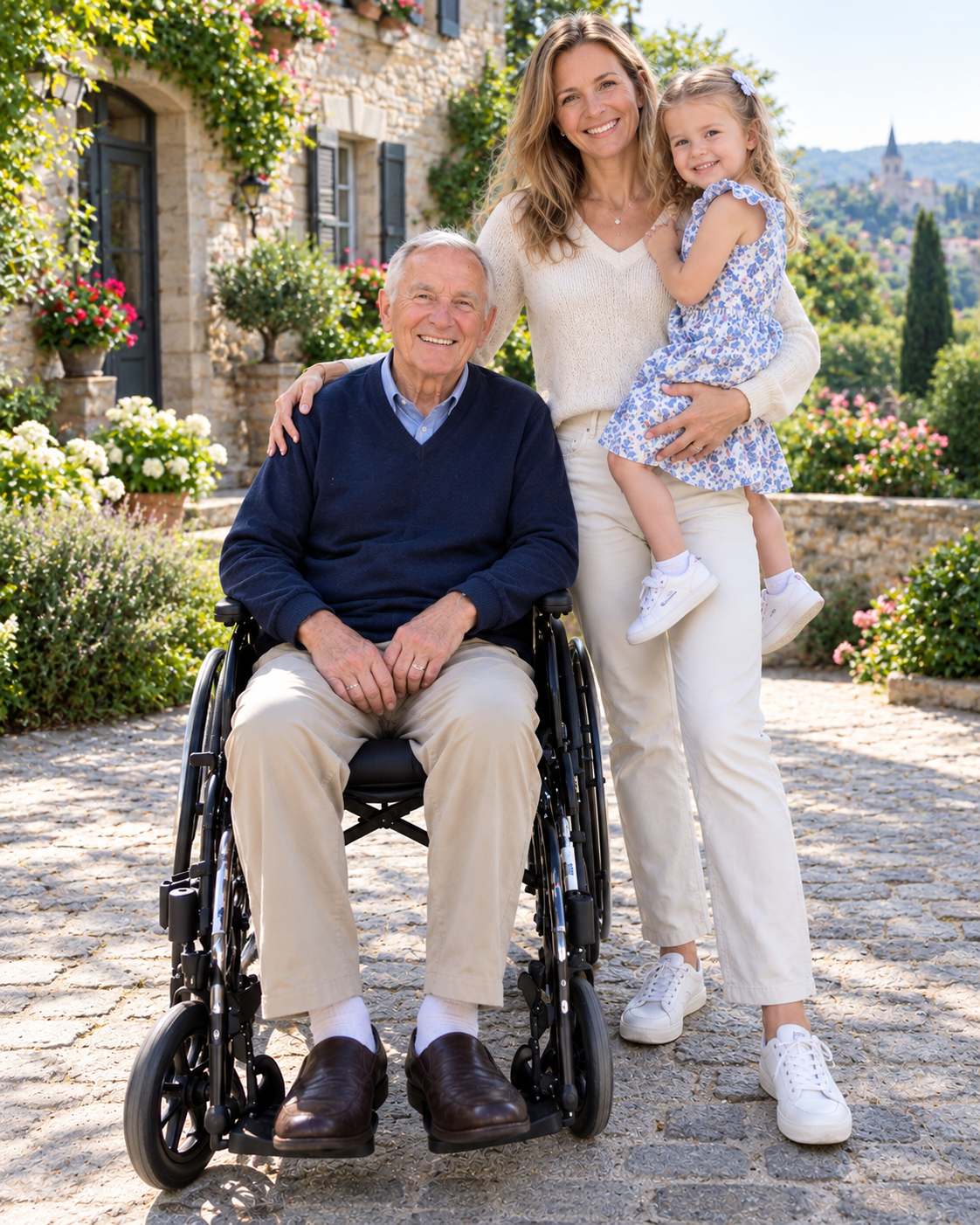
And here is the part nobody believed afterward: it was not a cold arrangement. He taught Emily to play chess on an old wooden board, starting with a pawn and a queen when she was four. He stayed up all night with me when she ran a fever of 104. I made his coffee exactly the way he liked it, one spoon of sugar. And when he could no longer walk and had to use a wheelchair, I took him out along the gravel path in the mornings, and he rode with his hands folded in his lap like a man on a boat.
Five years. That’s what we got.
He died in April, at home, in the bedroom at the end of the hall. I was holding his hand.
I knew he had no relatives. He’d told me so many times — no brothers, no sisters, no children, no one. So when the funeral was over and the last car had left the drive, I sat at the kitchen table and let myself think one thing I had never let myself think while he was alive, which was that Emily and I were going to be safe.
The next morning, his lawyer knocked on the door.
I recognized him. Mr. Graves had come twice in five years, both times shaking his head over papers Richard wouldn’t sign.
He walked in without being invited, with his hat in his hand and a smile on his face I have thought about every day since.
“He knew you’d fall for it,” he said. “He knew you’d fall for all of it, and you’d agree to marry him. But unfortunately, the will leaves you nothing from his estate.”
My voice shook. “Sir — what are you talking about?”
He sighed the way a man sighs when he has to be patient with someone slow, and said the sentence I will hear until the day I die.
“Well, all this time, you never knew who Richard really was. But he did leave you something special. Open this envelope, and you’ll understand everything.”
───────────────────────────────
PART 2
I did not open the envelope in front of Mr. Graves.
I stood in my own kitchen with it in my hands until he understood that he was not going to watch me do it, and after a while he put his hat on, told me he would be in touch about “the arrangements,” and let himself out. I heard his car on the gravel and then nothing at all, just the refrigerator and a dog barking somewhere down the road.
Then I sat down at the table where Richard used to take his coffee and I opened it.
There was no will inside. There was a key — a small brass key on a leather fob, the kind they give you at a bank — and one sheet of paper, folded in thirds, in handwriting I would have known anywhere from five years of grocery lists and birthday cards.
“Claire. Whatever he told you, understand two things first. He was told to say it, and he was paid to say it. Do not sign anything he puts in front of you. Do not sign anything at all until you have read to the end. The key opens box 118 at Merrimack Savings, on Chestnut Street. Take Emily with you. My lawyer’s name is Ruth Ocampo and she is in the book. I am sorry that you had to find out this way — it was the only way I could think of that would keep you safe after I was gone. — R.”
I read it four times. Then I went upstairs and stood in the doorway of Emily’s room and watched her sleep with her arm hanging off the bed, and I made a decision in that doorway that I have never once regretted.
I was done being the one who gets sent back.
We went to the bank the next morning. Emily wore her raincoat and carried a book, and a woman named Mrs. Delaney took us into a small room with a table and brought the long gray box and left us alone with it.
Inside the box were four things.
The first was a letter, dated the day Richard proposed to me.
The second was a second letter, dated seven weeks before he died.
The third was a certified copy of a will and a trust, executed four years earlier, with the seal of the county on it.
And the fourth was a photograph, black and white, curled at the edges, and when I turned it over there was a date on the back in Richard’s handwriting, and three words.
Bellhaven, 1982. Marcus.
I sat in that little bank room with my daughter turning pages in her book and I could not breathe. Because Marcus is my husband’s name. Marcus was my husband.
Seventeen years before he met me, in a children’s home two hundred miles from here, someone had handed a baby to a photographer and written my husband’s name on the back of the picture.
The first letter was two pages long, and it was the first time in five years that Richard ever raised his voice with me, and he did it on paper.
“Dagnosed eleven weeks ago,” he wrote. “Motor neuron disease. Your doctor will confirm the date. I did not ask you to marry me because I was lonely. I asked you because I knew I had between three and five years, and because I knew you would say yes for Emily, and because a man cannot leave his house and his money to a stranger’s child without every lawyer in the state calling it unnatural. But a grandfather can leave his granddaughter anything in the world.”
I stopped reading and put the page down.
He went on.
“I have been looking for my son since 1984. I found his widowed wife working in my own kitchen. I did not choose that — I chose the agency I chose, and I asked them for someone with no family, and they sent me you, and on the day you walked in I already knew your name and your daughter’s name and the year your husband died. If you are angry with me for that, you are entitled to be. I have had five years of the only family I have ever had, and I would do it again tomorrow.”
And then the last paragraph of that letter, in handwriting that had gotten smaller toward the bottom of the page:
“His mother’s name was Lila. She died three weeks after he was born. My mother took one look at him and told me that no son of hers was going to raise a child born out of wedlock in this town, and the home took him at four months old. I looked for him for forty years. I never found him alive. I found his daughter instead. Tell Emily she was wanted before she was born.”
I cried in that little room, quietly, so my daughter wouldn’t look up.
Then I turned to the second letter, the one dated seven weeks before Richard died, and I understood that Richard had known things about the man in his own kitchen that I had never once guessed.
“Claire,” it began. “Now the part I owe you most. Graves has been taking from me since 2007. Twice I caught him, and twice I chose the friendship over the money, because he was my oldest friend and I have no one else in the world who remembers my wife’s voice. This winter I closed it off. Everything I own is in a trust dated four years ago, and none of it passes through him.
When I die, he will try to put another piece of paper on that table, and he will tell you something cruel in my name. Let him. He is going to be very proud of himself. But everything he needs to hang himself with is in this box, and the one thing he cannot survive is being asked questions by a judge.
Judge Whitmore knows me. Tell her about the photograph.”
PART 3
I called Ruth Ocampo from the bank parking lot, and she told me to bring her everything and not to speak to anyone else, and to say nothing to Mr. Graves at all until she told me to.
She was sixty years old, she worked out of a converted house with a law office in the front room and a dog asleep on a rug, and she read the entire contents of box 118 in about forty minutes without once looking up.
When she finished, she took her glasses off.
“Mrs. Vaughn,” she said.
“Claire.”
“Claire. The trust is four years old, it’s funded, it names your daughter as the primary beneficiary, and it names you as trustee. Everything he owned goes into it — the house, the brokerage, the land behind the orchard, all of it. Two point nine million, give or take the market.” She tapped the certified copy. “And the will that goes with it leaves the estate residue to you, and specifically, memorably, reserves the wooden chess set for Emily. He wrote that in himself.”
“So what is Graves holding?”
“I don’t know. But wills don’t get executed in a vacuum. Whatever he has, it was drafted in his own office, which means it was drafted by the person who benefits from it. That’s how these things always look.” She stood up and took a legal pad off a shelf. “Claire, I’m going to ask you something, and I need you to answer me honestly, because everything after this depends on your answer.”
“All right.”
“Are you willing to fight a man who has been a lawyer in this county for thirty-one years, in front of a judge he drinks with, for something that everyone in this town already believes you married your way into?”
I thought about the group home, and the bag by the door, and the two women in the kitchen deciding whether I was worth keeping.
“Yes,” I said. “That’s the whole reason I know how to do this.”
Graves called twice the next week and left cheerful messages about “the transition.” Then he sent a letter by courier that left the house to me for one year, “as a courtesy,” and named himself executor with authority to sell the brokerage immediately.
So we did what lawyers do, and we asked to see the will. And on a Thursday morning, in Graves’s own conference room, with his secretary taking notes and Ruth Ocampo beside me, I read the document that was supposed to be the last thing my husband ever wrote.
It was dated eight months before he died. It revoked all prior wills, including the trust, “in its entirety.” It left the entire estate — the house, the accounts, the orchard, everything — to a charitable entity called the Pembroke Foundation, “in recognition of my lifelong commitment to children in need.”
And in paragraph nine, in the middle of the page, there was one sentence.
“I married late in life in a manner I have come to regret, and I make no provision for that arrangement beyond what the law requires.”
Ruth put her hand on my arm under the table. I kept my face perfectly still, and I did what Richard had told me to do in that first letter.
I let him be proud of himself.
“It leaves you nothing from his estate,” Graves said pleasantly. “Which is exactly what I told you. But given the sentiment, I’d encourage you not to embarrass yourself.” He opened a folder. “Comfortably, though, we’re prepared to discuss the furnishings, the car, and a modest relocation allowance. We’ll also need the house listed by the spring.”
“The signature,” Ruth said.
“Is witnessed and notarized. As you can see.”
“And the notary?”
“Also here, if you’d like to argue with her.”
“And who drafted it?”
Graves smiled. “I did, obviously. Mr. Vaughn was a man of great sentiment and very few words. That’s what his own hand looked like by then, as you may remember.”
I remembered. Richard had been unable to hold a pen for the last eleven months of his life.
We stood up. In the hallway, Graves said one more thing, quietly, only to me, as I passed him.
“You’ll want to think about the arithmetic, Claire. That house, this fight, a judge, two years of lawyers. You have no family and a child to raise. Take the furnishing money, buy a car, and start over. Everyone in this town is going to think you married an old man for his money anyway. What do you have that would convince them otherwise?”
I looked at him for a long moment.
“A photograph,” I said.
I have never in my life seen a man’s face change the way his did in that half-second — because he had no idea what photograph I meant, and because he had looked in that box every year for twenty years, and there was no box. There was only an account in his inventory marked “deceased’s desk — no value.”
That afternoon, Ruth filed my objection to his appointment, my petition to admit the 2021 will and the trust, and a request for a hearing. Then she asked me one more question.
“He wrote that Marcus’s mother died three weeks after the birth, and that Richard’s own mother wouldn’t let him keep the baby.”
“She died in a car accident,” I said. “That’s what the group home told Marcus, anyway. Nobody ever told him his father looked for him.”
“He did more than look,” Ruth said. “Look in the back of the box. Under the letters.”
I looked. There was a folder of investigator’s reports going back forty years — the children’s home, a closed agency, sealed records, three states. Forty years of his own money and somebody else’s paper trail, following a baby who was handed back to the system at fourteen months old.
And stapled to the last report, a photocopy of an index card in a caseworker’s hand.
“Child returned to agency by prospective adoptive family, male child, fourteen months. Reason given: not a good fit.”
PART 4
The hearing was set for the second Tuesday in June, in front of Judge Whitmore, and for six weeks before that, Mr. Graves did everything a man does when he wants the other side to give up.
First came the inventory. The house was listed as an asset of the estate, meaning of the foundation, meaning of him. The brokerage accounts were frozen pending determination, so the money I had been living on — my wages, my husband’s household account, Emily’s school tuition — stopped moving.
Then came the affidavit.
Her name was Mrs. Hoyt and she had been the night aide for fourteen months, which meant she was in that house at two in the morning, three nights a week, when Richard slept. I knew her. She had eaten soup at my table and cried on my shoulder the week her son went to prison.
Her sworn statement said that the deceased had told her, repeatedly, that his marriage was “a business arrangement he had been talked into,” that I had “isolated him from his advisers and his oldest friend,” and that he had appeared “confused about who was signing what.” It said that she had once seen me bring him papers in bed at eleven at night. It ran to four pages. It used the word “exploitation” twice.
I read it standing up in Ruth’s office and then I sat down.
“They paid her,” I said.
“They paid her,” Ruth agreed. “That’s a check, and checks are traceable, and if they were smart they paid her in cash. Heads or tails, we’ll find out.”
Then came the court order. Judge Whitmore granted the foundation’s motion to list the property for sale “pending resolution, to preserve the asset.” Twenty-one days. A realtor’s sign went up at the end of my gravel drive on a Thursday, the same week the county paper ran the story with a headline that read WIDOW OF LATE EXECUTOR’S CLIENT FIGHTS CHARITY FOR CHILDREN.
They didn’t have to say the rest. Everybody in town knew the rest. She married the old man for his money, and now she wants the money, and there’s an orphanage or a children’s fund or whatever on the other side of it, and she’s fighting that.
Emily came home from school that Thursday with her chin up and her eyes red. A boy in her class had told her his mother said my mother married a rich old man and now she’s trying to steal from orphans.
I sat her down at the kitchen table and told her the truth, at seven years old, in words a seven-year-old can hold.
“A man named Richard loved you and he loved me, and he grew up in a children’s home, and his son grew up in one too. His son was your daddy.”
She thought about it for a long time, and then she said, “So Grandpa was Daddy’s daddy.”
“That’s right.”
“So we’re not orphans.”
“No,” I said. “We’re not.”
That night I sat in the dark in Richard’s study and looked at the sign on the fence with the reflection of a sheriff’s cruiser going by on the county road, and I did what I had told Ruth I would never do. I opened the offer.
Graves had couriered it that afternoon. Two pages, on his letterhead, “without prejudice,” which Ruth told me later is what lawyers write when they want to be embarrassing without being liable.
Eight hundred thousand dollars. Cash. Clear title to the car. A trust for Emily’s college. And in exchange, one statement, signed and notarized, in which I would confirm that my marriage to Richard Vaughn was “entered into for reasons of financial security,” that at no time did I “provide the companionship and care of a spouse,” and that I had no claim on the estate.
Nine hundred thousand dollars to call my own marriage a lie, in writing, in a courthouse, for the rest of my life, while Emily’s name sat on the same page.
I read it twice. Then I called Ruth at nine o’clock at night and read it to her over the phone.
“Don’t answer it,” she said. “Not for a week. Let him sweat.”
“No,” I said. “I want to answer it tonight.”
“Claire—”
“One sentence, Ruth. Come to court.”
The hearing was set for Thursday morning, and on Wednesday night, at twenty past nine, a car I didn’t know pulled into my gravel drive and stopped short of the porch light.
I stood behind the door with my hand on the lock and Emily asleep upstairs, and I watched an old woman get out slowly, holding the car door with both hands. She was in her late seventies. She was wearing a raincoat buttoned wrong, and she carried a purse and a folder, and she walked up my steps like a person who had been rehearsing it.
I opened the door before she knocked.
She looked up at me with eyes that were full and steady.
“You don’t know me,” she said. “My name is Eleanor Frost. In 1982, I was thirty-four years old, and I took a baby home from the Bellhaven Children’s Home and called him my son for fourteen months. Then I gave him back.”
The porch light hummed. Somewhere far off a dog was barking.
“Four weeks before he died, Richard mailed me a letter and a key,” she said, and lifted the little brass key out of her palm so I could see it — the twin of the one in my hand. “He wrote one instruction on the card. ‘If the lawyer comes to her with a paper, bring what you kept.'”
She held out the folder.
“I kept everything, dear. Forty years of his letters. And there’s a second box at that bank, number one twenty-one, that belongs to you in a way I can’t do by myself.”
I stood in my own doorway and looked at the woman who had returned my husband’s father’s son to the system, and I understood that Richard had known all along that the thing he could not fix in his lifetime would arrive on my porch the night before the last hearing, carrying everything I needed.
She stayed until almost midnight. And when she left, I did not sleep. I sat at the kitchen table with her folder open in front of me — with Richard’s handwriting in it going back decades, with the ledger, with the names and dates and check numbers, with a letter written in 2007 that started “El, I caught him again today” — and I waited for the sun to come up over the orchard.
At six o’clock, Ruth called. “Are you ready?”
“Yes,” I said. “Bring a box of paper to court. We’re going to need a bigger table.”
PART 5
Judge Whitmore read the objection, looked at both lawyers over the top of her glasses, and said, “Ms. Ocampo, you asked for this morning. Don’t waste it.”
Ruth stood up. “Your Honor, before we reach the will contest, the petitioner asks that two exhibits be accepted into the record,” she said. “Both were delivered to my client last night, and both are time-stamped, witnessed, and sealed.”
Graves was already on his feet objecting. The judge told him to sit down.
Exhibit A was a small steel box, opened that morning in the bank at eight o’clock with Ruth present, myself present, and Eleanor Frost holding a brass key. Judge Whitmore’s clerk broke the seal in open court.
The bank officer read the contents into the record: a notarized statement, a physician’s certification of capacity, a ledger, and a disc.
Exhibit B was the disc.
The court’s technician played it on the courtroom screen, and there, in front of everyone, in a study that I had cleaned for five years, my husband appeared.
He was in his wheelchair. He had a blanket over his knees. Behind him, at the edge of the frame, sat Dr. Samuel Crane, who had been his physician for nineteen years and who was in the gallery that morning, and beside him stood a notary public named Jean Bauer, whose commission seal is on the first page of the exhibit.
“I, Richard Alan Vaughn, being of sound mind, record this on the fourteenth of February, five weeks before my death.”
His voice was slow and the disease had already gotten into it. He paused between sentences. No one in that room breathed.
“I am making this record because I know exactly what is going to happen when I am gone. My attorney of record, Mr. Charles Graves, has taken money from me three times that I can prove, in 2007, 2014, and 2016, and I have chosen not to prosecute him for reasons that have to do with friendship and with my own cowardice. I am not proud of that. I am simply finishing what I should have finished.”
In the gallery, Mrs. Hoyt put both hands over her mouth.
“If any document appears after my death bearing my signature, promising my estate to a charitable body, you are to ask three questions. Who drafted it. Who witnessed it. And who is its registered agent. I revoke nothing. My trust of four years’ standing is my final word. Everything I have goes where I put it, and it goes where I put it because of her.”
Then he looked directly into the camera, and I put my hand over my mouth because it felt like he could see me.
“There is one sentence that will be attributed to me. It will say I regretted my marriage. I want that sentence on the record in my own voice, in my own words, and here it is. I never regretted a single day of it.”
The screen went dark. The room was silent for about four seconds. Then Ruth said, “Your Honor, I’d like to call Mrs. Hoyt.”
Mrs. Hoyt was on the stand for eleven minutes when she broke.
She had been paid ten thousand dollars, five thousand in October and five thousand in November, out of the operating account of Graves & Pell, marked “witness preparation.” Ruth had subpoenaed the bank records and had them printed with the highlighted dates. When Judge Whitmore asked Mrs. Hoyt if the words in the affidavit were hers, she said they were not; that Mr. Graves’s associate had written it and she had read it for the first time when she signed it; and that she had taken the money because her son was in a state facility and she had no one to ask for help.
She was crying by the end. “That house was the first place anybody was ever kind to me,” she said. “I’m sorry, Claire.”
Then the notary on the forged will. She was twenty-six and she had stamped a document she never saw signed, because her mother worked the front desk at Graves & Pell and had asked her to do a favor.
Then Eleanor Frost.
She walked to the witness box in her raincoat and the same brown folder, and Judge Whitmore, who had been listening with her hands folded, sat forward when Ruth gave the witness’s name.
“Mrs. Frost,” the judge said slowly. “I knew Richard Vaughn for thirty years. He told me once that he had lost a son before he ever had one. Are you telling this court that you know what he meant?”
And Eleanor Frost told the courtroom about a baby at Bellhaven Children’s Home in 1982, and a fourteen-month-old who was handed back to an agency because he was, according to a caseworker’s index card, not a good fit.
“I was the one who handed him back,” she said. “I have carried that every day of my life. And Mr. Vaughn wrote to me for forty years without one word of blame, and I saved every letter because I didn’t deserve them.”
Ruth had the index card entered into evidence, and the 1982 photograph with Marcus written on the back, and the ledger from box 121 — eighteen years of dates, amounts, and initials, kept in a stroke-free hand by a man who knew he was going to lose the ability to write.
Judge Whitmore took eleven minutes to rule.
The Pembroke Foundation was not a charity; it was a shell whose only registered agent was the attorney who drafted the will that funded it. The purported will was found to have been executed by a signature that did not match the testator’s, notarized without the testator present, and witnessed by persons selected by the sole beneficiary. It was declared void. The trust of four years’ standing was admitted, confirmed, and ordered funded immediately from every account in the estate.
Mr. Graves’s appointment was denied. The court ordered a full accounting of his eighteen years as attorney of record for the estate and, on the spot, referred the matter to the county district attorney and to the state bar. The clerk of the court was instructed to compile a list of every estate he had handled since 2005.
“Sir,” the judge said to him at the end, in a voice I can still hear when the room gets quiet. “You told my client that her husband had expected her to fall for it. I disagree. I think he expected you to.”
They took his license in September. They indicted him in January. There were, in the end, five other estates.
I kept the house. Emily kept the chess set, by name, exactly as her grandfather wrote it. And the charitable side of his trust — the part he built for kids who age out with their whole lives in a duffel bag — went on being what it had always been, except that I renamed it, because Richard never put a name on it and somebody ought to.
The Marcus Vaughn Fund.
The last letter was in box 121, dated a week before he died, and it is short, and I have read it enough times to know it by heart.
“Claire. If you are reading this, then El found you and the last of it is over. One favor. Keep the board. Teach her the middle game — she will be better than I ever was. And when she asks about her grandfather, tell her the truth: that he gave away a son and spent forty years learning how that felt. Tell her nothing else matters. You are the first thing in my life I was ever allowed to keep.”
Emily is eight now. She plays a bad, brilliant game of chess on her grandfather’s board, and when she goes to bed she leaves the white queen standing in the middle of it, the way he always did.
She has a house behind her, a name in the ledger, and a grandfather who looked for her for forty years before she was born.
Nobody is ever going to send her back.