PART 1
My son Grant has always been the calm one. He avoids arguments the way other people avoid the flu — quietly, sensibly, at no visible cost to himself. Vanessa was the opposite: outspoken, certain, the kind of woman who finishes your sentence and is usually right. I thought that was why they worked. She pushed him out of his comfort zone, he softened her rough edges, and across my table they looked like two people who balanced.
A week before the wedding, Vanessa called me.
“Joan, could you please not wear blue to the wedding?”
I had already bought my dress. Navy, with a lace collar — the first thing I had bought for myself since Ray died four years ago.
“Why? Is something wrong with it?”
“No, no. It’s beautiful. Blue is just part of the wedding palette, and I don’t want it to look strange in the photos.”
I didn’t want to make a big deal out of a dress. So the next morning I drove forty minutes to the mall and bought a deep green dress I didn’t love, and told myself that was the end of it.
Then I arrived at the wedding.
The moment I walked into that room, I stopped dead.
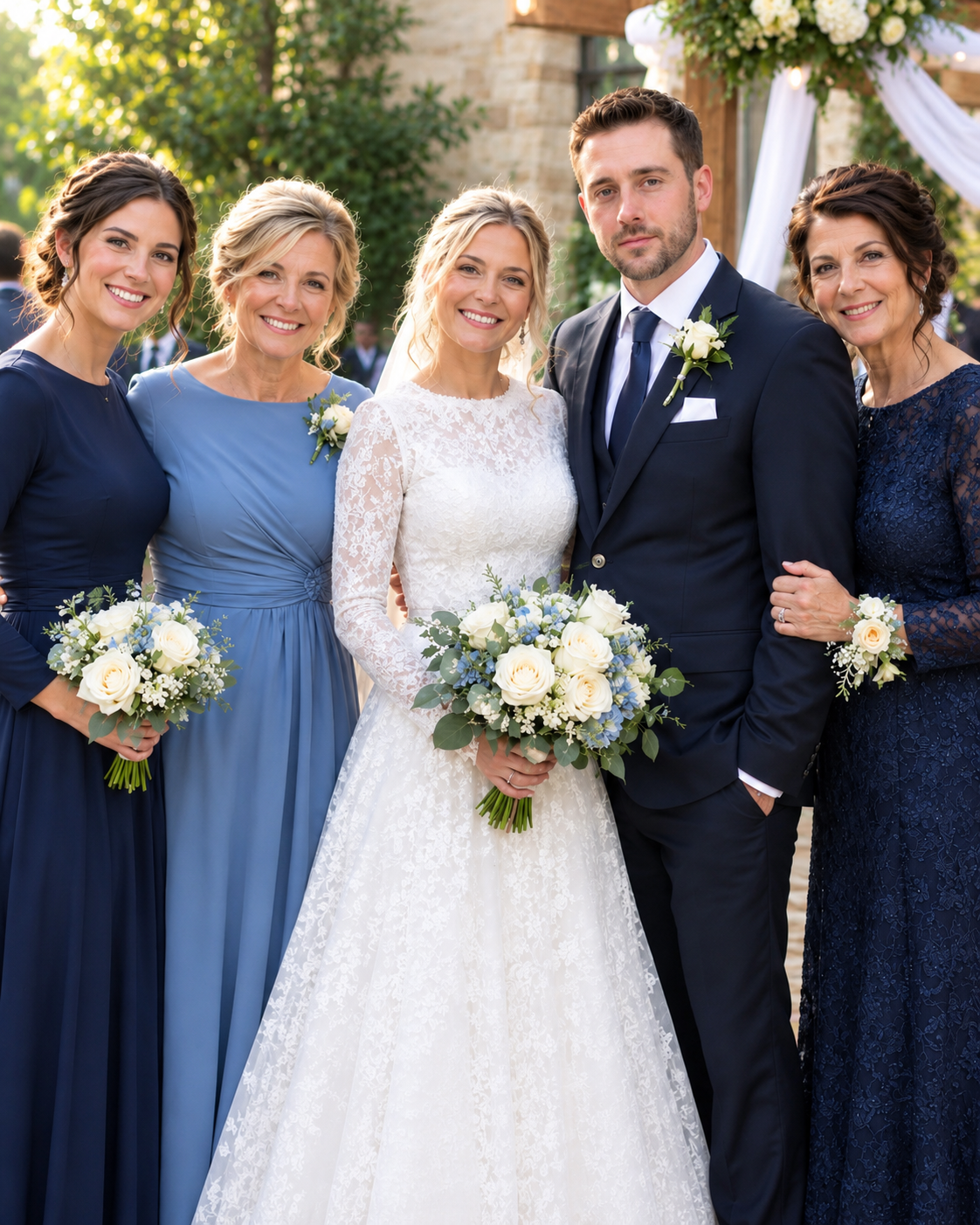
Vanessa’s mother was wearing blue.
For one second I honestly thought I was seeing things. A floor-length blue gown, silk, a corsage pinned to her shoulder — walking through that room like a woman who owned the walls.
I had spent money I did not have on a dress I did not want, because my son’s fiancée had asked me not to wear that color. And there was her mother, in blue, greeting guests.
Then I looked around.
Two of Vanessa’s aunts, in blue. A cousin, in blue. Matching little corsages on every one of them, the same ones pinned to the women standing by the gift table.
They all had matching corsages.
I found Vanessa before the ceremony, in the little room where they keep the bride.
“You told me no one was supposed to wear blue.”
She shifted uncomfortably and looked at my shoulder instead of my face.
“Not exactly.”
“Then why did you tell me not to?”
Before she could answer, her mother stepped closer.
“Blue is for family,” Cynthia said.
I stared at her. “I’m the groom’s mother.”
She gave me a tight little smile. That was all.
I turned to my son.
“Grant?”
He wouldn’t meet my eyes.
“Mom. Please. Not now.”
Fine. I was not going to start a fight on my son’s wedding day. I have been a mother for thirty-six years; I know how to swallow a thing.
But I started noticing things I hadn’t noticed before.
When Grant asked the photographer for one picture with just the two of us, Vanessa shook her head before he could lift the camera.
“We don’t have time for that.”
Grant glanced at me. “Maybe just one—”
“Grant. We have a schedule.”
He went quiet.
At dinner, Grant started telling his uncle about their honeymoon.
“No, honey,” Vanessa said. “That’s not what we’re doing anymore. Remember?”
A few people laughed. Grant laughed too. I watched his neck go red.
Later, I pulled him aside by the doors that led out to the terrace.
“What is going on?”
“Nothing.”
“Forget the blue dress. I’m talking about you.”
“Mom—”
“I have watched her shut you down all day and you haven’t said one word.”
“She’s stressed. It’s our wedding day.”
“Grant. Look at me.”
He finally did.
“Are you actually happy?”
For one second he looked like a man who wanted to hand me something. Then Vanessa appeared behind him.
“There you are! Grant, seriously? I’ve been looking everywhere. We have a schedule.” Then she looked at me and laughed. “And Joan, could you please stop stealing my groom?”
A couple of people nearby laughed with her.
Grant didn’t. He followed her back inside without another word.
I stood there for a moment, furious.
Part of me wanted to take my son by the arm, walk him out to that parking lot, and make him say out loud what his face had just told me. But this was his wedding, and two hundred people were behind that glass, judging every second I stood there.
So I went back to my table and kept my mouth shut.
For the next twenty minutes, I watched Vanessa laugh with her family like nothing had happened. Grant barely said a word. He looked at me twice, and both times he looked away first.
Then I heard the sharp clink of a spoon against a champagne glass.
I looked up.
Grant was standing.
My heart skipped a beat. Vanessa looked up at him, clearly surprised.
“I’d like to make a toast,” my son said.
Then he looked directly at me.
And that was when I saw it.
Grant was furious. His tie was loosened, his face was red, and he gripped that champagne glass so hard I thought it might crack. I had never seen my calm, quiet son look like that in his life.
And suddenly I knew exactly what was about to happen.
I shot to my feet.
“No!”
───────────────────────────────
PART 2
My son looked at me across two hundred people and said, “Sit down, Mom. Please. This won’t take long.”
I sat.
He didn’t tap the glass again. He just waited, and the room went quiet on its own — because Grant Keller is not a man who stands up at parties. That was how I knew it wasn’t a toast. It was a decision.
“I want to thank everybody for coming,” he said. “Especially Cynthia and Douglas, who planned this evening down to the minute, and my wife, who is the most organized person I have ever met.”
Polite laughter moved around the room and died at the edges.
“A week ago, Vanessa called my mother and asked her not to wear blue. My mother has never made trouble for anyone in her life. She bought a new dress. She picked a color she didn’t even like, and she wore it tonight, and she never said one word to me about it.”
He stopped and looked at the head table.
“Tonight, Cynthia explained it to her. Blue is for family. That’s the rule in this room. I have spent three hours watching that rule land on my mother’s shoulders, and I’m not going to let it happen quietly.”
He lifted his glass.
“To my mother, Joan Keller. Everything I know about showing up for people, I learned from watching you when nobody was watching you.”
Then he set his glass down without drinking from it.
“Vanessa,” he said. “I want the papers.”
The music kept playing for one more second, and then it stopped. Cynthia Hale’s face didn’t do anything you could call shock — it did something more careful than that. Douglas Hale’s chair scraped back on the marble like a shot. Vanessa said, “What?” and Grant said, “You heard me,” and walked out of the room.
I followed him.
I found the two of them in the vestibule, between the coat check and the doors.
“What is wrong with you?” Vanessa was hissing, both hands on his lapels. “In front of my family? Tonight?”
“Which papers, Vanessa? The ones I signed Tuesday?”
I said, “What papers?”
Grant looked at me, and something in his face had gone quiet and certain in a way I had not seen since his father died.
“The prenuptial agreement,” he said. “Your father’s office. Tuesday afternoon. Three days before my wedding.” He turned back to her. “I didn’t have a lawyer. I was told everybody in your family signs one, that it was a formality, that if I loved you I wouldn’t make it into a thing.”
“It was a formality.”
“Then get me a copy.”
“It’s in the safe at the house. You’re being—”
“The deed has one name on it, Vanessa, and it isn’t mine.” His voice was steady. “For fourteen months I have been told it would be handled after the wedding. Well. We just had the wedding.”
“Mom,” Grant said. “Say the number.”
“One hundred and eighty-five thousand dollars,” I said.
Cynthia had come out into the vestibule behind them, and she stopped when I said it, and I understood then that she knew exactly what the number was.
“That was every dollar Ray left him,” I said. “Life insurance, and the sale of the machine shop, and the tools his father taught him on. Fourteen months ago that money went into the house on Marlow Street, and I have the wire confirmation at home, because I was the executor of my husband’s estate and I keep every piece of paper I have ever signed my name to.”
Vanessa’s chin came up. “That money was a gift to the marriage. You said so yourself. When you signed.”
“I said it because your father put his finger on the line and told me where to put my name,” Grant said.
“Don’t.” Her voice cracked, and something behind her eyes went hard. “My parents will eat you alive, Grant. You have no idea.”
“Grant.” Cynthia’s voice could have cooled a drink. “Let me say one thing to you, and then you can go home and be angry in the morning. You signed a paper you didn’t read. That is not a crime. That’s a Tuesday. And nobody in that room is going to remember one word you said tonight.”
“Then I’ll say the rest of it where it counts.”
He took my arm. And when we got out to the parking lot, my son took his jacket off, sat on the tailgate of his truck in his tuxedo, and put his face in his hands for a long minute. Then he said, “There’s something else, and then I’ll take you home.”
He pulled a folded page out of his inside pocket. It was worn soft at the corners, the way a piece of paper gets when a man has folded it and unfolded it a hundred times.
It was an email from Cynthia Hale to her daughter.
“Subject: After the wedding,” Grant read out loud, in the dark, over the sound of two hundred people dancing twenty feet away. “‘One thing I want handled now that the ink is dry on the papers. Your mother-in-law’s visits. Twice a year is generous. She has her own life. Make sure she lives it. Don’t let Grant turn this into a fight — you’re better at this than he is.'”
He folded it back up.
“I printed it off two weeks ago. Our printer, our paper, our house — she left it in the tray. I read it, I folded it, and then I went to work and pretended I hadn’t.”
I could not say anything at all.
“It’s dated ten days before the wedding,” my son said. “Three days before she called you about a dress.”
PART 3
Monday morning at eight forty, I sat in Paul Reyes’s office with my son, wearing the navy dress.
Paul had done my husband’s estate four years earlier, and he had known Ray since they were both young men. He read the prenuptial agreement twice without saying a word, and then he set it down and took his glasses off.
“Signed at the Hale family attorney’s office,” he said. “Three days before the ceremony. No lawyer of your own. No financial disclosure attached. You never received a copy, and you didn’t read anything but the signature page.”
“That’s right.”
“And the wire for the down payment was from the estate of Raymond Keller to Grant Keller, dated fourteen months ago.”
“I banked at First Republic for thirty-one years,” I said. “I have every statement.”
Paul nodded slowly. “Good. You’re going to need them.” He turned to Grant. “Now tell me what you actually want. Because I can tell you what’s true, and the truth is that you have some leverage, and I want to know what you plan to do with it.”
Grant sat with his hands on his knees for a moment.
“I want my name on the deed by Friday,” he said. “Or I want the money back. Or I want the whole thing undone, and I’ll go on with my life.”
“All three at once is a lawyer’s dream,” Paul said. “Pick one and mean it.”
“Then I mean the first one, and I’ll take the third if I have to.”
On Wednesday, we met in a conference room at Ashby & Lowe, the Hales’ lawyers. Cynthia and Douglas were already seated when we came in, and Vanessa sat beside them with her hands folded like a woman at a recital. There was a paralegal, a pitcher of water, and a folder with my son’s life in it.
Mr. Ashby started with the standard speech. Everyone was emotional. Both families wanted what was best. Reasonable people could resolve reasonable differences.
Paul let him finish. Then he said, “We’d like the terms read into the room. Out loud. All of it.”
And I watched my son read his own marriage contract off the page.
“Paragraph four. Each party waives any claim to the premarital assets of the other.” His voice was flat, and it never shook. “Paragraph seven. The residence at 405 Marlow Street is the sole and separate property of Vanessa Hale. Paragraph eleven, entitled ‘Acknowledgments.’ The parties acknowledge that any contribution to the purchase of the residence was made as an unconditional gift to the marriage.”
He looked up.
“I put one hundred and eighty-five thousand dollars into that house. My name was never on the deed, my name is not on the deed today, and the value of that house has gone up sixty-one thousand dollars since we bought it.”
“Grant—” Douglas Hale started.
“There’s one more line,” Grant said. “It’s on the last page. My father’s name isn’t in it. It says ‘unconditional gift to the marriage,’ and my mother is going to put on this table the paper that shows where every dollar of that gift came from.”
I slid the statements across the table. Three pages, tabbed, page one on top, exactly the way I had kept the books in the school office for nineteen years.
Paul said, “The wire originated from the estate of Raymond Keller. Mr. Hale, shall we keep going, or would you like to discuss the deed?”
Ashby wanted to talk about the deed. Ashby wanted very much to talk about the deed.
So then Cynthia did something I did not expect. She laid one hand flat on the table, and she said, “Douglas. Give them the number they want, and let’s all go home and forget this.”
I understood in that moment that she would have paid the money in one minute. What she could not do was let a wedding end in a hallway in front of two hundred guests.
“No,” Vanessa said. Quiet, and hard. “He doesn’t get to stand up at my wedding, humiliate my family, and leave me with a check. What he gets is what he signed.”
And I looked at my son’s wife, who was thirty-two years old and had already decided that the whole day was hers, and I felt sorry for her in a way she would never once believe.
Grant stood up. “Three things,” he said. “My name on the deed by Friday. Or the money in my account by Friday. Or annulment papers.” He picked up his jacket. “And Vanessa, if you have to think about it, I’ll know exactly what I’ve been married to for two days.”
We walked out. And in the elevator, as it went down those six floors, Cynthia Hale’s voice carried through the closing doors, calm as a woman asking for the check.
“Douglas. Call Whitcomb.”
PART 4
They didn’t wait until Friday.
Thursday morning, Grant was called into a small room at Hale Properties with a woman from human resources and a folder he wasn’t allowed to take with him. Six years of work. Project manager. Forty-seven minutes from the phone call to the moment security walked him to his truck with his hard hat in a box. Position eliminated. Restructuring. Nothing personal.
He called me from the parking lot, and I heard him laugh, which I understood later was the only thing he could do.
“I worked for them for six years,” he said. “I met her at their Christmas party.”
On Friday, the letter came by courier. Whitcomb & Ryle. It demanded that Grant vacate the residence at 405 Marlow Street within seven days, advised him that he was not an owner but a licensee, and informed him that any attempt to remove fixtures, furnishings, or appliances would be treated as theft. It closed with a sentence about “the generosity of our client in permitting this transition.”
On Saturday, Vanessa came to my house.
She stood on my porch with a cardboard box — Grant’s boots, his fishing gear, two shirts — and under her arm, a gift bag with a bottle of wine in it, which I never did understand.
“He has to sign one paper,” she said. “One. It says the down payment was a gift, and the deed stays as it is. My father will put him back on the payroll Monday, and everything goes back to normal. He can be angry with me for a year if he wants.”
I did not invite her in, and I did not take the bag.
“Vanessa,” I said, “why blue?”
Her face flickered.
“What?”
“Your mother said blue is for family. Why did you make that call to me? You didn’t have to give me a reason at all.”
She looked past me into the house, where her husband was sleeping in my guest room after two days of driving around with his résumé in the passenger seat.
“Because she told me to,” she said. Then, quietly, and it was the truest thing she ever said to me: “I loved him first.”
“No, honey,” I said. “I did. That was never the problem.”
She left the box on the porch. She took the wine with her.
I thought the letter on Monday was going to be about the house. It was certified, from Whitcomb & Ryle, and it was two pages, and I opened it in the kitchen with my coffee still hot.
HALE V. KELLER. It was a complaint for damages of one hundred and forty-eight thousand dollars — the full cost of the wedding, the flowers, the band, the bar, the rehearsal dinner, the brunch — on the grounds that Grant had held himself out as a host of the event and had failed to pay for it.
And on the second page was a copy of the venue contract from April.
I know my own handwriting when I see it. It was on the bottom line, in blue ink, in the neat little script I have used on grocery lists and report cards for fifty years.
Guarantor: Joan Keller.
I had signed it in a country club office in April because my son called and asked me to, and because a woman with a clipboard told me it was a formality, and because I did not want to be the reason my son’s wedding didn’t happen.
Thirty days, the letter said. One hundred and forty-eight thousand dollars. And if it wasn’t paid, they would come for what I had signed against.
My house on Elm Street. Thirty-nine years. The porch Ray rebuilt the summer he retired.
Outside, my son’s truck was in the driveway, and he was asleep in my guest room, and neither of us knew yet that the bill for his wedding had arrived with my name written on the bottom of it.
PART 5
Paul Reyes was on the phone with me by nine and in the courthouse by Wednesday.
I sat in his office while he built the case out of my file boxes, and I understood for the first time in my life why Ray used to say I was the most stubborn person he ever met, and that he meant it as a compliment.
The prenuptial agreement was executed seventy-two hours before the ceremony, in the office of the opposing family’s attorney, by a man with no counsel of his own, with no financial disclosure attached, and no copy provided. Paul called it procedural unconscionability, which is lawyer language for a paper that a judge is going to look at very hard. Then he attached my wire statements to it, and he attached the venue’s own paperwork, which listed the hosts of the April event as Douglas and Cynthia Hale, and the seating chart, which put the groom’s mother at table nineteen behind a pillar.
Then he looked up at me and said, “Mrs. Keller, you signed a guaranty. That’s real. The question is what they told you when you signed it.”
“They told me it was a formality,” I said. “They told me the balance was Mr. Hale’s to pay and that a second signature was how the club kept its books. They told me I wouldn’t be on the hook for a dollar.”
“And the wedding was a gift from the parents of the bride to the newlyweds.”
“The invitation said ‘Cynthia and Douglas Hale request the pleasure of your company,'” I said. “I have it. I keep everything.”
Mediation was in a room at the county building with a mediator named Mr. Tolliver and a table that was too small for what we brought into it. The Hales’ offer came out of Whitcomb’s mouth in one breath: they would drop the damages claim, and they would return the one hundred and eighty-five thousand dollars, and we would sign papers ending the marriage quietly.
“And these,” Paul said, sliding over three more pages.
Mr. Whitcomb read them and his mouth got small. A mutual nondisclosure agreement. A statement that no party had done anything improper. A clause about “the mother of the respondent” and her “unfounded allegations regarding a private communication.”
I looked at Cynthia Hale — perfect suit, perfect hands, three generations of silver on her wrist — and I said the first thing I had said directly to her since the vestibule.
“You were right, Cynthia,” I said. “Blue is for family. My son chose his.”
She did not answer me. She never did again.
Grant signed the annulment in June, and he did not sign the rest of it. He told Whitcomb, in that little mediation room, that he would say whatever a court asked him to say and nothing that was not true.
“I’ll sign that the marriage didn’t happen,” he said. “I won’t sign that you didn’t do this. Keep your money if that’s the trade.”
Whitcomb looked at Douglas Hale. Douglas Hale looked at his watch. They took the trade, and they paid every dollar, and in July the house on Marlow Street sold for four hundred and thirty thousand dollars, and my son’s share came back to him in a wire — the same amount that had left his account fourteen months earlier, returned on a Tuesday morning with a bank confirmation that said nothing about anybody’s wedding.
Grant moved home for five months, which is another way of saying he slept in my guest room and fixed every hinge in my house. He started his own renovation company in August with two men, a truck, and the sign he’d had made for the side of it. He is thirty-eight now. His forearms look like his father’s.
And the claim against me? It went away in September, quietly, the way those things do when the other side realizes that a courthouse has a public hallway. Nobody apologized. I did not need them to. I still have the invitation: “Cynthia and Douglas Hale request the pleasure of your company.” I keep it in the file, and the file has a label on it, in my handwriting, because I keep everything.
Vanessa came to my door once more, in the fall. No box, no wine, no mother in the car. She had cut her hair and looked like somebody who had been crying in a vehicle.
“I know you don’t want an apology from me,” she said. “So I’m not going to make one of those. I just want you to know one thing. When I said it was her idea — the dress — that was true. Every single fight we ever had, she was standing behind me with her hand on my back.” She looked down at her boots. “It was never about the color.”
“No,” I said. “It was about who got to decide the color. And now you know what that costs.”
She nodded, and she left, and I made myself a cup of tea.
Last spring my son bought a house on Vine Street with a big ragged yard and a porch that needs him, and in April he had people over for the first cookout of the year — his crew, their wives, two neighbors, and me, in my navy dress. He asked the neighbor with the good camera to take one picture of him and his mother, and then he put his arm around my shoulders the way Ray used to do.
“One picture with my mom,” he said. That was all. No mention of schedules, no mention of palettes, no mention of family that has to be earned by standing at a door being told no.
We have eleven of those photographs now, on the wall going up my stairs — one a spring, one a Thanksgiving, one the day his contractor’s license came in the mail. I am wearing the navy dress in every single one of them.
He asks for one every time. He has never once needed a schedule.
Neither have I.