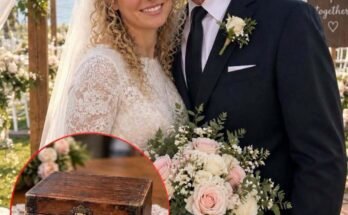
I came home from work and froze when I saw my wife standing outside our own front gate, clutching a small grocery bag as if she had nowhere else to go. “Your son told me this house belongs to him now,” she whispered. “He ordered me to get out.” My blood ran cold. I took the bag from her hands, walked her back inside, and said, “Then tonight, he’s going to find out who truly owns this family.” What I did next changed everything.
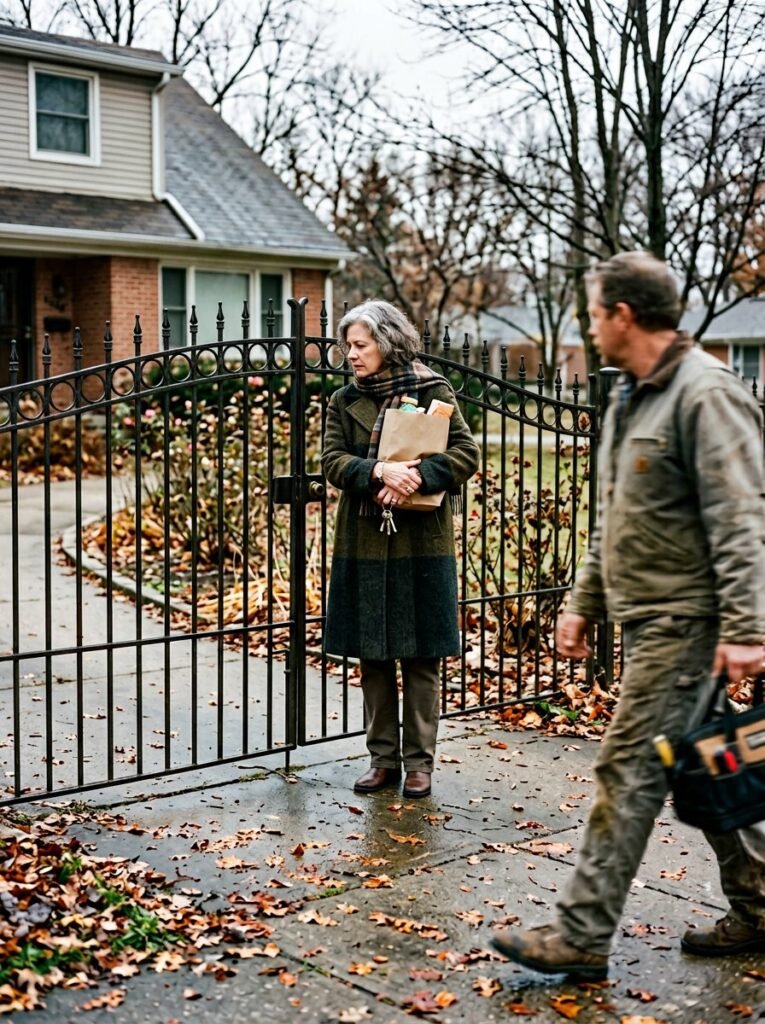
I came home from work and saw my wife standing outside our own gate with a grocery bag clutched in her hand.
At first, I assumed she was waiting for me. Linda had always enjoyed standing beside the front garden in the evenings, especially when the roses were in bloom. But that afternoon, she was not admiring the flowers. She was staring at the locked gate as though someone had decided she no longer had the right to be on the other side.
I parked my truck, climbed out, and asked, “Linda? Why are you standing out here?”
She turned to face me, and then I saw her expression.
My wife of thirty-eight years looked completely humiliated.
In her right hand, she carried a little paper bag containing bread, milk, and a bottle of her heart medicine. Her purse hung from her shoulder, while her house keys were tightly gripped in her fist.
“Tom,” she said softly, “Ethan changed the code.”
My chest tightened. “He did what?”
She swallowed with difficulty. “He said the house belongs to him now. He told me I needed to leave before you came home because I’ve been ‘living off his future’ for long enough.”
For one moment, I could not breathe.
Ethan was our only child. Thirty-two years old. Married to a woman named Ashley, who had never once volunteered to wash a single dish in this house, yet constantly discussed what “we” should remodel after Linda and I were gone.
I walked over to the keypad and entered the old code.
Access denied.
I entered it once more.
Denied again.
Tears gathered in Linda’s eyes. “He told me not to cause a scene.”
I carefully took the grocery bag from her hand, then reached out to her.
“Come with me.”
She looked frightened. “Tom, please don’t fight with him.”
“I’m not going to fight him,” I replied. “I’m going to remind him.”
We went around to the side entrance beside the garage. Ethan had overlooked one important detail: I had built this house years before smart locks and security applications ever existed. I opened the old manual lock using the spare key I kept hidden inside my work boot in the shed.
When we stepped inside, Ethan was standing in my kitchen with Ashley, measuring one of the walls as though the entire place already belonged to them.
His face filled with shock when he noticed us.
“Dad,” he said. “We have to talk.”
PART 2
I want to describe my kitchen, because a man should be able to describe a room he built.
Nineteen feet by fourteen. Old-growth fir joists I bought off a demolition on Route 9 in 1987 for ninety dollars and a case of beer. The island is a slab of maple from my father’s barn, planed by hand over four weekends, and there is a place on the near corner where the grain turns and where, in summer, it is always two degrees cooler than the rest.
I framed that room at twenty-three with a $61,000 construction loan, a borrowed Skilsaw, and a wife who carried the lumber ends because she is five-foot-two and too proud to stand on the sidelines.
He was standing in the middle of it with a tape measure, and Ashley was holding the other end.
“Dad. We have to talk.”
“We are going to talk. But first your mother is going to sit down.”
I set the grocery bag on the island — bread, milk, and a bottle of heart medicine. Fourteen dollars of groceries and a prescription that keeps my wife alive. Then I looked up, and something in me that had been quiet for thirty-eight years went completely still.
“Tell me what you did.”
He had it memorized. That is the part that stays with me: he did not fumble for a paper.
“Affidavit of Successor Trustee. Recorded June twelfth, instrument 2024-097-233. It says the grantor of the Hardy Family Revocable Trust died on April third, which makes me the successor trustee. There’s a deed behind it, recorded the same day, transferring the property out of the trust to me as the sole remaining beneficiary.” He put a folder on the counter and did not open it. “That’s mine, Dad. Legally. It’s recorded.”
Linda made a small sound behind me.
“Say the rest of it,” I said. “You said there was a mortgage.”
And that is when Ashley spoke, and I want it written down that she was not embarrassed, and that she did not look at my wife.
“Four hundred and twelve thousand dollars. First Mercantile. It closed July eighth, a construction line against the property for Ethan’s company, and before you start, it isn’t reckless — we’ve got two subdivisions under contract and it’s already being serviced out of the draw.” She shifted the tape measure. “The paint color is already picked.”
“Ashley.”
“It’s a good house on a good lot and it’s wasted on two people in their sixties. Somebody had to say it.”
I have thought since about the order in which a man’s life comes apart in a kitchen. It did not come apart from the deed or the money. It came apart from the word wasted, spoken by a woman holding a tape measure against a wall my wife and I have painted four times in thirty-eight years — once when we moved in, once after Ethan’s chickenpox, once when my mother died, and once in 2016 when Linda wanted a color called Pewter Moon, hated it, and made me do it again.
“Where was I on April third?” I said.
Ethan smiled. “You tell me.”
“Where was I, Ethan, when you swore to the county that I was dead?”
The kitchen went quiet.
And Linda, behind me with her keys still in her fist, said the sentence that saved us.
“He was in the cardiac unit at St. Aloysius. Room four-twelve. Three stents and a balloon. I have the bracelet in my purse.”
Nobody moved.
“I’ve been carrying it since April,” my wife said, “because I couldn’t throw it away.”
Ethan looked at the folder. Then he picked it up and tucked it under his arm, and what he did next tells you everything about the man I raised: he did not apologize, did not explain, did not lose his temper. He looked at his watch.
“Then I’d call a lawyer,” he said. “Because I recorded it in good faith, the bank has funded against it, and if you try to undo that deed the bank will call four hundred and twelve thousand dollars, and you don’t have four hundred and twelve thousand dollars. I know you don’t. I’ve seen the trust returns every year since 2019.”
He was right, and everything that happened in the next nine days came out of that: my son was right about the arithmetic and wrong about me.
At the door he stopped.
“April third. You want to know what gets me? You didn’t even tell me you were in the hospital. Mom called from the parking lot and said it was routine.” He opened the door. “So as far as the county knows, I had a very good reason to believe what I filed.”
The door closed. Linda sat down on the stool she has sat on since 1994 and put her forehead on the maple.
“I called him from the parking lot,” she said. “I didn’t want to scare him. I said it was routine.”
“He’s using it. He’s using the day his father almost died to explain why he put me on the street.”
I called Ada Fenwick, who has been an estate lawyer in this county since 1994 and who drew the Hardy Family Revocable Trust in March of 2019 and told me the whole point of a trust was keeping a family out of probate court.
“Ada. Your trust has a hole in it.”
“I know,” she said. “I’ve been waiting for this phone call since 2021, and part of what happened here is mine.”
We met her at nine that night.
“The affidavits went online in 2022,” she said. “Before that, a successor trustee filed with a clerk and the clerk looked at you. Now you upload a PDF, pay a hundred and forty dollars, and a recording clerk stamps whatever is notarized. Nobody verifies a death. The system was built so a grieving family could transfer a house without a lawyer. It works exactly as designed — and just as well for a man who wants to steal one.”
“What do we do?”
“Three things, tonight, in this order. One, I’m writing a revocation. You’re the settlor; you can revoke a revocable trust at any time.” She looked at me. “Tom, say it back to me so there’s no misunderstanding later. That does not undo the deed. The deed was recorded against the trust before the revocation. The revocation keeps him from ever touching it again. It does not put your house back.”
“I understand.”
“Two, you open a file with the recorder contesting the affidavit, and you attach a certified copy of your license dated today and a photograph of you sitting in this office.” Ada looked over her glasses. “It is the most compelling document in American law, Tom. A photograph of the dead man.”
Linda laughed — cracked and awful — and put her hand over her mouth.
“Three,” Ada said, “and this one is going to hurt. Do you know where the four hundred and twelve thousand dollars went?”
I took out my phone and looked, for the first time in my life, at my son’s company page, because I am a man who builds houses and I do not follow people on the internet.
Nine photographs. A white pickup with the company name on the door. A job site with a foundation poured and no framing above it. A boat.
And Ashley standing on the porch of a house on Lakeview Trail with a key in her hand.
I turned the phone around on Ada Fenwick’s desk.
“That’s not his money,” I said. “That’s my kitchen.”
PART 3
Charlene Dozier came to the house at ten-forty that night with her stamp in a leather case and the look of a woman who has done this job in a thousand kitchens.
I signed the revocation of the Hardy Family Revocable Trust at 11:06 p.m. on the twelfth of September. Linda witnessed. Charlene notarized it and wrote the time in her log, which turned out to be the second most valuable document in this story.
“Mr. Hardy,” she said, packing her case. “I’m sorry about your boy.”
“You know him?”
“I know his notary,” she said, and went out to her car.
I did not think about that sentence for four days. When I did, it took two more to understand what she had told me.
The next morning at 7:40 I stood in the yard with a drill.
The lock on our front door was a Schlage Ethan installed in June, with a brass face he chose because it matched the porch light. It took me eleven minutes to remove and four to replace with the deadbolt I bought at Hoyt’s in 1987 for twenty-two dollars and kept in a coffee can in the shed for thirty-seven years, because I am the kind of man who keeps a deadbolt in a coffee can.
Linda stood on the walk with her hand over her mouth.
“It matches,” she said.
“It never stopped matching.”
At 9:20 I filed the contest with the recorder. Delphine Ash, seventy-one, who had known my father, looked at the affidavit, then my license, then me.
“We are not allowed to question a notarization. If it comes in with a stamp we record it and take the fee, and that is the law in this state. The clerk who took it was a temp and she’s gone. There is nobody to blame in this building, and I want to spare you four months of looking.”
“I’m not looking for somebody to blame. I’m looking for the notary.”
Delphine put her finger on the stamp. “Dozier. Charlene Dozier.”
I called her at 11:40 from a parking lot in Ashford.
“Ms. Dozier. This is Tom Hardy. You notarized an affidavit in June that says I died in April.”
A long silence.
“I know,” she said. “I’ve been waiting since June twelfth for somebody to call. I’m sixty-four years old, I have never done a dishonest thing in my life, and I knew it when I did it.”
“Tell me what happened.”
“Your son came to my table at the Panera on Dublin Road at nine in the morning with the paper already signed. And Mr. Hardy, that is the first thing — he had your signature on an affidavit of death, and there is no world in which a man signs a paper declaring himself dead. So I asked him, and he said it was a formality, that the estate was in probate and the court wanted a notarized statement.”
“And you believed him.”
“No. I notarized it anyway, because he had a folder from a bank and I am a woman of sixty-four who does not get to turn down work on a Tuesday. I’m not going to blame the bank or my age. I’ve been sick about it since June.”
“One question, and answer it the way you’d answer it in a courtroom. Did you take the stamp to the paper, or did somebody hand you the stamp?”
She made a sound I have heard once in my life.
“He signed the journal,” she said. “That’s what you should know. Your son signed my notary journal in his own hand on the twelfth of June at nine-fourteen in the morning, and he put down his license number, and the reason I remember is that he asked me twice whether the journal was a public record.” She took a breath. “Whatever you do with me, Mr. Hardy — get that journal. Because that is not my word against a folder from a bank. That is his handwriting in a book I bought in 2013.”
Ada had the journal photographed on the eighteenth. The entry for June twelfth has my son’s signature, his license number, and the name of the firm that commissioned it: Pullman Rowe LLP.
Pullman Rowe does real estate work for First Mercantile Bank.
“Now we have a problem,” Ada said. “Now this isn’t a boy who lied to a notary. This is a bank’s law firm in a folder with a forged affidavit, and that means the bank is either a victim or a participant, and either way they are going to fight.”
They fought eight days later, on a Friday, when Linda carried a slip of paper in from the front gate.
LOAN 2024-7741. $412,000.00. DEMAND FOR FULL PAYMENT WITHIN THIRTY (30) DAYS.
At the bottom: the borrower had been suspended pending investigation of the collateral certification, and if the balance was not satisfied in thirty days, the lender would commence foreclosure on the property described in the mortgage recorded July 8.
Linda sat down with her coat still on.
“Tom. Do we have four hundred and twelve thousand dollars?”
I have built eleven houses and added on to six others, and I have never once sat across from my wife with a number that size on the table.
“No,” I said.
Then I picked up the phone and called my son. He answered on the second ring, from a boat.
“Ethan. There is a demand for four hundred and twelve thousand dollars on my front hall table with thirty days on it. I’m telling you tonight, before I call a lawyer: if you walk into Ada Fenwick’s office on Monday and sign a release and a confession of judgment for the full amount, I will not call the county prosecutor.”
The wind came through the phone.
“And if I don’t?”
“Then I will spend everything I have ever built to make sure the next house you live in has a door I can’t open.”
He was quiet.
“Dad,” he said, and for one second my son was in his voice, “you don’t get it. It’s gone. There’s no boat, there are no subdivisions, and there’s a hole in the account the size of a swimming pool. If you call the prosecutor, all you do is put me in a cell where I can’t sell anything.”
“Gone where?”
He told me. It took ninety seconds and I have not repeated most of it to another living soul. I will tell you the one detail that matters: the house on Lakeview Trail is in Ashley’s name, and the down payment was my kitchen.
“Monday,” I said. “Ten o’clock.”
He hung up. He did not come on Monday. He did not come Tuesday, and on Wednesday a woman from a title company called Ada Fenwick with a question that changed the shape of everything.
“Why is there a lis pendens on eleven sixty Lakeview Trail filed by a Marisol Verity from the prosecutor’s office — and does your client know that a personal injury settlement of two hundred and ten thousand dollars was structured in 2014 in the name of Linda Hardy?”
Ada put the phone on speaker, promised to call back, and looked at me.
“Tom. Was your wife in an accident in 2014?”
Linda put her fork down. “A man ran a red light on Ninth. I broke my hip in two places. It settled that fall.”
“Did anyone ever tell you where the money went?”
“We used it for Ethan’s college. There wasn’t much left.”
“There should be a hundred and ninety thousand dollars left,” Ada said, “because a structured settlement doesn’t get spent in a year. It pays out on a schedule, and there’s a schedule in a file with a carrier in Ohio, and I would bet my license that somebody has been collecting those payments in your name since 2016.”
PART 4
Here is what Ada Fenwick found in eleven days.
In March of 2016, a structured settlement annuity belonging to Linda A. Hardy was re-registered to a new account at First Mercantile by change of address and a notarized letter of instruction. The signature on that instruction is my wife’s name. My wife did not sign it.
Between April 2016 and July 2024, that account received one hundred and forty-four monthly payments totaling one hundred and ninety-three thousand four hundred dollars. Every payment was deposited. Every payment was withdrawn within four days. Every withdrawal went to an account ending in 8841, which belongs to Hardy Construction Group LLC — my son’s company, started in 2016 with a hundred dollars of filing fees and a name that sounds like mine.
“He took her settlement,” I said.
“He took her settlement,” Ada said. “Nineteen pieces of mail a month to a post office box he opened in Ashbury in 2016 with your address and his signature on the card. Nobody noticed because a structured settlement pays the carrier’s processor, and the processor mails a statement four times a year to a box nobody looks at.” She closed the folder. “This is not a boy who panicked in 2024. This is a man who has been stealing from his mother since 2016, and who learned in eight years that documents are easy.”
That was Wednesday.
On Thursday at 9:15, Ethan’s attorney — Vincent Sable, who coached my son in Little League and for whom I have bought exactly two beers in my life — served us with papers: a petition filed in a county an hour north of us, where his business partner’s uncle is a magistrate. It alleged that we had unlawfully altered trust records and terminated a vested interest without notice, asked the court to declare Ethan sole owner by the deed of June 12th, and — in paragraph nine — asked for immediate possession.
Immediate possession. Of my kitchen.
On Friday, Judge Hallam signed a temporary order granting it — hearing the following Friday at nine, and exclusive possession of the residence in the meantime.
One line on the last page is the one I have looked at eleven times since.
The Court having reviewed the notarized affidavit and finding it facially sufficient.
Facially sufficient. The judge did not know about the cardiac unit. He did not know about the bracelet in my wife’s purse. He got a folder from Vincent Sable at four in the afternoon on a Thursday and it was notarized, and it was facially sufficient.
Ada was in my driveway by six, standing in the rain, which is how she works.
“A. The order is defective — the property is in this county and the filing is in that one. We vacate it Monday morning with a motion, a certified copy of your license, and a photograph of you in a hospital gown in April, which your wife took, which I have seen, and which I will be showing to a judge at nine.”
Linda, behind me in the doorway: “You’re not showing that.”
“It is the best photograph I have ever seen in my life,” Ada said, “and then I am showing it to my children at Christmas.”
“B. The bank won’t wait. Thirty days is the twentieth of October. We can beat it with a bond, and the bond is eleven thousand dollars, and I want you to know the number tonight.”
“And C?”
“C is that a moving company called Ostrander is hired to remove the contents of this house at seven o’clock Monday, the order giving them the right to do it is signed, and I cannot get a judge in this county to hear you before Monday at four.”
“Seven o’clock Monday,” I said.
“Seven o’clock Monday. If your son is who I think he is, he will be on your front walk at seven with the order in his hand. And the only question that matters is which of us has a better piece of paper by ten past.”
That is where we were at 11:40 on a Sunday night. Linda had gone to bed in a house that is hers and Ethan’s and mine, with her heart medicine still in the little bag on the counter, because when I brought it in I never unpacked it and she never asked me to.
I sat at the maple island with a coffee going cold, and at eight minutes past midnight my phone lit with a number I did not know.
“Mr. Hardy. My name is Marisol Verity. I’m an assistant county attorney, and I need to tell you before you hear it from a moving company tomorrow that I am opening a file tonight — and I need you to understand that opening a file is not the same as stopping a truck.”
“Why are you calling me at midnight?”
“Because a title company called me this afternoon, and because I pulled the notary journal an hour ago, and because at nine-fifteen tonight a man named Vincent Sable called the prosecutor’s duty line to report a suspected fraud.” She let that sit. “The reason he called is that his client’s bank has decided to protect itself before it protects your son.”
“Does Ethan know?”
“Not from me. He’s going to find out before Monday, and when a man finds out he’s twice exposed he does one of two things. He runs, or he comes to your door. If he comes to your door, call me before you call a lawyer, and remember that I said please.”
I did not sleep.
At 6:52 on Monday morning I stood in my front room with a cup of coffee and the porch light on. It was still dark. At 7:04 a box truck came up the road and stopped across the end of the driveway with its flashers going, and behind it a sedan, and behind that a police cruiser with its lights off.
Ethan got out of the sedan in a suit. He walked to the gate and did not look at the house and did not look at me. He looked at the keypad, and he entered a code.
“Dad,” he said, before the gate had finished opening. “The bank’s got an investigator on me. Ashley’s got a lawyer about Lakeview and she’s talking about a transfer of assets. I need you to withdraw everything you filed and put me on a promissory note, and I need it before nine. If you do that, all of this goes away and we never speak about it again.”
The porch light was buzzing. The sky in the east was the color of iron.
“Ethan,” I said. “Where is your mother’s one hundred and ninety-three thousand dollars?”
PART 5
He did not answer.
He stood at my gate in a suit with a police cruiser at his back and did not answer, and that silence is the last one we have ever had between us — because at 7:14 a black car came up our street and Marisol Verity got out in a gray coat with two deputies behind her.
“Ethan Hardy. I’m going to need your hands, sir.”
They took him to a car in front of his mother’s roses. The box truck went away empty and Ostrander charged us four hundred and eleven dollars for the trip, which I paid, because I did not want it in a lien file.
That was the thirtieth of September. I have not spoken to my son since, except once, in a courtroom, in March.
The order from the northern county was vacated at 9:06 the next morning, in four minutes, by a judge who looked at a photograph of me in a hospital gown with a whiteboard behind me that said MORE THAN A-FIB in a nurse’s handwriting, and said the word into a microphone before the bailiff finished sneezing.
The quiet title was granted in November. Two pages, a seal, and one clause: the trustee’s deed of June twelfth is void ab initio, and Thomas A. Hardy and Linda M. Hardy are the owners in fee simple as tenants by the entirety. Ada charged eleven thousand four hundred dollars for the whole year and I paid it with a check and put the invoice in the drawer with the deed.
The bank released in February. It cost us patience and nothing else. Marisol Verity’s file did the work — nine loan documents, a journal entry, and a call log showing six calls to my son’s number the afternoon the loan closed. First Mercantile paid forty thousand dollars into escrow toward our fees and released the mortgage, and the loan officer who certified the collateral is no longer employed in lending in this state.
Ethan pleaded in January to forgery of a public record and theft by deception. He was sentenced in March to four years, suspended after fourteen months, and ordered to pay restitution of four hundred and twelve thousand dollars to the bank and one hundred and ninety-three thousand four hundred to his mother — six hundred and five thousand four hundred dollars, in installments of two hundred a month for two hundred and fifty-two years, which the judge said out loud, and which I have thought about more than she knows.
Ashley filed for divorce in October and kept the house on Lakeview Trail. People expect me to be bitter about that. The truth is I do not think about her at all.
The trust is gone. Ada dissolved it in February and put the house in a new one with a bank as trustee and my sister’s girl as remainder beneficiary. When she asked whether I wanted a provision for Ethan, I sat in her office for a while and then said, “Leave it the way it is.”
“He’s still your son,” Ada said.
“He’s still my son,” I said. “He’s not my heir.”
He wrote to me in June — two pages, in pencil, which I had not seen him do since he was twelve. He did not ask for anything, which is the only reason I read it twice. He said he had spent his first night in that facility doing arithmetic on a sheet of lined paper and had arrived at the same number I had, and that the thing that undid him was not the affidavit or the journal or the loan. It was that he could not remember, when he tried to write it down, the month my wife’s hip was broken.
He said he was sorry. Once, plainly, with no reason attached, which is the only way I have ever known a Hardy man to say a thing and mean it.
I have not answered. I am not going to tell you I never will, because the last two years have taught me a man does not know what he will do in another ten. I put the letter in the drawer of the maple island, with the invoice and the deed.
Here is what I did on the first Sunday in May of this year.
I took the keypad off the gate.
Not because of what he did with it. Because of what it is. There is a motor in that gate that weighs nine pounds, and for thirty-eight years my wife has never once been the person who opened it. She has ridden in and been carried through. And then for eleven days in September she stood on the wrong side of it holding bread and milk and a bottle of pills.
A gate on a house should be a thing you open with your hand.
I put in a latch. Simple iron, three inches, nineteen dollars at Hoyt’s, installed on a Saturday morning in an hour and ten minutes with a level and a socket set. It makes a sound when you lift it — a good sound, the kind a gate makes when it is just a gate and not an argument.
Then I went and got my wife.
Linda came down the walk in her gardening shoes with a paper bag from the market in her hand, bread and milk, because she goes on Sundays and it is not a symbol of anything, it is just the shopping. She stopped at the gate and put her hand on the latch and lifted it.
It made the sound.
She came through and let it fall shut behind her and walked up the path with her head up and the bag swinging, and I stood on the step and watched my wife come home and did not say one word about it, and neither did she.
She went in and put the milk in the refrigerator. I closed the door behind us.
It latched.