
PART 1
I opened my own bank statement yesterday for the first time in four years. My son does not know the credit union mailed it to me. He has managed my money since his father died. Every Friday he hands me an envelope and tells me to make it stretch.
Forty dollars. That is what is in the envelope. Grocery money, church money, everything money.
Last month I asked if I could buy my granddaughter a store-bought birthday present instead of knitting one, and he rubbed his eyes like I was a leaky faucet and said, “Money’s tight, Ma. Maybe make her something. Kids love that.”
She is turning thirteen. Kids that age do not love that. But I said all right, honey, and I knitted, and I said thank you Friday when he handed me my own money like an allowance.
You should know why I never checked. When his father passed, I was not myself for a good year. Scott stepped in, and everyone at the funeral said thank goodness, Scott is so good with numbers. He moved everything to paperless so, as he put it, I wouldn’t be bothered. Nothing has come to this house with a dollar sign on it in four years. That is not an accident. I understand that now.
What cracked it open was the quilt raffle. Our church circle raffles a quilt every spring, and this year my name came out of the coffee can. A little check, made out to me. I walked it down to the credit union myself because it was sunny and I felt proud.
The teller was new. Young, chatty, sweet as anything. She looked at her screen and said, “Which one should this go into, sweetheart? You’ve got the checking, the savings, and the two certificates.”
The two certificates.
I said, very calmly, the checking please. And then I sat on the bench outside the credit union with my raffle money and did arithmetic in my head until my hands stopped being cold.
Tight, he says.
That week I asked them to mail my statements to my friend Dottie’s house. My accounts, my signature, no phone call to anybody required. Dottie has been my friend since we were girls and she asked no questions, just cleared a drawer.
The statements say my husband left me looked after. They also say there is a withdrawal every single month labeled “management,” going to an account that is not mine. Four years of Fridays, four years of forty dollars, four years of managing.
The new deck on his house. The truck with the heated seats. I passed the potatoes at Sunday dinner and asked how the deck was coming along, and he said, “Getting there, Ma,” and I smiled and kept my voice in its regular place.
I have kept every Friday envelope, by the way. I don’t know what made me start. Each one has the date on it in pencil, in my handwriting, in a shoebox in my closet. One hundred and ninety envelopes. When you set the shoebox next to the statements, the two of them tell a story with no missing pages.
Why didn’t I just confront him, you ask. Because I have watched how this goes for other women. A mother who accuses her son of stealing does not get an apology. She gets a doctor’s appointment made for her, and a talk about how she’s been confused lately. I was not going to hand him that.
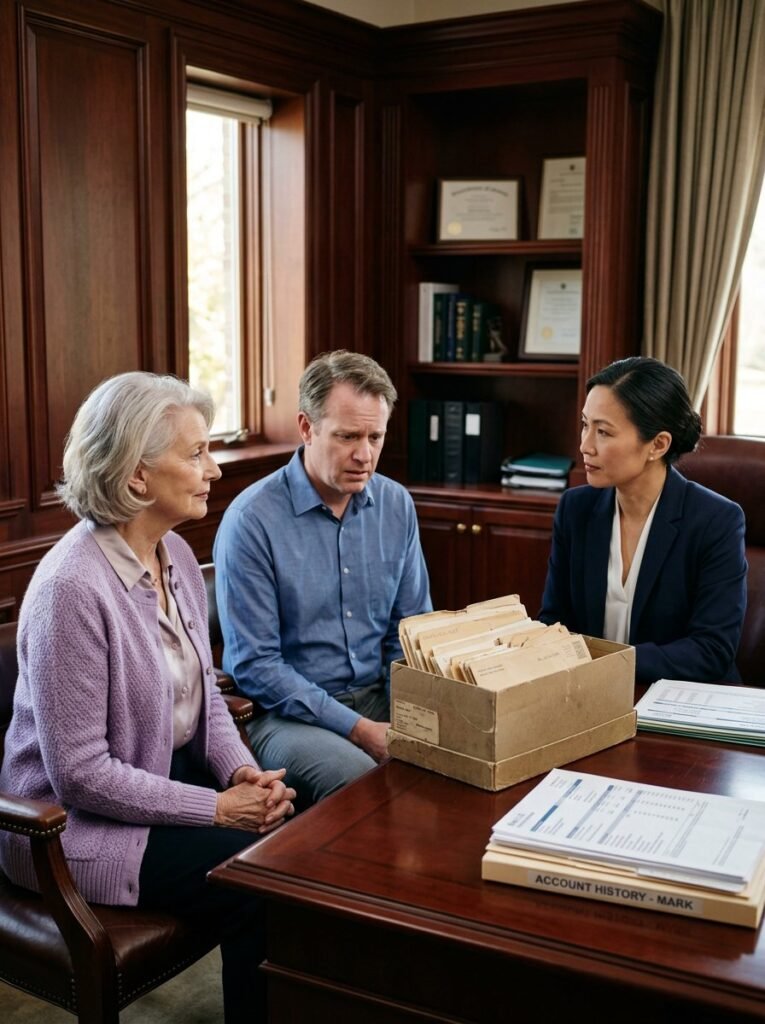
So instead, Dottie drove me to the credit union on a Tuesday, and I sat down with the branch manager, a lovely composed woman, and a gentleman whose card says he handles what they call elder services. I put the shoebox on the desk, and the statements, and I told it plain. The manager went very still in a way I found deeply satisfying, and the gentleman took notes for one hour and eleven minutes.
There is one thing in those statements even I cannot explain. On the third of every month, money goes out to a name I have never heard in my life. A woman’s name. Four years of thirds. I have not asked anyone yet. One fire at a time.
Yesterday I called Scott and told him the credit union needed me to come sign some papers, and would he drive me Thursday. Signing my papers is his favorite thing in this world. He said of course, Ma, and to wear my hearing aids.
So Thursday at ten, my son will walk me into that branch holding my elbow like a good boy, straight into the manager’s office, where the shoebox will already be sitting on the desk.
And the manager will fold her hands, the way she promised me she would, and say, “Before your mother makes any changes today, sir, we’d like you to walk us through this monthly withdrawal marked management. And after that, the transfer that leaves her account on the third of every month, made out to a Miss—”
PART 2
“…made out to a Miss Julianna Vance.”
The name fell into the quiet of the office like a dropped lead weight.
Scott’s hand, which had been resting casually on the mahogany armrest of his chair, gave a sharp, involuntary twitch. The comfortable, patronizing smile he had worn while helping me through the heavy glass doors vanished so fast it looked as if someone had wiped it off his face with a rag.
“Julianna Vance?” Scott repeated. His voice went up half an octave, cracking at the edges. “I don’t… there must be some kind of clerical mix-up. Ma, you remember, Julianna was the independent tax preparer we hired after Dad’s funeral to sort out the back filings.”
Mrs. Gable, the branch manager, did not blink. She didn’t look at Scott; she looked at the open file folder in front of her.
“Mr. Miller,” Mrs. Gable said evenly, her voice as smooth and cool as slate, “the credit union’s forensic audit department pulled the routing numbers yesterday afternoon. These transfers have been executing automatically on the third of every month for forty-eight consecutive months. They do not route to a professional tax firm. They deposit directly into a personal checking account linked to a residential lease on Sycamore Ridge Apartments in South Charlotte. The account holder is thirty-two years old.”
Mr. Henderson, the elder services representative who had been sitting quietly in the corner armchair with a legal pad on his knee, looked up over his horn-rimmed glasses.
“Furthermore, Mr. Miller,” Mr. Henderson added softly, “we pulled the signature card on your mother’s two high-yield certificates of deposit. When your father passed four years ago, those certificates held two hundred and forty thousand dollars. Today, after four years of systematic twelve-hundred-dollar monthly ‘management’ withdrawals into your personal construction business account, along with eight hundred dollars a month to Miss Vance, those certificates have been drained to less than thirty-five thousand dollars.”
Scott turned in his chair, his neck turning a mottled, furious red above his starched collar. He looked at me, his eyes wide, trying to find the frail, grieving woman who had nodded and accepted forty dollars every Friday without looking him in the eye.
“Ma,” he said, reaching out to grab my wrist, his voice trembling with a mixture of panic and anger. “What have you done? You brought strangers into our private family business? You don’t understand how these accounts work! I set this up to protect you from taxes! I took on all the stress so you wouldn’t have to worry!”
I didn’t pull my wrist away. I simply looked down at his hand until he felt the chill in my silence and let go.
“Scott,” I said, keeping my voice as quiet and steady as church bread. “I spent thirty-two years balancing the household ledger when your father was on the railroad. I know what a certificate of deposit is. I know what forty dollars buys at the grocery store. And I know you told me money was tight when your daughter asked for a birthday gift, while you drove here today in a seventy-thousand-dollar truck with heated leather seats.”
Scott swallowed hard. For the first time in his life, he saw that his mother had never been confused. She had simply been patient.
“This is absurd,” Scott blustered, pushing his chair back and standing up, towering over the desk in an attempt to command the room. “My mother is seventy-three. She has been showing signs of memory loss and agitation for months. I am her legal financial representative under power of attorney, and I demand that you freeze these inquiries immediately until I can bring in our family physician.”
Mrs. Gable smiled—a tight, professional line that carried zero warmth.
“You do not have power of attorney, Mr. Miller,” Mrs. Gable said calmly, turning a single blue-ink document toward him. “We reviewed the file yesterday. Your father explicitly drafted these accounts with sole individual survivorship to your mother. You were merely an authorized electronic signer for bill payments—a privilege Mrs. Miller revoked in writing at nine o’clock this morning.”
The room went so still you could hear the hum of the fluorescent lights overhead.
Mr. Henderson closed his legal pad with a dry snap. “Mr. Miller, our fraud division has already submitted a mandatory report to the state Department of Health and Human Services Elder Protection Unit. If you cannot produce documentation accounting for two hundred and five thousand dollars within forty-eight hours, this file moves directly to the District Attorney.”
PART 3
Scott didn’t say another word in that office. He turned on his heel, slammed the heavy oak door so hard the frosted glass rattled in its frame, and peeled out of the credit union parking lot in his shiny black truck, leaving me to ride home with Dottie.
Dottie was waiting in the lobby with a thermos of hot coffee. When I walked out, she didn’t ask a single question; she just linked her arm through mine, handed me a warm porcelain cup, and drove me back to my small brick house on Elm Street.
By six o’clock that evening, the storm hit.
A car door slammed outside my front window. It wasn’t Scott’s truck. It was a silver minivan.
Karen, Scott’s wife of fourteen years, came marching up my front walkway, clutching her purse against her ribs, her hair windblown and her face streaked with mascara. Behind her, thirteen-year-old Lily stood on the sidewalk, looking bewildered and frightened.
I opened the front door before Karen could knock.
“Brenda… please tell me this is a lie,” Karen choked out, stepping into my front hallway. “Scott came home screaming that you’re trying to ruin him. He said you went to the bank behind his back, had his accounts frozen, and that the bank is threatening to send the police to our house. He says you’re losing your mind!”
“Come sit at the table, Karen,” I said gently, gesturing toward the kitchen. “Lily, honey, there’s fresh peach cobbler in the pantry and ginger ale in the fridge. Go put on the television in the den for a little while.”
Lily looked at her mother, who gave a quick, tearful nod, and slipped quietly down the hall.
I set the kettle on the stove and pulled the shoebox from the dining room sideboard. Next to it, I placed the neat stack of duplicate bank statements Mrs. Gable had printed for me.
“Karen,” I said, sitting down across from her at the kitchen table. “Look at the numbers yourself.”
Karen pulled the top statement toward her. She was a sensible girl, an office manager for a dental practice who handled payroll every two weeks. She knew how to read a ledger.
I watched her face as her eyes moved down the columns. First, the monthly twelve-hundred-dollar transfers into Scott’s commercial contracting account—matching the exact dates he had installed granite countertops in their kitchen and built the two-story cedar deck in their backyard.
Then her finger stopped at the third of every month.
Transfer to Vance, J. — Sycamore Ridge #204 — $800.00.
Karen’s face went chalk-white. “Who is Julianna Vance?”
“I don’t know,” I said honestly. “The bank manager told us today it’s an apartment in South Charlotte.”
Karen’s hands began to tremble so violently that the paper rattled against the tablecloth. A sickening realization washed over her features.
“Julianna was the receptionist at his old construction firm,” Karen whispered, her voice barely audible. “She left two years ago. Scott told me she moved back to Ohio… Oh God. He’s been paying her rent. For four years.”
Karen buried her face in her hands and began to sob—not with anger, but with the hollow, gutting despair of a woman who realized her entire comfortable life had been bought with stolen family money and built upon a mountain of deceit.
“He told me your pension was small,” Karen wept, looking at the pencil-marked forty-dollar envelopes scattered across my table. “Every time I suggested we take you on vacation with us, he said you preferred to stay home because travel made you anxious. When I bought Lily that winter coat, he told me his mother was too proud to take charity from us. He made you live on forty dollars a week while he paid for a mistress with his dead father’s savings.”
“He did,” I said softly, reaching across the table and taking Karen’s cold, trembling hands in mine. “But you and Lily did not do this. And you will not be punished for what Scott built out of greed.”

PART 4
By Thursday morning, forty-eight hours after the bank meeting, Scott realized that his life was unraveling from every direction.
Karen packed three suitcases, took Lily, and moved into her sister’s house in Gastonia. Before leaving, she retained an attorney and filed for immediate legal separation, freezing their joint marital assets.
Deprived of both his domestic cover and his access to my accounts, Scott went completely feral.
At two o’clock on Friday afternoon, he pounded on my back door until the glass panes shook. When I refused to unlock the deadbolt, he stood on my back porch in the pouring rain, shouting through the kitchen screen.
“You think you’ve won, Ma?!” he yelled, his voice ragged, smelling heavily of stale beer and desperation. “I built that business! I took care of you when Dad died! You would have rotted in this house without me! If you don’t call the bank and drop that elder fraud complaint by Monday, I’m filing for full emergency guardianship! I’ve got three neighbors who will swear you’ve been wandering the yard talking to yourself! You’ll be in a locked memory unit before Thanksgiving, and I’ll sell this damn house to pay the lawyers!”
I stood on the other side of the glass, looking at my only son. The boy I had nursed through scarlet fever, the boy whose baseball uniforms I had washed by hand, the boy who had looked his grieving mother in the eye every Friday for four years and handed her forty dollars while stealing her husband’s legacy.
I didn’t yell. I didn’t cry.
I picked up the landline phone mounted beside the refrigerator, dialed the direct extension Mr. Henderson had given me, and spoke clearly into the receiver:
“Mr. Henderson. My son is on my back porch making verbal threats of institutional retaliation. Please notify Detective Miller.”
When Scott saw me holding the phone to my ear, his eyes widened with sudden panic. He cursed, kicked the porch railing, and sprinted back to his truck, tires spinning in the wet gravel as he tore down Elm Street.
Within three hours, two uniformed deputies from the County Sheriff’s Department arrived at my door to serve an emergency domestic protection order forbidding Scott from coming within five hundred yards of my house, my church, or my bank.
Over the weekend, Mr. Henderson and Detective Miller worked through the financial paper trail. The findings were devastating.
Scott hadn’t just siphoned the certificates of deposit. When they audited his business filings, they discovered he had taken out a seventy-five-thousand-dollar Small Business Administration loan using my forged signature as a secondary guarantor, listing my debt-free home as collateral.
On Monday morning, Mr. Henderson called my kitchen phone.
“Mrs. Miller,” he said, his tone grim and urgent. “We have uncovered the loan documents. The signature on the mortgage encumbrance is an undeniable forgery, but because the loan is currently thirty days delinquent, the regional lending bank has issued a notice of default against your property.”
My breath caught in my throat. “A default on my house?”
“Yes, ma’am,” Mr. Henderson said. “Scott attempted to transfer the remaining twenty-two thousand dollars from his business account to an offshore debit card this morning to flee before the indictment comes down. The County Prosecutor has convened an emergency grand jury session for tomorrow morning at nine. You will need to take the stand to testify against your son under oath.”
The trap had closed, the stakes were my home, and tomorrow morning I would have to look my only child in the eyes from the witness box.
PART 5
On Tuesday morning at nine o’clock, the marble corridors of the county courthouse were cold and quiet.
I sat in the witness waiting room wearing my Sunday navy dress, my silver hair pinned neatly, my hands resting calmly over my leather handbag. Beside me, Dottie sat holding a cup of chamomile tea, and Karen sat holding Lily’s hand, both of them there to stand with me.
When the bailiff opened the heavy double doors and called my name, I stood up straight and walked into Grand Jury Room C.
Scott sat at the defense table in a wrinkled gray suit, his shoulders slumped, his eyes refusing to meet mine. Beside him stood a court-appointed public defender; his high-priced private attorney had withdrawn after Scott’s funds were frozen by the state.
Prosecutor Davis stepped forward, holding a thick file.
“Mrs. Brenda Miller,” the prosecutor said gently. “For the record, please state your relationship to the defendant.”
“He is my son,” I answered clearly, my voice carrying without a tremor across the high-ceilinged room.
For the next forty-five minutes, Prosecutor Davis laid out the anatomy of a four-year betrayal.
She displayed the 190 pencil-marked forty-dollar envelopes on the evidence table. She presented the bank audit showing the $205,000 drained from my certificates of deposit. She presented the lease records for Sycamore Ridge Apartments, showing forty-eight monthly payments made directly to Julianna Vance from my stolen savings.
And finally, she projected the forged loan document on the large courtroom screen, showing Scott’s clumsy attempt to copy my late husband’s and my handwriting to mortgage my home.
“Mrs. Miller,” Prosecutor Davis asked, turning toward the witness stand. “Did you ever authorize your son to take these funds, to pay the living expenses of Miss Vance, or to pledge your home as collateral for his commercial debts?”
I looked across the room. Scott finally looked up. His eyes were red, pleading, silently begging his mother to soften the blow, to tell a small white lie, to save him from the consequences of his own choices.
I took a deep breath, feeling Thomas’s gold wedding band against my knuckle.
“I did not,” I said clearly. “I trusted my son with my grief. He repaid that trust by stealing his father’s hard work, keeping me on an allowance like a beggar, and trying to steal the roof over my head.”
The Grand Jury returned a true bill indictment in less than twenty minutes: four counts of Felony Financial Exploitation of an Elder, two counts of Grand Larceny, and one count of Forgery and Uttering.
Judge Holloway revoked Scott’s bail on the spot, citing the flight risk and the severity of the predatory conduct.
The sound of the handcuffs clicking around Scott’s wrists was loud and final in the silent courtroom. As the bailiff led him toward the holding cells, Scott turned back, tears streaming down his face, choking out, “Ma… please!”
I did not answer. I simply watched him go until the iron door clicked shut.
Two months later, the court-ordered restitution and insurance bonds restored every single dollar to my accounts. The fraudulent lien against my house was officially expunged by judicial decree. Scott accepted a plea agreement resulting in four years in the state correctional facility, followed by ten years of strict financial probation.
On a warm Saturday afternoon in May, my front doorbell rang.
It was Lily’s thirteenth birthday.
Karen brought her over for Sunday dinner. When Lily walked into my dining room, sitting on the polished mahogany table was a large, beautifully wrapped box with a lavender silk bow.
Lily opened it with wide, shining eyes. Inside was the brand-new digital drawing tablet and professional art kit she had dreamed of for two years—store-bought, paid in full from my own checking account, with a hand-knitted lavender scarf tucked around the box.
Lily threw her arms around my neck, burying her face in my shoulder. “Thank you, Grandma! It’s the best present in the whole world!”
I held my granddaughter tight, kissing the top of her head.
Later that evening, after the dishes were cleared and the house was quiet, I sat on my front porch in Thomas’s old rocking chair with a glass of sweet tea, listening to the crickets in the sweet clover, finally at peace in the home we built together.