My Mother Banned My Seven-Year-Old Daughter From Thanksgiving So My Sister Could Impress Her Boyfriend. She Forgot I Was Paying for Everything.
“Clara, your daughter isn’t invited to Thanksgiving anymore. Briana wants a peaceful holiday, and Ivy might cause distractions.”
I froze.
My mother had just informed me that my seven-year-old daughter was no longer welcome at the family Thanksgiving celebration.
The celebration I had organized. At the lake house I had rented. With my own money.
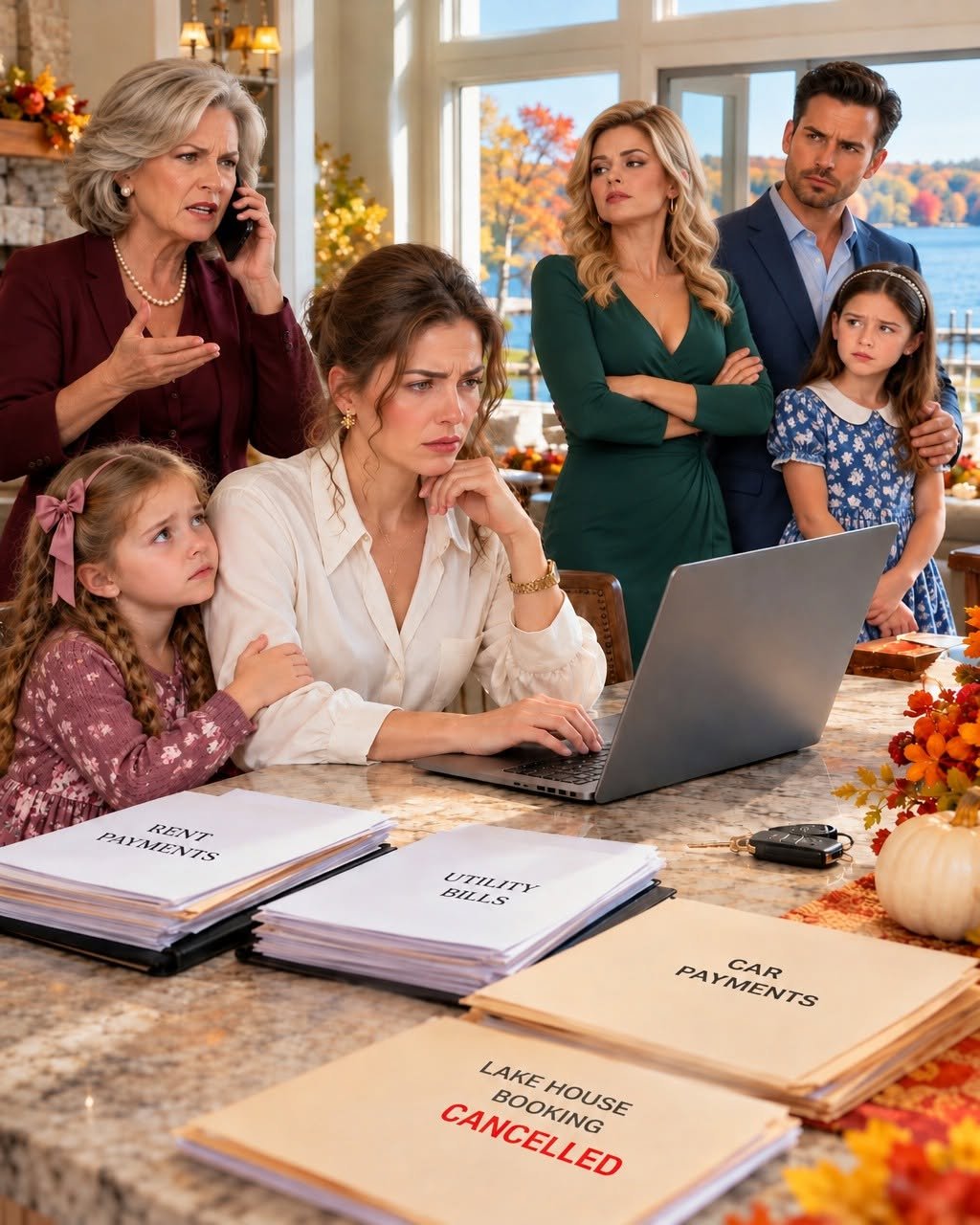
For three years, I’d spent over $60,000 helping my parents and younger sister, Briana, with rent, bills, and car expenses.
Yet they expected me to leave my child behind so Briana could impress her new boyfriend.
I didn’t argue.
I simply ended the call and opened my laptop.
By that evening, the lake house reservation would be canceled, my financial support would be ending, and the car I’d purchased for Briana would be coming back under my control.
I’d always been the dependable daughter.
Whenever my parents needed help, I provided it. When Briana faced another financial emergency, I paid what I could.
I never expected anything in return.
But I believed my family loved Ivy.
My daughter was a sweet, affectionate little girl who enjoyed drawing pictures and making handmade cards for her grandparents.
She’d been excited about Thanksgiving for weeks.
“Mommy, can I bring Grandma the picture I made?”
“Of course, sweetheart.”
I’d arranged the entire holiday because I wanted her to have beautiful memories with her family.
Then my mother called.
“Briana’s relationship with Travis is getting serious,” she explained. “She wants everything to be perfect.”
“That’s wonderful, Mom.”
“Well, Travis has a ten-year-old daughter, and Briana wants them to enjoy a sophisticated, relaxing holiday.”
I frowned.
“What does that have to do with Ivy?”
Mom hesitated.
“Your sister thinks the gathering would be better without her.”
I stared at the wall.
“Travis’s daughter is invited, but mine isn’t?”
“Ivy can be rather energetic, Clara.”
“She’s seven!”
“Children need to learn that plans sometimes change.”
My chest tightened.
“Mom, she’s been making Thanksgiving cards for everyone.”
“Then arrange something else for her. Perhaps a babysitter.”
I couldn’t believe it.
“You want me to pay for Thanksgiving and hire someone to watch my daughter?”
“Don’t be dramatic. Briana deserves this opportunity.”
I took a slow breath.
“And what does Ivy deserve?”
Silence.
That was my answer.
After hanging up, I sat alone in my office.
I thought about the thousands I’d given my family and the times I’d sacrificed my own plans to help them.
Then I realized something.
I couldn’t force them to welcome my daughter, but I could stop paying for a holiday that excluded her.
I opened my laptop.
The lake house reservation was in my name.
The deposit came from my account.
I reviewed the cancellation terms and contacted the rental agency.
Next, I examined the recurring payments I’d been making for my parents and Briana.
I began arranging to end the voluntary financial support responsibly.
Then I checked the ownership documents for Briana’s car.
It was still registered in my name.
I started making arrangements to reclaim it.
Hours later, Mom texted:
Thank you for understanding. Briana is so relieved!
I stared at the message.
She believed I’d agreed to leave Ivy behind.
She had no idea what I’d just arranged.
My family thought they could exclude my daughter while continuing to enjoy everything I provided.
They were about to discover that my generosity was no longer unconditional.
PART 2
The rental agency was called Heron’s Rest, and the woman who answered was named Deb.
“Confirming the cancellation for November twenty-seventh through the first,” she said. “Four nights, the main house. The deposit refunds in full if you cancel more than fourteen days out, which it is. Eight thousand nine hundred and forty dollars back to the card ending in 4417.”
“How long until it clears?”
“Three business days. Ms. Whitfield — I’m sorry. You booked this in August.”
“I know.”
That is the thing about being a person who organizes things. I did not slam the phone down. I did not call my sister a name. I sat in a chair I paid for in an office I paid for and asked a stranger how long a refund takes.
Then I opened the bank portal and moved through the last three years the way you go through a closet when you’ve finally decided to clean it out.
Seven hundred and fifty dollars to my mother on the first of every month, since March 2021, described in the memo line as “rent help.” Two hundred and forty to my father for the truck note. Eleven hundred to my mother in November 2022 for the furnace. Four hundred to Briana every other Friday since January of last year, which had no description at all, because you do not describe that kind of money when you are embarrassed about it.
Briana’s car loan, four hundred and six dollars a month off my checking account for two years and seven months. The insurance, also mine. The tires on it, and the alternator, and the nine hundred dollars in August when she called crying and said the transmission was going.
And then the debts that only exist in my own accounting. The vacation to Asheville we did not take. The roof on my own house, eleven years old, because every year there was a better use for six thousand dollars than my own roof.
Sixty thousand, four hundred and eighteen dollars over thirty-eight months. What I felt looking at the total was not anger. It was the specific shame of a woman who has been congratulating herself on being helpful while building the cage her daughter is now locked out of.
I called the car dealer at 4:22. Ray Delgado, at Crawford Motors, who has known me since I bought my own car there in 2019.
“Ray. The loan on the Corolla.”
“How are you, Clara.”
“The car’s registered to me, the loan’s in my name, and I need to know my options.”
There was a pause on his end, and a sound like a chair. “Is everything all right?”
“No.”
“Do you want me to tell you what you can do, or what you should do?”
“What I can do.”
“Then here it is. You are the titled owner and the note holder. The other operator has a license to drive it and no ownership interest, and you can revoke that license in writing, certified mail, with a date and a demand for the keys within a set number of days. If she keeps it, it is not theft, because she had permission — it is a civil matter, and the sheriff will not help you until you have a court order.” He cleared his throat. “And if she has an accident, the vehicle is titled to you, so the first call from a lawyer would be to your number.”
“Thank you, Ray.”
“Whatever it is,” he said, “get the keys back.”
At 5:40 the group chat lit up.
Briana had taken a photo of our mother’s dining table: four dozen roses in a vase I recognized, on a tablecloth I had paid for in October, beside a platter of something expensive. My mother had her arm around Briana’s shoulder and her cheek against her hair.
My mom is the best. Everything is going to be PERFECT.
I watched the little grey dots appear and disappear, and then the second message came through.
Can you bring the good candles Thursday? The ones from the lake house.
I put the phone face down on the desk.
At 6:12 my mother called and left a voicemail in the cheerful voice, the one she saves for strangers and for me when she wants something.
“Hi sweetheart, it’s Mom. I’ve got the turkey ordered and Briana’s doing a centerpiece and Travis is coming at noon, so we’ll eat at three. Your father’s going to get the leaf for the table. Full house! This is going to be the best Thanksgiving we’ve ever had. Call me!”
I did not call her. I made two lists instead — everything I had paid for, and everything I had ever asked them for. The second list had four items on it, and one of them was an apology I never got.
At 7:30 my daughter came into the office with a piece of construction paper and a glue stick and asked me whether it was too late to put glitter on the back of the card, and I said no, it was not too late, and we did it on the floor of my office with a trash bag open between us, and I got glitter on my slacks and did not care.
Then I asked her a question.
“Ivy. If it was just you and me on Thanksgiving, what would you want to do?”
She thought about it very seriously. She is seven, and she thinks about things very seriously.
“Can we have pancakes and wear pajamas and watch the parade on the couch?”
“We can do exactly that.”
“Can we do it in the fort?”
“Yes.”
She looked up at me. “Is Grandma not coming?”
“No, baby. Grandma’s having her own Thanksgiving.”
“Okay,” she said, and went back to the glitter, and I sat there with a glue stick in my hand and understood that the whole of my childhood had been spent trying to earn a seat at a table that my daughter would simply walk past on her way to something better.
That night I wrote three letters.
One to the rental agency, confirming cancellation in writing, asking for the refund by check as well as card.
One to my mother, which I did not send, and which I have kept.
And one to Briana, which I sent certified mail on Monday morning, with a copy to my father, that revoked permission to operate the 2021 Toyota Corolla titled in my name and demanded return of the vehicle and both keys within ten days.
My husband Dax read it standing up in the kitchen.
“You’re sure,” he said.
“I’m sure.”
“Because when we do this, we don’t get to un-do it. She’ll call her mother and her mother will call you and then there’ll be a meeting.”
“There’s always a meeting,” I said. “I’ve been going to them for three years, and I’ve been the only one paying for the coffee.”

PART 3
The letter was delivered on Tuesday at 10:14 in the morning. I know because I paid for the tracking and checked it eleven times in four hours.
My mother called at 10:41. My mother called again at 10:43. Briana called at 10:44, and my father called at 10:47, which is the thing that told me it was serious, because my father has not initiated a phone call with me since 2019.
I let all four ring through and put the phone in a drawer, and then I sat in a meeting about a lease on Sutter Street and did not think about any of it for fifty minutes, which is the closest thing to a religious experience I have had in years.
At noon my mother left a voicemail, and I listened to it in the stairwell, because it was not the cheerful voice.
“I don’t know what’s gotten into you. Your sister is crying in her car in a parking lot. You cannot just take a person’s car away, Clara, that is her car, she’s been driving it for three years, and we have a holiday in nine days, and you have not thought about anybody but yourself.”
That was the first voicemail. There would be eleven.
At 4:20 that afternoon my parents were standing on my porch.
My father stood one step behind my mother with his hands in his pockets and did not say anything for the first ten minutes. My mother did all of it. She came in, sat down without being asked, and put her purse on my table.
“We need to talk about Thanksgiving. You canceled the house.”
“I did.”
“Without asking anyone.”
“It was my reservation. It was my deposit. I don’t need permission to cancel my own reservation.”
“That’s not the point and you know it.” My mother’s voice had gone into the register that used to make me eight years old. “The point is that we are nine days out and your sister has been telling Travis about this house for a month. Do you understand what you have done to her?”
“Yes,” I said. “She has no place to hold a holiday she was not paying for.”
My father shifted his weight. “Clara,” he said quietly. “Come on.”
“No, Dad. Let’s do this part properly.” I turned the laptop around, and they both looked at the screen the way people look at a bill. “Seven hundred and fifty dollars a month since March of 2021. Two hundred and forty for the truck. Four hundred and six for Briana’s car, plus insurance, tires, and the transmission in August. Sixty thousand, four hundred and eighteen dollars. You have never once asked me if I could afford it. You have only ever asked me when it would arrive.”
My mother looked at the number, and then at me.
“Well,” she said, “we didn’t know you were keeping a list.”
“I wasn’t. I made it on Sunday at four o’clock, because your daughter told me mine wasn’t welcome at my own holiday.”
“That is not what I said.”
“You said Ivy might cause distractions. You said Briana needed a peaceful holiday. You said, and I wrote it down that night, ‘arrange something else for her, perhaps a babysitter.'”
My father said, “Your mother didn’t mean it like that.”
“Then how did she mean it? You have a granddaughter who has made you a card every week of her life, and you have not come to her birthday in two years because of the drive. Tell me how she meant it, Dad.”
He did not answer.
My mother’s chin came up. “And the car?”
“The car is mine. The title is mine. The note is mine. And as of this morning, so is the insurance, which is canceled as of the fifteenth, so she is driving an uninsured vehicle that is registered to me. If she has an accident tomorrow, the first lawyer who calls is going to call me, and I am not going to spend the next six years of my life paying for a decision your daughter made in a parking lot.”
“You cannot just—”
“I sent her a letter. It’s legal, dated, certified, and it gives her ten days. She can bring me the keys, or I can file, and if I file it goes in a court record with her name on it.”
My mother stood up.
“After everything we did for you,” she said.
There it was. The sentence I had spent my whole life being afraid of.
“Name one thing,” I said.
She stared at me.
“Name one thing you did for me since I turned eighteen that I did not pay for, and I will put the deposit back on the house tonight and drive to the lake on Wednesday with the candles.”
The room was very quiet. My father was looking at the carpet.
“Your father drove you to the airport when your car broke,” my mother said.
“In 2017. And the next day you asked me for four hundred dollars for the water heater, and I sent it.”
“This is not a negotiation, Clara.”
“You’re right,” I said. “It’s a list, and we just finished reading it.”
At 6:05 that evening Briana called me for the first time, and I answered.
She was not crying, and I want to be honest about that, because the story everyone tells later is that she was crying. She was using the voice she uses when she is doing arithmetic and does not like the answer.
“Is this about Ivy?” she said.
“It is about Ivy.”
“Because I didn’t even say that. Mom said that. I said Travis and his daughter were coming and it would be easier if the whole thing was quieter, and she said she’d handle it, and now everybody’s mad at me, and Travis is asking questions about the house and I don’t know what to tell him—”
“Briana. You called my seven-year-old a distraction.”
The silence on that call went on long enough that I heard her television in the background, and something small and metallic, which I think was a fork on a plate.
“I didn’t mean it like that,” she said.
“I know,” I said. “That’s the part that keeps me up.”
“Can I still have the car?”
“No.”
“Clara—”
“Then just tell me what you want,” she said, and her voice cracked in a way that had not cracked when she was talking about her boyfriend, “because I don’t have anywhere to put a turkey.”
“I want my daughter to know that when somebody tells her the seat she’s been sitting in isn’t hers, she can get up and go somewhere better,” I said. “I can’t teach her that if I don’t do it this week.”
She hung up on me.
At 9:50 that night Travis Albright called me from a car. We had never spoken; both times we had met he shook my hand and called me “Clara’s sister,” which I have thought about more than I should.
“Clara. It’s Travis. Briana told me the lake house was her family’s place.”
I closed my eyes.
“She told me she was hosting,” he said. “I’ve been telling people I was going to spend Thanksgiving at a house on the water with my daughter, and it’s been a hard year for my kid.”
“Travis,” I said, “whose name is the reservation in?”
“Hers, I’m assuming.”
“It’s mine. Nine thousand dollars. I canceled it on Sunday because my mother called me and told me my daughter was not welcome at the party I was paying for.”
There was a long silence on that call.
“That’s not what I was told,” he said finally.
“I know it isn’t.”
“Then I need to think about some things,” he said, “and I need to talk to my kid, because she’s eleven and she’s been looking forward to this.”
“I understand.”
“Clara. Is it true you’ve been paying for everything?”
“Sixty thousand dollars in three years,” I said. “I have the spreadsheet.”
I did not send it to him. That is the one regret in this story, and I am allowed one.
PART 4
Briana did not bring the car back in ten days.
She brought it back on the eleventh, at 7:10 in the morning, in front of my house, and she sat on my driveway wall with the keys in her fist and her chin up in a way I had known since she was four years old.
“Travis is coming to my apartment,” she said. “I told him everything.”
“Good.”
“His exact words were, ‘I don’t know why you’d let her,’ which is not the same as him being on your side.”
“He’s not on my side, Briana. He’s got a kid.”
She stood up.
“I’m not supposed to be the one that does this,” she said, and I did not understand what she meant until much later. “I’m the one everybody likes. That’s the arrangement. You’re the dependable one and I’m the one everybody likes, and you just—”
“I just moved the furniture,” I said.
She held out the keys. I did not take them.
“Come in,” I said. “Have coffee. Help me hand out pancakes.”
She looked at me with her mouth open. “You want me to come in.”
“I don’t want you to come in for the car, and I don’t want you to explain yourself, and I don’t want to hear about Travis. I want you to come in because your niece is making pancakes and she asked me on Sunday whether you were going to make it.”
She stood there with the keys in her hand and her jaw going.
Then she said, “She made me a card.”
“She’s made everyone a card.”
“With the glitter on it?” Briana said. “The one that gets everywhere?”
“The one that gets everywhere.”
Briana sat at my kitchen counter on Thanksgiving morning in her coat and did not take it off, and my daughter put a plate of burnt pancakes in front of her and a construction paper card with a turkey on the front and her name spelled in purple glitter, and I want to be very clear that this is the part I remember most from that whole year.
Then Briana started to cry in a way that had nothing to do with the car.
“I’m sorry,” she said, and it came out cracked and awful. “I’m sorry, Ivy. I’m sorry. I’m so sorry. I’m so sorry.”
My daughter, who is seven and has better instincts than anyone in that family including me, climbed up on the stool beside her and put her arms around Briana’s neck and said, “It’s okay. You can have half my pancakes. They’re a little burnt.”
At noon my mother called.
I answered it in the hallway with the parade going in the other room.
“Where is your sister,” she said.
“She’s on my couch.”
There was a silence.
“Clara.”
“She’s on my couch, and my daughter is teaching her how to put glitter on the back of a card. If you would like to come over, you’re welcome to come over, and there are four conditions, and they are not negotiable.”
“What conditions?”
“One. Nobody speaks to my daughter about any of this — not one word, not even to apologize — until she’s older or she brings it up. Two. Nobody mentions the house, the car, or the money today. Three. If you say grace, you do not use grace to say something about family being forever. Four—” I stopped and looked out at my street.
“Four?”
“Four,” I said, “is that you tell me, out loud, before you sit down at my table, that you were wrong on Sunday.”
“That’s an ultimatum.”
“Yes,” I said. “It is. I’ve been forty-one years old for six weeks and I just learned how.”
My mother did not come.
I want you to know that I am not pretending that is the ending, and I am not pretending it was painless. She stood in my driveway at four in the afternoon with two covered dishes in her arms and did not get out of the car. My daughter waved at her from the window. She waved back, and then she reversed out and drove away, and I stood in the front room with my hands on my hips and cried for a minute and a half and then went back in and cut the pie.
My father came at 4:30.
He came by himself, without her, in the truck, and he stood on my front steps with a paper sack in his hand and said, “I’m not staying. I just wanted to bring this.”
It was a jar of my grandmother’s cranberry relish. My mother has not made it since my grandmother died, because it is the only thing in that kitchen my grandmother ever taught my mother to make and I think it cost her something to do it.
“She made it two days ago,” my father said. “She put it in the pantry and said it was for you. She’s not going to come, tonight. She’s angry and she’s hurt and she’s going to be up all night and I’m not going to defend her.” He put the sack in my hand. “But I want the record to say that she made the relish.”
“What about Sunday, Dad?” I said. “You were in that room when she said it.”
He stood on my steps and looked at his boots.
“Forty-one years I’ve let her do the talking,” he said. “I don’t have a good reason for it and I don’t want to make one up in front of you on your steps.” He looked up. “She was wrong. And the way we talk to you has been wrong for a long time, and I noticed it and I did not say anything, and that makes it mine.”
“Thank you,” I said.
“Don’t thank me. I should have said it Sunday.” He backed down the steps. “Merry Christmas, Clara. I’m going to go in nine days, but I’m not going to leave it like this.”
He drove away.
At 7:25 that night my daughter stood on my coffee table in her pajamas, because we ate at five o’clock like people with a sense of order, and she held up her hand and said, “I want to make a toast.”
“You don’t know what a toast is.”
“Mommy, I know what a toast is. It’s when you say a thing and then everybody clinks.”
“All right,” I said. “Make a toast.”
My father’s truck was still in the driveway, because he had come back at six with a pie and a bottle of my mother’s wine and had not said anything about it. Briana was on the couch with her coat still on. My husband Dax was in the doorway with his sleeves rolled up and his hand over his mouth.
My daughter held up her juice glass.
“I want to say,” she said, very seriously, “that this is the best Thanksgiving I ever had, because nobody had to leave.”