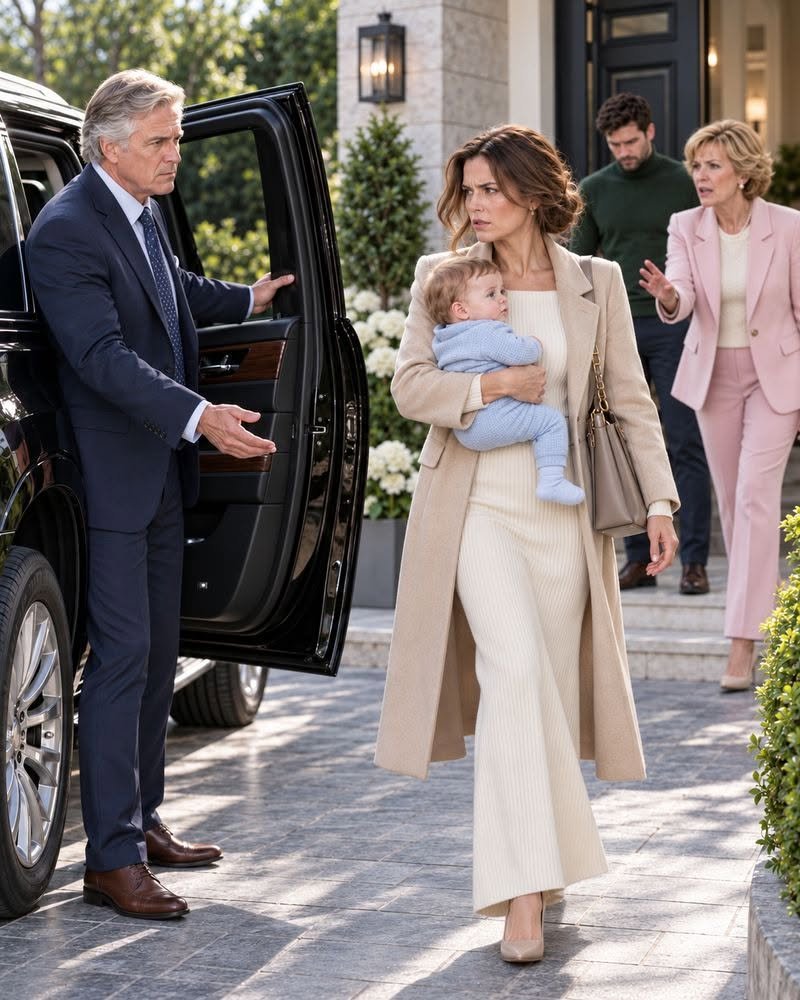
My mother-in-law confiscated the keys to the SUV I had purchased, and my husband willingly gave them to her while I struggled through a mile-long walk home with our eleven-month-old son, my injured ankle throbbing and heavy grocery bags digging into my palms. When my father spotted me along the sidewalk, the threat that had forced me into silence for the past six months was beginning to unravel. Yet the revelation that would ultimately leave everyone in that household speechless had nothing to do with the vehicle.
My name is Elena, and Marlene’s biggest mistake was believing I would never stand up to her.
A black SUV eased to a stop alongside the curb.
“Elena?”
My heart sank.
“Dad.”
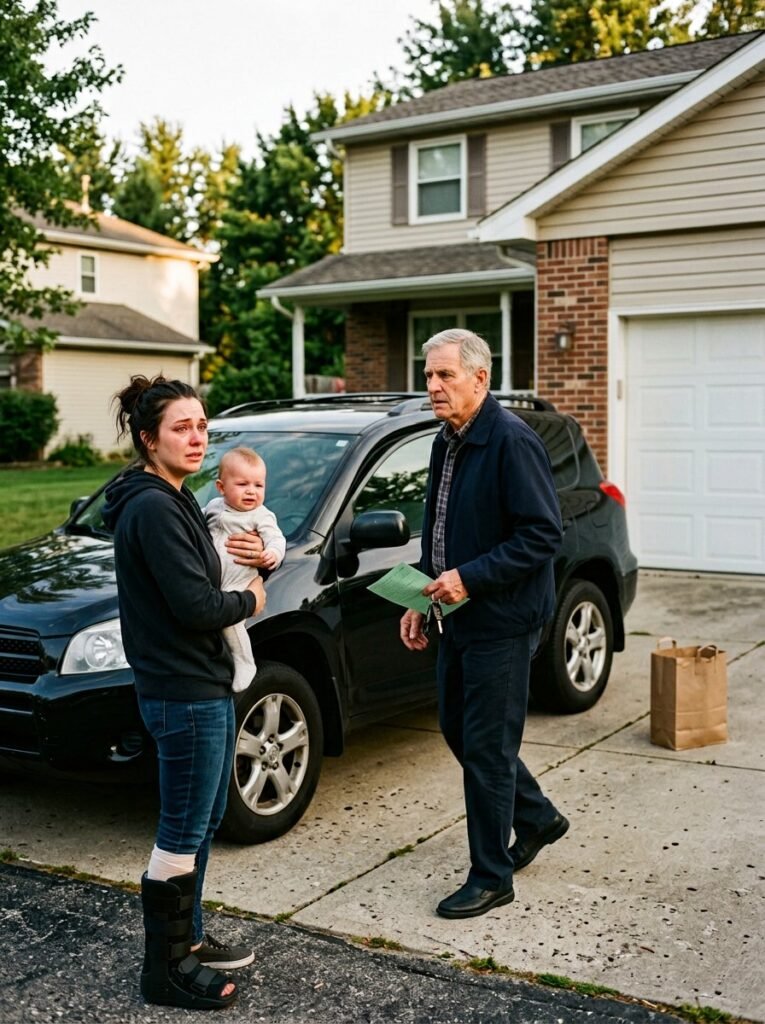
My father parked and climbed out, his gaze traveling from Lucas to the bags weighing down my arms before settling on my visibly swollen ankle.
“What happened?”
“Nothing.”
He held my gaze without speaking.
I quickly changed my answer.
“I twisted it a few days ago.”
I attempted another step.
A sharp burst of pain traveled through my ankle, making me wince.
Dad immediately relieved me of the groceries before carefully taking Lucas into his arms.
Then came the question I had desperately hoped he wouldn’t ask.
“Where’s your car?”
I lowered my eyes toward the sidewalk.
“My mother-in-law has it.”
He remained quiet, waiting for me to explain.
“She took it,” I finally said.
His expression hardened into stillness.
“What do you mean, she took it?”
“She has the keys.”
“The SUV you bought after Lucas was born?”
I gave a small nod.
I had covered the down payment myself, and every installment was withdrawn directly from my bank account.
The registration, however, carried Daniel’s name.
“Why does Marlene have your keys?”
I struggled to swallow.
“She said I don’t deserve to use it.”
My father’s voice dropped.
“What happened?”
I searched for words that might make the situation seem less awful than it was.
Daniel was unemployed after losing his job.
We had moved into his parents’ house.
Marlene insisted that we had to cut our expenses.
According to her, I used the car far too often.
She also claimed that getting around on foot would be healthier for me.
Dad glanced down at my injured ankle.
“She knows you’re injured?”
I couldn’t bring myself to respond.
“How far is the grocery store?”
“About a mile.”
“With Lucas?”
“I had the stroller.”
“Where is it?”
“One wheel jammed halfway there.”
My father fell completely silent.
After a moment, he spoke again.
“Where’s Daniel?”
“At home.”
The hurt crossing his face was harder to bear than any anger.
“Daniel let you do this?”
“He’s under a lot of pressure.”
Dad met my eyes directly.
“Pressure doesn’t make a man blind, Elena.”
There was nothing I could say to that.
He pulled open the passenger-side door.
“Get in.”
“Dad, I can handle this.”
“I know you can.”
His response caught me off guard.
“I know my daughter can survive almost anything. That doesn’t mean she should have to.”
Emotion tightened around my throat.
“What are you going to do?”
“We’re going to the house where you’re living.”
“If Marlene sees me arrive with you, she’s going to lose it.”
“Then she’ll lose it.”
“She might throw us out.”
“Then you won’t spend another night there.”
I raised my eyes to his.
“What if Daniel chooses them?”
For a moment, Dad paused before answering.
“Then at least you’ll finally know.”
I climbed into the SUV.
During the drive, my attention drifted to the military installation access pass hanging beneath his rearview mirror.
Daniel’s family knew only that my father had spent his career serving in the Army.
They knew nothing beyond that.
Once, Marlene had dismissed him as “some career Army officer.”
I hadn’t bothered to correct her.
Using my father’s reputation or accomplishments to gain special treatment had never appealed to me.
What I failed to recognize was that keeping quiet had encouraged Marlene to believe I had no other place to turn.
As we pulled into the driveway, I spotted my SUV parked beside the garage.
Then something visible through its windshield caught Dad’s attention.
My extra set of keys lay inside the center console.
He turned off the ignition.
“Did Marlene take those keys from you?”
“No.”
Dad examined my expression closely.
“Then who gave them to her?”
Only two sets of keys existed.
One belonged to me.
The other belonged to Daniel.
I kept staring through the windshield at the keys.
And suddenly, everything became clear.
“Daniel did.”
PART 2
Dad did not get out of the car.
He sat with both hands on the wheel and looked at the SUV beside the garage. Then, in the flat voice I had heard twice in my life: “Take Lucas inside and tell your husband I’d like a word with him in the driveway.”
“Dad—”
“Inside. Not a conversation for a baby’s ears.”
So I did it. The kitchen smelled like someone else’s dinner. Marlene was at the stove, Gerald at the table with the paper, Daniel on the couch with his telephone and a bag of chips, and nobody looked up when I came in with my son on my hip and no groceries.
“Elena. You’re late. The baby’s supper was at five.”
“Dad’s outside.”
The paper went down. Gerald looked at the window and then at his wife, and I saw the look of a man hearing a sound in the machinery.
“Your father.” Marlene turned. “Wonderful. The career officer. Does he know you’ve been lying to him about that ankle?”
Daniel sat up. “Elena. What did you tell him?”
“That I twisted it.”
“Good. Because you know how he gets.”
Marlene took off her apron and walked out the back door, and I stood at the window and watched my mother-in-law go out into her own driveway to be pleasant to a man she had spent six months calling “Elena’s father, he was in the service.”
Dad was not at the front door. He was standing at the driver’s side of my SUV with the door open.
“Colonel.” She said it the way you say a rank to a man out of uniform and out of fashion. “What a surprise. Elena didn’t tell me she’d called you.”
“She didn’t call me. I found her on Van Buren with a bag in each hand and an ankle like a grapefruit.” His voice was quiet. “Marlene. Where are the keys to this vehicle?”
“They’re in the house. In my sewing room.”
“How long?”
“Five weeks.” She lifted her chin. “And before you say a word to me, that girl was driving everywhere. Do you know what fuel costs? We are carrying three adults and a baby on one pension, and she is out taking the baby to story hour.”
My father did not raise his voice. He has never once in his life raised his voice, and it is the most frightening thing about him.
“Whose name is on the registration?”
“Daniel’s.”
“Whose name is on the loan?”
Nothing.
“Whose money paid the down payment, and whose account the installment comes out of on the eleventh?”
“Well,” Marlene said. “Family money.”
“That’s not what I asked.”
Daniel came out with his hands up. “Dad, this is a misunderstanding.” Then: “This is our household. We handle things our way. Elena can be a little dramatic about—”
“Daniel. Did you give your mother a set of keys to that car?”
“She needed to move it for the—”
“Did you.”
“She said Elena shouldn’t—”
“I asked you a question.” Then, quietly: “I have watched you six months, waiting for one sentence out of your mouth with a spine in it.”
“Daniel,” I said, “I walked home from Dillons with a sprained ankle and your son on my hip because your mother took the keys to a car that comes out of my account. And you gave them to her.”
“I didn’t think she’d actually—”
“Don’t you dare put this on me,” Marlene said. “You told me she didn’t need it. You came into my kitchen and said, ‘Take it, maybe she’ll finally learn to stay home.'”
The driveway got very quiet.
Dad leaned into the SUV’s window and moved the floor mat with one hand, and I do not know why he did it, whether a man who spent thirty-four years reading other people’s intentions can smell a room with something wrong in it. He came out with a folded green form.
He read it standing in the driveway, then read it again. Then he walked to the open window of his car and held it up.
“Elena. Is this your signature?”
A Kansas title transfer, dated nine weeks earlier. I read the top and then the bottom, and the name in the buyer’s box was not mine and was not Daniel’s.
It was Gerald’s.
PART 3
“Gerald,” Dad said.
My father-in-law came out in his glasses with the expression of a man called into weather.
“Would you like to explain this?”
Gerald did not look at the form. That was the first thing I noticed. He looked at Marlene, and Marlene looked at the corners of the garage, and my husband looked at the ground.
“A transfer,” Gerald said. “It’s preliminary. Not filed.”
“It’s signed by the seller.”
“That’s an administrative thing. We were moving money around—”
“Gerald. Do you know what an odometer certification is?”
“You have certified this vehicle at forty-nine thousand miles. You have signed a seller’s signature that is not yours and is not my daughter’s.” He did not raise his voice. “I have spent my adult life looking at documents like this. That is a false instrument. In this state that word has consequences, and they do not fall on the young lady who walked home with the groceries.”
It was not the idea of losing the SUV that broke me. It was that they had already put a plan on paper. For six months I had told myself that if I kept my head down and my account paid and my mouth shut, it would be a bad year with an ending that did not have to involve a lawyer.
But there on the concrete, held up in my father’s hand, was a form with a buyer’s box and a seller’s signature line, and I understood: the reason the keys had gone to Marlene was so that Marlene could begin a process on paper. They were not disciplining me. They were moving an asset.
“Dad. Can you get that from him without tearing it?”
“I’ve already got it.”
He walked to his car, put the green form into a leather case, then took out a small silver thing on a ring and tossed it to me.
It was the key to my own SUV.
“Where did that come from?”
“Where do you think.”
He had gone into the house while I stood at the window with the baby.
“Here is what happens tonight,” my father said. “Elena and Lucas are going to eat supper and go to bed in that house, because I will not take a mother and child out of a heated building on a Tuesday out of pride. Tomorrow at nine she and I go to a lawyer. By the time we come back there had better be keys on that counter and a written apology, and I don’t care which one of you writes it.”
“And if there isn’t?” Marlene said.
My father looked at her.
“Elena. Do you remember what I told you the day you married him?”
I did. It was not a thing to say aloud in front of anyone.
“No,” I lied.
“Then I’ll say it again. I told you I would not be an interfering father, and I would not use what I do for a living to solve your problems. I kept that. You never asked me for anything, and I told myself that was you being strong. What I did not notice was that your silence wasn’t strength. It was the same silence your mother used to have.” He paused. “She’s been gone eleven years, and I still hear it in this driveway.”
I stood on that concrete with my son on my hip and did not cry, which I have never understood.
“And what is it you do for a living, Dad?”
He looked at me for a moment.
“Come in. Eat something. I’ll be back at nine.”
PART 4
My father is a retired colonel in the United States Army. That is what the family knew, and what they had decided to call “some career Army officer.”
Daniel asked me four times at dinner what my father had meant. Marlene had closed herself in her room, which is the closest thing I have seen her do to retreating, and Gerald ate with the newspaper up.
“He’s bringing us to a lawyer,” I said.
“A lawyer costs money we don’t have.”
“You have my money.”
I had never said anything like that to my husband. I was surprised at how calm it sounded.
At nine the next morning we sat in a small office on Cottonwood Street across from a woman named Annette Rusk, thirty-four years in practice, who did not once look at me with the soft expression people get when a woman with a baby tells them something bad.
My father put the green form on the desk, said four sentences, and did not speak again for forty minutes.
Annette held the form at arm’s length and read it front and back.
“Who signed this?”
“My son-in-law’s father. And I want the seller’s signature line examined, because it is not my daughter’s hand.” Dad turned to me. “Show her your signature.”
I signed a deposit slip. Annette put the two side by side and looked between them, and said, “Well. That’s not the same hand.”
“Which is what I told them.”
“All right.” She made a list and turned it around. Letters of engagement. Two years of bank statements. The loan paperwork. The registration. A statement from me, dated and signed.
“And the house. You say his parents own it.”
“They do.”
“Then that’s a moving truck’s problem, not a lawyer’s. What’s a lawyer’s problem is the money.” She tapped the pad. “Your husband has been unemployed nine months and you have been paying for that household while his parents decided how it got spent. That is not a marriage, and it does not get better with a conversation. I have watched two hundred of these and never once seen it get better with a conversation.”
At half past ten her assistant set a printout in front of her. Annette read it, then took her glasses off and looked at my father, and something passed between them I did not catch.
“When did your husband last work?”
“Nine months ago. He was laid off from a company in Wichita.”
“And what did you think of the layoff?”
“He was let go with a group of twelve. He said it was a restructuring.”
Annette turned the printout around. A Kansas Department of Labor notice, seven pages. Daniel’s name was on the fourth, and beside it, in small cold print, the reason the employer had filed.
For cause. Abandonment of position.
“I don’t understand.”
“Your husband wasn’t laid off. He was terminated for cause and did not contest it. There is a box on a form, Mrs. Vaughn, and he had sixty days to object to it.” She put the page down. “Every month since April, while you paid for groceries and your car and his mother’s utilities, he has told your family he was laid off. And told his parents the same thing.”
My father had not moved.
“Annette. The car.”
“I’m getting to it.” She turned the page. “Financed in July of the year before last. Six thousand down, drafted from Mrs. Vaughn’s own account at the Farmers State Bank in Holcomb. Installment of four hundred and eleven dollars, same account, forty-four consecutive months. Total contributed by Mrs. Vaughn: twenty-four thousand and eighty-four dollars.”
“The registration is in the husband’s name, and the lien is in the husband’s name. Under Kansas law that car is his, and the form your father found is not the crime you think it is. What is not permitted, and what I am going to file on, is a transfer by him to his father after service of a divorce petition, to remove that vehicle from the marital estate. We file Monday. That form goes in the safe, and you say nothing about it in that house.”
“Annette. I opened a savings account when Lucas was born. There is eleven thousand dollars in it, my father is on it as a co-signer, and Daniel does not know it exists.”
She looked at me for a long moment.
“Good. You’re going to need it. A divorce you don’t have money for costs you everything you do have; a divorce you do have money for is just a bill.”
Then she said the sentence I have since repeated to every woman who has asked me how I got out.
“The vehicle is not going to decide this, Mrs. Vaughn. Property never does. A judge will divide a car in nine minutes. What is going to decide this case is that your father put a piece of green paper on my desk that proves the family you have lived with for six months did not intend to keep you. They intended to keep your money and let you keep the baby.”
PART 5
It took eleven months, and for the first three I told my father it would be over by spring. Annette filed in November, and the temporary order came back the next day: Lucas with me, Daniel’s time supervised at his parents’ address, and a freeze on any transfer of marital property.
The transfer was set aside in April. The car was sold in May and the proceeds split. I bought a used Honda with my own money, drove Lucas to the store, and did not look back at it once.
Then there is Daniel, and I want to be careful, because he is the father of my child and I have spent a year deciding how to write this so my son can read it one day and not hate me.
He wrote me a letter in August, six pages, mostly about his father. The central fact of it was that he had known about the transfer, because his mother brought it to the table and told him it was “for the family,” and he signed it and went back to his phone. And he wrote the thing I have thought about more than the green form: “I didn’t think she was taking anything from you. I thought she was taking something from us, and I was tired.”
I have never answered that letter.
He has not worked a full year since, and lives with his parents. Marlene went to her sister’s in Iowa and stayed five months, and Gerald sold the boat.
I say nothing unkind about her to him. He is five; that will be his business.
My father is seventy-one. He comes for supper on Sundays and plays trucks on the rug, and never once in three years has he said a word to me that begins with “I told you.”
I asked him twice about the sentence he would not finish in that driveway. Both times he said it was not worth repeating. So one Sunday in June I got the envelope out of my bag and brought it to him.
He looked at it and did not take it. “Where did you get that?”
“The trunk of your car. Your trunk is not locked.”
“You told me you would not use what you do for a living to solve my problems.” I sat on the floor with my back against the couch. “I have not asked you for a thing in thirty-four years, and once in my life I am going to ask you a question.”
I set the envelope on the coffee table. “What is in that house that you came in for? You came in through a kitchen, out a back hall and across a garage in nine minutes, and you did not take the keys off a hook. You took them off a set.”
My father sat on the other side of the coffee table and looked at the trucks his grandson had lined up.
“An institution,” he said, “and a man.” He was choosing his words with a precision I have inherited. “There was a version of this, from April until August, where what I was going to do was simpler than a lawyer. I never did it. That is what I meant. What I do is not a thing that helps a woman with a swollen ankle and a baby at the end of a driveway.”
“I am not sorry,” I said. “I am glad you didn’t do the simple thing.”
“Why?”
“Because a car is a thing, and the green form was a thing, and a thing is not what they took from me.”
“What did they take?”
I thought about the grocery bags cutting into my hands and the smell of another woman’s dinner in a kitchen I was paying for.
“The version of me that thought I had to be quiet to be safe,” I said.
My father nodded slowly, picked up Lucas’s smallest truck, and set it in the driveway of the plastic house. “You know what your mother would have said about this.”
“No.”
“She’d have said it took you long enough.”
And we both laughed in a way neither of us had laughed in eleven years.
The green form is in a box in my closet; Annette made me keep it. The keys are on my own ring, in my own name, in a Honda I chose on a Saturday with my father in the passenger seat and my son asleep in the back.
For six months I believed the way out of that house was a man coming to the door and taking me out of it.
It wasn’t. It was a man finding me on Van Buren with my bags, and then a lawyer, and then eleven months of the most boring paperwork of my life, and then an afternoon in April when I stood in that driveway, felt nothing, and drove my son to the park.